10 Deep-Sea Creatures That Seem Too Strange to Be Real
Far beneath the waves, nature begins to look unfamiliar.
Fish stand on the seafloor using fins like stilts. Squid watch the water above and below with two completely different eyes. Transparent predators hide glowing meals inside blood-red stomachs. Mouthless worms grow root-like tissues into the bones of dead whales.
These creatures sound like ideas rejected from a science-fiction movie.
But every animal on this list is real.
They live in a world shaped by permanent darkness, freezing temperatures, crushing pressure, and long periods without food. Down there, the familiar body plans we see near the surface are not always useful. Survival may require transparent skin, expandable mouths, glowing organs, unusual senses, or reproductive strategies that seem almost impossible.
Many of these animals were poorly understood until scientists began observing them with remotely operated vehicles, or ROVs. Traditional fishing nets often damage delicate deep-sea organisms before they reach the surface. ROV cameras allow researchers to see them alive, moving naturally in the environment that shaped them.
The result is a view into a hidden world where evolution has produced animals unlike anything most humans will ever encounter.
Here are ten deep-sea creatures that seem far too strange to be real.
10. Sea Pig — Scotoplanes globosa
At first glance, the sea pig looks less like an animal and more like a half-inflated balloon walking across the mud.
Its pale body can be almost transparent. Several soft projections rise from its back, while long tube feet lift it above the sediment. Internal organs may be visible through its body wall, making the creature appear unfinished.
But the sea pig is a real sea cucumber.
One of the best-known species is Scotoplanes globosa, an animal commonly observed on abyssal plains. These enormous stretches of soft sediment can lie thousands of meters below the ocean’s surface.
Most sea cucumbers move using rows of small tube feet. In Scotoplanes globosa, some of those feet are greatly elongated. They function almost like legs, keeping the animal from sinking too deeply into the soft mud.
Adults are generally only around eight to 14 centimeters long. Close-up ROV footage can make them look much larger, but they are relatively small animals moving across an enormous landscape.
Sea pigs feed by processing sediment.
They slowly move across the seafloor, swallowing mud and extracting tiny pieces of organic material. Much of that material originally formed near the surface before sinking through the water column as marine snow.
Marine snow can contain dead plankton, waste, mucus, and fragments of other organisms. By consuming this material, sea pigs help recycle nutrients on the deep seafloor.
They sometimes gather in large numbers around recently deposited food.
Researchers have also observed juvenile king crabs riding on sea pigs or sheltering beneath their bodies. The young crabs may gain protection from predators, although scientists are still uncertain whether the sea pigs receive anything in return.
Nothing about the sea pig is designed to frighten prey or attack large animals.
Its bizarre appearance is simply the result of living on one of Earth’s softest, darkest, and most remote landscapes.
It looks unreal because almost nothing near the surface moves in quite the same way.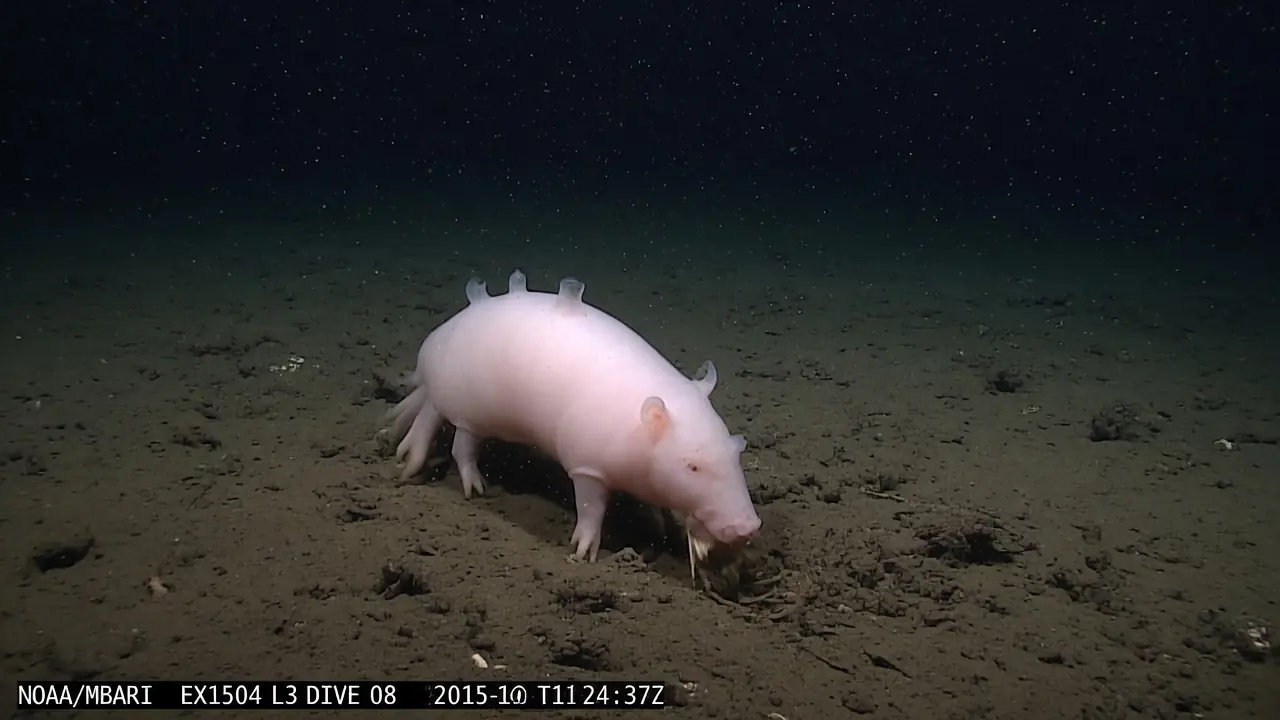
9. Tripod Fish — Bathypterois grallator
The tripod fish does something few people expect a fish to do.
It stands.
Bathypterois grallator possesses extremely long fin rays extending from its pelvic fins and tail. Together, these structures form a three-point support system that holds the fish above the seafloor.
The animal can remain balanced in this position for long periods.
Its body faces into the current while two elongated pectoral fins stretch forward. The tips of those fins contain sensitive structures that help detect small animals drifting nearby.
Instead of swimming after prey, the tripod fish allows the current to bring food toward it.
This is an excellent strategy in the deep ocean, where energy is difficult to replace. Constant swimming would consume calories that might not be recovered for days.
The tripod fish reduces that cost by becoming a living ambush platform.
Its eyes are greatly reduced. Vision offers limited value in near-total darkness, so the animal relies heavily on touch and vibration.
When a small crustacean or fish contacts its sensitive pectoral fins, the tripod fish can guide the prey toward its mouth.
NOAA describes Bathypterois grallator as a blind ambush predator that rests on modified fins while waiting for food to pass close enough to capture.
The long supporting rays are flexible rather than rigid.
ROV footage often shows the animal bending gently with the current while remaining elevated above the sediment. It resembles a thin underwater weather vane balanced on three nearly invisible wires.
If disturbed, it can lift away from the bottom and swim.
Once the threat has passed, it returns to its standing position.
Its reproductive biology is also adapted to isolation. Some members of the genus possess both male and female reproductive tissue, which can increase the chance of successful reproduction when encounters are rare.
The tripod fish does not look fast, powerful, or threatening.
It looks like a fish that has decided to become a piece of underwater equipment.
Yet its unusual posture is one of the most energy-efficient hunting strategies in the deep sea.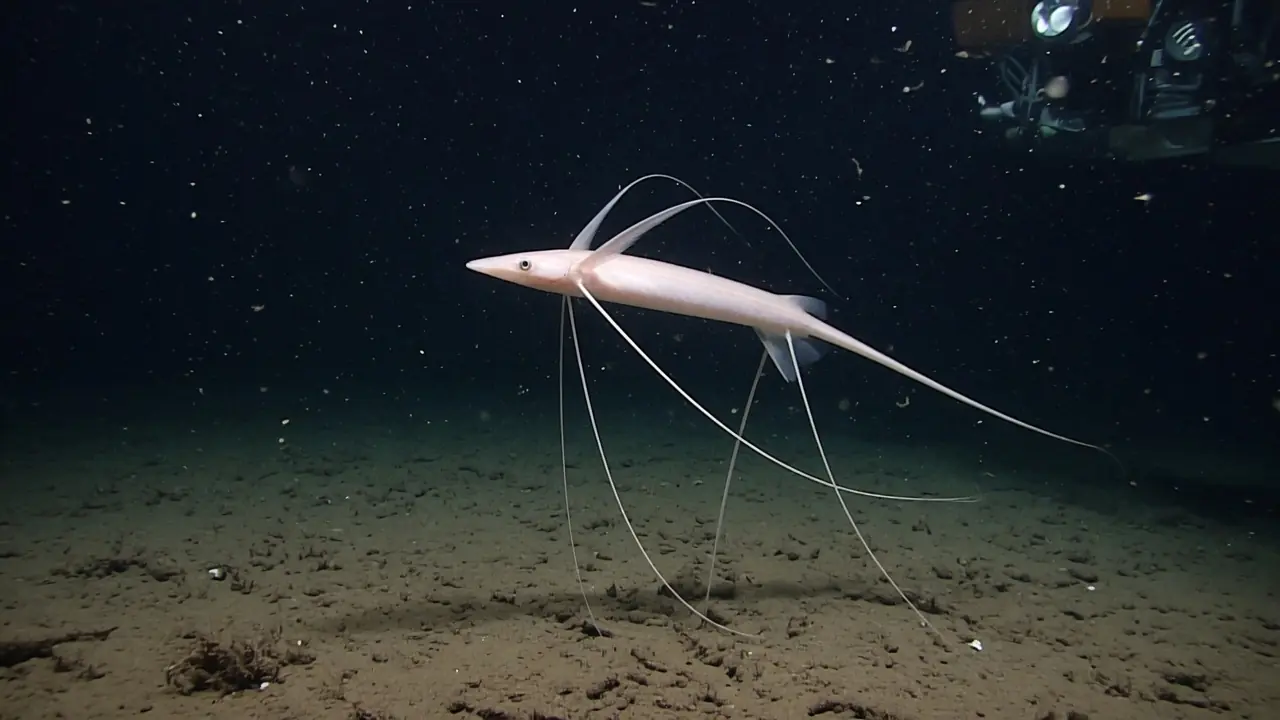
8. Strawberry Squid — Histioteuthis heteropsis
The strawberry squid seems to have been built with two different sets of instructions.
Its red body is covered with small light-producing organs called photophores. Under artificial light, those organs create a dotted appearance resembling the seeds on a strawberry.
But the strangest feature is its mismatched eyes.
Histioteuthis heteropsis has one enormous eye and one much smaller eye.
The large left eye is tubular and usually points upward. It searches for the silhouettes of animals moving against the faint light filtering down from the surface.
The smaller right eye points downward into darker water. It is better positioned to detect bioluminescent flashes produced by animals below.
The squid therefore watches two different visual environments at the same time.
Its body is often held at an angle, keeping each eye directed toward the region it is specialized to examine.
The large eye may also have a yellow lens. Researchers believe this coloration could help the squid distinguish between natural light coming from above and the bioluminescent camouflage used by potential prey.
Many animals in the twilight zone use counterillumination.
They produce light along the undersides of their bodies to match the faint glow overhead. When viewed from below, this light can erase their silhouette.
The strawberry squid’s specialized eye may help reveal the difference between genuine sunlight and light created by another animal.
Its red coloration also provides camouflage.
Red wavelengths disappear quickly underwater. At the depths where Histioteuthis heteropsis lives, its red body may appear nearly black.
This allows the squid to remain difficult to detect despite looking bright and colorful when illuminated by an ROV.
Young strawberry squid begin life with eyes that are much more similar in size. As they mature, the left eye grows dramatically larger than the right.
That difference is not a deformity.
It is one of the most specialized visual systems known among cephalopods.
Most animals use two matching eyes to understand one world.
The strawberry squid uses two different eyes to watch two worlds at once.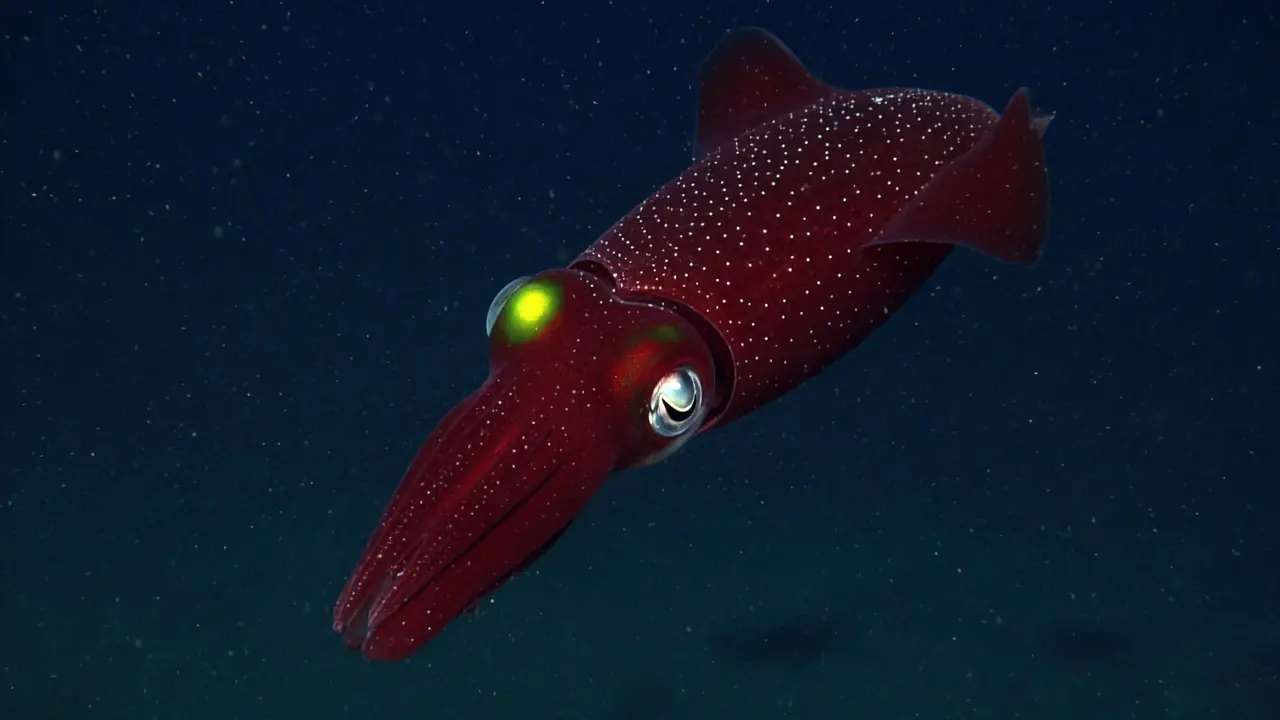
7. Bloody-Belly Comb Jelly — Lampocteis cruentiventer
The bloody-belly comb jelly resembles a transparent crystal containing a dark red organ.
Its scientific name is Lampocteis cruentiventer. The species is a ctenophore, commonly called a comb jelly, rather than a true jellyfish.
Its body is soft, transparent, and gelatinous.
Eight rows of tiny hair-like structures called cilia run along the outside. When those cilia beat, they bend and reflect light, producing moving bands of rainbow colors.
The colors seen under ROV lighting are often reflections rather than bioluminescence.
Without artificial light, the animal may be extremely difficult to see.
Its most noticeable feature is the deep red tissue surrounding its digestive system.
That color helps solve a dangerous problem.
Many animals eaten by deep-sea predators can produce their own light. A transparent predator that swallows bioluminescent prey could suddenly begin glowing from the inside.
That glow would reveal its position to larger hunters.
The red digestive tissue of Lampocteis cruentiventer helps conceal those flashes. Red appears extremely dark in deep water because very little red light reaches that environment.
The stomach therefore works almost like a blackout curtain.
A struggling meal can flash inside the animal without turning the entire predator into a visible lantern.
MBARI researchers helped formally describe the species in 2001 after observing its unusual form in the deep waters of Monterey Bay.
The bloody-belly comb jelly does not have bones, a shell, or powerful jaws.
It survives through delicacy, transparency, and color.
Its appearance seems decorative, almost like a floating gemstone.
But the crimson tissue at its center is not there for beauty.
It hides the final light produced by the animals it has already swallowed.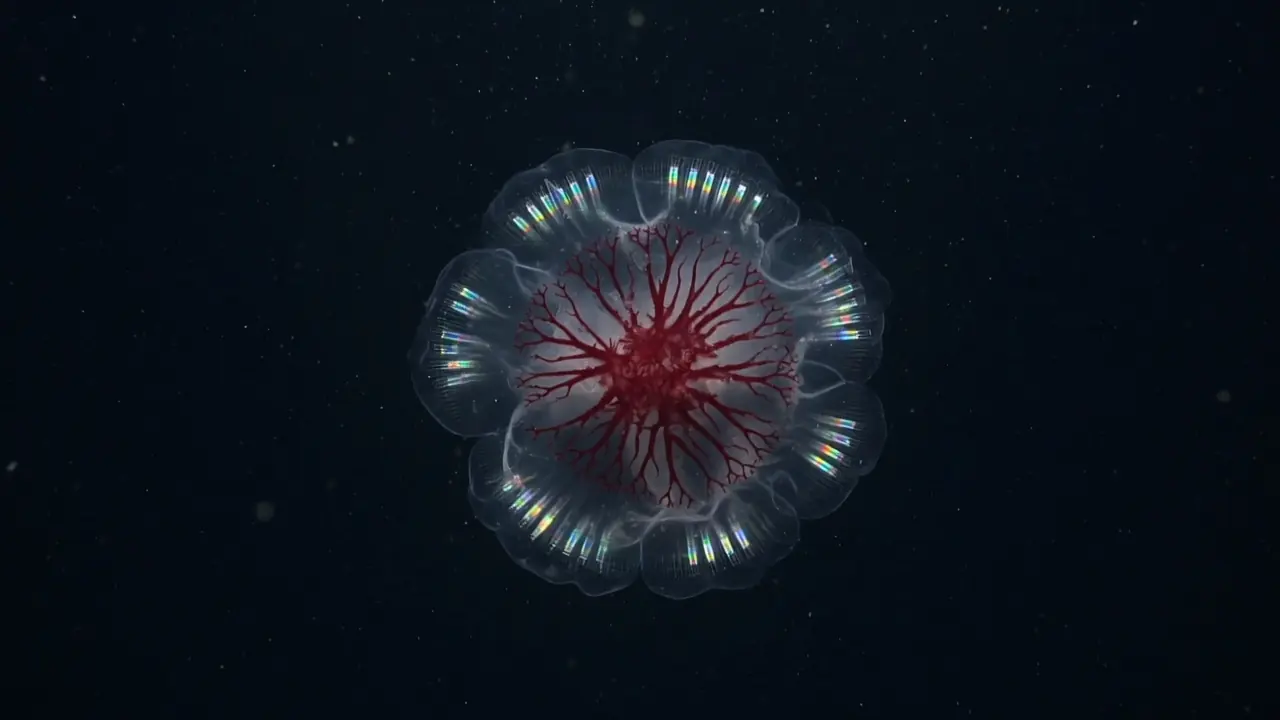
6. Predatory Tunicate — Megalodicopia spp.
Most tunicates are quiet filter feeders.
They remain attached to a surface, draw water into their bodies, collect microscopic food, and release the filtered water through another opening.
Predatory tunicates in the genus Megalodicopia have evolved a much stranger method.
Their enlarged oral siphon resembles a transparent mouth with two broad lips. The animal remains fixed to a rocky surface with this opening directed into the current.
When small animals drift inside, the lips close around them.
The prey is then moved into the tunicate’s digestive system.
The best-known predatory tunicates are often referred to as Megalodicopia hians, although MBARI commonly identifies observed animals more cautiously as Megalodicopia spp. because the genus includes multiple forms.
They have no jaws or teeth.
Their bodies are pale, soft, and partly transparent. Internal organs may be visible through the outer wall.
The animal can grow to around 26 centimeters tall and has been observed from approximately 200 to 3,900 meters deep.
Its lifestyle resembles that of a carnivorous plant.
It cannot chase prey. It cannot move to a better hunting ground. Once attached to the seafloor, it must depend on the current.
Position becomes everything.
A tunicate facing the correct direction may receive a steady supply of plankton, organic particles, and small invertebrates. One in a poor location may have little opportunity to feed.
Tunicates are also more closely related to vertebrates than their simple bodies suggest.
During their larval stage, many possess a notochord, a flexible supporting structure associated with chordate animals.
The adult predatory tunicate looks like little more than an open mouth attached to a stem.
Yet hidden within that simple form is an evolutionary relationship connecting it to animals with backbones.
It is a motionless, transparent predator that waits for the ocean to place food directly inside its body.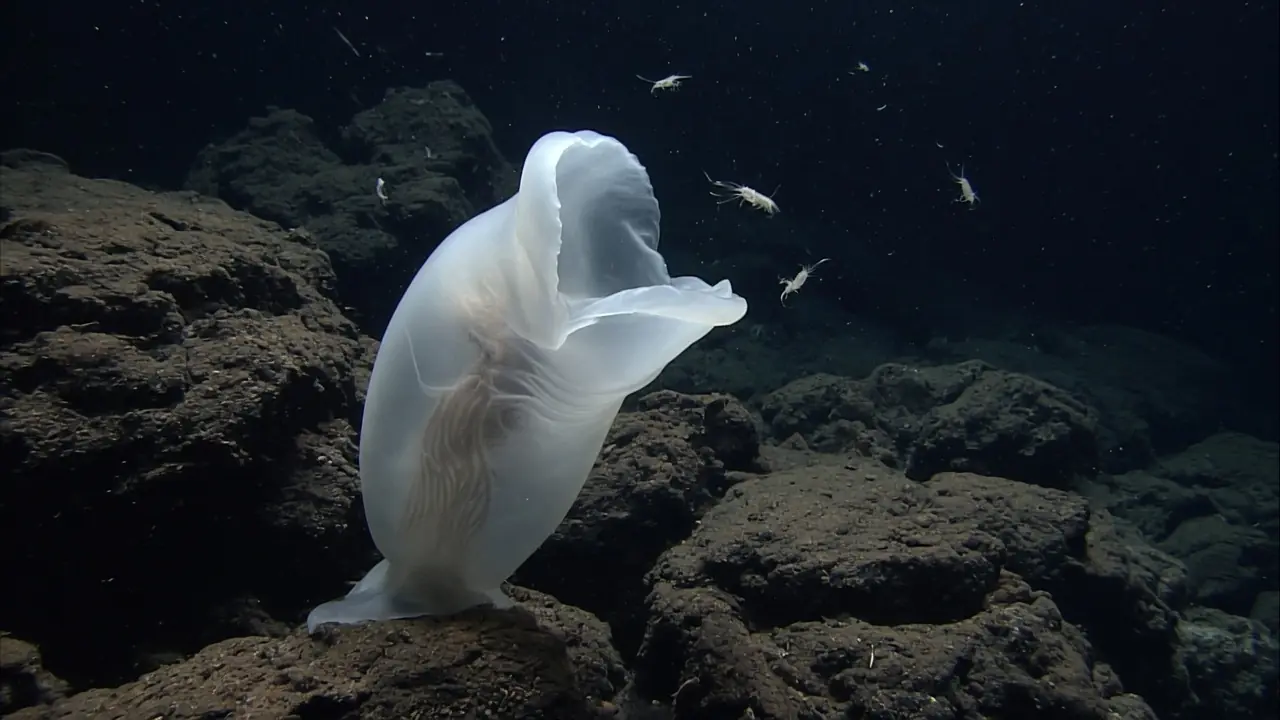
5. Barrel Amphipod — Phronima sedentaria
The barrel amphipod turns another animal’s body into a home.
Phronima sedentaria is a small, transparent crustacean that lives in open water. It has large eyes, a curved body, and several sharp appendages.
Female barrel amphipods search for gelatinous animals such as salps.
A salp is a transparent marine animal with a hollow, barrel-shaped body. It moves by pumping water through itself.
The amphipod attacks the salp and removes much of the soft tissue inside.
It then keeps the remaining outer structure.
The hollowed body becomes a portable shelter that the amphipod pushes through the water. It may also become a nursery for the female’s eggs and young.
MBARI describes Phronima sedentaria as a shrimp-like crustacean that repurposes the bodies of salps as mobile homes.
The behavior is especially useful in the open midwater zone.
There are no rocks, caves, plants, or solid hiding places nearby. An animal may drift hundreds of meters above the seafloor with nowhere to rest.
The salp barrel provides protection in an environment that offers almost none.
Females attach eggs along the inner wall. The young can remain inside the structure during their early development.
ROV observations have documented white clusters of eggs around the sides of these transparent barrels.
The amphipod itself is only a few centimeters long.
Its behavior sounds horrifying when described from the salp’s perspective, but it is an effective survival strategy.
The animal is not simply using an abandoned shell.
It creates the shelter itself from another living organism.
A transparent mother drifting through darkness inside the body of her former prey sounds impossible.
For Phronima sedentaria, it is normal life.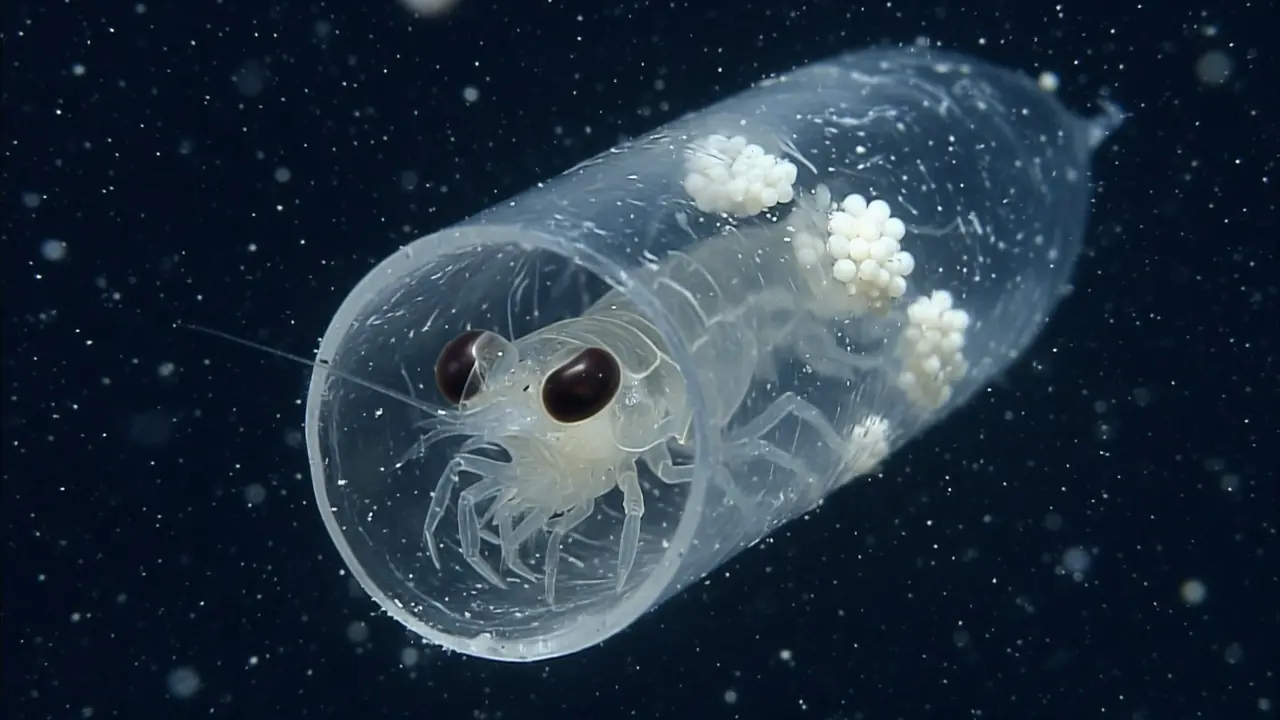
4. Bone-Eating Worm — Osedax rubiplumus
When a whale dies and sinks, its body does not disappear quickly.
The carcass can support an entire deep-sea ecosystem. Scavengers remove the soft tissue first. Smaller animals consume the remaining fragments.
Eventually, only the bones remain.
That is when Osedax rubiplumus begins its work.
Osedax means bone devourer.
These worms possess no mouth and no conventional digestive tract. They cannot bite pieces from a bone or swallow material.
Instead, the female grows root-like tissue directly into the skeleton.
The roots penetrate the bone and help extract collagen and fats. Symbiotic bacteria living within the tissues appear to play an important role in processing those nutrients.
The visible part of the worm resembles a small flower.
Bright red or pink feathery plumes extend into the water and function in respiration. Below them, most of the animal remains hidden inside the bone.
Osedax rubiplumus was among the first bone-eating worms discovered and described after scientists examined a whale carcass in Monterey Canyon.
Its reproduction is equally unusual.
The large, visible worms are females.
Microscopic males can live inside the female’s tube. A single female may contain numerous tiny males that remain there and produce sperm.
Since the first discoveries, scientists have identified many additional Osedax species.
Different species can colonize the bones of whales, fish, birds, turtles, and even terrestrial mammals placed on the seafloor. MBARI reports that dozens of species have been found across a wide depth range.
Over time, these worms can weaken and break apart large skeletons.
They help recycle nutrients that would otherwise remain locked inside bones for far longer.
A whale skeleton on the seafloor may appear silent and lifeless.
In reality, its surface can be covered with colonies of mouthless worms feeding through roots.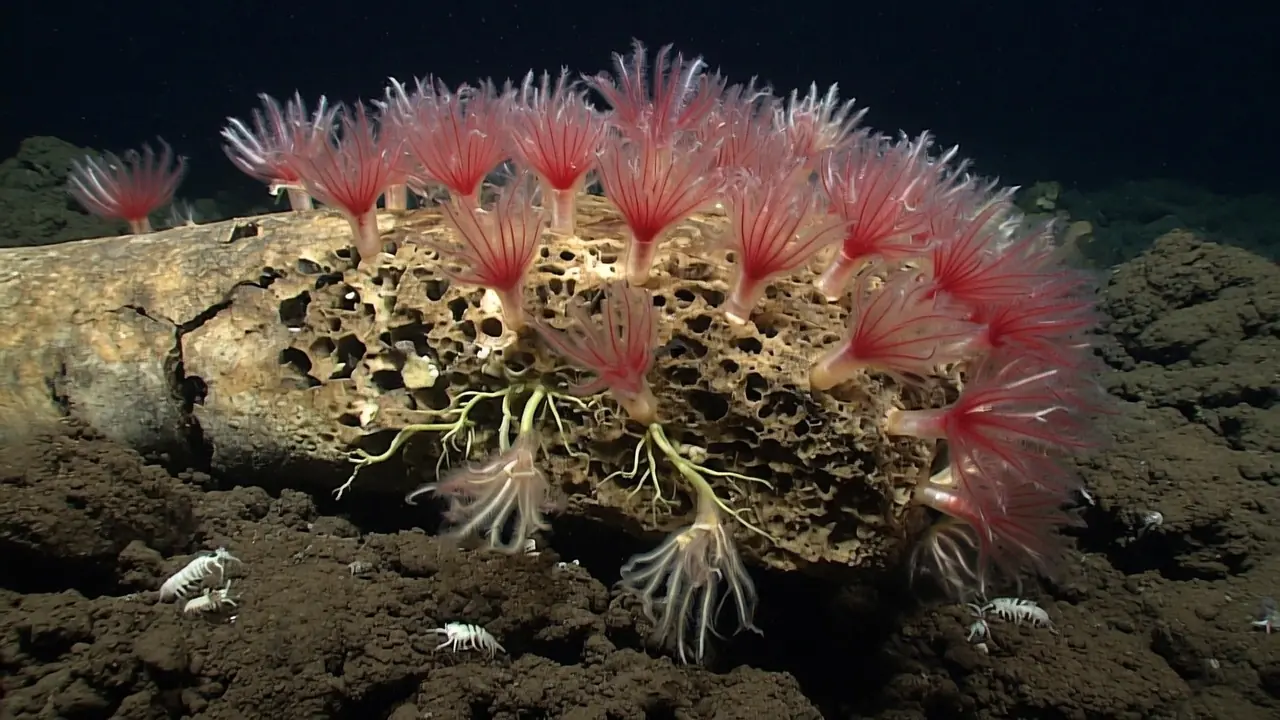
3. Giant Siphonophore — Praya dubia
A giant siphonophore can look like one impossibly long animal drifting through the darkness.
But Praya dubia is not a single animal in the usual sense.
It is a colony composed of many genetically identical units called zooids.
Each zooid performs a specialized task.
Some capture prey. Some digest food. Some help the colony move. Others are responsible for reproduction.
Individual zooids cannot function normally on their own.
Together, they behave like one coordinated organism.
Praya dubia can form an extremely long and delicate colony. MBARI researchers have described it as capable of growing longer than a blue whale, although its body is narrow and fragile rather than massive.
Long tentacles extend from feeding sections of the colony.
These tentacles carry stinging cells used to capture krill, small fish, and other drifting animals.
The colony does not chase prey like a shark.
It creates a large suspended feeding structure and waits for animals to enter it.
This strategy allows Praya dubia to affect an enormous volume of water without building a thick, muscular body.
Its organization raises a difficult biological question.
Is it one creature or many?
The colony begins from a single fertilized egg. As it develops, new zooids bud from the original body and remain permanently connected.
They share resources and coordinate their behavior.
In that sense, the colony functions as one animal.
Yet each part resembles a highly modified individual.
Siphonophores are difficult to collect because their bodies tear easily in nets. Much of what scientists now understand about their natural appearance comes from direct ROV observations.
NOAA has recorded living members of the genus Praya in open deep water using advanced underwater imaging systems.
A giant siphonophore is not simply a long jellyfish.
It is a drifting community of specialized bodies that has become one life form.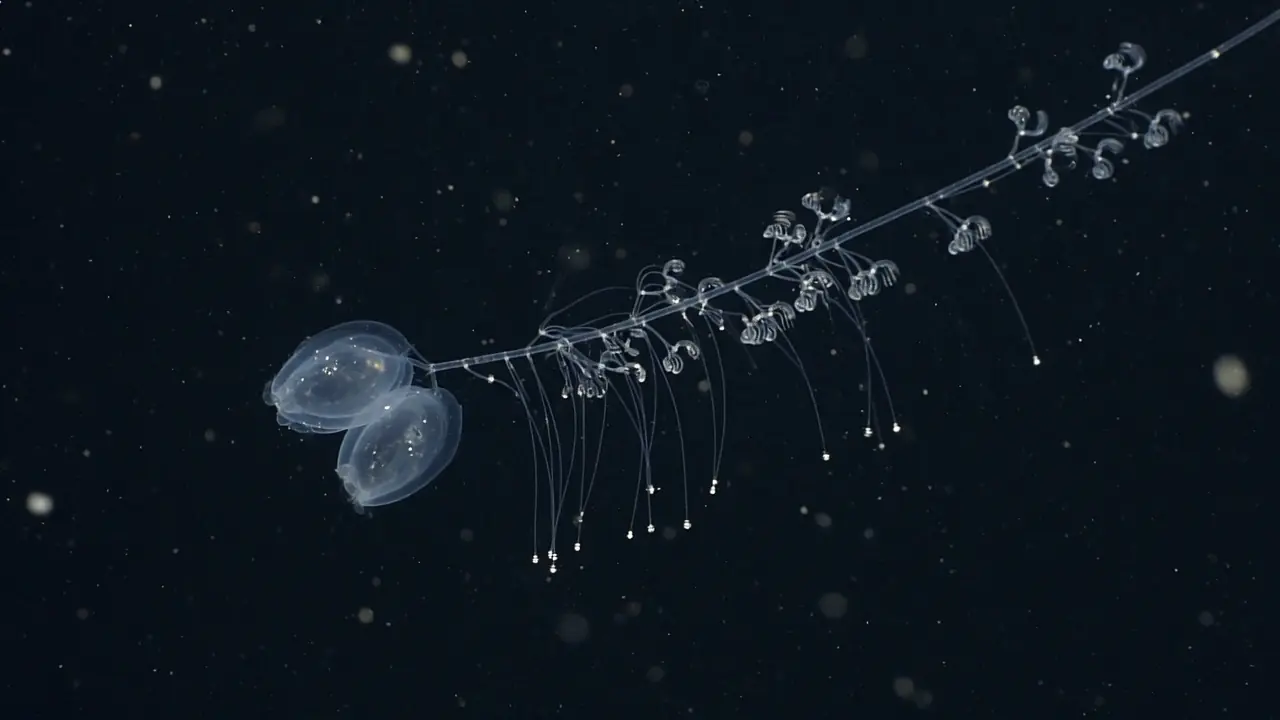
2. Barreleye Fish — Macropinna microstoma
The barreleye fish can see through the top of its own head.
Macropinna microstoma has a small dark body and broad fins that help it hover almost motionless in the water.
Above its face is a transparent, fluid-filled shield.
Inside that shield are two green tubular eyes.
The dark spots near the front of the fish may look like ordinary eyes, but they are actually olfactory organs similar to nostrils.
Its real eyes sit farther back, inside the transparent dome.
For years, scientists believed the tubular eyes could only point upward.
This position would help the fish search for silhouettes of animals moving against the faint light above.
Observations of living barreleyes revealed something more remarkable.
The eyes can rotate forward.
When the fish detects food and moves into position to capture it, the eyes shift so it can see what is directly in front of its mouth.
This discovery was difficult because older specimens were often damaged by fishing nets.
The transparent dome could collapse or disappear during collection, leaving scientists with an incomplete view of the living animal.
ROVs finally showed the intact structure.
Researchers believe Macropinna microstoma may feed on small crustaceans and other animals associated with siphonophore tentacles.
The transparent shield may help protect its sensitive eyes from stinging cells while it takes trapped prey.
This feeding behavior remains difficult to observe directly, so parts of the interpretation are still being studied.
The fish is also much smaller than its strange face suggests.
It is generally only around 15 centimeters long.
Its green eyes do not glow supernaturally. Their coloration comes from pigments that may help filter light and increase visual contrast.
The barreleye does not have a completely transparent skull.
It has a clear protective shield over the top portion of its head.
That distinction matters when creating or selecting realistic images.
The animal already looks extraordinary without adding fictional features.
It has eyes inside a transparent dome, nostrils that look like eyes, and a visual system capable of changing direction.
That is strange enough.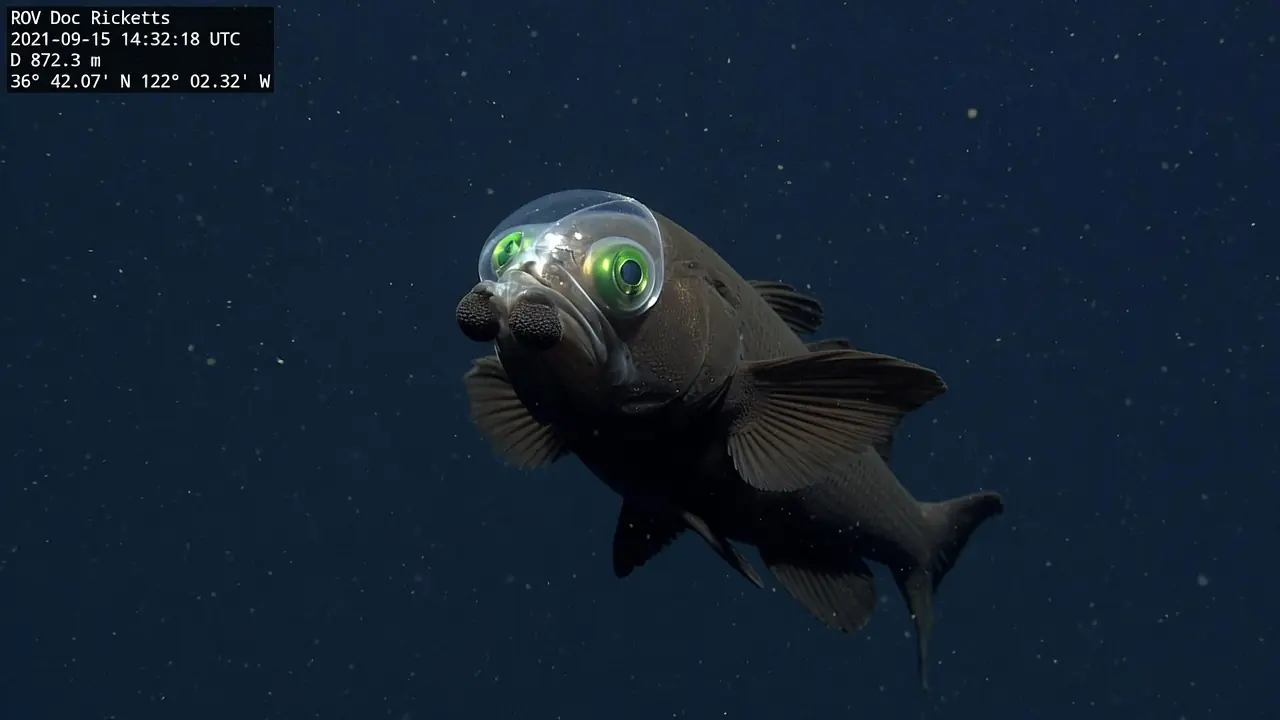
1. Dumbo Octopus — Grimpoteuthis spp.
The dumbo octopus appears to fly through the ocean.
Two large fins rise from the sides of its head and move like ears. Its arms are connected by a soft web, creating an umbrella-shaped form.
The name dumbo octopus refers to multiple finned octopus species, especially members of the genus Grimpoteuthis.
Because several species share the common name, the scientifically accurate label is often written as Grimpoteuthis spp. unless researchers have identified a specific species.
One documented species is Grimpoteuthis bathynectes, which NOAA filmed alive at approximately 2,000 meters off the Oregon coast.
Dumbo octopuses belong to a group known as cirrate octopuses.
Unlike familiar shallow-water octopuses, they possess fins and rows of soft structures called cirri along their arms.
The cirri may help manipulate food or move small prey toward the mouth.
These octopuses can swim by flapping their fins, pulsing the web between their arms, or using jet propulsion.
Slow fin movements allow efficient travel while conserving energy.
That matters in deep water, where food may be difficult to locate.
Dumbo octopuses generally feed on small crustaceans, worms, snails, and other animals found near or above the seafloor.
Some swallow prey whole rather than tearing it apart first.
They do not depend on an ink cloud for defense.
Ink offers less protection in an environment where darkness already surrounds the animal. Producing and carrying ink would also require resources that could be used elsewhere.
Different dumbo octopus species vary greatly in color, size, eye development, and body shape.
Some appear white or pale pink. Others may be orange, red, brown, or purple.
Not every animal with ear-like fins belongs to Grimpoteuthis. Several families of finned deep-sea octopuses are grouped within the suborder Cirrata.
That is why realistic images should avoid combining features from unrelated species.
The dumbo octopus looks gentle and almost cartoon-like.
But its fins, webbed arms, soft body, and slow movements are not decorative.
They are highly efficient adaptations for surviving under extreme pressure in a cold, food-poor environment.
One of the harshest habitats on Earth has produced an animal that seems to float through darkness like a living parachute.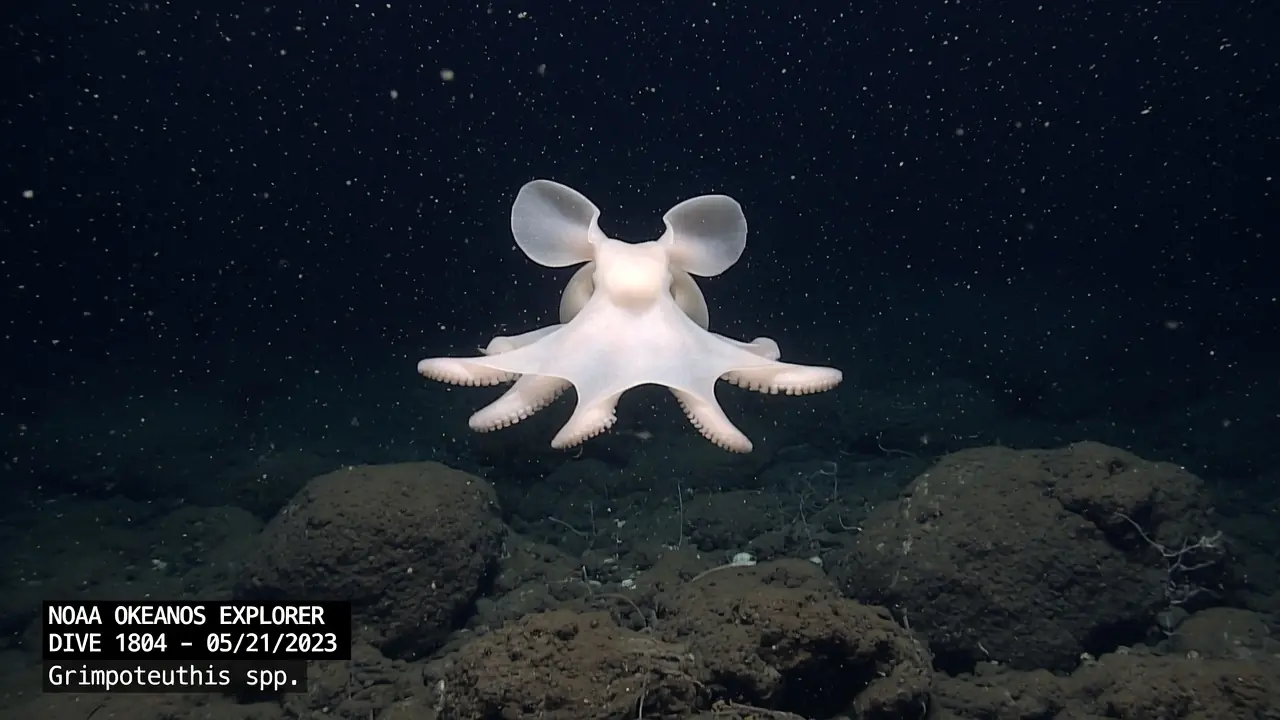
Why Do Deep-Sea Animals Look So Unusual?
Deep-sea creatures are not strange because evolution stopped following rules.
They look unusual because the rules of their environment are different.
Near the surface, sunlight supports plants and plankton. Animals can hide among rocks, reefs, seaweed, or sediment.
In open deep water, there may be nowhere to hide.
Transparency becomes useful because it reduces the animal’s visible outline. Dark red or black coloration provides camouflage because red light cannot penetrate to great depths.
Large eyes help collect faint light.
Reduced eyes conserve energy where vision offers little value.
Bioluminescence can attract prey, confuse predators, communicate with mates, or erase a silhouette through counterillumination.
Food scarcity creates another set of adaptations.
A predator may remain motionless rather than waste energy chasing prey. A scavenger may process enormous amounts of sediment to collect small quantities of nutrition.
Animals may develop expandable stomachs, oversized mouths, or extremely slow metabolisms.
Reproduction also becomes challenging when individuals are widely separated.
Some deep-sea species possess both male and female reproductive organs. Others carry dwarf males, store sperm, or produce eggs at different stages of development.
Nothing can be wasted.
Every movement, flash of light, and piece of food matters.
Are These Creatures Dangerous to Humans?
Almost none of these animals present a realistic danger to people.
Most live hundreds or thousands of meters below the surface, far beyond normal swimming and recreational diving depths.
Several are also much smaller and more delicate than photographs suggest.
The pressure in their habitat would be far more dangerous to an unprotected human than the animals themselves.
Their unusual appearance often comes from magnified ROV footage taken against a completely dark background. Without familiar objects for scale, a creature only a few centimeters long can look enormous.
Terms such as alien, bizarre, and terrifying describe how unfamiliar they appear to us.
They do not mean the animals are actively hunting humans.
In reality, human activity may pose a greater threat to deep-sea ecosystems through pollution, climate change, fishing, and potential seabed disturbance.
These animals evolved for relatively stable environments.
Even small changes in temperature, oxygen, food supply, or sediment could affect species that grow slowly or reproduce infrequently.
Final Thoughts
The deep sea is not an empty black space.
It is a vast living world filled with animals that solve familiar problems in unfamiliar ways.
Scotoplanes globosa walks across the mud on elongated tube feet.
Bathypterois grallator stands above the seafloor and waits for prey to touch its fins.
Histioteuthis heteropsis uses one eye to watch the light above and another to search the darkness below.
Lampocteis cruentiventer hides glowing meals inside red tissue.
Phronima sedentaria turns the hollow body of another animal into a nursery.
Osedax rubiplumus feeds on bone without possessing a mouth or stomach.
Praya dubia transforms thousands of specialized zooids into a single coordinated colony.
Macropinna microstoma rotates green eyes inside a transparent shield.
Members of Grimpoteuthis glide through darkness using fins that resemble ears.
These creatures are not incomplete, deformed, or poorly designed.
They are highly specialized animals shaped by millions of years in environments humans have only recently learned to observe.
The ten species on this list may seem too strange to be real.
The more unsettling truth is that even stranger animals may still be waiting beyond the reach of our cameras.