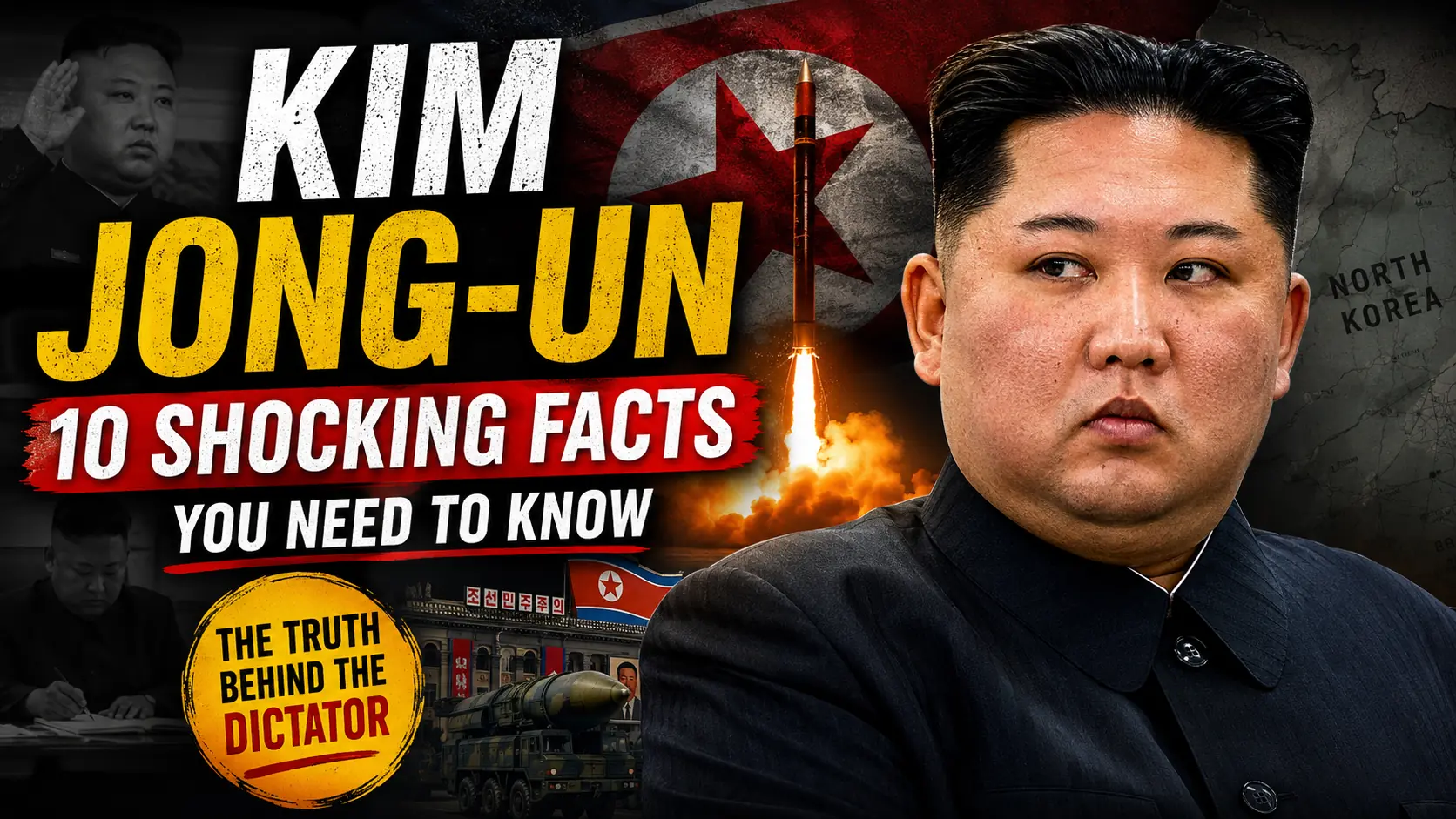
10 Fascinating Facts About Kim Jong-un
1. Kim Jong-un Is the Third Generation of the Kim Family to Rule North Korea
Kim Jong-un is the grandson of Kim Il-sung, the founder of North Korea, and the son of Kim Jong-il, the country's second supreme leader. When Kim Jong-il died in December 2011, Kim Jong-un quickly emerged as North Korea's new leader despite being remarkably young and relatively unknown to the outside world.
This made North Korea highly unusual among modern states. Although officially established as a socialist republic, the country's supreme leadership has effectively passed through three generations of the same family: from Kim Il-sung to Kim Jong-il and then to Kim Jong-un.
But Kim Jong-un's power cannot be explained by family connections alone. During his first several years in office, he systematically strengthened his control over the Workers' Party of Korea, the military, and the state bureaucracy. Senior officials were promoted, demoted, replaced, or removed as he consolidated authority around himself.
Many international observers initially wondered whether such a young leader could maintain control over a political system dominated by much older military officers and party officials. More than a decade later, however, Kim Jong-un has demonstrated that his position at the top of the North Korean system is far more durable than many outsiders initially expected.
2. Even Kim Jong-un's Exact Birth Year Was Uncertain for Years
One of the strangest things about Kim Jong-un is how little the outside world knew about him before he became North Korea's leader.
January 8 is widely regarded as his birthday, while 1984 is the birth year most commonly cited by international sources. However, conflicting information about his age and birth year circulated for years.
For the leader of a modern country, that degree of uncertainty is remarkable.
In most countries, the childhood, education, political career, and personal history of a future national leader are extensively documented. Kim Jong-un's early life was almost the opposite.
North Korea maintains extraordinary secrecy around its ruling family. As a result, much of what outsiders know about Kim's childhood has been reconstructed through intelligence assessments, foreign records, interviews with people who reportedly encountered him, and information provided by individuals familiar with North Korea.
This secrecy has also created an environment where genuine information and sensational rumors can easily become mixed together. It is one reason stories about Kim Jong-un should always be evaluated carefully rather than automatically accepted as fact.
3. Kim Jong-un Reportedly Spent Part of His Childhood in Switzerland
Perhaps one of the most fascinating aspects of Kim Jong-un's early life is that he is widely believed to have spent part of his childhood studying in Switzerland.
Reports indicate that he attended school there while using another identity, allowing him to live relatively anonymously compared with the extraordinary political position his family occupied back home.
The contrast is striking.
A boy who would eventually lead one of the world's most isolated countries apparently spent part of his youth living in one of Europe's wealthiest and most developed nations.
Former classmates and other people connected to this period have provided accounts that helped journalists and researchers reconstruct portions of his time in Switzerland.
One interest repeatedly associated with the young Kim Jong-un was basketball, particularly the NBA.
That fascination appears to have continued into adulthood and eventually contributed to one of the strangest celebrity relationships involving any modern head of state.
However, because North Korea reveals very little about the private lives of the Kim family, many specific details about his years in Europe remain difficult to independently verify.
4. Kim Jong-un Took Power While the Outside World Barely Knew Who He Was
Before approximately 2010, Kim Jong-un was virtually unknown to the general public outside North Korea.
Only during the final years of Kim Jong-il's rule did he begin appearing more clearly as the likely successor.
When Kim Jong-il died in December 2011, the transition immediately generated enormous international speculation.
Kim Jong-un was young, politically inexperienced, and taking control of a nuclear-armed state with a powerful military establishment and an extremely complicated internal political structure.
Some analysts questioned whether he would actually rule independently.
Others speculated that senior generals, party officials, or experienced relatives might exercise the real power behind the scenes.
Instead, the following years showed Kim systematically consolidating his authority.
Senior figures disappeared from public life, were removed from their positions, or were replaced. Other officials rose rapidly through the system.
Over time, it became increasingly clear that Kim Jong-un was not simply serving as the symbolic face of a government controlled by older officials. He was building a leadership structure centered firmly around himself.
5. The Execution of His Powerful Uncle Sent a Dramatic Message
One of the most shocking events of Kim Jong-un's early rule involved Jang Song-thaek.
Jang was married to Kim Jong-un's aunt and had long been considered one of the most powerful political figures in North Korea.
Because of his experience and family connections, some outside observers initially viewed Jang as a possible mentor or political guardian who could help the young Kim Jong-un navigate the complicated North Korean leadership system.
That assumption proved dramatically wrong.
In 2013, Jang was arrested, publicly denounced by North Korean state media, accused of serious crimes against the state, and executed.
The event shocked observers around the world.
It demonstrated that even membership in the extended Kim family did not necessarily provide protection from political punishment.
It also reinforced the perception that Kim Jong-un was prepared to remove extremely powerful figures who might threaten, challenge, or complicate his control.
However, an important distinction needs to be made.
Numerous sensational stories circulated afterward describing particularly gruesome methods supposedly used to execute Jang. Some of these claims were repeated widely despite lacking reliable evidence.
The execution itself was confirmed by North Korea, but many of the dramatic details surrounding exactly how it happened should be treated cautiously.
6. Kim Jong-un's Half-Brother Was Killed at an International Airport
On February 13, 2017, one of the most extraordinary incidents involving the Kim family occurred thousands of miles away from North Korea.
Kim Jong-nam, Kim Jong-un's older half-brother, was attacked at Kuala Lumpur International Airport in Malaysia.
Two women approached him inside the airport and applied a substance to his face. He became seriously ill shortly afterward and died.
Malaysian authorities later identified the nerve agent VX as being involved in the killing.
The case immediately became an international sensation.
The two women involved maintained that they believed they had been participating in a prank or entertainment program rather than an assassination.
The killing triggered a major diplomatic confrontation and intense international scrutiny.
The United States and South Korea attributed responsibility for the assassination to the North Korean government, while Pyongyang denied involvement.
The incident remains one of the most notorious political killings associated with the Kim family during Kim Jong-un's leadership.
It also demonstrated how events involving North Korea's ruling family could suddenly become international crises far beyond the country's borders.
7. Kim Jong-un Dramatically Accelerated North Korea's Nuclear and Missile Programs
One of the defining features of Kim Jong-un's rule has been the rapid development of North Korea's nuclear weapons and ballistic missile capabilities.
Under his leadership, North Korea conducted nuclear tests and dramatically expanded its missile development program.
The country tested numerous types of ballistic missiles, including systems designed for extremely long ranges.
This development fundamentally changed how governments around the world assessed the North Korean threat.
Pyongyang argues that its nuclear arsenal is necessary to deter foreign military intervention and guarantee the survival of the North Korean state.
The United States, South Korea, Japan, and numerous other countries view the program as a major threat to regional and international security.
The United Nations Security Council has imposed multiple rounds of sanctions related to North Korea's nuclear and ballistic missile activities.
Despite years of sanctions, diplomatic negotiations, international pressure, and periods of extreme tension, North Korea has continued developing its strategic weapons capabilities.
By the mid-2020s, North Korea's nuclear arsenal remained one of the world's most difficult unresolved security problems.
8. Kim Jong-un Became the First North Korean Leader to Meet a Sitting U.S. President
In 2018, the world witnessed something that would have seemed almost unimaginable only a short time earlier.
Kim Jong-un sat face-to-face with U.S. President Donald Trump in Singapore.
The summit marked the first time a sitting North Korean leader had met a sitting president of the United States.
The images were extraordinary.
Only months earlier, Washington and Pyongyang had been exchanging hostile rhetoric while concerns about military confrontation and nuclear escalation were growing.
Suddenly, the leaders of the two countries were shaking hands in front of cameras.
Kim and Trump met again in Hanoi, Vietnam, in February 2019.
That summit ended without a major agreement after negotiations broke down over disagreements involving sanctions relief and denuclearization.
Then, in June 2019, another remarkable encounter occurred at the Korean Demilitarized Zone.
Trump briefly crossed the military demarcation line into North Korean territory while meeting Kim, becoming the first sitting American president to step into North Korea.
The meetings produced some of the most memorable diplomatic images of Kim Jong-un's rule.
However, despite the historic symbolism, they ultimately failed to produce a lasting agreement eliminating North Korea's nuclear weapons program.
9. Dennis Rodman's Relationship With Kim Jong-un Is One of the Strangest Celebrity Connections in Modern Politics
Kim Jong-un's reported fascination with basketball eventually produced one of the most unusual relationships between a world leader and an American celebrity.
Former NBA star Dennis Rodman traveled to North Korea multiple times and personally met Kim Jong-un.
Rodman spoke publicly about Kim in surprisingly friendly terms and described their relationship as a friendship.
The visits generated enormous controversy in the United States.
Rodman was not a diplomat, yet he had gained unusual personal access to the leader of a heavily sanctioned nuclear-armed country.
The situation became even stranger because relations between Washington and Pyongyang were frequently extremely tense during this period.
Rodman's visits provided the public with rare glimpses of Kim Jong-un outside the usual settings of military inspections, political meetings, missile launches, and enormous state ceremonies.
The image of the North Korean leader watching basketball alongside a former Chicago Bulls star created an almost surreal contrast with his international reputation.
Whatever the political significance of their relationship, it remains one of the most bizarre examples of sports, celebrity culture, and international politics intersecting in recent history.
10. The Biggest Mystery Surrounding Kim Jong-un Comes From North Korea's Extraordinary Control of Information
Perhaps the most important fact to understand about Kim Jong-un is that separating reality from rumor can be extremely difficult.
North Korea operates one of the world's most restrictive information environments.
Domestic media is controlled by the state. Information about senior leaders is released selectively, independent journalism faces severe restrictions, and foreign reporters cannot freely investigate the country's internal political system.
That creates an enormous information vacuum.
And information vacuums attract rumors.
Over the years, dramatic stories about Kim Jong-un and his government have spread around the world, sometimes appearing in major media outlets before being independently confirmed.
Some North Korean officials have even been reported dead or executed by outside media, only to appear publicly again later.
Other stories describing bizarre or extremely brutal punishments have circulated internationally despite weak or unclear evidence.
This does not mean documented abuses or political repression in North Korea should be dismissed. Rather, it means individual sensational claims require careful verification.
When examining stories about Kim Jong-un, it is important to distinguish between confirmed events, intelligence assessments, testimony from defectors, anonymous reports, and rumors repeated by other media organizations.
That extraordinary lack of transparency is one reason Kim Jong-un remains such a mysterious figure.
Despite being one of the most recognizable leaders in the world, many aspects of his private life, internal decision-making, family relationships, and political calculations remain hidden from outsiders.
In a strange way, that may be one of the most remarkable things about Kim Jong-un: the world has watched him rule North Korea for well over a decade, yet there is still an enormous amount about the man behind the public image that remains unknown.