10 Deep-Sea Mysteries That Still Have No Clear Answer
A camera descends thousands of meters below the ocean’s surface.
For hours, its lights reveal little except drifting particles and black water. Then something enters the frame.
It may be a squid with arms several times longer than its body. A jellyfish larger than a person. A fish living under pressure powerful enough to crush ordinary equipment. Sometimes the animal remains visible for only a few seconds before disappearing into darkness.
Scientists save the recording, compare it with previous observations, and begin asking questions.
How does it feed?
Where does it reproduce?
How many more are out there?
Sometimes, no one knows.
The deep ocean is Earth’s largest living environment, but it is also one of its least directly observed. Sunlight reaches only the upper portion of the water column. Below approximately 200 meters, the ocean transitions into the twilight zone. Farther down are the midnight, abyssal, and hadal zones, where darkness, cold, and immense pressure make exploration extraordinarily difficult.
Modern remotely operated vehicles, autonomous robots, environmental DNA, sonar, and deep-sea landers have transformed ocean exploration. Yet every new expedition seems to reveal how much remains unknown.
Some famous ocean mysteries have already been solved. Several mysterious underwater sounds were eventually linked to ice movement, earthquakes, whales, or human activity. Other questions, however, remain genuinely open.
They concern real animals, real ecosystems, and real processes that scientists have observed but cannot yet fully explain.
Here are ten deep-sea mysteries that still have no clear answer.
10. How Many Deep-Sea Species Have Never Been Discovered?
The most basic deep-sea mystery may also be the largest.
We do not know how many species live there.
The deep ocean includes vast open-water habitats, underwater mountains, trenches, cold seeps, hydrothermal vents, coral gardens, submarine canyons, and abyssal plains. Each environment can support a different biological community.
Researchers continue encountering animals that may be new to science. Some are collected and formally described. Others are seen only in video recordings, making identification difficult.
A brief ROV observation may show a jelly, worm, squid, sponge, or crustacean that does not match any known species. But scientists generally need more than an unusual appearance to establish a new species.
They may require a physical specimen, detailed anatomical comparisons, genetic analysis, and a review of previously collected material.
That process can take years.
Delicate animals create an additional problem. Traditional nets may tear gelatinous organisms apart before they reach the surface. Some creatures also change shape when removed from the pressure of their natural environment.
Consequently, an animal that is relatively common at depth might remain unknown simply because existing collection methods rarely preserve it.
MBARI has documented a wide variety of unusual deep-sea animals during more than three decades of exploration. Its researchers emphasize that direct observations have revealed behaviors and species that would have remained hidden using older sampling methods.
Environmental DNA offers a promising new tool. Animals constantly release genetic material through mucus, waste, skin cells, and reproductive material. Scientists can collect water and search for those traces without seeing the animals themselves.
But DNA creates its own questions.
A sequence may indicate that an unknown organism was present without revealing its size, appearance, behavior, or abundance. Researchers may know that something passed through the water while having no idea what it looked like.
The number of undiscovered deep-sea species cannot currently be measured with confidence.
The next animal new to science may already have appeared briefly in an old recording without anyone recognizing it.
What remains unknown?
Scientists still do not know the true scale of deep-sea biodiversity, which regions contain the greatest number of undescribed species, or how many species could disappear before they are documented.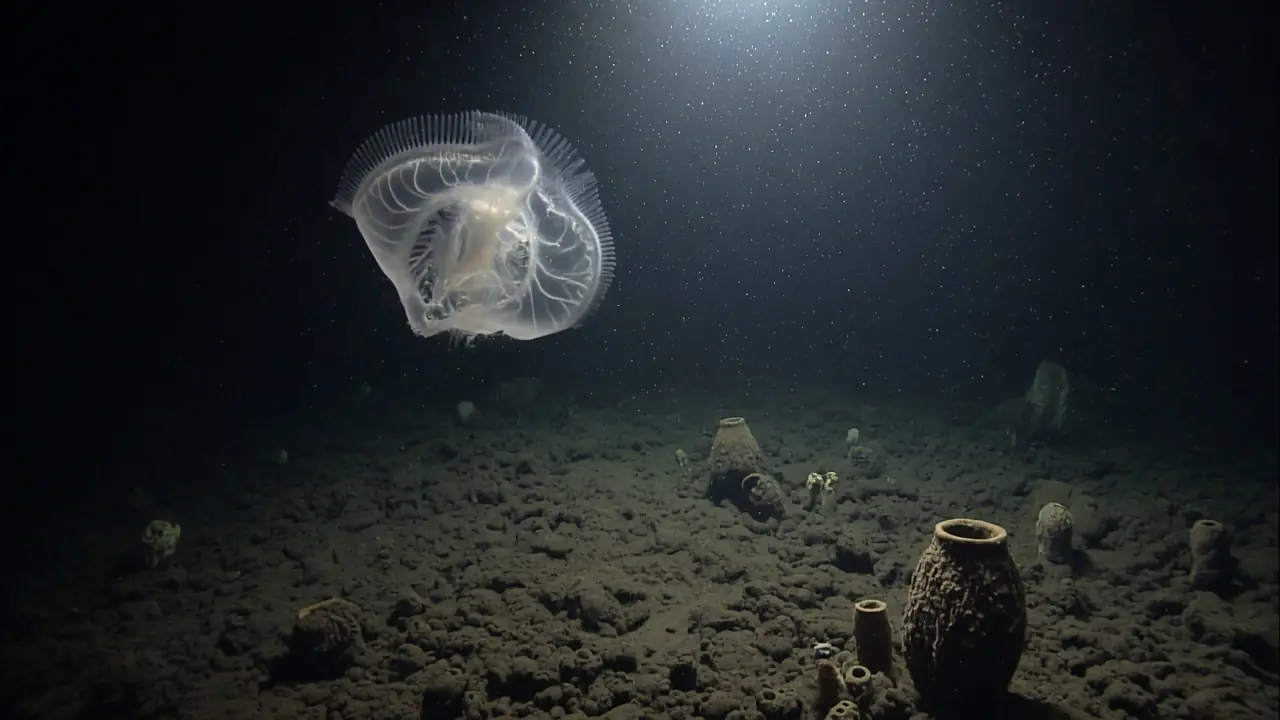
9. How Does the Bigfin Squid Use Its Extraordinary Arms?
Few animals look more mysterious than a bigfin squid.
Members of the genus Magnapinna possess large fins and extremely long, thin arm and tentacle filaments. In some recordings, the appendages hang downward before bending at sharp angles, creating an appearance unlike that of any familiar squid.
The filaments may extend many times the length of the body.
Only a small number of confirmed observations have been made, despite bigfin squid apparently having a broad global distribution. NOAA has described encounters with Magnapinna as exceptionally rare and reported only roughly a dozen confirmed sightings worldwide in one overview.
The animal’s feeding behavior has never been clearly documented.
Researchers have proposed that the long filaments may work like passive fishing lines. Microscopic suckers could trap small animals that touch them while the squid hovers above the seafloor or moves slowly through open water.
The squid might also drag the filaments across the bottom to locate prey.
But those explanations remain hypotheses.
No widely accepted footage shows an adult Magnapinna successfully capturing and eating prey. Scientists have not confirmed whether the filaments actively search, remain motionless, detect chemical signals, or perform several functions.
Even basic aspects of the animal’s life remain uncertain.
Researchers do not know how frequently adults feed, how fast they swim, where they reproduce, or how long they live. Only a few species have been formally described, and additional undescribed species may exist.
The mystery exists partly because encounters are so brief.
An ROV may spend weeks surveying the seafloor and see a bigfin squid only once. The animal then moves beyond the lights before researchers can observe a complete behavior sequence.
Its unusual shape has made it one of the internet’s most famous deep-sea creatures.
Scientifically, however, Magnapinna remains less a known animal than a collection of rare glimpses.
What remains unknown?
Scientists still cannot say exactly how bigfin squid capture food, how they control their long filaments, or whether those structures have functions beyond feeding.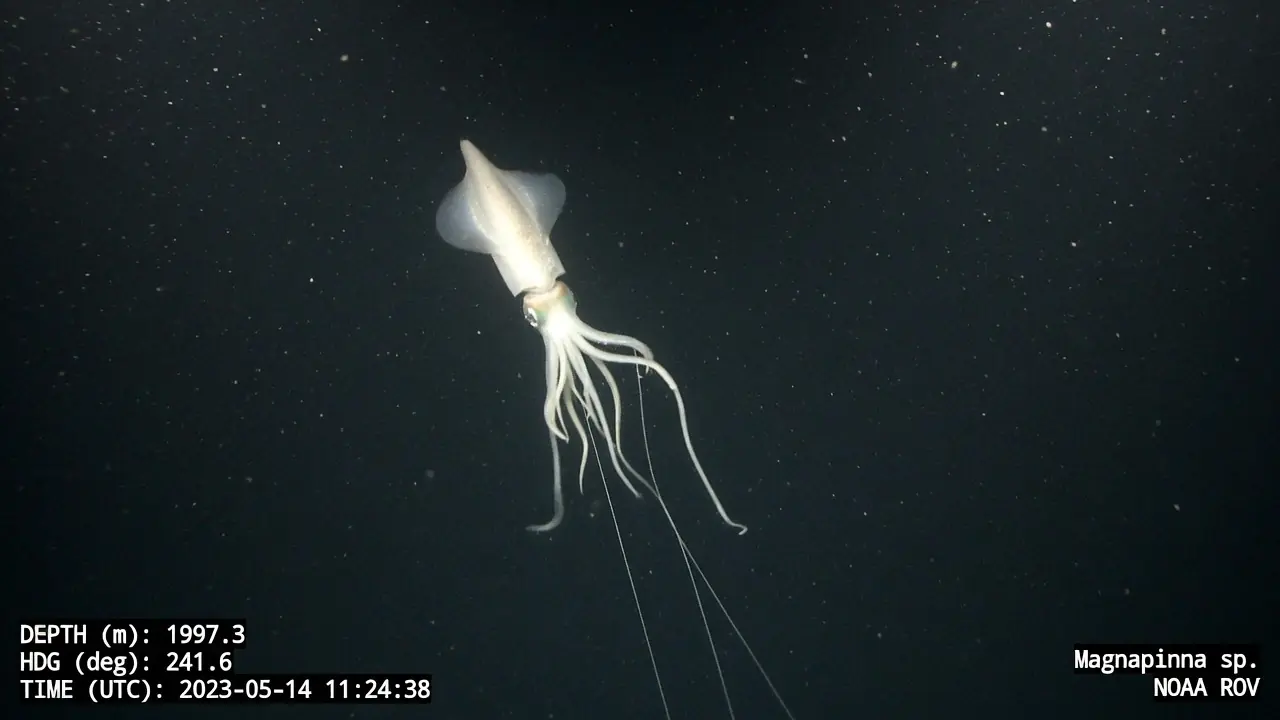
8. What Is the Complete Life Cycle of the Giant Phantom Jelly?
The giant phantom jelly, Stygiomedusa gigantea, can grow a bell more than one meter wide and trail four enormous ribbon-like oral arms behind it.
Unlike many jellyfish, it does not have a fringe of obvious stinging tentacles.
Its dark red or purple body drifts through the midnight zone, where it may be almost invisible until illuminated by an underwater vehicle.
The species was scientifically described in the early twentieth century, but living encounters remain rare.
MBARI reported seeing the animal only nine times during more than 34 years of deep-sea research as of 2021.
Researchers believe its broad oral arms may capture plankton and small fish. However, scientists have rarely watched the entire feeding process in the wild.
No one has documented every stage of its natural life cycle.
Many jellyfish alternate between a free-swimming medusa stage and a small attached polyp stage. The polyp may reproduce asexually before releasing young medusae into the water.
Whether Stygiomedusa gigantea follows a similar pattern has not been fully established through direct observations in nature.
Researchers also have questions about its relationships with fish.
ROV footage has shown the pelagic brotula Thalassobathia pelagica swimming close to the jelly’s bell and moving among its enormous oral arms. In the open water, where shelter is scarce, the fish may use the jelly as protection from predators.
But the nature of the relationship is uncertain.
Does the jelly receive any benefit? Does the fish remove parasites or collect leftover food? Does it occasionally steal captured prey? Or is the jelly simply a moving shelter that tolerates its passenger?
Rare observations cannot easily distinguish between a regular biological partnership and an unusual encounter.
The giant phantom jelly is enormous, widely distributed, and visually unmistakable.
Yet scientists still know remarkably little about how it grows, reproduces, feeds, or interacts with the animals around it.
What remains unknown?
Its full reproductive cycle, growth rate, lifespan, feeding strategy, population size, and relationship with associated fish remain incompletely understood.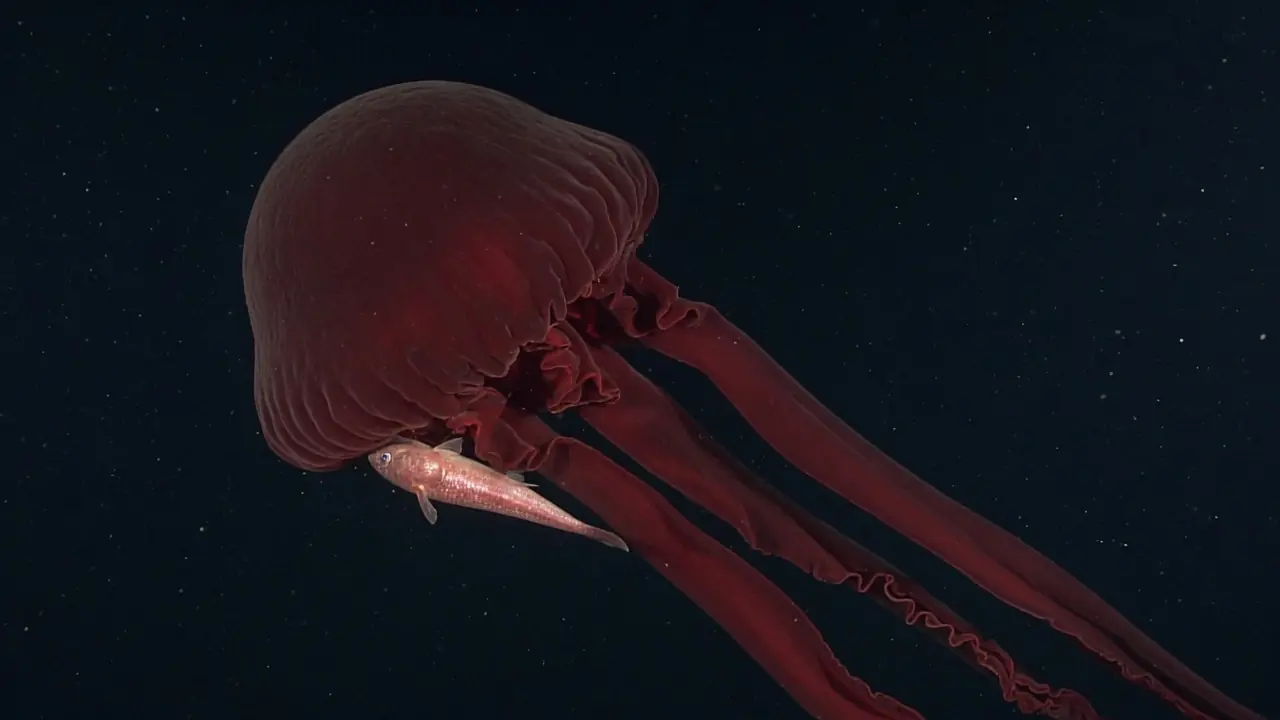
7. Where Do Giant Squid Reproduce?
The giant squid, Architeuthis dux, is one of the world’s most famous marine animals.
It is also one of the least understood large predators.
Scientists know that giant squid inhabit deep waters across much of the world. Their remains have been recovered from beaches, fishing nets, and the stomachs of sperm whales.
Rare recordings have shown living individuals in their natural environment.
Even so, researchers have never assembled a complete picture of their daily lives.
One of the greatest unanswered questions concerns reproduction.
Female giant squid can produce enormous numbers of eggs. Males possess specialized structures for transferring packets of sperm. Scars and embedded sperm packets found on some females suggest that mating may be physically unusual.
But scientists have not directly recorded giant squid mating in the wild.
They do not know where the animals gather, how males find females in the darkness, whether courtship occurs, or how often an individual reproduces.
The locations of their egg masses are also uncertain.
Some squid species release floating gelatinous masses containing thousands of eggs. Others attach eggs to the seafloor or carry them. Researchers suspect giant squid may produce large drifting egg masses, but definitive natural observations remain extremely limited.
Young giant squid are also rarely documented.
Scientists have identified small individuals and probable larvae, yet the routes connecting hatchlings to full-grown adults remain unclear. Where do juveniles live? Do they occupy shallower water? Do they migrate into deeper habitats as they mature?
Another mystery is whether all giant squid belong to a single globally distributed species or whether hidden population structure exists across ocean basins.
Genetic studies have supported the classification of giant squid under Architeuthis dux, but details of regional breeding populations and movement remain under investigation.
Specialized low-light camera systems have improved the chances of seeing these light-sensitive animals without frightening them away. NOAA-supported researchers have captured rare footage using systems designed to observe deep-sea animals more naturally.
Yet no camera has followed a giant squid through its complete reproductive cycle.
The animal that inspired centuries of sea-monster stories remains mysterious at the most fundamental stage of life.
What remains unknown?
Scientists still do not know precisely where giant squid mate, where females release their eggs, how the hatchlings develop, or whether adults gather in particular breeding areas.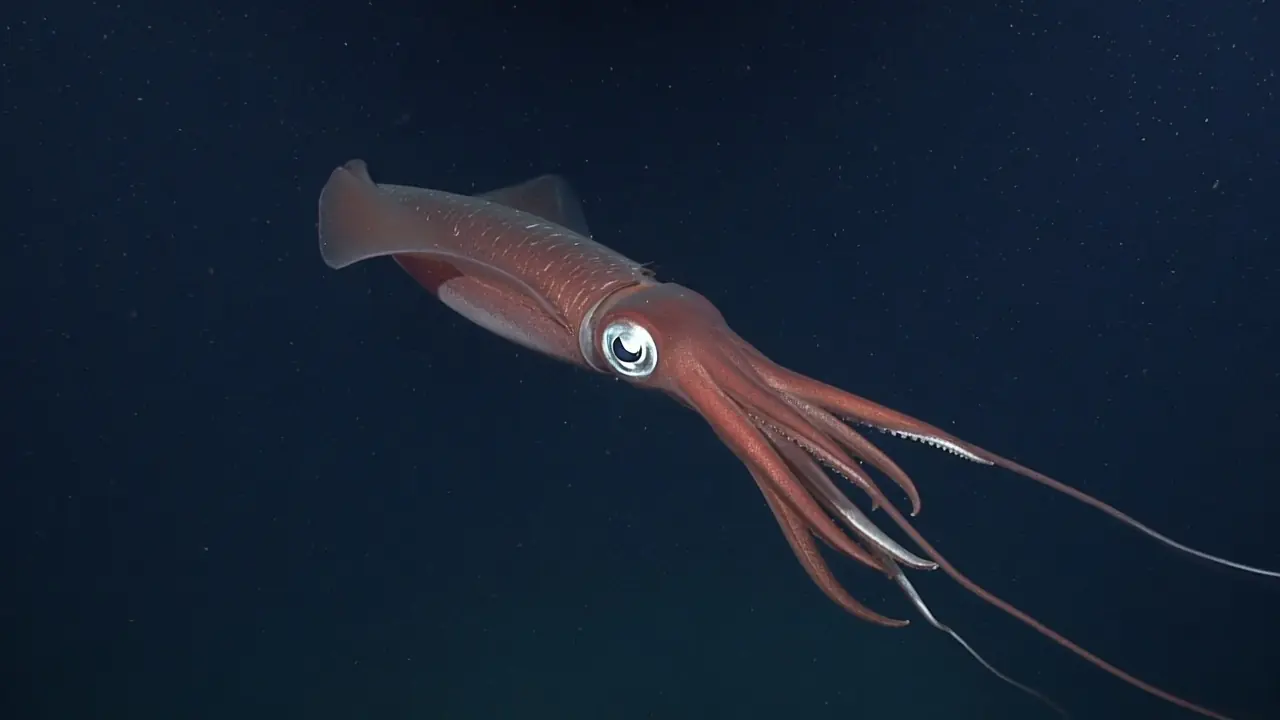
6. What Sets the Maximum Depth at Which Fish Can Survive?
Fish have been recorded in ocean trenches under pressures that seem almost impossible.
Hadal trenches descend below 6,000 meters. At those depths, pressure reaches hundreds of times the pressure at sea level.
Snailfish are among the deepest vertebrates ever observed.
Their bodies lack heavy scales and contain soft, gelatinous tissues. Their cells also produce compounds that help proteins maintain their shape under pressure.
Yet fish appear to have a depth limit.
Below a certain point, increasing pressure may disrupt cellular chemistry faster than biological adaptations can compensate. Researchers have proposed that the amount of a stabilizing compound called trimethylamine N-oxide, or TMAO, may help determine this boundary.
But the exact limit is not completely settled.
Records depend on cameras, baited landers, and collected specimens. The deepest individual ever seen does not necessarily represent the deepest depth at which the species can survive.
A fish may live deeper but never approach a camera.
Depth records also vary by trench, temperature, food availability, and local chemistry. Different populations may possess different physiological abilities.
Below the apparent fish boundary, trenches are not lifeless. Amphipods, sea cucumbers, worms, microbes, and other organisms continue into the greatest depths.
This raises an evolutionary question.
Why have invertebrates crossed barriers that vertebrate fish apparently cannot?
Pressure is only part of the answer. Fish must coordinate nerves, muscles, membranes, enzymes, buoyancy, reproduction, and development. A single adult surviving briefly at extreme depth does not prove that an entire population can reproduce there.
WHOI notes that trench ecosystems remain difficult to study systematically and that improved vehicles and long-term sensors are needed to observe them over extended periods.
The deepest regions of the ocean are therefore testing grounds for a basic biological question.
How much pressure can a vertebrate body tolerate before its chemistry can no longer function?
What remains unknown?
Researchers have not established a universal maximum depth for fish or determined whether undiscovered populations live beyond current observations.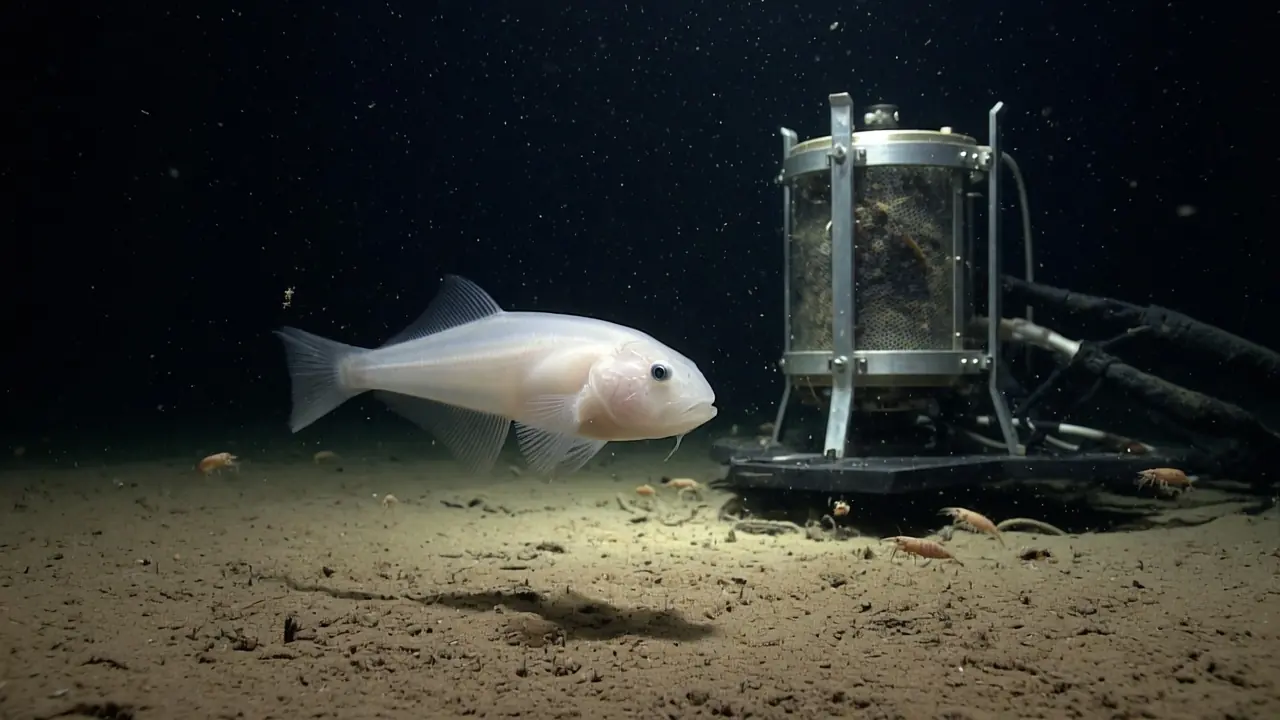
5. How Do Hydrothermal-Vent Animals Find New Vents?
Hydrothermal vents are temporary islands of life scattered across the deep seafloor.
They form where seawater enters cracks in Earth’s crust, becomes heated, reacts with rock, and returns carrying dissolved chemicals.
Microbes use those chemicals to produce energy through chemosynthesis. Entire communities of tubeworms, mussels, clams, shrimp, crabs, and other animals depend on that microbial production.
But individual vent fields do not last forever.
Geological activity changes. Chimneys collapse. Fluid flow slows or shifts. New vents may appear many kilometers away.
This creates a mystery.
How do animals that cannot survive long in ordinary deep-sea conditions locate a newly formed vent?
Many vent species release microscopic larvae into the water. Ocean currents may carry them far from their birthplace.
But drifting alone is not enough.
The larva must remain alive, encounter a suitable habitat, recognize the correct chemical or physical signals, settle, and begin developing before its energy reserves are exhausted.
Scientists are investigating whether larvae follow temperature changes, mineral signatures, pressure, sound, magnetic fields, or chemicals released by vent microbes.
Different species may use different cues.
Another problem is distance.
Some vent fields are separated by tens or hundreds of kilometers. Yet related populations may remain genetically connected across large sections of the ocean.
That suggests larvae sometimes travel remarkable distances.
Underwater ridges and currents may act like hidden highways, while geological barriers may isolate neighboring populations more effectively than distance alone.
New vent sites also raise questions about ecological succession.
Which species arrive first?
Do microbes establish the environment before larger animals settle? Do adult animals survive nearby and colonize quickly, or can larvae remain dormant until they detect the right conditions?
Hydrothermal vents support diverse ecosystems without sunlight, but NOAA describes them as dynamic systems shaped by changing geology and chemistry.
Every new vent community represents the successful completion of an extraordinary journey.
Scientists can observe the result.
They still cannot fully reconstruct how the animals found it.
What remains unknown?
The complete sensory cues, migration pathways, larval endurance, and colonization sequence that connect distant vent communities remain unresolved.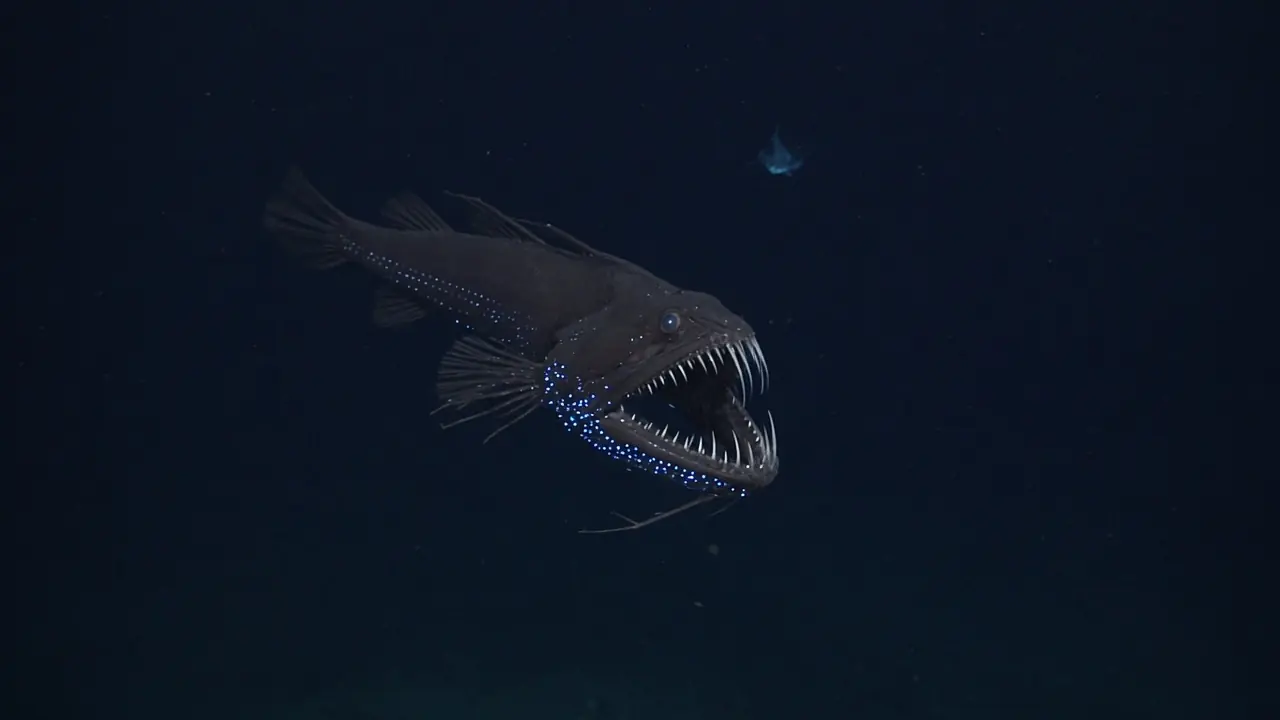
4. Why Do So Many Deep-Sea Animals Produce Light?
Bioluminescence is so common in the deep ocean that darkness is not truly dark.
Fish, squid, crustaceans, worms, jellyfish, siphonophores, and microbes can produce light through chemical reactions.
Some use it to attract prey.
Others use it to find mates, startle predators, illuminate food, communicate, or hide their silhouettes.
Counterillumination is one of the most remarkable strategies. An animal produces light on its underside that matches the weak glow from above. To a predator looking upward, the animal’s silhouette becomes difficult to detect.
Scientists understand many individual examples.
What remains unclear is the full language of deep-sea light.
A flash may be a warning, a mating signal, a defensive distraction, or an attempt to attract another animal. Without knowing the viewer’s sensory system and the context of the behavior, researchers may misinterpret what they record.
Some species can produce several distinct patterns.
Why does one pattern appear during one encounter and a different pattern during another? Are the flashes species-specific? Can animals recognize individuals? Do they communicate information about size, sex, readiness to mate, or danger?
The challenge is that ROV lights can change natural behavior.
A vehicle may illuminate an animal that normally lives in darkness. The creature may flash because it feels threatened, not because researchers have observed its ordinary communication.
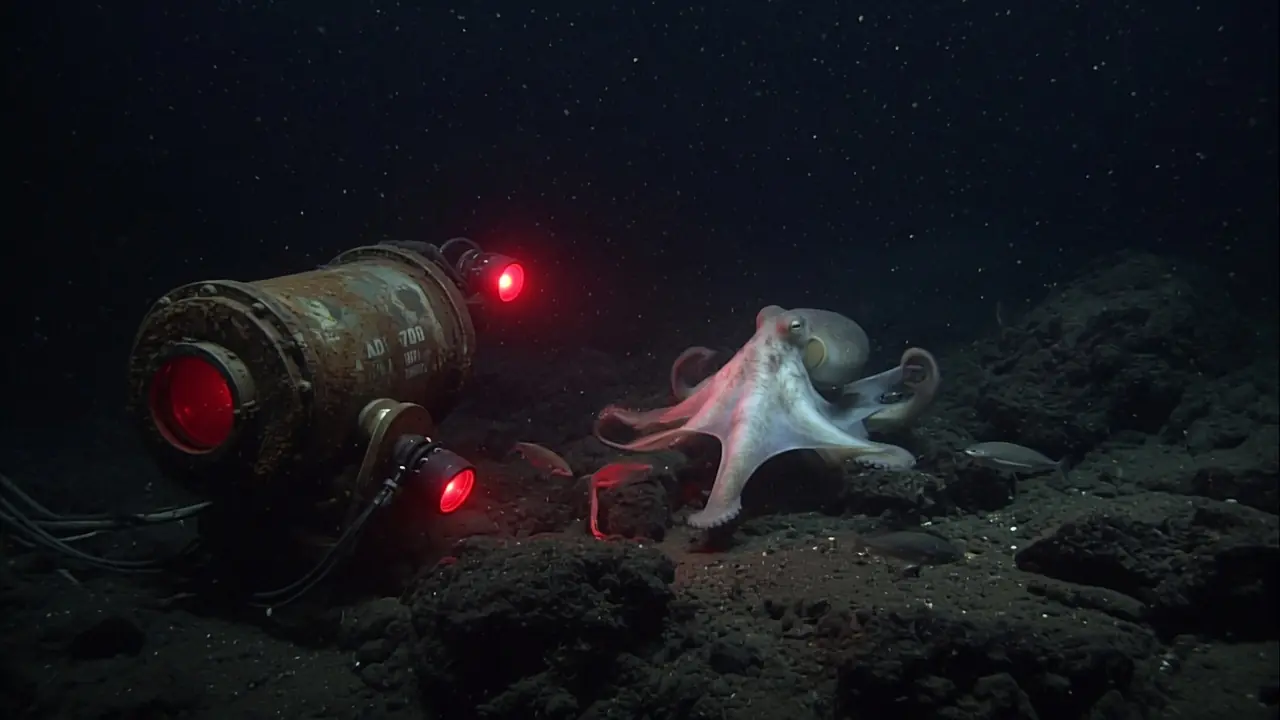
Scientists have developed low-light cameras and red illumination to reduce disturbance. Even then, the meaning of many displays remains uncertain.
The evolution of bioluminescence is another open question.
The ability appears in many unrelated branches of life and has evolved independently numerous times. In some organisms, the light-producing chemistry is created internally. Others obtain glowing bacteria or light-producing chemicals through food.
The distribution suggests that producing light provides enormous advantages in the deep sea.
But no single explanation covers every species.
WHOI describes bioluminescence and chemical sensing as major adaptations that allow animals to find one another in darkness. Yet the detailed messages exchanged in that light remain largely hidden.
We can see the flashes.
We often cannot read them.
What remains unknown?
Scientists have not decoded the full range of bioluminescent communication or determined the purpose of many patterns observed in the wild.
3. How Much Carbon Does the Deep Ocean Really Store?
The deep ocean is not isolated from life at the surface.
Every day, carbon-containing material sinks through the water column.
Some falls as marine snow. Some is carried downward inside migrating animals. Some reaches the seafloor in large events, such as dead whales, collapsing plankton blooms, or masses of gelatinous organisms.
This process is part of the biological carbon pump.
It helps move carbon away from the atmosphere and upper ocean into deeper water, where it may remain for decades, centuries, or longer.
Scientists know the process is important.
They do not know its full magnitude.
Measuring falling particles is difficult. Sediment traps collect only a small sample and may miss fast-sinking objects or drifting material.
Microbes and animals consume much of the carbon during its descent. Some is released back into the water through respiration. Some continues downward. Some is transported laterally by currents rather than falling in a straight line.
Daily animal migration adds another layer.
Countless fish, squid, and crustaceans rise toward the surface at night to feed, then descend before daylight. They carry carbon into deeper water through waste, respiration, and predation.
This is sometimes called active transport because living animals physically move the carbon.
But researchers do not know exactly how much each group contributes.
Gelatinous animals may also be underestimated. Jellyfish, salps, and siphonophores can grow rapidly and sometimes sink in large numbers. Their fragile bodies are difficult to measure with conventional nets.
Microbes further complicate the system.
They can transform dissolved carbon into particles, consume sinking material, or release compounds that remain in the ocean for long periods.
The abyssal seafloor may appear inactive, yet its microbial and animal communities continuously process material arriving from above. WHOI notes that the role of microbes in deep-ocean systems remains an active area of investigation.
Understanding this mystery matters far beyond deep-sea biology.
If scientists miscalculate the amount of carbon transported or stored at depth, climate models may underestimate or overestimate one of Earth’s major carbon pathways.
What remains unknown?
The total amount of carbon transported by deep-sea animals, microbes, sinking particles, and episodic events remains difficult to calculate accurately.
2. What Happens in the Ocean When No Camera Is Watching?
Almost everything humans know about deep-sea behavior comes from brief windows of observation.
A research vehicle may visit one location for several hours.
A baited lander may record a small patch of seafloor for a day.
A camera attached to a mooring may remain longer, but its field of view is limited.
The deep ocean continues around those instruments in every direction.
This creates a major observational problem.
Scientists often cannot tell whether a behavior is normal, rare, or caused by the equipment.
ROVs produce light, sound, heat, vibrations, and electrical activity. Some animals flee before entering the camera’s view. Others approach out of curiosity.
A predator recorded near a bright vehicle may behave differently when hunting in natural darkness.
Baited cameras create another distortion. They attract scavengers from surrounding areas and produce an artificial food source. The resulting gathering may reveal which species are present but not how they normally interact.
Even an apparently passive instrument can alter the environment.
Its structure provides a new surface. Its lights may attract plankton. Its sound may affect sensitive animals.
Researchers are developing quieter robots, low-light systems, autonomous cameras, environmental DNA samplers, and long-term observatories. New imaging and sampling technologies are opening previously inaccessible windows into midwater ecology.
Still, most deep-sea animals have never been followed continuously for days, months, or an entire life.
We do not know how far many individuals travel.
We do not know their normal sleep or resting patterns.
We may not recognize their courtship, territorial behavior, social relationships, or seasonal migrations.
An unusual event captured once can become famous precisely because there are so few other observations for comparison.
The animal may be demonstrating a rare emergency response.
Or it may be doing something that happens every night across the entire ocean.
What remains unknown?
Scientists cannot yet determine the ordinary long-term behavior of most deep-sea species or fully measure how research equipment changes what they observe.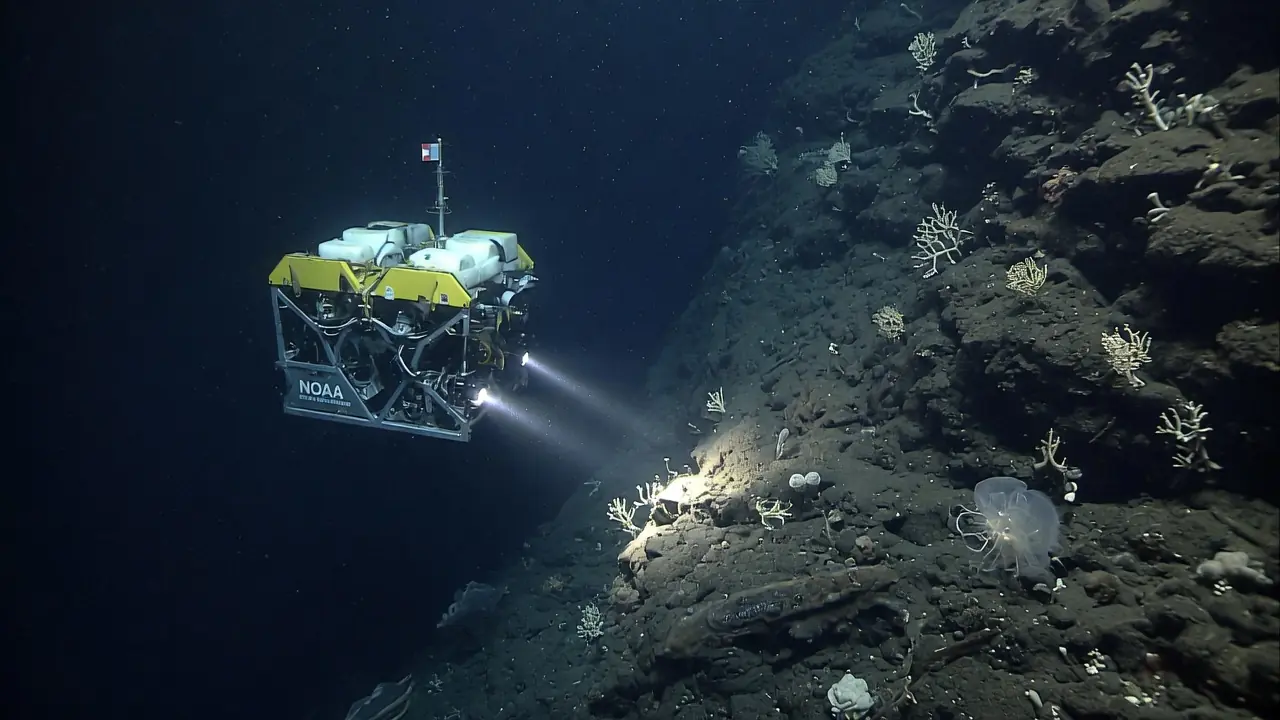
1. What Is Still Living Beyond the Reach of Our Deepest Surveys?
The greatest deep-sea mystery is not a single animal or process.
It is everything that remains outside the light.
Ocean exploration does not examine the deep sea evenly. Research concentrates near coastlines, scientific stations, known geological features, shipping routes, and places accessible to major vessels.
Enormous regions receive little or no direct visual observation.
Even mapped seafloor is not necessarily explored seafloor.
Sonar can show the shape of a mountain, trench, canyon, or plain without revealing the small animals living there. A map may identify a geological feature several kilometers wide while missing coral colonies, seeps, caves, or biological communities.
New expeditions still find unnamed seamounts and previously undocumented ecosystems.
Schmidt Ocean Institute expeditions have mapped underexplored canyons, discovered seamounts, documented deep coral systems, and encountered suspected new species.
Each feature can create unique conditions.
An underwater mountain changes currents and may concentrate food. A cold seep releases chemicals that support chemosynthetic life. A trench isolates populations under extreme pressure. A whale fall creates a temporary island of energy on an otherwise food-poor seafloor.
One expedition can reveal an ecosystem that has existed for centuries without being known to science.
The open water between the surface and seafloor is even harder to survey.
Animals are not attached to a fixed location. They move vertically and horizontally, sometimes across enormous distances. A camera examines only a narrow beam inside a three-dimensional habitat extending for kilometers.
Rare creatures may avoid lights or live at depths seldom visited.
Others may be too transparent, small, fast, or fragile to detect using standard methods.
NOAA’s ocean-exploration program describes its mission as exploring the unknown ocean, emphasizing how much remains to be discovered even with modern technology.
The most unusual deep-sea animal known today may eventually seem ordinary.
A stranger one may be drifting just beyond the range of the camera.
What remains unknown?
We do not know which ecosystems, species, behaviors, and geological features remain undocumented—or whether some could fundamentally change our understanding of life on Earth.
Why Are Deep-Sea Mysteries So Difficult to Solve?
The greatest obstacle is access.
A person standing on land can return to a forest repeatedly, observe an animal from several angles, and follow tracks across the ground.
Deep-sea scientists must place complex machines between themselves and the environment.
These machines must survive saltwater, darkness, cold, and immense pressure. They need power, communication systems, cameras, navigation, and sampling equipment.
A technical failure can end an entire expedition.
Research vessels are also expensive to operate. Every hour must be divided among mapping, observation, sampling, maintenance, and travel between locations.
The ocean’s size creates another limitation.
A remotely operated vehicle may travel only a few kilometers during a dive. Compared with the total area of the deep seafloor, each expedition examines an almost invisible fraction.
Animals rarely cooperate.
A squid may disappear when the lights turn on. A transparent jelly may break during collection. A migrating fish may pass through the area only once each year.
Researchers can spend decades waiting for a second observation of a behavior seen for only a few seconds.
That is why deep-sea science often moves carefully.
One strange recording can suggest a hypothesis.
It cannot always prove it.
Could These Mysteries Ever Be Solved?
Some probably will be.
Long-duration autonomous vehicles may follow animals without needing a surface ship directly above them. More sensitive cameras can record natural bioluminescence without bright white lights.
Environmental DNA can reveal which species recently occupied an area.
Improved acoustic systems can track movements over larger distances. Pressure-preserving samplers can bring delicate animals to laboratories without exposing them to destructive changes.
Artificial intelligence can help scientists examine millions of hours of footage and identify unusual animals or behaviors that humans might overlook.
But solving one mystery often creates several new ones.
Discovering that a species exists leads to questions about its diet, reproduction, evolution, population, and ecological role.
Recording a new behavior raises questions about how common it is.
Mapping a new vent field reveals an ecosystem whose origins must then be explained.
The deep ocean may never become completely familiar.
Its size, depth, movement, and complexity guarantee that observation will always be incomplete.
Final Thoughts
The deepest ocean is not mysterious because scientists have ignored it.
It is mysterious because exploring it is extraordinarily difficult.
Researchers have seen Magnapinna squid hanging long filaments through the water but have not confirmed exactly how those structures capture food.
They have recorded the giant phantom jelly, Stygiomedusa gigantea, but have never observed its complete life cycle.
They know the giant squid, Architeuthis dux, reproduces somewhere in the darkness, yet no one has documented the full event in the wild.
Scientists can measure bioluminescent flashes without always understanding their meaning.
They can find life at hydrothermal vents without completely reconstructing how the first colonists arrived.
They can map an underwater mountain without knowing which species live on its slopes.
Every discovery illuminates a small part of the ocean.
Around that light remains an incomparably larger darkness.
That darkness does not represent emptiness.
It represents questions.
And somewhere beyond the reach of today’s cameras, the answer to one of those questions may already be swimming past.