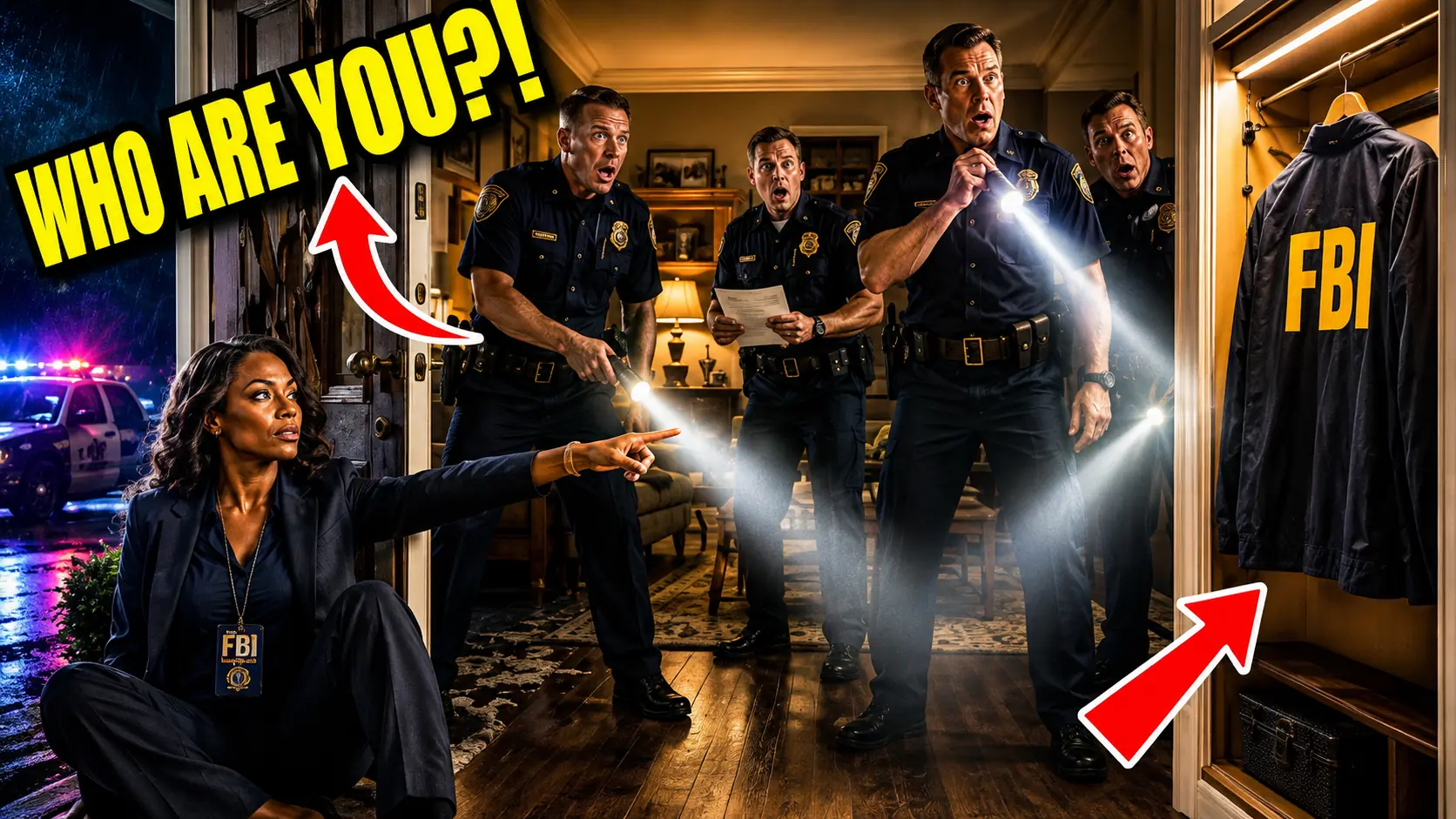
Hit it. She ain’t opening for us anyway. The door caved in. Debris everywhere. A woman in pajamas, barefoot. 2:00 a.m. “Lie down. Now.” “Officers, this is my—” “I said down.” He shoved her face into the floor. “Smells like a slum in here. Going to cry? That’s all you know—whine and make a fuss.” “I’m not resisting.” “You’re having trouble just breathing.” His partner ripped photos off the wall. Another kicked her bookshelf over. “No one’s saving you, darling. Not at this hour.” Her hand slid under the cushion. One button. Not 911. A red dot blinked behind the shelf. The sergeant’s flashlight caught the coat hook by the broken door. Navy blue. Three letters. Four men went silent. But that jacket was just the beginning.
Ridgewood, Georgia. Population 9,000. The kind of town where everybody waved at each other from their porches and nobody locked their doors. Unless you were Black. Then every door locked when you walked by. Brenda Dawson arrived on a Tuesday afternoon in a rented sedan with two suitcases and a box of books. She wore a plain gray blouse and reading glasses. Looked like an insurance consultant. That was the point. Twelve years with the FBI, specializing in civil rights violations within law enforcement—the kind of cases nobody wanted because the targets wore badges. Her assignment was simple on paper. Ridgewood Police Department had accumulated more civilian complaints in eighteen months than most departments see in a decade. Forty-three incidents. Ninety-one percent involving Black residents. Zero disciplinary actions. The Department of Justice flagged the pattern. The FBI sent Brenda.
She rented a small house on Maple Ridge Lane. Quiet street. White picket fences. The neighborhood association had a Facebook page where they posted about bake sales and missing cats. Brenda moved in on a Wednesday. By Thursday morning, three neighbors had already stopped by with questions. Where did she work? Was she married? How long was she staying? Friendly enough on the surface, but the eyes told a different story. The first thing Brenda did after unpacking was install three cameras. One behind the bookshelf in the living room. One above the kitchen window. One inside the smoke detector by the front door. Each one wireless. Each one feeding directly to a secure FBI server in Atlanta. She tested them twice. Then she hung her FBI jacket on the coat hook beside the front door. Old habit. Some agents kept theirs in a closet. Brenda kept hers in plain sight—not as a warning, as a reminder to herself of why she was here.
Her neighbor to the right was Eleanor Price, sixty-eight years old, retired schoolteacher, white hair pinned up in a bun. She brought over a lemon cake the first day and smiled wide enough to show every tooth. But by the second day, the smile was gone. Eleanor stood at her kitchen window and watched Brenda carry groceries inside. She watched Brenda take out the trash. She watched Brenda sit on her own porch and read a book. And then she picked up the phone. “Kyle, there’s a Black woman who moved in next door. She’s trouble. I can feel it.” Kyle Price, Sergeant, Ridgewood PD, fifteen years on the force. Eleanor’s only son. Within four hours of that call, Brenda’s license plates had been run through the system. Her background pulled. A patrol car parked at the end of her street with the engine running. Brenda noticed. She was supposed to notice. She noted the plate number, the time, and the officer’s face. She wrote it all down in a file labeled Ridgewood, Day Two.
During her first week, she moved through the Black community quietly. Conversations at the grocery store. Small talk at the laundromat. Nothing that looked like an investigation. Jerome Wallace ran a barbershop on Fifth Street. He told Brenda he had been pulled over eleven times in six months. Same stretch of road. Same officers. Never a ticket—just questions, just hands on the hood of his car, just the quiet humiliation of standing on the sidewalk while white drivers slowed down to watch. Tanisha Brooks was a nurse at the county hospital. She told Brenda that three months ago, four officers kicked in her front door at midnight, said they had a tip about drugs. They found nothing. No apology. No report filed. Her six-year-old daughter still slept with the lights on. Brenda listened. She recorded nothing in front of them, but every night she sat in her living room and typed detailed notes into an encrypted laptop. Names. Dates. Badge numbers. Patterns.
Deputy Director Harmon called her on the fifth night. “How’s it looking?” “Worse than the file suggested.” “Be careful, Brenda. They don’t know you’re coming. Let’s keep it that way.” “Understood.” She closed the laptop, walked to the front door, checked the coat hook. The jacket was still there—navy blue, with three white letters catching the hallway light. She turned off the lamp and sat in the dark. Through the window, she could see Eleanor Price’s kitchen light still on, still watching. Somewhere out there, Sergeant Kyle Price was reading his mother’s texts and deciding what to do about the new Black woman on Maple Ridge Lane. He had already made up his mind. He just didn’t know it yet.
The first call came on day four. Eleanor Price dialed 911 at 6:47 p.m. on a Saturday. She reported suspicious activity at the house next door. A Black woman receiving multiple visitors throughout the day. Possible drug activity. She used the word “suspicious” three times in ninety seconds. Two patrol officers arrived within eight minutes. They knocked on Brenda’s door. She opened it with a glass of iced tea in her hand. “Evening, ma’am. We received a complaint about suspicious activity at this address.” “Suspicious activity.” “Multiple individuals coming and going. A neighbor expressed concern.” Brenda looked past them at Eleanor’s house. The curtain twitched. “Those were friends from church. We had lunch.” The officers looked at each other. One of them, name tag reading Coleman, scratched the back of his neck. “Mind if we take a look inside?” “Do you have a warrant?” Silence. Coleman shifted his weight. “No, ma’am.” “Then I’m afraid I can’t help you. But you’re welcome to come back with one.” She smiled. They left. And Brenda wrote it all down. Time of arrival. Badge numbers. The exact words they used. The fact that neither officer had turned on their body camera. She checked the footage from her hidden cameras. Everything captured. Crystal clear.
That evening, Jerome Wallace stopped by. He brought a six-pack of root beer and sat on Brenda’s porch steps. “Cops were here today,” he said. “They were.” “Eleanor.” “Who else?” Jerome shook his head slowly. “That woman called the police on the last Black family that lived here—the Hendersons. They lasted four months before they moved out. Said they couldn’t take it anymore. Cops showing up every other week. Always polite. Always smiling. Always asking to look inside.” “What happened to them?” “Moved to Savannah. Mr. Henderson told me before he left. He said, ‘Jerome, I fought in two wars, but I can’t fight a whole town that doesn’t want me here.’” Brenda stared at her iced tea. The condensation dripped down her wrist. “How long have you lived here, Jerome?” “Two years. My shop’s been on Fifth Street for nineteen of them. I pay my taxes. I coached Little League on Saturdays. And last month, Danny Sutter pulled me over on my way home from church. Told me my taillight was out. It wasn’t. I showed him. He said, ‘Must have just come back on.’ Then he let me go. That was the eleventh time.” Eleven times. Eleven times in six months. Same officers. Same road. Same nothing. They never find anything because there’s nothing to find, but they keep looking. Brenda added it to the file. Jerome’s story alone would fill half a chapter in the DOJ report.
The second call came six days later. This time, Eleanor didn’t bother with 911. She called Kyle directly. “She had three Black men come to her house tonight. They were there for two hours. I could hear music. Kyle, I’m telling you, she’s dealing or worse.” The three men were residents Brenda had interviewed. Jerome Wallace, a retired postal worker named Grant Holloway, and a young man named Terrence Adams who worked at the gas station on Route 9. Terrence had been tased during a traffic stop four months ago. No charges filed. No body-camera footage available. The officer who tased him was Danny Sutter. Terrence had shown Brenda the scars. Two burn marks on his left shoulder where the prongs went in. He pulled his shirt aside in her living room and pointed at them like he was showing old war wounds. “He didn’t even tell me to get out of the car first. Just opened my door and fired. I was reaching for my registration. He said I made a sudden movement.” “Did you file a complaint?” Terrence laughed. It was the saddest laugh Brenda had heard in years. “File a complaint with who? Kyle Price? Danny’s best friend? Chief Vaughn? The man who plays golf with the mayor every Sunday?” Brenda understood. The system wasn’t broken. It was built this way.
Kyle listened to his mother that night. He didn’t file a report. He didn’t run it through dispatch. Instead, he walked into the breakroom at the station the next morning and pulled Danny Sutter aside. “Got a situation on Maple Ridge. New tenant. Black female. My mom says she’s got traffic in and out at all hours.” Danny leaned back in his chair. “You want me to run her?” “Already did. Came back clean. Insurance consultant out of Atlanta. But clean doesn’t mean clean.” Danny grinned. “When do you want to move?” “Not yet. Let’s watch her first.” For the next five days, the same unmarked car appeared at the end of Brenda’s street every evening. Different times. Same car. Same tinted windows. She photographed it each night from behind her bedroom curtain, logged the plates, sent every photo to the Atlanta field office with a timestamp and GPS coordinates.