Don't move. Follow me.
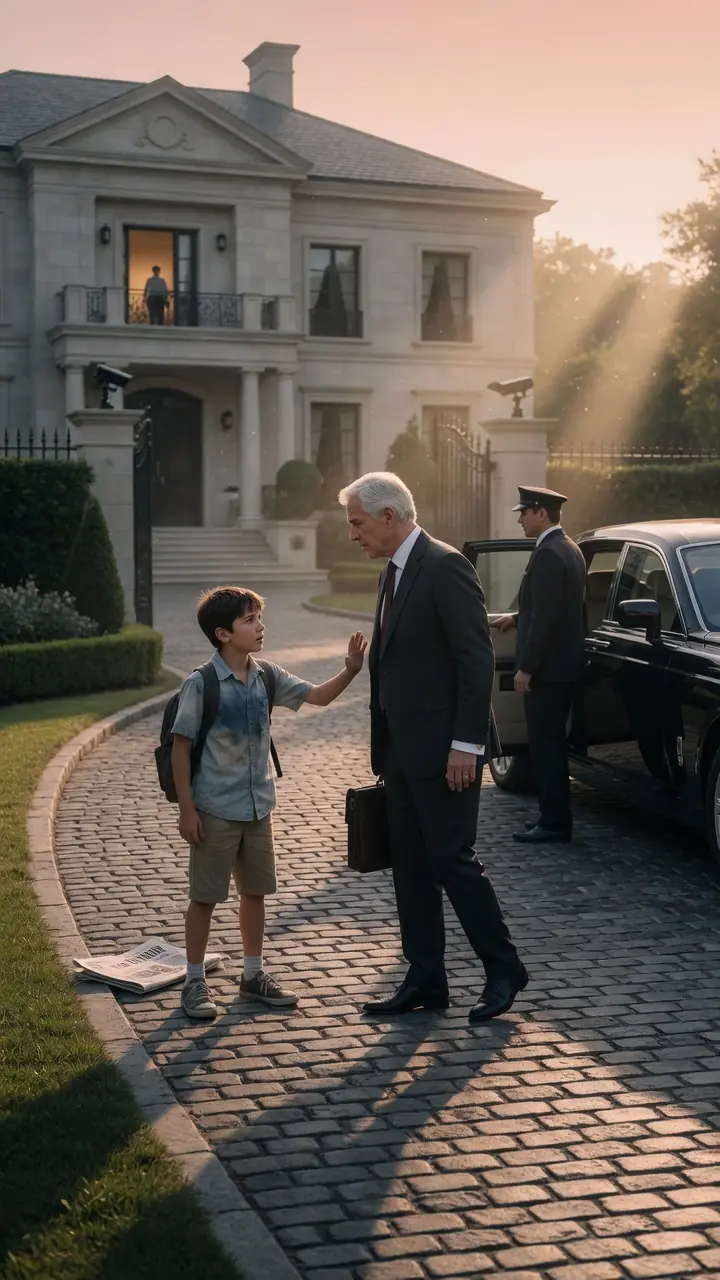
The boy's voice was barely louder than a whisper, but something in it made Richard Callaway stop in the middle of his own driveway.
He had been walking toward the silver town car waiting at the gate, briefcase in one hand, phone in the other, his mind already three hours ahead in a boardroom across the city.
Now he was standing perfectly still on the polished stone path, looking down at a small boy in a faded blue shirt who had appeared from behind the rose hedges like he had been waiting there for hours.
"What did you say?" Richard asked.
He recognized the boy, or at least he thought he did. The housekeeper's son, maybe ten years old. He had seen him a few times helping his mother carry laundry baskets across the back lawn, but he could not remember ever speaking to him directly.
"Don't move," the boy repeated, even quieter this time. "Please, sir, follow me. Don't let the man at the gate see you."
Richard glanced toward the gate.
His driver was standing beside the town car, holding the rear door open, looking down at his phone.
Nothing seemed wrong.
Nothing seemed out of place.
The morning was bright.
The sky was clean.
The engine of the car was humming softly the way it always did when his driver had been waiting for more than two minutes.
"Son, I'm late for a meeting," Richard said, trying to keep his voice patient. "Whatever this is, can we talk about it tonight?"
The boy did not let go of his sleeve.
His fingers were small, but his grip was firm, and his eyes were not the eyes of a child playing a game.
They were the eyes of someone who had not slept the night before.
"If you go to that car," the boy whispered, "you won't come back. I heard them say it last night in the kitchen. Please, sir."
Richard felt something cold pass through him, but he pushed it away.
He had built his entire life on logic, on numbers, on the discipline of not reacting to surprises.
He was the founder of one of the largest private logistics firms on the East Coast.
He did not change his schedule because a child told him to.
But something about the way the boy was holding his sleeve made him look once more at the car at the gate.
And this time he looked carefully.
The car was the same model, the same color, the same plate as far as he could tell from this distance.
The driver was the same height, the same build, wearing the same dark jacket.
Everything was as it should be.
Except for one thing.
His regular driver, a man named Anthony, who had worked for him for almost four years, always wore a small silver ring on his left thumb, a gift from his late father.
Anthony was not a man who took the ring off, not even when he washed dishes or worked on his car.
Richard had once teased him about it at a Christmas party, and Anthony had told him the story behind it, and Richard had felt slightly embarrassed for joking.
The man at the gate was not wearing a ring.
"How do you know what you heard?" Richard asked quietly, his eyes still on the driver. "How do you know it was about me?"
"Because they said your name," the boy whispered. "Mr. Callaway. They said it three times, and they said your wife paid them already. Half last week, half when it was done."
Richard's chest did not move for a long moment.
He felt his lungs stop and then start again slowly, the way they always did when he received very bad news in a meeting and could not let anyone see it.
"Walk with me," he said quietly. "Slowly, toward the side of the house. Don't run. Don't look at the gate."
The boy nodded once and let go of his sleeve.
The two of them walked together across the stone path, past the fountain that Richard had paid more for than most people pay for a car, past the marble bench where his wife sometimes drank her morning coffee, and around the corner of the house where a tall row of cypress trees blocked the view from the gate.
When they were behind the trees, Richard knelt down so his eyes were level with the boy's.
"What's your name?" he asked.
"Elijah, sir."
"Elijah."
Richard nodded slowly as if locking the name into a place inside his head where important things were kept.
"Tell me everything slowly. Don't skip anything. Start from last night."
Elijah took a deep breath.
His shoulders were trembling slightly, but his voice stayed steady.
"My mom was making tea in the kitchen," he said. "It was late. I was supposed to be sleeping, but I came down because I forgot my book. The lights in the kitchen were off, but I could hear voices on the back patio. Two people. A woman and a man."
"The man was not from the house. I had never heard his voice before. And the woman was Mrs. Callaway."
Richard kept his face very still.
"She said, 'Everything is ready for the morning.' She said the driver had been replaced. She said her husband would be in the car at 8:30 and that he would not notice because he never notices anything in the morning because he is always reading his phone."
Elijah paused, and his eyes filled with something that looked older than ten years.
"And then she said that after today she would finally be free."
Richard Callaway stayed very still behind the cypress trees, listening to his own heartbeat in his ears, and felt the entire shape of his life shifting underneath him like a floor that had just stopped being solid.
For a long moment, Richard Callaway did not speak.
He stayed crouched behind the cypress trees, one hand resting on the cold stone of the garden wall, the other still holding his briefcase as if it were the only thing connecting him to the world he had walked out of three minutes earlier.
The sound of the town car's engine drifted softly from the gate.
Patient.
Mechanical.
Indifferent.
"Elijah," he said quietly. "Do you have anything else? Anything you can show me? A note, a picture, anything?"
The boy hesitated.
He looked down at his shoes for a second, then reached into the front pocket of his shirt and pulled out a small black object.
It was an old phone, the kind that had been new maybe six years ago, with a cracked screen held together by clear tape along the corner.
"My mom gave me this one when she got her new one," Elijah said. "It still records sound. I was scared, so I pressed the button. I held it near the door."
Richard took the phone carefully, the way a man might handle a piece of glass that had been pulled out of a wound.
He looked at the screen.
There was a single audio file saved from the night before.
Eleven minutes and forty-two seconds long.
"You recorded it," Richard said.
"I didn't know what else to do, sir. I thought if I told my mom, she would say I was dreaming. I thought if I told nobody, then nobody would believe me later."
Richard nodded slowly.
He pressed play.
The first thing he heard was the sound of dishes settling in a sink.
Then, almost immediately, the soft sliding noise of the patio door.
Then his wife's voice, calm and warm in the way she always spoke at dinner parties, saying something he could not quite make out at first.
He raised the volume.
"Has to look ordinary. He has to walk to the car himself. If anything is forced, if anything looks wrong, the police will find it within a day. He has to get in willingly."
Then a man's voice.
Deeper.
Slower.
Careful in the way a person sounds when they are reading from a list they have memorized.
"He will. 8:30 is his window. He never varies. He walks out. He opens his email. He gets in the car. The new driver knows the route. There's a place outside Hartwick where the road bends along the reservoir. The car will stop there. The rest happens after."
A pause.
A small sound that might have been ice in a glass.
"And the policy?" the man asked.
"It pays out after seven months," his wife answered. "Accidental death. Double indemnity. The lawyers have already reviewed it. There is no contest because there is no other beneficiary. I am the only one."
"The house, the company shares, everything moves through the trust to me. The board cannot stop it. They tried to put protections in two years ago, but he signed them away during the merger. He never read the third page."
Richard closed his eyes.
He remembered that day.
He remembered signing a stack of documents at a hotel desk in Boston while a junior lawyer pointed at the lines.
He remembered being told that the third page was administrative language.
Standard.
Nothing to worry about.
He remembered feeling tired and not asking.
The recording continued.
Then the man's voice asked, "When everything is settled?"
"We wait," his wife replied. "A year, maybe longer. We do not appear in the same room for at least eighteen months. We say nothing. We change nothing. Patience is what makes this work."
The recording went on a little longer, but Richard stopped the playback.
He did not need to hear the rest.
He had heard enough to know that whatever life he had been living that morning, that life had ended sometime during the night while he was asleep upstairs.
Richard looked at Elijah, who was watching him with the patient eyes of someone who had been waiting all morning to be believed.
"Your mother," Richard said carefully. "Does she know you recorded this?"
"No, sir."
"Did she hear them too?"
"I don't think so. She had the kitchen radio on. She was making tea. I think she heard nothing."
"Good."
Richard exhaled slowly.
"I need you to keep it that way for now. Do you understand? Not because your mother would do anything wrong. But because the more people who know, the more people are in danger."
Elijah nodded.
He had the kind of seriousness in his face that did not belong on a child.
Richard slipped the old phone into the inside pocket of his jacket.
Then he stood up slowly, brushed the dust off his trousers, and looked out through a gap in the cypress branches toward the front gate.
The town car was still waiting.
The driver had finished with his phone now and was looking toward the house, no longer relaxed, his weight shifting from one foot to the other in the small way a man does when he has been told to wait somewhere for a specific reason and is starting to wonder why he is still waiting.
Richard took out his own phone and tapped a single name from his favorites.
The line rang twice.
"Richard, you should be in the car already. The Hartwick meeting starts at 10:00."
"Marcus."
Richard's voice was very calm.
"I am not going to Hartwick today. I need you to do something for me, and I need you to do it without telling anyone in the office. Not Helen. Not the legal team. No one."
There was a pause on the other end.
Marcus Vale had been his lawyer for nineteen years, and he had only heard Richard speak in this exact tone twice before.
And once on the night Richard's mother died.
"Tell me."
"Marcus, I need everything on my life insurance policy. Every change made in the last two years. Every signature. Every adjustment to the beneficiary clause. And I need it in the next ninety minutes."
"Richard, what is happening?"
Richard looked down at Elijah, who was looking back up at him with the same steady eyes.
"Something I should have noticed a long time ago."
Marcus did not waste time with more questions.
"Give me ninety minutes. Stay where you are."
And he ended the call.
Richard stood behind the cypress trees, holding the silent phone in his hand.
He could feel his own pulse in his fingertips.
He had negotiated against governments.
He had bought companies and sold them in the same week.
He had walked into rooms full of people who wanted him to fail and walked out with their signatures on his paper.
None of it had prepared him for the simple act of standing twenty feet from his own front door and not knowing who in his house wanted him alive.
His phone rang.
The screen lit up with a single word.
**Vivien.**
He almost did not answer.
But he understood, in the same calm and distant way he had understood the recording, that not answering would tell her something.
She would call the driver.
The driver would walk up to the house.
The plan would shift.
And whatever advantage he had right now would disappear into the morning air.
He pressed the green button.
"Vivien."
"Richard, where are you? The driver just texted me. He says he has been at the gate for almost ten minutes."
Her voice was warm.
Patient.
Slightly amused.
The way a wife sounds when her husband has forgotten where he put his keys again.
"I came back inside," Richard said. "I forgot a folder for the Hartwick meeting. I think I left it in the study."
"Oh. Do you want me to come help you find it?"
"No. Stay where you are. I'll be out in two minutes."
"Hurry, darling. You know how traffic gets."
"I know."
He ended the call and looked down at Elijah, who had not moved.
"She is in the house?" Richard asked quietly.
"She was on the back patio twenty minutes ago," Elijah said. "When I saw your car pulling around to the front, I came to find you. I did not see where she went after."
Richard nodded slowly.
He thought for a moment.
"Elijah, I need to see her one more time. I need to see her with my own eyes before I do anything else. Do you understand why?"
The boy thought about it.
Then he nodded.
"Because if you don't see her, you might still believe she didn't do it."
Richard looked at him for a long second.
He realized that this child in a faded blue shirt with a cracked phone in his pocket had just described the exact shape of his hope in fewer words than Richard could have used.
"Yes," Richard said. "Exactly."
They moved together along the back of the house, staying close to the wall, ducking under the low windows.
Richard had not crouched like this since he was a boy himself, hiding from his father in the cornfield behind the small house where he had grown up.
He was surprised at how easily his body remembered.
They reached the corner of the south wing.
From there, through a screen of climbing jasmine, they could see the back patio, the long stretch of lawn that led to the gardener's shed, and the white wrought-iron table where Vivien sometimes had her morning coffee.
She was there.
She was not alone.
The man sitting across from her was the man whose voice had been on the recording.
Richard knew it before he could explain how he knew it.
He was tall.
Lean.
Somewhere in his early forties, with the kind of carefully kept hair that men have when they spend more time on their appearance than they admit.
He was wearing a dark gray jacket over a black shirt.
His hands were resting on the table near hers.
Not touching.
But close enough that anyone watching would understand.
Vivien was smiling.
She was wearing the light blue dress that Richard had bought her in Florence two summers ago.
She had told him at the time that she would save it for something special.
The man said something Richard could not hear.
Vivien laughed softly and reached across the table and laid her hand on top of his.
"By tonight," she said, just loud enough to carry across the lawn, "this will all be over."
Richard did not move.
He did not feel anger.
He did not feel grief.
He felt something stranger.
Something that did not have a name.
Something like the feeling of watching a photograph of yourself slowly catch fire from the corner inward.
The man lifted her hand and kissed the inside of her wrist.
And then he said:
"We begin."
Richard turned away from the screen of jasmine.
He looked down at Elijah, who had also seen it, who had also heard it, and whose small face had gone very quiet.
"Come with me," Richard said.
They walked together back along the wall, around the corner, and through the side door that led into the laundry room.
Richard knew this part of the house only vaguely.
He had spent twenty-six years living here and could not have told anyone before this morning what the laundry room looked like.
He found this fact almost funny in the cold and distant way he was finding many things funny right now.
He took out his phone again and tapped a different name.
"Anthony," he said when the line picked up, "I need you to listen carefully and not ask questions yet. Are you at home?"
"Yes, sir. I'm off today. You told me last week, remember? You said the company was sending a car from a different service because mine is in for service. I figured you got the dates mixed up, but I didn't want to call and bother you about it. Mr. Callaway, is something wrong?"
Richard closed his eyes for a brief moment.
There it was.
The lie had been planted last week by someone who had access to his schedule, his phone, and his trust.
"Anthony," he said, "your car is not in for service, is it?"
"No, sir. It's in my driveway right now."
"I thought so."
Richard exhaled slowly.
"I need you to drive over here. Park one street away. Do not come up to the gate. I will call you again in a few minutes and tell you what to do next."
Anthony arrived 14 minutes later.
Richard watched from the small window above the laundry sink as a dark sedan rolled slowly to the curb one street over and stopped beneath a row of maple trees.
No flashing lights.
No sudden movements.
Just a man following instructions.
Richard checked his watch.
8:27.
Three minutes before the time he was supposed to be in the town car.
Three minutes before the version of his life everyone else expected to happen.
His phone vibrated.
Marcus.
Richard answered immediately.
"I have it."
Marcus sounded different.
Not alarmed.
Focused.
"The beneficiary change was filed nineteen months ago."
Richard leaned against the wall.
"Who submitted it?"
"Your wife."
"I assumed that."
"There is more."
Richard waited.
Marcus rarely paused unless he was deciding how much damage to deliver at once.
"The change wasn't just the insurance policy."
"What else?"
"The trust."
Silence.
Marcus continued.
"Three separate amendments."
"One transferred voting authority in the event of incapacity."
"One altered succession rights inside the holding company."
"And one removed the secondary review requirement if death occurred outside company property."
Richard stared at the washing machine across the room.
The words landed one at a time.
Not because they were complicated.
Because they were thorough.
Someone had been preparing this for a long time.
"How long?" Richard asked quietly.
Marcus already knew what he meant.
"The earliest amendment was twenty-three months ago."
Almost two years.
Not a moment of passion.
Not an impulsive mistake.
A project.
A strategy.
A campaign.
Richard felt strangely calm.
When disasters become large enough, panic loses its usefulness.
"What do you need from me?" Marcus asked.
Richard looked down at Elijah.
The boy was sitting on an overturned laundry basket, waiting quietly.
"I need two things."
"Name them."
"First, I need copies of every amendment."
"You'll have them in fifteen minutes."
"Second, I need a private investigator."
Marcus was silent.
Then:
"Already making calls."
Of course he was.
That was why Richard had trusted him for nineteen years.
Marcus prepared for the next move before being asked.
"Richard."
"Yes."
"If what you're implying is true, don't confront anyone."
"I wasn't planning to."
"Good."
Another pause.
Then Marcus added something unusual.
Something personal.
"Be careful."
The line disconnected.
Richard slipped the phone into his pocket.
Then he looked at Elijah.
"Do you know where your mother is?"
"In the staff cottage."
"Good."
Richard nodded.
"I need you to go stay with her."
The boy frowned.
"But what about you?"
Richard smiled for the first time all morning.
A tired smile.
An honest one.
"What about me?"
"The man outside."
"The car."
"Your wife."
Richard considered the question.
Then he crouched so they were eye level again.
"My grandfather taught me something when I was younger than you."
"What?"
"He said that when somebody builds a trap, the smartest thing you can do isn't run."
Elijah listened carefully.
"It's step out of the place where they expected you to be."
The boy thought about that.
Then nodded.
"I think that's smart."
"I think so too."
Richard stood.
"Go find your mother."
Elijah hesitated.
Then he reached into his pocket and pulled out the cracked phone again.
"You should keep it."
Richard looked at the phone.
The small device suddenly seemed heavier than it should.
A child had carried it.
A child had recorded the truth.
A child had changed the course of an entire morning.
Richard accepted it.
"Thank you."
Elijah gave a small nod and disappeared through the side hallway.
Richard watched him go.
Then he walked toward the rear exit.
Not the front door.
Not the grand entrance where the driver waited.
Not the route everyone expected.
A narrow service path wound behind the property, hidden by hedges and maintenance sheds.
He had never used it before.
Most owners never do.
The path led to a side street.
Anthony was waiting there.
The moment Richard climbed into the passenger seat, Anthony turned toward him.
"What happened?"
Richard looked out the windshield.
The mansion was visible through gaps in the trees.
Large.
Beautiful.
Familiar.
And suddenly very far away.
"Drive."
Anthony didn't ask again.
They pulled away.
Back at the estate, 8:30 came and went.
The town car remained at the gate.
At 8:34, the replacement driver checked his watch.
At 8:36, he made a phone call.
At 8:38, Vivien stepped out onto the front porch.
She looked toward the gate.
Toward the empty driveway.
Toward the place where Richard should have been.
The driver said something.
Vivien answered.
Then both of them stood very still.
Because for the first time that morning, the plan was no longer unfolding according to schedule.
And people who rely on plans often reveal themselves the moment those plans begin to fail.
At 8:41, Vivien made a second phone call.
This time she walked away from the front porch before speaking.
The replacement driver remained by the gate, pretending to inspect the car.
But Richard's security cameras, which Marcus had quietly gained access to 20 minutes earlier, captured everything.
The footage streamed directly to a laptop in Marcus's office downtown.
By 8:47, Marcus had three attorneys, a retired state investigator, and a former insurance fraud analyst sitting around a conference table.
Nobody interrupted.
Nobody speculated.
They simply watched.
The first rule of investigations is simple.
People tell you the truth fastest when they think nothing has gone wrong.
Vivien still believed Richard was somewhere on the road toward Hartwick.
That assumption was about to become very expensive.
At 8:52, she returned inside the house.
The replacement driver stayed outside.
At 9:03, a black SUV arrived.
Not through the main gate.
Through the service entrance on the north side of the property.
A man stepped out.
Marcus paused the video.
Zoomed in.
Then looked toward the investigator beside him.
"You know him?"
The investigator nodded once.
His expression darkened.
"Yes."
"Who?"
"Name's Daniel Cross."
The room went quiet.
Cross wasn't a professional driver.
He wasn't logistics staff.
And he definitely wasn't associated with Richard's company.
For fifteen years he had appeared around insurance fraud investigations, suspicious inheritance disputes, and three cases that never quite produced enough evidence for criminal charges.
Never convicted.
Never clean.
Always nearby when large amounts of money changed hands after unexpected deaths.
Marcus looked back at the frozen image.
"Wonderful."
The investigator folded his arms.
"If he's involved, this wasn't spontaneous."
Marcus already knew that.
Nothing about the paperwork Richard described sounded spontaneous.
The trust amendments.
The insurance changes.
The replacement driver.
The timing.
This had structure.
And structure leaves trails.
Meanwhile, Richard sat quietly in the passenger seat of Anthony's sedan.
They were parked in the underground garage beneath one of the company's older office buildings.
A building nobody associated with him anymore.
Most operations had moved years ago.
The place sat half empty.
Which made it useful.
Anthony leaned against the hood of the car.
"Are you going to tell me what's happening?"
Richard stared across the concrete garage.
A janitor pushed a mop bucket through the far hallway.
The ordinary sight felt strangely comforting.
Finally he answered.
"My wife arranged for me to disappear today."
Anthony blinked.
Then waited.
Then realized Richard was serious.
The color left his face.
"What?"
Richard handed him the cracked phone.
"Listen."
Anthony listened.
Six minutes later he lowered the device slowly.
His jaw tightened.
"I'll kill him."
Richard shook his head immediately.
"No."
"Mr. Callaway—"
"No."
The word echoed sharply through the garage.
Anthony fell silent.
Richard softened his tone.
"If you get angry, they win."
Anthony looked away.
He wasn't angry because of loyalty to a paycheck.
He was angry because Richard had attended his daughter's graduation.
Because Richard had helped pay for surgery when Anthony's wife got sick.
Because twenty years of trust creates something larger than employment.
Richard understood that.
Which was why he placed a hand on Anthony's shoulder.
"We do this correctly."
Anthony nodded reluctantly.
"Okay."
Richard looked at his watch.
9:17.
Back at the estate, the timeline was collapsing.
Whoever expected him at the reservoir would already be asking questions.
Whoever coordinated transportation would be checking schedules.
And eventually someone would decide to call Vivien again.
Pressure was building.
Pressure creates mistakes.
His phone vibrated.
Marcus.
"Talk to me."
"We identified one of them."
Richard listened quietly as Marcus explained Daniel Cross.
The insurance cases.
The inheritance investigations.
The pattern.
When Marcus finished, Richard remained silent for several seconds.
Then:
"So they hired a professional."
"Looks that way."
Marcus hesitated.
"There is something else."
"What?"
"The trust amendments weren't witnessed by your usual legal staff."
Richard closed his eyes.
"I assume there's a name."
"There is."
Marcus read it aloud.
Richard recognized it immediately.
A junior associate from a firm his wife had recommended eighteen months earlier.
Someone he met exactly twice.
Someone who suddenly seemed much more important than he had appeared at the time.
The pieces were no longer scattered.
They were beginning to fit together.
And once pieces begin fitting together, outcomes become predictable.
Marcus cleared his throat.
"Richard."
"Yes."
"I need to ask something difficult."
Richard already knew the question.
"How long do you think it's been going on?"
The silence lasted nearly ten seconds.
Then Richard answered honestly.
"I don't know."
And that was the hardest part.
Not the betrayal.
Not the money.
Not the plan.
The uncertainty.
The realization that somewhere in the last two years, perhaps longer, he had stopped seeing the people closest to him clearly.
That realization hurt more than anything on the recording.
Outside the garage, the city continued normally.
Traffic lights changed.
People drank coffee.
Meetings started.
Deliveries arrived.
The world had no idea that a billionaire businessman was sitting in an underground parking structure trying to determine when his marriage had ended and when a conspiracy had begun.
Then Marcus spoke again.
"Good news."
Richard almost laughed.
"There's good news?"
"Actually, yes."
"What is it?"
Marcus's voice became very calm.
"The moment you failed to appear at the reservoir, the conspiracy stopped being a murder plan."
Richard frowned.
"What do you mean?"
"It became a panic."
And panic, Marcus knew from experience, is where people make mistakes.
At 9:31, panic arrived exactly on schedule.
Not at the estate.
Not at the reservoir.
At a prepaid phone purchased three days earlier from a convenience store outside Knoxville.
The phone belonged to Daniel Cross.
And Daniel Cross was suddenly receiving far more calls than he liked.
The first call lasted 12 seconds.
The second lasted 19.
The third went unanswered.
That was when mistakes began.
In Marcus's office, the retired investigator watched incoming records populate across a screen.
Cross had been careful.
But careful people often prepare for the event itself and neglect the collapse afterward.
The investigator pointed at a number.
"There."
Marcus leaned forward.
"What about it?"
"Same contact pattern appears in a probate dispute from 2017."
Another click.
Another screen.
Another name.
Marcus stared.
Then immediately called Richard.
"You sitting down?"
Richard looked around the garage.
"I've been sitting down all morning."
"Good."
"What happened?"
Marcus exhaled.
"We found the connection."
Richard waited.
"The man coordinating this isn't Cross."
"Then who?"
"The lawyer."
Silence.
"The associate who handled the trust amendments."
Richard closed his eyes.
The name settled into place.
Suddenly everything made sense.
Access to paperwork.
Knowledge of the insurance structure.
Awareness of succession provisions.
The ability to recommend specific legal changes without raising suspicion.
You don't rob a bank without studying the vault.
And you don't build a two-year inheritance scheme without someone who understands the paperwork.
"Can you prove it?" Richard asked.
"Not yet."
"But we're getting close."
Marcus paused.
"Richard, where are you exactly?"
"Still at the garage."
"Stay there."
Richard smiled faintly.
"That's becoming everyone's favorite advice today."
"Then keep listening to it."
The call ended.
Across town, Vivien was no longer calm.
At 9:44 she made another call.
Then another.
Then another.
Security footage showed her pacing through the study.
The replacement driver had already left.
Daniel Cross had disappeared.
And nobody had heard from Richard.
That was the problem.
Not his death.
His absence.
A successful plan produces certainty.
An interrupted plan produces questions.
At 10:07, she finally did something unexpected.
She logged into Richard's company email.
Marcus watched it happen remotely.
The screen in his office populated with access records.
Login.
Search.
Inbox.
Travel schedule.
Board communications.
Emergency contact files.
The investigator smiled.
"She's looking for him."
Marcus nodded.
"And documenting it."
People trying to establish innocence often begin performing innocence.
Unfortunately for them, performance creates evidence.
By noon, the situation had changed completely.
Cross was missing.
The replacement driver had abandoned the town car.
Vivien had called six different people.
The associate lawyer had attempted to access archived trust documents twice.
And none of them knew the most important fact.
Richard Callaway was alive.
At 12:18, Richard finally left the garage.
Not alone.
Anthony drove.
Two investigators followed.
Marcus met them at a private office building on the river.
The conference room was small.
Nothing like the grand boardrooms Richard usually occupied.
Just a table.
Coffee.
A stack of documents.
The truth looked surprisingly ordinary.
Marcus pushed a folder across the table.
Inside were copies of the trust amendments.
Insurance changes.
Communication logs.
Property records.
Financial transfers.
Everything collected in less than four hours.
Richard turned pages slowly.
Methodically.
Not because he was shocked anymore.
That part had already happened.
He was looking for the moment.
The first decision.
The first lie.
The first place where trust had become strategy.
Finally he stopped.
One page.
A transfer authorization dated twenty-two months earlier.
Signed by him.
Recommended by Vivien.
Prepared by the associate attorney.
The beginning.
He looked at the date.
Then remembered something.
A dinner.
A charity gala.
A conversation afterward in the car.
Vivien had suggested simplifying the estate structure.
He had agreed.
Not because he reviewed the paperwork.
Because he trusted her.
Marcus watched him.
"You remember."
Richard nodded once.
"Yes."
And suddenly the entire story became visible.
Not as documents.
Not as evidence.
As choices.
Small choices.
Repeated.
Accumulated.
Until they formed a road leading directly to this morning.
Outside the window, sunlight reflected off the river.
The city moved normally.
Unaware.
Richard closed the folder.
Then looked at Marcus.
"What happens now?"
Marcus leaned back.
The answer was simple.
"We stop reacting."
Richard waited.
"We let them keep panicking."
A slow smile appeared on Richard's face.
Not happy.
Not angry.
Strategic.
For the first time all day, he felt something familiar.
Control.
Because Marcus was right.
The trap had failed.
The conspiracy was exposed.
And the people who built it still believed they had time.
They didn't.
What they had now was fear.
And fear, unlike patience, always spends itself too quickly.
At 1:04 p.m., the first person broke.
It wasn't Vivien.
It wasn't Daniel Cross.
And it wasn't the replacement driver.
It was the associate attorney.
The weakest link is rarely the person with the most to gain.
It's usually the person with the most to lose.
Marcus had seen it happen dozens of times.
Pressure moves downhill.
And eventually somebody decides saving themselves is more important than protecting everyone else.
The attorney's name was Grant Holloway.
Thirty-four years old.
Five years into a career he had spent his entire adult life building.
A mortgage.
A pregnant wife.
Student loans.
Professional licenses hanging on the office wall.
Things people become very protective of when investigators start asking questions.
At 1:04, Grant called the wrong person.
Daniel Cross.
The call lasted 47 seconds.
At 1:11, he called again.
No answer.
At 1:18, he sent a text message.
That was the mistake.
Text messages create timelines.
Timelines create stories.
And stories become evidence.
Marcus's investigator stared at the screen.
Then smiled.
"What?"
Richard asked.
The investigator turned the monitor around.
One message.
Seven words.
**Where are you? They know something went wrong.**
Nobody in the room spoke for several seconds.
Then Anthony laughed once.
Not because it was funny.
Because after an entire morning of uncertainty, somebody had finally admitted there was a plan.
Marcus picked up his phone immediately.
"Now we move."
The next two hours unfolded quickly.
Too quickly for Vivien.
Too quickly for Grant.
Too quickly for anyone still trying to keep the story together.
At 2:07 p.m., investigators located Daniel Cross at a motel outside the city.
He wasn't arrested.
Not yet.
But he was found.
And people who are found start making calculations.
Especially when they realize the person they expected to be dead is still alive.
At 2:31, Grant Holloway requested an emergency meeting with his firm's senior partners.
At 2:44, Vivien attempted to access the trust records again.
At 2:49, she called Grant.
The call lasted 3 minutes and 12 seconds.
At 2:53, Grant called Daniel Cross.
At 2:55, Daniel Cross checked out of the motel.
The investigator looked at the timeline and shook his head.
"They're running in circles."
Marcus nodded.
"Good."
Richard sat quietly at the far end of the table.
Listening.
Watching.
Thinking.
For most of the day he had been reacting.
Now he was analyzing.
There was a difference.
Reaction is emotional.
Analysis is useful.
And Richard had spent forty years building a company by understanding the difference.
He stood and walked toward the window.
The river below reflected the afternoon sunlight in fractured patterns.
For a moment, he remembered something strange.
Not a board meeting.
Not a contract.
Not a business deal.
A Sunday morning eleven years earlier.
Vivien standing in the kitchen laughing because she had accidentally burned pancakes.
A completely ordinary memory.
Small.
Meaningless.
And somehow more painful than the recording.
Because that was the part he couldn't calculate.
The part no investigation could answer.
When had it become real?
When had affection become resentment?
When had partnership become planning?
Marcus walked over beside him.
"You're wondering when it started."
Richard looked at him.
"You reading minds now?"
"No."
Marcus folded his arms.
"Just human nature."
Richard looked back toward the river.
"I don't even know what part was real anymore."
Marcus was quiet for a moment.
Then:
"Maybe all of it."
Richard frowned.
Marcus continued.
"People don't wake up one day and become strangers."
"They change."
"Slowly."
"One choice at a time."
Richard didn't answer.
Because he knew Marcus was probably right.
The betrayal didn't erase twenty-six years.
It complicated them.
That was worse.
At 3:22 p.m., Marcus's phone rang.
The investigator answered first.
Then looked up.
His expression changed immediately.
"What?"
Marcus asked.
The investigator lowered the phone.
"Daniel Cross wants to talk."
Silence.
Anthony straightened.
Richard turned away from the window.
"About what?"
The investigator gave a short humorless laugh.
"Everything."
Apparently Daniel Cross had spent the afternoon doing math.
And the numbers were no longer working in his favor.
A missing businessman is one thing.
A living businessman with evidence, lawyers, investigators, and communication records is something else entirely.
Cross had reached a conclusion.
The same conclusion most professionals eventually reach.
Loyalty is expensive.
Prison is more expensive.
Marcus looked toward Richard.
"You want to hear this?"
Richard nodded.
"Yes."
The investigator pressed a button on the speakerphone.
A voice filled the room.
Tired.
Careful.
Defeated.
"My name is Daniel Cross."
Nobody interrupted.
Cross continued.
"I want immunity discussed before I say anything."
Marcus smiled slightly.
There it was.
The beginning.
Not of the conspiracy.
Of the collapse.
Because every scheme eventually reaches the same point.
The moment someone decides survival matters more than silence.
And Daniel Cross had just arrived there.
Richard sat down slowly.
Folded his hands.
And listened.
For the first time all day, the answers were finally coming toward him instead of away.
Daniel Cross took a long breath.
The sound carried through the speakerphone.
Not fear.
Not exactly.
More like exhaustion.
The exhaustion that comes when a man realizes every exit he counted on has quietly disappeared.
"I never met Richard Callaway until this morning," Cross said.
"I was hired six months ago."
Marcus picked up a pen.
"By who?"
A pause.
Then:
"Vivien Callaway."
No surprise in the room.
Only confirmation.
Sometimes hearing the truth out loud still matters, even when everyone already knows it.
Cross continued.
"The original plan wasn't supposed to happen today."
Richard looked up.
That was new.
Marcus asked the next question.
"When?"
"Three months from now."
Another pause.
"The timeline changed after the insurance review."
Richard's expression didn't move.
Inside, however, pieces were shifting.
Three months.
Not a spontaneous betrayal.
Not even a recent one.
A project.
Years of paperwork.
Months of planning.
Weeks of coordination.
Cross kept talking.
Once people begin confessing, silence becomes harder than honesty.
"The attorney handled the documents."
"Grant Holloway?"
"Yes."
"What was his role?"
Cross laughed bitterly.
"The same role lawyers always have in these things."
Nobody answered.
Cross continued.
"He made sure everything looked ordinary."
"The trust."
"The amendments."
"The succession provisions."
"The insurance review."
"He wasn't supposed to be involved directly."
"He just made sure the paperwork landed where it needed to land."
Marcus made a note.
Then another.
Richard remained silent.
Cross's voice came through again.
"The replacement driver wasn't a killer."
That got everyone's attention.
Anthony frowned.
"What?"
"The driver didn't know the full plan."
"He was told he was participating in a surveillance job."
"He thought he was transporting someone for a staged insurance investigation."
Anthony shook his head.
"You're saying he didn't know?"
"No."
Marcus looked toward the investigator.
The investigator nodded slowly.
That actually fit.
Real conspiracies rarely tell everyone everything.
Too much information creates witnesses.
Cross continued.
"The actual accident was supposed to happen at the reservoir."
Richard folded his arms.
"How?"
A long silence.
Then:
"Brake failure."
Anthony swore under his breath.
Cross kept talking.
"The replacement vehicle had been modified."
"The road near the reservoir curves above the water."
"The report would say mechanical failure."
"The car enters the guardrail."
"The rest explains itself."
Nobody spoke.
The room felt smaller.
Not because of the details.
Because of how ordinary the details sounded.
Not dramatic.
Not cinematic.
Just practical.
Efficient.
Planned.
Marcus finally spoke.
"Who came up with it?"
This time the pause lasted longer.
Cross knew the answer mattered.
When he finally answered, his voice was quieter.
"Vivien."
Silence.
Richard stared at the table.
Not shocked.
That emotion had already burned away hours ago.
What remained was something colder.
Acceptance.
Cross continued.
"Grant refined it."
"I organized logistics."
"The driver was recruited afterward."
Marcus leaned back.
There it was.
Structure.
Hierarchy.
Responsibility.
The entire shape of the conspiracy.
Then Cross said something unexpected.
"She almost canceled it."
Richard looked up immediately.
"What?"
Cross sighed.
"About six weeks ago."
Nobody moved.
Cross continued.
"There was an argument."
"She said maybe she should walk away."
"Take a settlement."
"Get divorced."
Marcus glanced toward Richard.
Richard's face remained unreadable.
Cross went on.
"Grant talked her out of it."
The room fell quiet again.
Because somehow that detail made everything worse.
Not better.
Not softer.
Worse.
At some point there had been another path.
A door that could have been opened.
A conversation that could have happened.
And someone had chosen differently.
Cross's voice sounded distant now.
Like a man watching his own decisions from far away.
"I told them it was getting complicated."
"Too many people."
"Too many records."
"Too much risk."
Nobody interrupted.
Cross laughed once.
A tired laugh.
"I should have listened to myself."
Marcus finally spoke.
"Why are you telling us all this?"
The answer came immediately.
No hesitation.
No calculation.
Because Cross had already done the math.
"Because Richard Callaway is alive."
Silence.
Then:
"And because nobody involved in this is going to protect me anymore."
Marcus nodded slowly.
That, at least, was honest.
The call lasted another hour.
Names.
Dates.
Meetings.
Financial transfers.
Phone numbers.
Locations.
By the end, the outline was complete.
Not every detail.
Not every answer.
But enough.
Enough to understand.
Enough to act.
Enough to end it.
When the call finally disconnected, nobody spoke for several seconds.
The room felt strangely calm.
After a day of uncertainty, certainty had arrived.
Not pleasant certainty.
Not comforting certainty.
But certainty nonetheless.
Anthony broke the silence first.
"So what happens now?"
Marcus looked toward Richard.
For the first time all afternoon, everyone else did too.
Because ultimately this wasn't about lawyers.
Or investigators.
Or conspirators.
It was about the man sitting at the end of the table.
The man who had been supposed to die before lunch.
Richard sat quietly.
Then stood.
Walked back toward the window.
The river below was turning gold beneath the late afternoon sun.
Finally he spoke.
"Now?"
Marcus waited.
Richard nodded once.
A small motion.
Precise.
Deliberate.
The motion of a man making a decision.
"Now we stop hiding."
Outside, the city continued exactly as it had all day.
Cars moved.
People worked.
Life carried on.
Unaware that somewhere above the river, a man who had lost his marriage, discovered a conspiracy, and survived his own murder plan had just decided the next chapter would begin on his terms.
And somewhere across town, Vivien Callaway still believed she had a few more hours before the truth reached her door.
She was wrong.
Very wrong.
At 5:12 p.m., the knock finally came.
Not on Richard's door.
On Vivien's.
Three black vehicles rolled quietly into the circular driveway.
No sirens.
No flashing lights.
Just certainty arriving in an orderly fashion.
Vivien saw them through the front window.
For one brief moment, she thought Richard had returned.
Then she saw the investigators stepping out.
Then the attorneys.
Then Marcus.
And she understood.
The color drained from her face.
The front door opened before anyone knocked a second time.
"Where is he?" she asked immediately.
Marcus stood on the porch.
Calm.
Professional.
Holding a thin folder under one arm.
"Alive."
The word landed harder than any accusation.
Vivien stared at him.
Then past him.
Looking for Richard.
Looking for evidence.
Looking for hope.
She found none.
"Can I come in?" Marcus asked.
She stepped aside.
Inside the house, everything looked exactly the same.
The paintings.
The furniture.
The photographs.
Twenty-six years of carefully arranged history.
Marcus wondered how many lies could fit inside a beautiful room.
Apparently quite a few.
Vivien remained standing.
"So this is it?" she asked.
Marcus placed the folder on the dining room table.
"No."
"What do you mean no?"
"This is the beginning."
The investigators entered quietly behind him.
One moved toward the study.
Another toward the back patio.
Documentation.
Photographs.
Preservation of evidence.
Methodical.
Unemotional.
The way truth usually arrives.
Vivien crossed her arms.
For the first time that day, her composure began to crack.
"You don't have anything."
Marcus almost smiled.
Almost.
"Daniel Cross disagrees."
That got her attention.
A flicker.
Small.
Fast.
But unmistakable.
Marcus saw it.
So did the investigators.
The name had landed exactly where it needed to.
"Daniel Cross is a criminal."
"Yes."
Marcus nodded.
"He is."
"And fortunately for us, criminals become surprisingly honest when they think they're about to be left holding the entire bill."
Vivien looked away.
Toward the kitchen.
Toward the back windows.
Anywhere except Marcus.
Because somewhere in the last few hours, the story she had been telling herself had started collapsing.
And collapsed stories leave very little shelter.
Across town, Richard sat alone in Marcus's office.
The conference room was empty now.
The investigators had left.
Anthony had gone home.
Even Marcus was gone.
Only Richard remained.
The city outside was turning orange beneath the setting sun.
For the first time all day, nobody was asking him questions.
Nobody needed decisions.
Nobody needed signatures.
Silence.
Real silence.
He sat with it.
A few minutes later, his phone vibrated.
One message.
Marcus.
**It's over.**
Richard looked at the words.
Then set the phone down.
Not because he didn't care.
Because he did.
And because he suddenly realized something strange.
The conspiracy was over.
The investigation would continue.
The legal battles would come.
The headlines.
The testimony.
The consequences.
But the thing he had been carrying since 8:27 that morning was finally gone.
Uncertainty.
He knew.
And knowing, even when painful, is lighter than wondering.
A soft knock sounded at the conference room door.
Richard looked up.
It was Elijah.
The boy stood awkwardly in the doorway.
Wearing the same faded blue shirt.
Holding a paper cup of hot chocolate with both hands.
"Mr. Marcus said I could come say goodbye."
Richard smiled.
A real smile this time.
The first one all day.
"Come in."
Elijah stepped inside.
"You okay?"
The question was so direct that Richard laughed softly.
"I think so."
The boy nodded.
"Good."
Then he held out the hot chocolate.
"My mom made it."
Richard accepted the cup.
It was warm.
Simple.
Ordinary.
Exactly the kind of thing he needed.
"Thank you."
Elijah looked around the room.
Then back at Richard.
"Can I ask something?"
"Of course."
The boy hesitated.
Then:
"Are you mad?"
Richard thought about it.
A long moment.
Then answered honestly.
"No."
Elijah frowned.
"Really?"
Richard looked out the window.
At the river.
At the city.
At the life waiting beyond this day.
"I'm sad."
The boy nodded slowly.
That answer made sense.
Richard continued.
"But being angry wouldn't help me build what comes next."
Elijah thought about that.
Then smiled.
A small smile.
The kind children give when they don't fully understand something but know it's important.
A few minutes later, he left.
Richard remained by the window.
Holding the paper cup.
Watching the sun disappear beyond the skyline.
This morning he had walked toward a car that was supposed to carry him to his death.
Instead, it had carried him somewhere else entirely.
Toward the truth.
Toward freedom.
Toward a future nobody else had planned for him.
And as the last light faded across the river, Richard Callaway realized something his grandfather had known long before him.
The most dangerous trap is not the one built by your enemies.
It's the one built by your assumptions.
And sometimes the person who saves your life isn't a lawyer.
Or an investigator.
Or a security team.
Sometimes it's a ten-year-old boy who simply refuses to stay quiet.
END