“Clean that up. That’s what you people are here for.”
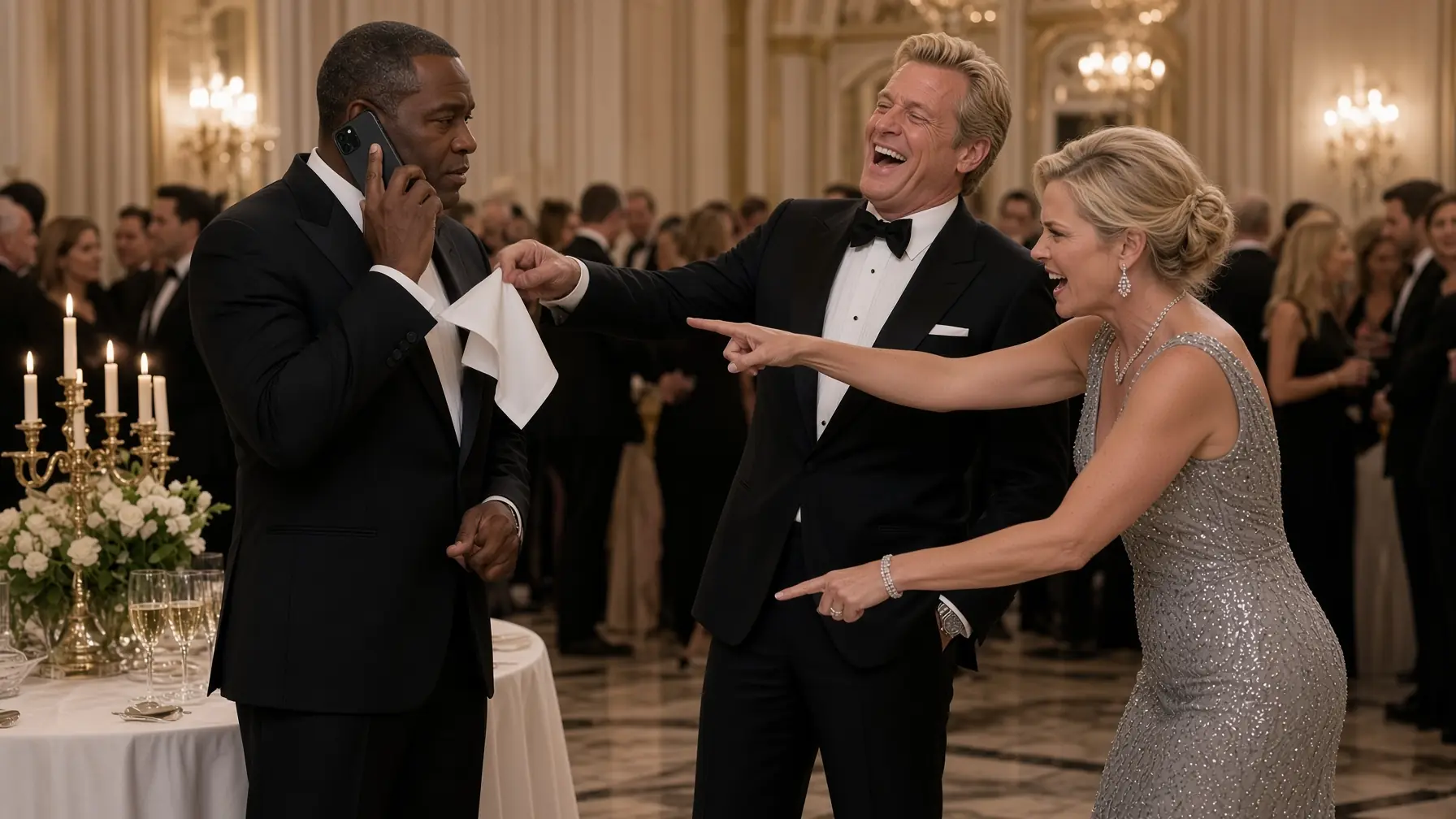
The sentence carried farther than Vanessa Langford intended, far enough to reach the neighboring tables beneath the crystal chandeliers of Manhattan’s Halcyon Grand Hotel. A few guests laughed because Edward Langford III was laughing, and in rooms built around inherited wealth, people often decided what was funny by watching the richest person at the table.
Malcolm Reed looked down at the champagne dripping across the marble near his polished shoes. He was fifty-three, tall, broad through the shoulders, and dressed in a black tuxedo tailored so precisely that anyone looking carefully would have recognized he was not wearing a hotel uniform. Nobody at the Langford table was looking carefully.
Vanessa lifted her empty glass toward him. “Well?”
Malcolm raised his eyes. “Well what?”
“Get someone to clean it.”
Edward smirked. “Or do it yourself. You’re standing right there.”
Several people laughed again.
Malcolm did not.
That bothered Edward more than anger would have.
“You got a problem?” he asked.
“No.”
“Then be useful.”
Malcolm glanced toward the ballroom entrance. His chief legal officer had not arrived yet, nor had the investment-banking team scheduled to join him before the evening’s private presentation.
So he stayed.
Not because he wanted to collect insults.
Because for six months Reed Global Holdings had been considering the largest transaction in its history, a proposed combination with Langford International that advisers valued, depending on stock price and structure, at nearly $150 billion. Malcolm had spent those six months reading financial statements, environmental disclosures, labor reports, antitrust forecasts, litigation schedules, internal audit summaries, and executive-retention agreements.
Something about the Langford organization had bothered him from the beginning.
Not one dramatic scandal.
Patterns.
Too many employee complaints settled quietly.
Too many senior executives who had departed without explanation.
Too many reports describing an unusually centralized family culture in which Edward’s father, Charles Langford Jr., still influenced decisions despite holding no formal operating role.
And now Malcolm was standing six feet from the family itself.
Edward mistook his silence for weakness.
“You deaf?”
Malcolm looked at him.
“No.”
Vanessa laughed. “Then why are you standing there?”
“I was wondering how long you intended to continue.”
Edward leaned back.
The men beside him smiled.
Vanessa said, “Continue what?”
Malcolm adjusted one cuff.
“This.”
Something in his voice made one guest stop smiling.
Edward did not notice.
“You know,” Edward said, “these events used to have standards. Now everybody gets inside if they know somebody.”
Malcolm answered, “That concerns you?”
“It should concern everyone.”
Vanessa looked Malcolm up and down. “What company are you with?”
Malcolm almost told her.
Instead, he asked, “Why?”
“So I know who invited you.”
A younger man at the table laughed into his drink.
Malcolm nodded slowly.
Then Edward said the sentence that changed the evening.
“Honestly, I don’t care who invited him. Somebody tell hotel management their staff shouldn’t be drinking with guests.”
Malcolm looked at the untouched glass in his hand.
Then at Edward.
“You believe I work here?”
Edward spread his hands. “Don’t you?”
“No.”
Vanessa’s smile weakened.
Edward shrugged. “Then congratulations. You’re overdressed and lost.”
A young server standing near the buffet heard the exchange. Her name was Isabel Torres, twenty-seven, and she had been working private events at the Halcyon for almost three years.
She knew Malcolm’s name.
The hotel had received a detailed security and guest list because several corporate leaders attending the gala were internationally recognizable. Malcolm Reed appeared near the top.
Isabel hesitated.
People in hospitality learned early that correcting wealthy guests could cost more than allowing wealthy guests to embarrass themselves.
Malcolm caught her eye.
He gave the smallest shake of his head.
Not yet.
Across the ballroom, Edward resumed talking to two investors about the merger.
“Our family keeps strategic control,” he said. “Reed gets scale, we get access to their infrastructure and Asian markets. Frankly, they need this more than we do.”
Malcolm listened.
One investor asked, “Have you met Reed yet?”
“Not personally.”
“You’re announcing tomorrow without meeting the CEO?”
“My father’s dealt with their people.”
Edward waved dismissively.
“CEOs come and go.”
Malcolm almost smiled.
That answered another question.
The proposed transaction had been described publicly as a merger of equals, although economically Reed Global shareholders would receive slightly more than half the combined company. Malcolm’s board had been uncomfortable with the Langford family’s insistence on disproportionate influence after closing.