A black waitress doing math. That's rich. Richard Sterling laughed, looking at Ivonne like she was a joke. He crumpled the paper with the equation and threw it at her chest. Pick it up. That's what girls like you are here for, right?
His eight guests howled, phones out, recording a young black woman being humiliated for their entertainment. Ivonne bent down, picked up the crumpled paper with shaking hands. Sterling grinned. I'll pay 3 million if you can even read that. But you didn't finish high school, did you? She probably thinks algebra is a pasta dish.
Someone laughed. But then Ivonne looked at the equation. Her hands stopped shaking. She looked up at Sterling and opened her mouth. Three hours earlier, Ivonne pushed through the staff entrance of the crystal room at 6:30 p.m. Just like she had every night for the past 8 months.
8 months of being invisible. The crystal room doesn't advertise. Doesn't need to. $50,000 annual membership waitlist of Fortune 500 CEOs. This is where billionaires close deals over thousand-dollar steaks.
Where senators shake hands with hedge fund managers. Where power eats dinner and where Ivonne Brooks served drinks and stayed quiet. She showed her ID to security, headed to the staff locker room. Vivaldi played through the hallways. Classy, expensive, suffocating locker 23.
She spun the combination. Inside, folded carefully against the metal wall was a torn envelope. Cambridge University. The acceptance letter that arrived 2 years ago. PhD program, pure mathematics, number theory.
She used to look at it every day. Now she tried not to. Next to it, a photo. Her younger brother Tommy grinning in a hospital bed 3 months post surgery. Thumbs up. Alive.
The surgery that cost $183,000. The surgery that saved his life and ended hers. Ivonne closed her eyes. Breathed. She was 28 years old.
She'd been 6 months away from becoming Dr. Ivonne Brooks. 6 months from defending her dissertation at one of the best mathematics programs in the world. And then Tommy collapsed during a pickup basketball game. Rare autoimmune disorder. Experimental treatment not covered by insurance.
The kind of medical emergency that doesn't wait for payment plans. Cambridge paid her 28,000 a year. Good for a graduate student. Useless for a crisis. She'd made the choice in under an hour.
Family first always. The Crystal Room paid $45 an hour plus tips. Working doubles, she pulled 70,000 a year. In two years, Tommy's bills would be paid off. Maybe then she could go back.
Maybe. But every day, Cambridge felt further away. And the equations in her head felt more like ghosts. Robinson, you're on Sterling tonight. Ivonne jumped.
Her manager, Dennis, stood in the doorway with a clipboard. His face was serious. Private dining room, eight guests, very high-profile. Understood. Dennis lowered his voice.
Ivonne, listen to me. Richard Sterling is difficult. He likes games, challenges. Last month, he made a bus boy recite the Constitution for laughs. The month before, he had a server solve a Rubik's Cube while balancing drinks.
Ivonne's stomach tightened. If he starts anything, Dennis continued, just stay professional. Don't engage. Don't react. Let him have his fun and move on. Stay invisible.
That was the rule. That was survival. Got it. Dennis left. Ivonne turned back to her locker.
Tucked in the corner behind her uniform was a worn notebook. Black cover pages filled with equations. Her equations problems she worked on during breaks in bathroom stalls. In the storage room when no one was looking because even though she served champagne, her brain never stopped working.
Modified Collatz variants. Elliptic curve applications, prime distribution patterns, the beautiful, elegant world of pure mathematics, where everything made sense, where she used to belong. She ran her finger over the notebook, then closed the locker. 2 minutes until her shift started.
Ivonne smoothed her black uniform, checked her reflection. Professional, invisible, perfect. She picked up her serving tray, and headed to the private dining rooms. The hallway outside Sterling's room buzzed with energy.
She could hear voices inside. Loud, confident, the kind of voices that never worried about being heard. Through the door, she caught fragments. My R&D team has been stuck on this for over a year. Best PhDs money can buy. Still can't crack it.
10 million in costs and we're nowhere. Ivonne's hand froze on the door handle. R&D team PhDs can't crack it. She knew that language. That was her language.
She shook it off. Not her world anymore. She knocked once, entered. Eight men in custom suits sat around a table covered in crystal and china. The kind of wealth that didn't need to announce itself.
Richard Sterling sat at the head. Mid-50s, silver hair, shirt open at the collar. The kind of confidence that came from never being told no. Ivonne moved silently around the table, setting down the first course. Seared scallops, micro greens, gold leaf.
The men barely glanced at her. She was furniture. Sterling kept talking. The problem combines number theory with cryptographic systems. It's the bottleneck in our new encryption platform.
Solve that and we're looking at a $50 billion market. A younger founder laughed. So your company's future depends on a math problem nobody can solve. Not nobody, just not yet.
Sterling grinned. I'm offering 10 million to whoever cracks it. Stanford's mathematics department is working on it. MIT consulted. Nothing.
Ivonne's hand trembled slightly as she set down the last plate. Number theory, cryptographic systems. That was her dissertation field. She steadied her breathing, and backed toward the door. Will there be anything else, Mr. Sterling?
He didn't look at her. We're fine. She left, closed the door behind her, leaned against the hallway wall. Number theory, cryptography. That was the exact framework she'd spent 2 years developing at Cambridge. 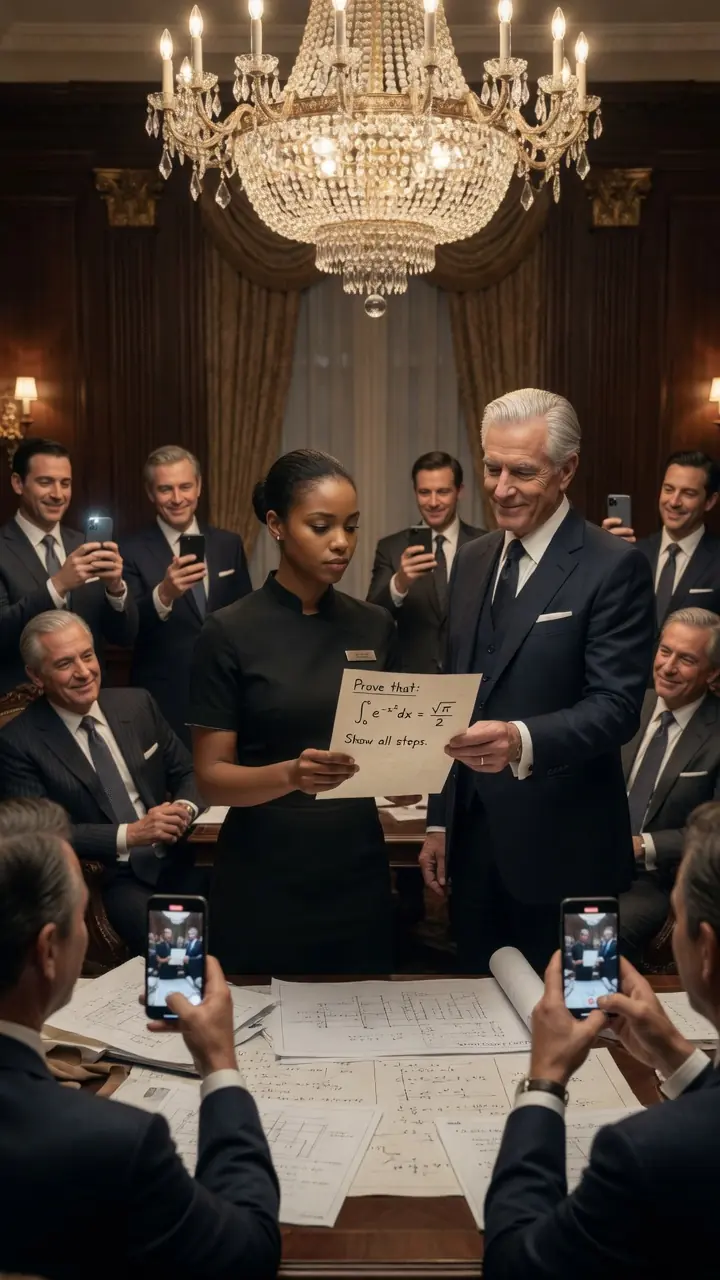
The work that should have made her Dr. Brooks. The research that would have changed her life. And Richard Sterling was sitting in there throwing millions at a problem she might actually understand. Might.
She collected tips. She paid bills. She didn't solve billion-dollar problems. She returned to the kitchen, picked up the second course. When she entered again, the energy had shifted.
Sterling had papers spread across the table. Equations. Dense mathematical notation. This is it, he said to his guests. This is the equation eating my budget alive.
18 months. Best team money can buy. Nothing. Ivonne set down plates of duck confit. Tried not to look at the papers. She failed.
From 3 ft away she could see it. The structure, the notation, the beautiful terrible complexity. And her heart stopped. She knew this problem.
Not similar, not close. This exact problem modified Collatz conjecture merged with elliptic curve theory, prime distribution overlay. This was a variant of her thesis framework, the work she'd presented at Cambridge, the research she'd abandoned. She could solve this right now.
Sterling looked up, noticed her frozen in place, his eyes narrowed, then brightened with something cruel. Wait, he said slowly, a smile spreading across his face. I just had the best idea. Ivonne's stomach dropped.
She knew what was coming. Gentlemen, Sterling announced, setting down his wine. Let's make this dinner interesting. The eight men turned their attention to him, to her, and Ivonne realized her life was about to change.
The eight men turned to look at Ivonne. Sterling stood up slowly, papers in hand, that smile still on his face, the smile of someone who just found a new toy. This young lady has been listening to us discuss the most complex mathematical problem my company has ever faced.
He gestured toward Ivonne like she was part of the furniture. What's your name again? Ivonne's throat went dry. Ivonne, sir. Ivonne.
Beautiful name. His smile didn't reach his eyes. Tell me something, Ivonne. You've been serving us all night, hearing us talk about equations and algorithms. Do you understand any of it?
Every instinct screamed at her to lie, to say no, to escape. But she looked at those papers in his hand, at the equation she recognized. Some, sir. The table went quiet, then erupted in laughter.
Some. Sterling repeated it like he was savoring wine. She understands some of it. Fascinating. He walked toward her, papers still in hand.
Did you go to college, Ivonne? The question was a trap. She could feel it. Some college, sir? Some college?
He turned to his guests. Gentlemen, we have a part-time scholar among us. More laughter. Tell me, Ivonne, where did you study? Community college?
Her jaw tightened. I attended several institutions, sir. Several institutions. How impressive. Sterling was enjoying this now.
Fully performing. And what did you study at these several institutions? Mathematics, sir. The laughter got louder. Mathematics.
One guest nearly choked on his wine. Richard, this is too good. Another guest leaned forward, grinning. Wait, wait.
So, you studied math and now you're serving dinner. That's what happens when you go to community college, someone else added. Great investment.
Sterling held up his hand for quiet. No, no, let's not be rude to our guest. But his eyes were cruel. Ivonne clearly has an interest in mathematics.
Who are we to discourage that? He held out the papers. In fact, I have a proposal. Ivonne's heart was pounding.
This equation here. Sterling tapped the papers. It's cost my company $10 million over 18 months. The best PhDs from Stanford and MIT have been working on it.
The absolute top minds in the field. He stepped closer to Ivonne. But you know what? I'm a generous man, an equal opportunity employer, so I'm going to make you an offer.
His voice dropped to mock sincerity. If you can solve this equation, Ivonne, I will personally write you a check for $3 million right here, right now. The room exploded in laughter.
Richard, you're insane. 3 million for the waitress. This is the best entertainment I've seen all year. A younger founder pulled out his phone.
I'm recording this. This is going viral. Another guest. Does she even know what an equation is?
Sterling ignored them. He was focused on Ivonne. Papers extended. I'm completely serious.
$3 million tax-free. All you have to do is solve one little problem that Stanford's mathematics department can't crack. He pushed the papers closer to her face.
Go ahead, Ivonne. Take a look. Show us what that community college mathematics education can do. More phones came out.
Everyone was recording now. This was going to be everywhere. A young black waitress being humiliated by a billionaire. Viral content, millions of views.
Ivonne's hands were shaking as she set down her tray on the sideboard. Actually, Sterling continued, turning to perform for his audience. Let's make this even more interesting. $5 million.
Because you know what? I believe in supporting education, especially for people who didn't quite make it the traditional route. Richard. She probably can't even read it.
Someone laughed. Another guest. Does she know what calculus is or algebra? Come on.
This is cruel even for you, Sterling. The girl looks like she's about to cry. But Ivonne wasn't about to cry.
She was staring at the papers in Sterling's hand. At the equation she'd spent two years of her life studying. Sterling waved the papers in front of her face.
What's wrong, Ivonne? Numbers not really your thing. That's okay. Not everyone is cut out for intellectual work.
Some people are meant to serve. Nothing wrong with that. A guest laughed. Sterling, give her a calculator.
Maybe she can figure out the tip or a pen and paper. Maybe some crayons. More laughter.
More phones recording. Sterling's voice dropped lower. Here's what I think, Ivonne.
I think you have no idea what you're looking at. I think you said you studied mathematics because it sounded good. But looking at you, he gestured at her uniform, her skin, her entire existence.
Girls like you don't end up solving problems like this. Girls like you end up exactly where you are, serving people like us. The room was howling now, but something had shifted in Ivonne's face.
Her hands stopped shaking. She looked at Sterling. Really looked at him. May I see the paper, sir?
The laughter faltered slightly. Sterling's eyebrows went up in mock surprise. Oh, she wants to see it. Absolutely, Ivonne. Please.
He thrust the papers into her hands. Take your time. We have all night. This should be hilarious.
Ivonne took the papers. Her eyes scanned the equation. Modified Collatz conjecture. Elliptic curve overlay. Prime distribution pattern embedded in residue classes.
This was it. This was her thesis framework. The exact problem she'd abandoned when Tommy got sick. The research that should have made her Dr. Brooks.
The work she dreamed about for 2 years. And Sterling was offering $5 million for the solution. 5 million. Tommy's medical bills paid in full.
Her own debt erased. Money to go back to Cambridge. Money to finish what she started.
All for solving a problem she already knew how to solve. Her heart was racing. The room was watching her, waiting for her to fumble, to admit defeat, to prove them right about who she was and what she was capable of.
Sterling was grinning. Anytime now, Ivonne, or would you like us to explain what those symbols mean? Someone laughed.
Give her a minute. She's probably trying to figure out which way is up. Ivonne's grip tightened on the papers.
She looked up at Sterling and she made a choice. I'll need something to write with. Ivonne's voice was calm. Too calm.
Sterling blinked. What? A pen or a stylus? Do you have a tablet? The laughter in the room shifted. Uncertain now.
Sterling pulled out his tablet, still grinning. Sure, let's see what you've got, sweetheart. He handed it to her like he was humoring a child.
Take your time. Maybe start by identifying which symbols are numbers. More nervous laughter from the guests.
Ivonne set the papers down on the sideboard, took the tablet. Her fingers moved across the screen, opening a note-taking app. The room watched, phones recording, waiting for the punchline.
She looked at the equation one more time, and then she began. Her finger moved across the screen, not hesitant, not searching, fast, confident, like she'd done this a thousand times before, because she had.
The room's laughter started to fade into confused murmurs. Sterling was still smiling, but something flickered in his eyes. Ivonne, you don't have to actually. This is a trap equation, she said quietly, not looking up.
The room went silent. Excuse me? Sterling's smile was frozen on his face. Ivonne's finger kept moving across the screen, writing, numbers flowing.
It's designed to look like a computational problem. That's why your team has been trying to solve it with brute force methods, sequential algorithms, infinite iteration models. One of the guests leaned forward.
What is she talking about? Another guest whispered. Is she actually doing math? Ivonne continued, her voice steady and clinical.
The Collatz conjecture component here. She circled a section on the screen. It's misdirection, a false lead. It makes you think the solution is in the recursive sequences, but that's not where the answer lives.
Sterling's smile was fading. Hold on. Your encryption bottleneck isn't in the algorithm design. It's in your key generation assumption.
Ivonne was writing faster now. Equations appearing on the screen in rapid succession. You're treating this as a sequential convergence problem. You're searching for the solution at infinity.
She looked up briefly, met Sterling's eyes. But this doesn't converge at infinity. It converges at a finite iteration point. A guest in the back, older glasses, quieter than the others, stood up slowly.
Wait, what did you just say? Ivonne didn't answer. She was already writing again. The elliptic curve pattern is hidden in the residue classes.
Most people miss it because they're focused on the Collatz trap. But if you isolate the prime distribution using Tao's modified method, the older guest took a step closer. You know Tao's work?
I attended his lecture series at Cambridge when he presented the 2019 modification. Ivonne's stylus moved faster. His approach to prime distribution in non-standard spaces is the key to unlocking this.
The room had gone completely quiet now. Even the phones had lowered slightly. Sterling was staring at the tablet screen, at the equations flowing from Ivonne's fingers. Cambridge? You went to Cambridge?
Ivonne ignored him. She was in the zone now. The place she hadn't been in 8 months. The place where her mind worked fastest, clearest, brightest.
The recursive function everyone tries to extend to infinity. She was talking faster now to herself as much as to them. That's the second trap. The convergence point is finite.
Specifically, iteration 39. Her fingers flew across the screen. More equations, more proofs, building on each other like a symphony.
Once you recognize that, the encryption key generation becomes straightforward. The elliptic curve collapses to a single solution set based on the 39th iteration convergence point. The older guest was right behind her now, looking over her shoulder at the tablet.
His face had gone pale. My god, she's right. The convergence point. We've been searching in the wrong space.
Who the hell is this? Someone whispered. Another guest. Sterling? What's happening? But Sterling wasn't answering.
He was staring at Ivonne like he was seeing her for the first time. Ivonne continued writing, her hand completely steady now. No tremor, no hesitation.
The bottleneck in your encryption system happens because you're generating keys across an infinite search space. But if you limit the space to the 39th iteration convergence, more writing faster, and apply the elliptic curve reduction using the residue class pattern, she was building the proof step by step.
Each line following inevitably from the last. The kind of mathematical elegance that only came from deep understanding. The kind of work that took years to develop.
The solution set reduces to a single value through modular arithmetic. Final stroke of the stylus. Ivonne looked up from the tablet. -39.2 recurring.
That's your encryption seed constant. Applied through the modified elliptic curve framework I just outlined. It will eliminate your bottleneck completely. She held out the tablet to Sterling.
Your team was solving the wrong problem. That's why they failed. Total time elapsed. 53 seconds.
The room was frozen. Eight billionaires collectively worth tens of billions of dollars staring at a black waitress holding a tablet like it contained the secrets of the universe. Because it did.
Sterling's hand shook slightly as he took the tablet. His eyes scanned the screen. The equations, the proofs, the elegant, inevitable mathematics flowing across it.
His face went from confident to confused to something that looked like fear. This is. You can't just. The older guest grabbed the tablet from Sterling's hands.
Let me see that. He studied the screen intensely, his finger scrolling, checking her work, his eyes moving faster and faster. Jesus Christ, he whispered.
What? Another guest stood up. What is it? The older man looked up at Ivonne. Who are you?
A waitress, someone muttered. But it sounded hollow now. Ivonne met the older man's eyes. I was a PhD candidate at Cambridge, pure mathematics, number theory specialization.
I focused on modified Collatz variance and elliptic curve applications in cryptographic systems. The second wave of shock hit the room even harder than the first. You were a PhD candidate at Cambridge?
Sterling's voice cracked. Then what the hell are you doing here? My younger brother needed emergency surgery, $183,000. The Cambridge stipend was $28,000 a year.
Ivonne's voice was steady. Matter of fact, I needed money immediately. This job pays more, so I made a choice. The room absorbed that, the weight of it.
The older guest was shaking his head, still staring at the tablet. Sterling, Richard, look at this. What? Sterling's voice was hoarse.
She didn't just solve your problem. She identified the fundamental flaw in your entire approach. He turned the tablet around, showing the screen to the room.
Your team has been trying to solve this computationally for 18 months. She just proved that computational approaches will always fail. You need an analytical solution, which she just provided.
He looked back at Ivonne with something like awe. This is doctoral level work. Beyond doctoral, this is publishable. Another guest pulled out his phone, started typing frantically.
I'm sending this to my quant team right now to verify. Don't, the older guest said sharply. Not until we confirm it's correct.
It's correct, Ivonne said quietly. Everyone turned to look at her. How do you know? Sterling asked.
Because this was my dissertation topic. I spent two years developing this exact framework at Cambridge. The equation you showed me is a variant of the problem I was researching before I left.
She gestured to the tablet. I didn't solve your problem just now. I applied research I'd already completed. The room went silent again.
A different kind of silence. The silence of people realizing they'd made a terrible mistake. Sterling was staring at her. You left Cambridge 6 months before finishing.
Yes. For your brother. Yes. And you've been working here for 8 months. Sterling sat down heavily like his legs couldn't hold him anymore.
The younger founder who'd been recording whispered, Holy shit, we just watched a genius solve an impossible equation while we mocked her. Another guest, red-faced, couldn't meet Ivonne's eyes.
I'm sorry. What I said was. But Ivonne wasn't looking at him. She was looking at the older guest still holding the tablet.
You can verify the solution if you want, she said, but it's correct. The 39th iteration convergence point is the key. Everything else follows from that.
The older man nodded slowly. I believe you. But I'm going to verify anyway because if you're right, and I think you are, this is revolutionary.
He pulled out his laptop from his briefcase, started typing, pulling up verification software, mathematical databases, academic papers. The room watched him work, watched his face, watched his expression cycle from skepticism to shock to something approaching disbelief.
Sterling, he said, his voice tight. Do you know who I am? Of course. Dr. William Foster, Stanford mathematics department.
Right. And I've been consulting on your encryption problem for 6 months. Dr. Foster looked up from his laptop. His hands were shaking.
I've got three PhD students working on this full-time. We've published 40 papers between us. I've been studying number theory for 30 years.
He turned the laptop screen toward the room. She's right. Completely perfectly mathematically right. The room exploded.
That's impossible. She's a waitress. How could she? Quiet. Dr. Foster's voice cut through the chaos.
Everyone shut up right now. Silence fell. Dr. Foster stood up. Walked directly to Ivonne.
What's your full name? Ivonne Brooks. Ivonne Brooks. Who was your adviser at Cambridge? Professor Sarah Mitchell, number theory.
Dr. Foster pulled out his phone, started typing. I'm calling Sarah right now. I know her. We've published together.
He put the phone on speaker. It rang three times. William, it's midnight here. What?
Sarah, quick question. Did you have a PhD student named Ivonne Brooks? Number theory. Left about 8 months ago.
A pause then. Yes. Brilliant student. One of the best I've ever supervised. She left for a family emergency. Why?
Dr. Foster looked at Ivonne, then at Sterling. Because I just watched her solve a problem in 60 seconds that's been stumping me for 6 months. Another pause. Longer this time.
That sounds like Ivonne, Professor Mitchell said softly. She was always the smartest person in any room. Most people just didn't notice.
Dr. Foster ended the call. The room was dead silent. He turned to Sterling. You owe her $5 million.
$5 million? The number hung in the air like smoke. Sterling was still sitting, staring at nothing. His face had gone completely blank.
Dr. Foster turned to him. Richard, you offered $5 million in front of eight witnesses. She solved it. I. Sterling's voice came out strangled.
I need to verify. I just verified it. Dr. Foster held up his laptop, triple checked. Her solution is mathematically sound.
It's more than sound. It's elegant. It's the kind of work that gets published in top journals. A younger guest stood up.
Wait, hold on. This is insane. She's a waitress. How do we know she didn't just get lucky? Just say random numbers.
Dr. Foster spun his laptop around. Does this look like luck to you? She identified the exact flaw in our methodology. She pinpointed why computational approaches fail.
She provided a closed form analytical solution with full proof. That's not luck, that's mastery. But she did it in 60 seconds, someone protested weakly.
53 seconds, Ivonne corrected quietly. Dr. Foster nodded. Because she'd already done the work at Cambridge for 2 years. This isn't new research for her.
This is her doctoral thesis. Sterling finally found his voice. But but my team, Stanford PhDs, 18 months, they couldn't.
Your team was solving the wrong problem. Dr. Foster interrupted. They were using the wrong approach, trying to brute force a solution that requires analytical elegance.
Miss Brooks just showed them, showed all of us what we were missing. He turned back to Ivonne. The 39th iteration convergence point. How did you identify that?
It's embedded in the elliptic curve coefficients, Ivonne said. Most people assume Collatz variants converge at infinity because that's standard. But this variant has a finite convergence point hidden in the prime distribution pattern.
Once you see it, everything else becomes straightforward. Dr. Foster was nodding like a student taking notes. Tao's modification. You applied his 2019 framework.
It was the only approach that made sense. Standard methods don't work for non-standard prime distributions. Tao's modification accounts for the irregularities.
Another guest, the one who'd made the calculus on the menu joke, was staring at his phone. I just Googled her. There's a Ivonne Brooks listed on Cambridge's mathematics department website.
PhD candidate left the program 8 months ago. He looked up. His face was red. It's her. She's real.
She 's. The room absorbed that. Sterling stood up slowly, walked to where Ivonne stood, looked at her like he'd never seen her before.
You're really her. You're really a Cambridge mathematician. I was, Ivonne said simply. Now I'm a waitress.
Because of your brother, because I needed money to save his life. Yes. Sterling's face cycled through emotions. Confusion. Embarrassment.
Something that might have been shame. Dr. Foster, he said, not taking his eyes off Ivonne. You're absolutely certain her solution is correct.
I'm running a fourth verification right now. Dr. Foster's fingers flew across his keyboard. But yes, Richard, I'm certain this solution works.
It's brilliant. It solves your encryption bottleneck completely. He pulled up another screen. I'm checking it against the Stanford team's latest attempt.
Look, they were trying to extend the convergence to infinity. Exactly what Miss Brooks said. They were in the wrong space entirely.
A guest leaned over and looked. So, she didn't just solve it. She proved that our entire approach was doomed from the start. Exactly. Dr. Foster confirmed.
Another guest, older in a Navy suit. Sterling, do you understand what this means? She just saved you what? Another year of R&D costs another 10 million more.
Dr. Foster said, with this solution, Sterling Technologies can launch their encryption platform within months instead of years. That's a market window worth hundreds of millions. The room went quiet again, everyone looking at Ivonne, at the young black woman in a waitress uniform who just casually solved a problem worth more than most people would see in their lifetimes.
Sterling's hands were shaking. I need to sit down. He sat, put his head in his hands. The younger founder who'd been recording was staring at his phone screen.
This is. This is the most insane thing I've ever filmed. Delete it, Dr. Foster said sharply. What?
Delete the recording right now. But this is viral gold. Delete it. Dr. Foster's voice was hard.
Miss Brooks just solved a proprietary problem. That solution is worth millions. If you post that video, you're exposing trade secrets. Sterling will sue you into the ground.
The founder hesitated, then deleted the video. Fine, but holy shit. Another guest pulled out his phone, started typing.
I'm texting my CTO. He's been working on a similar problem. Maybe Miss Brooks could. Don't, Ivonne said.
Everyone looked at her. Don't what? The guest asked. Don't offer me consulting work. Don't send me problems.
Don't treat me like I'm available for hire. Her voice was calm but firm. I just solved Mr. Sterling's problem. He offered $5 million.
That's the transaction. Dr. Foster was watching her with something like respect. You're not interested in more work. I'm interested in finishing my PhD, in getting my life back, in being Dr. Ivonne Brooks instead of Ivonne the waitress.
She looked around the room. $5 million gets me there. That's all I need. Sterling looked up. 5 million?
Right. I said that. You did? Dr. Foster confirmed. In front of everyone.
Sterling pulled out his phone. His hands were still shaking. What's your bank account number? Ivonne recited it, watched him type it into his banking app.
The room was absolutely silent. Everyone watching Sterling's thumb hover over the transfer button. He looked up at Ivonne one more time.
I humiliated you tonight. Yes, I threw paper at you, made you pick it up, called you stupid. His voice was hollow. Said you belonged in the kitchen, that girls like you don't end up at MIT.
Yes. And you just solved the biggest problem my company has ever faced. Yes. Sterling's thumb pressed the button.
Transfer initiated. $5 million. You'll see it in your account in about 30 seconds. Ivonne's phone buzzed in her pocket almost immediately.
She pulled it out, looked at the screen. Transaction alert. Deposit $5 million. Her hands were shaking now. Really shaking.
$5 million. Tommy's medical bills paid. Her student debt gone. Money to go back to Cambridge.
Money to finish her PhD. Money to become Dr. Brooks. $5 million for 53 seconds of work.
She looked up from her phone and found eight men staring at her. Not like furniture anymore. Not like entertainment. Like they were seeing her for the first time.
Dr. Foster was the first to move. He stood up, looked at Ivonne, and slowly, deliberately began to clap. The applause started slow. Dr. Foster's hands coming together once, twice, three times.
Deliberate, respectful, the kind of applause you give a colleague, an equal, a genius. Then the older guest in the Navy suit stood, joined the clapping, then another, then another. Within 10 seconds, all eight men were on their feet.
The sound built, grew, filled the private dining room like a wave. Not polite applause, not obligatory. This was genuine, overwhelming, almost desperate.
The applause of people who just witnessed something they couldn't explain, something that broke their understanding of the world. Ivonne stood there, phone in hand, transaction alert glowing on the screen, and felt something crack open inside her chest.
Eight months of being invisible, eight months of serving people who looked through her. Eight months of hiding who she was, what she could do, what she'd sacrificed. And now they were applauding her.
She wouldn't cry. She wouldn't give them that. But her throat was tight. The applause continued, swelled.
Someone whistled. Dr. Foster was smiling. A real smile full of admiration. Miss Brooks, that was extraordinary.
Sterling was still sitting, the only person not clapping. He was staring at Ivonne with an expression somewhere between shock and something that might have been understanding. Finally, he stood.
The applause died down as everyone turned to look at him. He walked toward Ivonne slowly, stopped a few feet away. $5 million, he said quietly. That's what I offered.
Ivonne nodded. But that's not what this is worth. Sterling's voice had changed completely. The performative confidence was gone.
What remained was raw. You just solved my company's biggest technical problem. The solution you provided will unlock our next generation encryption platform that's worth conservatively 50 million to my business.
He paused, swallowed hard. 5 million doesn't cover what you just did. The room went quiet again.
Dr. Foster stepped forward. Richard's right. Miss Brooks, what you just did isn't just problem solving. This is breakthrough work.
This needs to be published. A guest spoke up. You are 6 months from finishing at Cambridge. I can make calls, get you reinstated. Full funding.
Another guest. My company is hiring research mathematicians. Triple your salary here plus equity. Princeton's institute would want to hear about this work.
Someone else offered. Sterling raised his hand. Wait, everyone, wait. The room quieted.
He turned to Ivonne. I want to offer you a position. Chief innovation officer at Sterling Technologies. 500,000 base salary plus equity plus performance bonuses.
Someone whistled. That's a serious offer. She deserves it, Dr. Foster said firmly. Sterling continued.
You'd lead our R&D division. Work on real problems, problems that matter. He paused. Help me fix what's broken, not just the math, the whole system.
Ivonne studied him. What do you mean? I mean, I humiliated you tonight because I thought wealth proved intelligence.
I thought success meant I could identify genius. I thought I'd earned the right to judge people. He gestured at the tablet.
You just proved I'm an idiot with blind spots the size of Manhattan. The guest who'd made the community college joke stood up. His face was red.
Miss Brooks, I need to apologize. What I said was inexcusable. I was cruel and stupid and completely wrong. Another guest.
I'm sorry, too. We judged you based on your uniform, your job. We didn't see you. More murmurs of agreement, shame settling over the room.
But Ivonne wasn't interested in their shame. She was interested in what came next. Mr. Sterling, she said clearly. You said 5 million wasn't enough.
What exactly are you proposing? Sterling straightened. Keep the 5 million. That's yours.
But on top of that, the chief innovation officer position and one more thing. He pulled out his phone, started typing. I'm creating a new program, $10 million endowment.
Scholarships for people working service jobs who want to pursue advanced degrees, full tuition, living stipend, job flexibility, mentorship. He looked up. You'd help me run it.
Find more people like you. People whose brilliance is invisible because they're too busy surviving. Dr. Foster nodded enthusiastically. I'll contribute.
Stanford will want a partner on this. Another guest. My foundation will match Sterling's 10 million.
The younger founder will create a tech track, fund people studying computer science, engineering, mathematics. Ivonne watched this unfold.
These powerful men trying to fix in 5 minutes a system they'd benefited from their entire lives. It was something. Not enough, but something.
I'll consider your offers, she said finally. But I need time to think. She set her phone down, picked up her serving tray, then deliberately set it back down on the table.
And I'm taking the rest of the night off. Sterling actually smiled. Not cruel, almost humble. Of course. Take as long as you need.
Dr. Foster stepped forward. Miss Brooks, before you go, your dissertation, is it documented? Most of it. I have notes, partial drafts.
I want to help you publish it. Co-author if you need support or just advise. His voice was earnest. The world needs to see this work.
Ivonne nodded slowly. I'll think about that too. She walked toward the door, hand on the handle. Miss Brooks.
She turned. Sterling was standing, looking smaller somehow, less certain. What you did tonight? It wasn't just solving an equation.
You taught me something about seeing people. Really seeing them. Ivonne looked at him for a long moment.
Mr. Sterling, I didn't do this to teach you a lesson. I did it because you offered $5 million and I needed the money. Her voice was calm. Matter of fact.
If you actually learned something, if you actually change, that would mean something. She pulled open the door. The world is full of people like me, brilliant people doing survival jobs because the system doesn't see them.
She paused. If you really want to fix what's broken, don't just throw money at programs. Change how you see people. Change who gets opportunities.
Change the assumptions. Her voice softened slightly. I shouldn't have had to solve an equation to be seen as human. Remember that.
And she walked out. Behind her, the room sat in stunned silence. Then slowly the applause started again, softer this time, more thoughtful.
The sound followed her down the hallway. The sound of eight powerful men realizing they'd almost missed the most brilliant person they'd ever meet because she was serving their dinner.
Ivonne made it halfway down the hallway before her legs started shaking. She leaned against the wall, phone clutched in her hand, staring at the screen. Transaction alert. Deposit $5 million.
$5 million. Tommy's medical bills paid in full. Her student debt erased. Money to go back to Cambridge.
Money to finish what she started. Money to become Dr. Ivonne Brooks. She'd done it. She'd actually done it.
Her phone rang. Tommy's name flashing on the screen. She answered. Tommy? Ivonne? You okay? It's almost 11. You never call this late.
Tommy. Her voice cracked. Tommy, I need to tell you something. What's wrong? Nothing's wrong.
Everything just changed. She told him all of it. The equation, the humiliation, the solution, the $5 million.
Her words tumbling out. Eight months of being invisible suddenly breaking open. Tommy was silent for a long moment.
You solved it in 60 seconds. 53. My sister's a freaking genius. Ivonne laughed. Actually laughed for the first time in 8 months.
Your sister just got very, very lucky. No, my sister is brilliant. I always knew that. His voice got serious.
Now some racist billionaire knows it too. They talked for five more minutes. Ivonne told him about the job offer, about Cambridge, about the possibility of going back.
You're finishing your PhD, Tommy said firmly. You're going to be Dr. Brooks. Promise me. I promise.
Good. Now go tell them. Yes. Go get your life back.
Ivonne ended the call, took a deep breath, steadied herself. Her manager, Dennis, appeared at the end of the hallway. His eyes were wide.
Ivonne, what the hell just happened? Sterling's assistant came out and said, you solved some equation for $5 million. She nodded.
Holy. Dennis ran his hand through his hair. Are you serious? 5 million? Yes.
Jesus Christ, Ivonne, I had no idea you were. Nobody did. That was kind of the point.
Dennis looked at her differently now, like he was seeing her for the first time. Sterling just called the owner. He's donating 50,000 to establish a continuing education fund for our staff.
Anyone who wants to pursue degrees gets full support. Ivonne felt something warm in her chest. He'd actually started, actually begun changing things.
That's good, she said. That's really good. Dennis shook his head in disbelief. You did that?
You changed his mind about all of us. Maybe. Her phone buzzed. Text message. Unknown number.
Miss Brooks, this is Dr. William Foster from tonight. I meant what I said about Cambridge. I'm on the faculty advisory board. I can have you reinstated within a week.
Full funding. Please consider it. The world needs your work. WF? Another buzz. Different number.
Ivonne, this is Richard Sterling. Take all the time you need to think, but know my offer stands. We'll be better with you leading us. RS.
More texts coming in. Offers. Congratulations. Recognition. Ivonne silenced her phone, put it in her pocket.
Dennis, I'm taking the rest of tonight off and probably tomorrow. I have some thinking to do. Of course. Take whatever time you need.
He paused. Ivonne, I'm sorry for not seeing you, for not asking questions, for letting you stay invisible. You are doing your job.
I understand that better than anyone. She walked toward the staff exit out into the cool Manhattan night. The city lights felt different now, brighter, full of possibility.
Her phone kept buzzing in her pocket. More messages, more offers, more people wanting a piece of what just happened. But Ivonne didn't check them.
Tonight, she just wanted to walk, to process, to feel what it was like to be seen after eight months of invisibility, to remember what it felt like to be Dr. Ivonne Brooks again, or almost Dr. Brooks.
But soon, very soon, she smiled, actually smiled, and kept walking into the Manhattan night, $5 million richer and infinite possibility ahead. Behind her, in that exclusive dining room, eight powerful men were probably still talking about what just happened, about the genius they almost missed, about the black waitress who changed everything.
But Ivonne wasn't thinking about them anymore. She was thinking about Cambridge, about her dissertation, about finishing what she started, about becoming who she was always meant to be, the smartest person in the room, finally visible, finally free.
4 months later, Dr. Ivonne Brooks sat in her corner office at Sterling Technologies. The name plate on her door was new, shiny, real, chief innovation officer. But the office was just the beginning.
Through her window, she could see the R&D floor. 50 brilliant minds working on cutting-edge problems. And among them, four people who used to work service jobs.
A former janitor who turned out to have a gift for computational modeling. A hotel receptionist with an intuitive understanding of cryptographic systems. A delivery driver who taught himself advanced calculus on YouTube.
A bartender who could visualize four-dimensional geometry in her head. The Hidden Genius Initiative had launched 3 months ago. 10 million from Sterling. 10 million matched by Dr. Foster's foundation.
Full scholarships, flexible work arrangements, mentorship programs. 43 people enrolled in the first wave. Janitors, drivers, cashiers, servers, people with hidden brilliance finally given the chance to use it.
Ivonne had kept her promise to Tommy. She'd gone back to Cambridge, defended her dissertation remotely. The work she'd started two years ago finished in six weeks of focused intensity. Dr. Ivonne Brooks.
Finally, her solution to Sterling's encryption problem had been published in the Journal of Number Theory, co-authored with Dr. Foster, already cited over 200 times. Her work was changing how cryptographers approached elliptic curve applications.
Tommy had finished his freshman year, healthy, thriving, full scholarship to MIT. He called every week to tell her about his classes, about his life, about how proud he was.
The medical bills were paid, all of them. With money left over, money to breathe, money to choose, money to build the life she'd dreamed of. But the real change was bigger than her.
Sterling Technologies had transformed its hiring practices. Blind technical assessments, problem-solving challenges open to anyone, opportunities for people who'd been invisible.
The story had gone viral, not the humiliation. The videos had been deleted. But the outcome, waitress solves billion-dollar problem, became a case study.
Universities changed recruitment. Companies looked beyond pedigree. And Ivonne, she returned to the Crystal Room once a month, not as staff, as guest speaker for initiative recruitment events.
Standing in that same private dining room where Sterling had humiliated her, talking to service workers about hidden potential, about taking chances, about believing in their own brilliance. Today was one of those days.
She stood at the front of the room, 20 service workers sitting at the table where billionaires used to eat, listening, hoping. Four months ago, I was serving dinner in this room, Ivonne said.
A billionaire threw paper at me, made me pick it up, called me stupid, and then handed me a problem he thought I couldn't solve. The room was silent, attentive. I solved it in 53 seconds.
Not because I'm special, but because I'd already done the work. Years of work. Work nobody saw because I was too busy surviving.
She paused. The point isn't that I'm brilliant. The point is that brilliance is everywhere. In this room, in every restaurant, every hotel, every store.
The question isn't whether it exists. The question is whether we see it. A young man in a janitor's uniform raised his hand.
Dr. Brooks, I've been reading about number theory on my breaks, but I never finished high school. Can I still apply? Ivonne smiled, walked over to him.
What's your name? James, ma'am. James, let me tell you something important.
She pulled out an application form. This program exists for people exactly like you, and I'm going to personally sponsor your enrollment. His eyes went wide because 4 months ago, I was you, invisible, brilliant, waiting.
She handed him the form. The world is full of hidden geniuses. You just have to see them.
And in that moment, watching James's face light up with possibility, Ivonne understood this was the real victory. Not the money, not the position, not even the PhD. This passing it forward, making sure the next hidden genius didn't have to wait as long. The genius was always there.