A Billionaire Mocked a Black Nurse During Dinner — Until His Bodyguard Saw the Scar and Froze
Chapter 1
Reader Theme:
Font Size:
24px
What the hell is that smell? He shoved back from the table, napkin over his nose, glaring at the Black woman in the white dress.
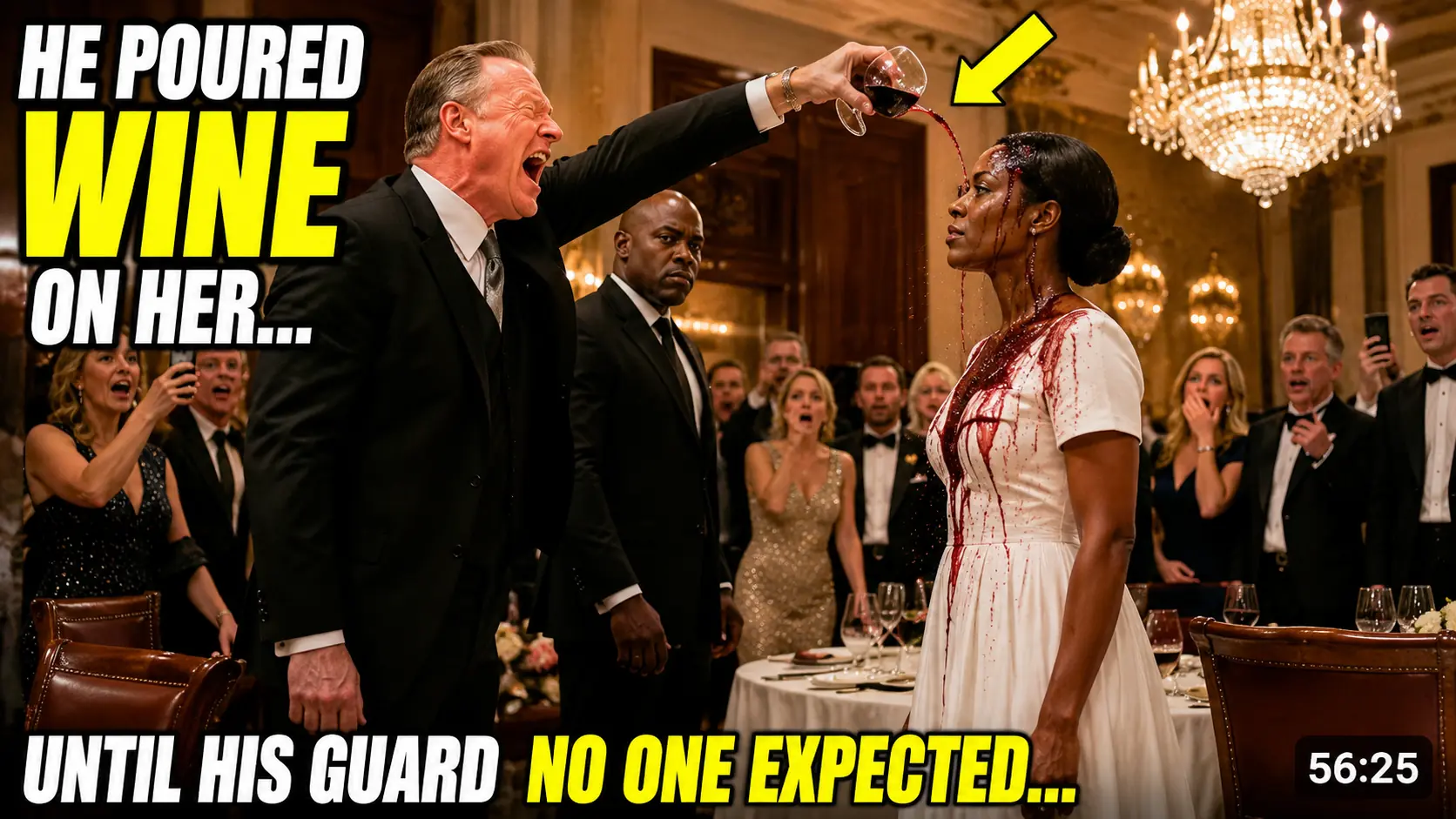
“Bleach and poverty. Who are you?”
“Audrey, sir. I’m a nurse.”
“A nurse? From some sewage drain they call a clinic?” He waved at her dress. “A hospital rag? Did you dig it out of a trash bag?”
“No, sir.”
“Shut your mouth.” He shoved her plate off the table. It shattered on marble. “Filthy hands on my silverware. Get out.”
She flinched, stepped back. Her fingers found the burn scar on her forearm. Behind him, his bodyguard saw it and went still. He knew that scar. What he didn’t know was how to tell his boss the truth without destroying him.
Audrey Underwood woke up the same way she had for the past six years—to the sound of a leaking faucet and a daughter who talked in her sleep. 5:14 in the morning. The alarm hadn’t gone off yet. It never needed to. Her body knew the rhythm. Roll left. Feet on cold linoleum. Avoid the floorboard that creaked near the bathroom door. She moved through the dark like a woman who had memorized every crack in her own life.
The apartment sat on the third floor of a building that should have been condemned twice. The hallway smelled like mildew and someone else’s cooking. The elevator hadn’t worked since March. But the rent was $480 a month, and in South End, that was a miracle. She brushed her teeth with the faucet barely open. The pipes groaned if you turned them too far. She pulled on her scrubs—the same three sets she rotated every week, washed by hand on Sundays because the laundromat charged $2.75 a load and that was bread money.
Lily was still asleep. Ten years old, long braids fanned across a pillow that was losing its stuffing. Audrey pulled the blanket up to her chin, pressed her lips to the girl’s forehead, and whispered what she whispered every morning. “We’re going to be okay.” She didn’t always believe it. But she always said it.
The walk to Mercy Hill Clinic took 22 minutes if she cut through the park. She passed the same corners—Mr. Coleman sweeping his barber shop steps before dawn, the bodega with the crooked awning, the mural of a woman holding a child that someone had painted on the side of a laundromat ten years ago and nobody ever painted over. South End wasn’t pretty. But it was hers.
Mercy Hill sat between a shuttered hardware store and a church that held services in Spanish on Sundays. The sign out front had a cracked letter. It read “Mary Hill Clinic” now, and nobody had the budget to fix it. Inside, the walls were clean but bare. The chairs in the waiting room didn’t match. The blood pressure machine was held together with tape and faith. But Audrey loved it.
She loved the way Mrs. Patterson brought tamales every Thursday even though she couldn’t pay her bill. She loved the way the Rodriguez kids drew pictures on the back of intake forms. She loved the way Dr. Hayes—63, bad knee, who could have retired a decade ago—still showed up at 7:00 sharp every single morning because he said these people deserved a doctor who looked them in the eye.
That morning, Dr. Hayes didn’t look anyone in the eye. He called Audrey into his office, closed the door, sat behind his desk with his hands folded the way people fold them when they’re about to say something that hurts. “We’ve got three months, Audrey.” “Three months until what?” “Until the funding runs out. The county cut our grant. The state’s redirecting to two larger clinics uptown.” He pulled off his glasses, rubbed his eyes. “We serve 1,100 patients a quarter. They know that. They just don’t care.”
Audrey didn’t sit down. She stood with her arms crossed, fingers resting on the burn scar the way she always did when something hit too hard. The scar was a map of raised tissue that ran from her right wrist to just past her elbow. She never covered it. Never explained it unless someone asked. And almost nobody asked. “So what do we do?”
Dr. Hayes opened a drawer, pulled out two thick envelopes—ivory, gold trim. The kind of paper that cost more than Audrey’s grocery bill. “These came last week. The Sterling Gala, hosted by the Holloway Foundation at the Grandview Hotel downtown. Black-tie charity event for community health programs.” He slid one across the desk. “They invited every small clinic in the district. I think they’re looking for tax write-off stories, honestly. But if we show up, shake the right hands, maybe we get on someone’s radar.”
Audrey picked up the envelope. It smelled like cologne and old money. “Black tie,” she said. “I know. I don’t own anything black tie.” “You don’t have to. You just have to show up and be you. That’s more than most people in that room can say.”
That night, Audrey stood in front of her closet, which was really just a metal rack behind a curtain, and pushed through the hangers. Scrubs. More scrubs. A hoodie. A church blouse. And in the back, wrapped in a plastic garment bag that had yellowed at the edges, a white dress—simple, cotton, A-line cut that fell just below the knee. Her mother had sewn it by hand on a Singer machine that sounded like a small motorboat the year before she passed. The hem was slightly uneven. One seam near the waist had been re-stitched twice. There was a faint discoloration near the left shoulder where Audrey had tried to bleach out a stain years ago and almost ruined the whole thing. But when she held it up to the light, it still looked like what it was. A dress made by someone who loved her.
She pressed it to her chest and closed her eyes. “Mama,” she said to no one, “I hope this is enough.” She didn’t know yet. She couldn’t. That one white dress was about to walk into a room full of black suits, and nothing would ever be the same.
The Grandview Hotel sat on the corner of 5th and Monroe like a cathedral made of glass and money. Audrey had driven past it a hundred times on her way to the pharmacy, the grocery store, the clinic. She had never been inside. She had never had a reason to be. Tonight was different. She parked three blocks away because the valet line was filled with cars that cost more than her apartment building—a black Escalade, a silver Bentley, a pearl-white Porsche with a license plate that read “Earn It.”
She locked her 15-year-old Honda Civic and checked the mirror one more time. The white dress fit the way it always had—snug at the waist, loose at the shoulders, hemline brushing just below the knee. She had ironed it twice, steamed the collar with a kettle because she didn’t own a steamer. Her shoes were borrowed—black flats from her neighbor Rosa, half a size too big, stuffed with tissue at the toes. She looked fine. Not glamorous. Not striking. Fine. And for tonight, fine would have to be enough.
Dr. Hayes was waiting at the entrance in a suit he hadn’t worn since his daughter’s wedding. The lapels were slightly too wide for the decade. His tie had a small coffee stain near the knot that he’d tried to cover with a pin. “You look nice,” he said. “You’re a terrible liar,” Audrey said. But she smiled. They walked in together.
The lobby hit her like a wall of light. Crystal chandeliers—not one, not two, but a cascade of them running the length of the ceiling like frozen waterfalls. The floor was marble so polished she could see her own reflection staring back up at her. Waiters in white gloves carried trays of champagne in glasses taller than Lily’s juice cups. The air smelled like orchids and leather and something she couldn’t name—the particular scent of places that didn’t want people like her.
She felt it immediately. The looks. Not hostile. Worse. Dismissive. Eyes that landed on her dress, calculated its value in under a second, and moved on. A woman in an emerald gown glanced at Audrey’s borrowed flats and turned back to her conversation without breaking her sentence. A man with a pocket square that probably cost more than Audrey’s weekly paycheck stepped slightly to the left as she passed, as if proximity itself was a risk.
Audrey’s hand drifted to her right forearm. The scar. She pressed her thumb into the thickest ridge, the one just above the wrist, where the skin had melted and reformed into something that looked like a river delta on a map. It was her reset button. Her way of reminding herself that she had walked through worse than a room full of strangers who didn’t want her there. She had walked through fire.
“Table nine,” Dr. Hayes said, reading the card a hostess had handed him. “That’s us.” Table nine was center stage—round, ten seats, white lilies in a crystal vase, three forks per setting. Audrey had never seen three forks at a single place setting in her life. She picked up the smallest one and put it back down like it might break.
Four people were already seated. A woman in red silk who didn’t look up. A couple in matching navy who nodded politely but said nothing. And at the head of the table—even though it was a round table, you could tell there was a head—a man in a black suit. Perfect black suit. Not a wrinkle. Not a thread out of place. Silver cufflinks that caught the chandelier light like tiny mirrors. A watch on his left wrist that was thick and gold and deliberate. The kind of watch that didn’t tell time so much as announce it. His hair was steel gray, swept back with the kind of precision that came from a barber who charged by the minute. His jaw was square. His posture was authority itself. Garrett Holloway.
Audrey didn’t know his name yet. She would. She sat down, smoothed her white dress over her knees, placed her hands in her lap, smiled at no one in particular, and waited for the evening to begin. She didn’t notice the man standing six feet behind Garrett’s chair. Black suit, earpiece, hands clasped at his waist. A bodyguard. Tall, broad-shouldered, face like carved stone. Cole Bennett. He didn’t smile. He didn’t talk. He watched. And right now, he was watching Audrey. Not her face. Not her dress. Her right forearm, where the sleeve of the white dress ended and the scar began. His eyes locked on it the way a soldier’s eyes lock on a tripwire. His pulse ticked up. His fingers uncurled. Eight years. A highway. A fire. He blinked hard and looked again.
But what he didn’t know yet—what no one in that room knew—was that the man Audrey had pulled from the flames that night shared a last name with the man who was about to ruin her evening.
The first course arrived on plates so white they looked surgical. Pan-seared scallops on a bed of microgreens with a drizzle of something gold. Audrey didn’t touch hers. Not because she wasn’t hungry—she hadn’t eaten since the granola bar she’d split with Lily that morning—but because she wasn’t sure which fork to use. And she wasn’t about to guess wrong in front of these people. Dr. Hayes leaned over. “The small one,” he whispered. She picked it up. Her fingers were steady.
That was when Garrett Holloway looked at her for the first time. Really looked. His eyes started at the top of her head, moved down to her white dress, paused at her shoes, and came back up with the kind of expression a man gives a stain on his favorite couch. “I don’t think we’ve met.” His voice was smooth, polished, the way a blade is polished. “And I make a point of knowing everyone at my table.”
News in the same category
The Officer Slammed a Black Visitor Into the Wall — Then He Mentioned Tomorrow’s Ceremony
He Mocked His Wife as a “Simple Florist” in Court — Then the Judge Asked One Question

He Threw Her Son to the Mat — Then Blocked the Mother From Taking Him Home
The HOA Woman Snatched His Federal Mail — Then the Carrier Said One Sentence That Changed Everything

The Officer Threatened to Drag Her Out of Her Truck — Then He Snatched Her Phone

The Deputy Smashed Her Bentley Windows — Then Found Something in the Trunk

Two Winters Later, Four Rescued Dogs Are Still Waiting for Someone to Call Them Family

“Stop — It’s a Trap!” a Homeless Black Girl Warned 15 Bikers — What They Did Next Left the Town in Tears

Prison Bully Picked on the New Black Inmate for Laughs — Then Learned About His Championship Past
Prison Bully Picked on the New Black Inmate for Laughs — Then Learned About His Championship Past

Twin Black Belts Mocked a Quiet Single Dad at the Gym — Unaware of His Hidden Training Past

Milo Is Learning to Trust Again After a Painful Past

Ollie Is Still Waiting for a Home Nearly a Year After Losing His Mother
Ollie Is Still Waiting for a Home Nearly a Year After Losing His Mother

Benny Is Still Waiting After Two Years at the Shelter

The MMA Fighter Followed the Trucker Into the Storm — Then Threw the First Punch
He Tried to Leave His Ex-Wife With $50,000 — Then Her Lawyer Mentioned a $45 Million Debt
She Mocked Her Friend’s Dress and Fiancé at the Wedding — Then One Guest Bowed to Him
She Showed Up at His Door Soaked in the Rain — Then Asked for One Night
News Post
Cheesy Ground Beef Bowtie Pasta – Creamy Paprika Sauce, Savory Beef & Loads of Melted Cheese
Pistachio White Chocolate Blondies – Buttery, Chewy & Loaded with Creamy White Chocolate
The Champion Shoved a 68-Year-Old Janitor Into a Rack — Then Mocked the Man Who Stepped In
The Banzai Brownie – Ultra-Fudgy Chocolate Brownies Loaded with Caramel, Pecans & Chocolate Chunks
The Officer Slammed a Black Visitor Into the Wall — Then He Mentioned Tomorrow’s Ceremony
He Mocked His Wife as a “Simple Florist” in Court — Then the Judge Asked One Question
He Threw Her Son to the Mat — Then Blocked the Mother From Taking Him Home
The HOA Woman Snatched His Federal Mail — Then the Carrier Said One Sentence That Changed Everything
The Officer Threatened to Drag Her Out of Her Truck — Then He Snatched Her Phone
The Deputy Smashed Her Bentley Windows — Then Found Something in the Trunk
Two Winters Later, Four Rescued Dogs Are Still Waiting for Someone to Call Them Family
“Stop — It’s a Trap!” a Homeless Black Girl Warned 15 Bikers — What They Did Next Left the Town in Tears

The 7 Foods I Eat Almost Every Day to Support Healthy Aging at 62
Prison Bully Picked on the New Black Inmate for Laughs — Then Learned About His Championship Past
Prison Bully Picked on the New Black Inmate for Laughs — Then Learned About His Championship Past
Twin Black Belts Mocked a Quiet Single Dad at the Gym — Unaware of His Hidden Training Past
Milo Is Learning to Trust Again After a Painful Past
Ollie Is Still Waiting for a Home Nearly a Year After Losing His Mother
Ollie Is Still Waiting for a Home Nearly a Year After Losing His Mother
Benny Is Still Waiting After Two Years at the Shelter
A Billionaire Mocked a Black Nurse During Dinner — Until His Bodyguard Saw the Scar and Froze
4 Part