Security had already started guiding the owner of Metropolitan Trust Bank toward the front doors when she smiled, lifted her phone, and spoke five words in a voice no one in the lobby understood yet.
"James. Code Seven. Downtown. Now."
The call lasted less than fifteen seconds. The consequences would last years.
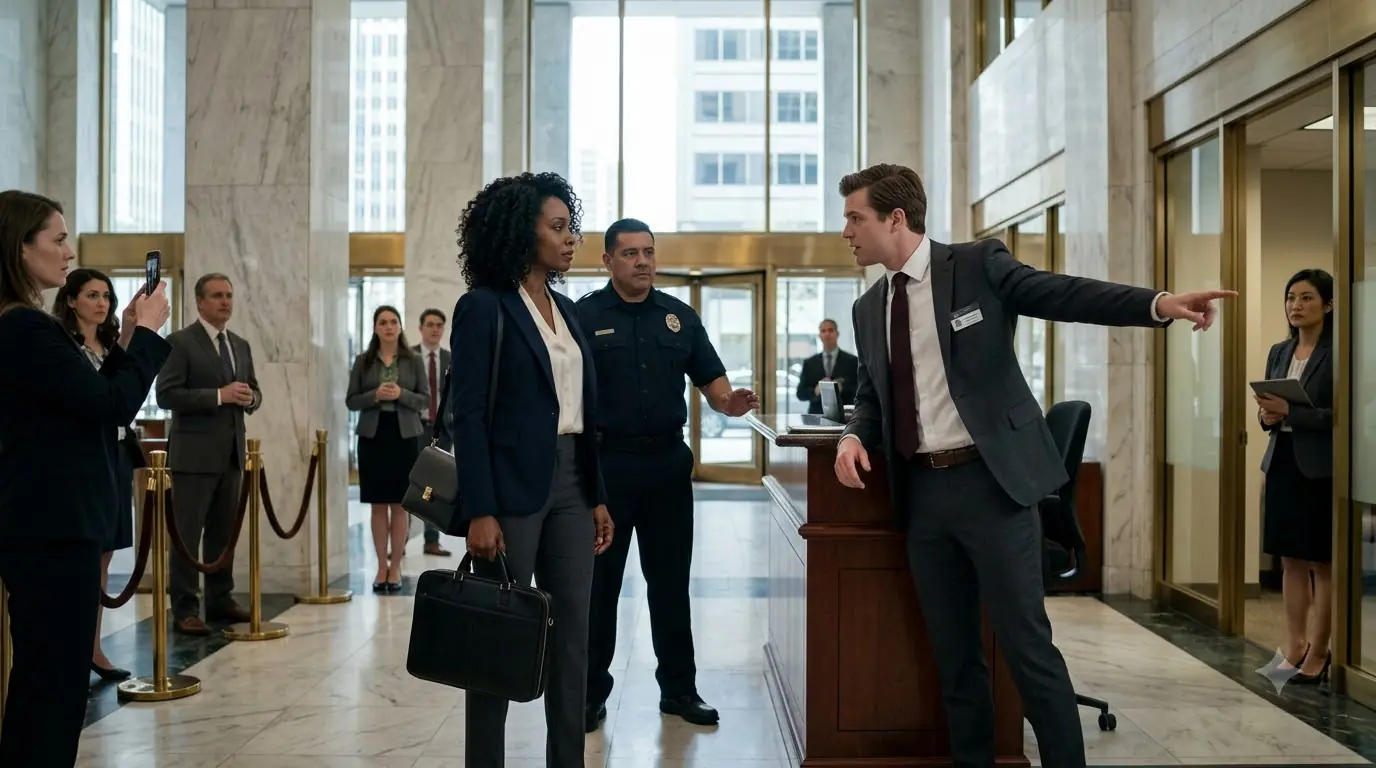
It was Tuesday at 2:47 in the afternoon, the kind of hour when a downtown bank existed in several worlds at once. Lunch traffic had faded, the after-work rush had not yet begun, and the marble lobby of Metropolitan Trust Bank carried the controlled murmur of tellers counting drawers, customers signing forms, printers feeding out receipts, and shoes crossing polished stone. Sunlight came through the tall glass facade in pale rectangles, reflecting off brass railings and a chandelier that had hung over the lobby since the building opened.
Dr. Amelia Richardson stepped through the revolving door alone. At forty-two, she had the compact, controlled presence of someone who had spent two decades being underestimated and had learned that calm could be more disruptive than anger. She wore a navy blazer cut cleanly through the shoulders, an ivory blouse, dark trousers, and low black heels that made almost no sound on the marble. Her leather briefcase was slim, her jewelry understated, and the watch at her wrist was expensive enough to attract attention only from people who knew what they were looking at.
Nothing about her appearance demanded spectacle. That was intentional.
Amelia had never liked arriving at branches with an entourage. Metropolitan Trust employed thousands of people across dozens of locations, and whenever senior executives announced a visit, reality disappeared before they reached the front door. Desks were cleared, customer complaints suddenly vanished from the queue, managers rehearsed greetings, and staff who normally cut corners became models of policy compliance for exactly as long as the executive remained in sight.
So Amelia occasionally entered branches the same way ordinary customers did. No assistants. No corporate security. No advance message. She would ask a question, stand in line, observe how long elderly customers waited, notice whether someone in work clothes received the same attention as someone in a tailored suit, and then go upstairs to whatever executive meeting had brought her into the building in the first place.
That afternoon she had two legitimate reasons to be there. The first was routine: a charitable foundation account required an in-person signature on a transfer authorization because of the amount and the structure of the grant. The second was a board meeting scheduled for three o'clock on the forty-seventh floor. She had allowed herself thirteen minutes in the lobby because signing a prepared form should have taken less than five.
She reached the concierge desk and waited while a young employee finished speaking to an older couple. No one acknowledged her for nearly a minute. Amelia did not mind the delay. What caught her attention was that two other customers who entered after her were greeted first.
One was a white man in a gray suit carrying a golf umbrella. A customer representative walked halfway across the lobby to ask whether he needed assistance. The second was a young woman wearing designer sunglasses who was directed immediately toward private banking. Amelia watched both interactions without changing her expression.
Then she approached the manager's desk.
Marcus Webb looked up from a spreadsheet only after Amelia said, "Excuse me. I need assistance with a transfer authorization."
Webb was twenty-eight years old and had been branch manager for three months. His diploma still felt new enough in his memory that he sometimes carried himself as though the degree were a credential that settled arguments by itself. He had come to Metropolitan Trust after an accelerated management program, a year at a regional lender, and a hiring process that praised his confidence, speed, and willingness to drive performance.
His quarterly sales numbers were good. His customer complaints were less impressive, although none had yet risen high enough to become a formal discipline issue. Several employees had described him privately as someone who made decisions about customers before they finished introducing themselves.
He looked at Amelia's face, then at her briefcase, then at the lobby behind her as if expecting someone more important to appear.
"Do you have an appointment?" he asked.
"No. I was told the authorization would be available at the branch."
"Private banking is appointment-based."
"I didn't say I needed private banking."
Something in her tone seemed to irritate him. It was not rude. If anything, that made it worse. Marcus Webb liked interactions that established hierarchy quickly, and Amelia's manner did not acknowledge the hierarchy he expected.
He leaned back in his chair. "Ma'am, this is a private institution. You can't just walk in here demanding things."
Amelia glanced toward the teller line, then back to him. "I haven't demanded anything. I asked for assistance with a prepared transfer authorization."
"And I'm telling you there are procedures."
"Then tell me the procedure."
The exchange was still quiet enough that most customers had not noticed. Near the security desk, Carlos Rodriguez did.
Rodriguez had worked security in financial institutions for fifteen years. He had learned to distinguish danger from discomfort, agitation from embarrassment, and genuine escalation from the kind managers sometimes created because they did not like being questioned. Amelia was not behaving like a threat. Her hands were visible. Her voice was low. Her posture was relaxed.
Webb looked toward him anyway.
That look was enough to bring Rodriguez a few steps closer.
"Is there a problem?" the guard asked.
"We're handling it," Webb said, not looking away from Amelia. "This customer is refusing to follow branch procedure."
"I haven't been given a procedure to follow," Amelia replied.
The sentence was simple. It changed the temperature of the interaction.
A woman waiting near the deposit counter glanced over. Another customer lowered a newspaper. Lisa Chen, the assistant manager, came out of a back office carrying a tablet and slowed when she saw security standing beside Webb's desk.
"What's going on?" Lisa asked.
Webb answered before Amelia could. "This woman claims she has business here. No appointment, no documentation, and now she's becoming argumentative."
Amelia turned her head slightly toward Lisa. "My name hasn't been requested. Neither has identification."