Tyler Anderson sat at the plaintiff's table. He wore a charcoal gray suit. His arm was still in the sling six weeks after the dislocation. His two lawyers sat on either side of him.
Expensive haircuts, expensive watches. At the defendant's table, Diana Moore sat alone next to Whitney. Whitney wore a simple navy blue blouse, short sleeves. The crescent scar on her right arm was visible to every juror, every reporter, every face in the gallery.
The Bronze Star was pinned over her heart. She had not put it on. Diana had put it on her that morning. Behind her, in the second row of the gallery, sat Colonel Frank Whitaker.
He wore his full dress uniform, service ribbons across his chest. Beside him sat Gunnery Sergeant Dwayne Brooks, also in dress blues. Beside Brooks sat Lisa Brennan and beside her 11 other veterans Whitney had never met.
All in uniform, all sitting at attention. The judge entered. Honorable Patricia Mendes, 22 years on the bench. The plaintiff went first.
Tyler's lead lawyer was sharp, polished. He played the doctored 16-second clip. He talked about an unprovoked assault. He asked for $2 million in damages.
He sat down at 10:15. Diana Moore stood up at 10:16. She did not raise her voice. She did not pace.
She walked to the projection screen. She opened her laptop. She loaded a file. Your honor, the plaintiff has shown you 16 seconds of edited video.
I would like to show the court the full 34 minutes. She pressed play. All three news station angles, timestamped, synchronized.
The courtroom watched Tyler point at Whitney from the stage. They watched his two students drag her up the steps. They watched Tyler call her a black rat. They watched him pour water on her head.
They watched him stomp on her cap. They watched him press her down onto her knees. They watched her say, "Please let me go." Then they watched the 1.4 seconds, followed by Colonel Whitaker standing, followed by the salute.
Diana stopped the video. The courtroom was silent. She turned to Judge Mendes. Your honor, the defense calls Colonel Frank Whitaker, retired.
Whitaker walked to the witness stand. He was sworn in. He sat down. Diana asked three questions.
Colonel Whitaker, what is the Marine Corps Martial Arts Program? He answered for 12 minutes. He explained MCMAP doctrine. He explained levels of force.
He explained that a level four instructor was trained to neutralize a threat with the least possible injury. Colonel Whitaker, did you observe the defendant's actions on the video the court just watched? I did, ma'am.
In your professional opinion, did her actions comply with MCMAP minimum force doctrine? Whitaker looked directly at Tyler. They were textbook.
She could have killed three men in that ring. She chose to break no bones. She chose to draw no blood except what they did to themselves. In 32 years of Marine Corps service, I have never seen better restraint under provocation. Ever.
Diana nodded. One more question, Colonel. Do you recognize the scar on the defendant's right arm? Whitaker's voice cracked.
I do, ma'am. I bandaged that wound myself. November 5th, 2016. The All-Marine Combatives Championship final.
Her opponent broke the rules, drew a tactical blade, cut her open from shoulder to elbow. She finished the match anyway, won the gold. He paused.
That is the scar of a woman who does not quit. That is the scar of a champion. Diana sat down. Tyler's lawyer stood up for cross-examination.
He had no questions. Diana called her second witness, Lisa Brennan, former gunnery sergeant. Ma'am, do you recognize the defendant? Yes, she saved my life.
November 24th, 2014. Helmand Province. A Humvee in our convoy hit an IED. I was the driver.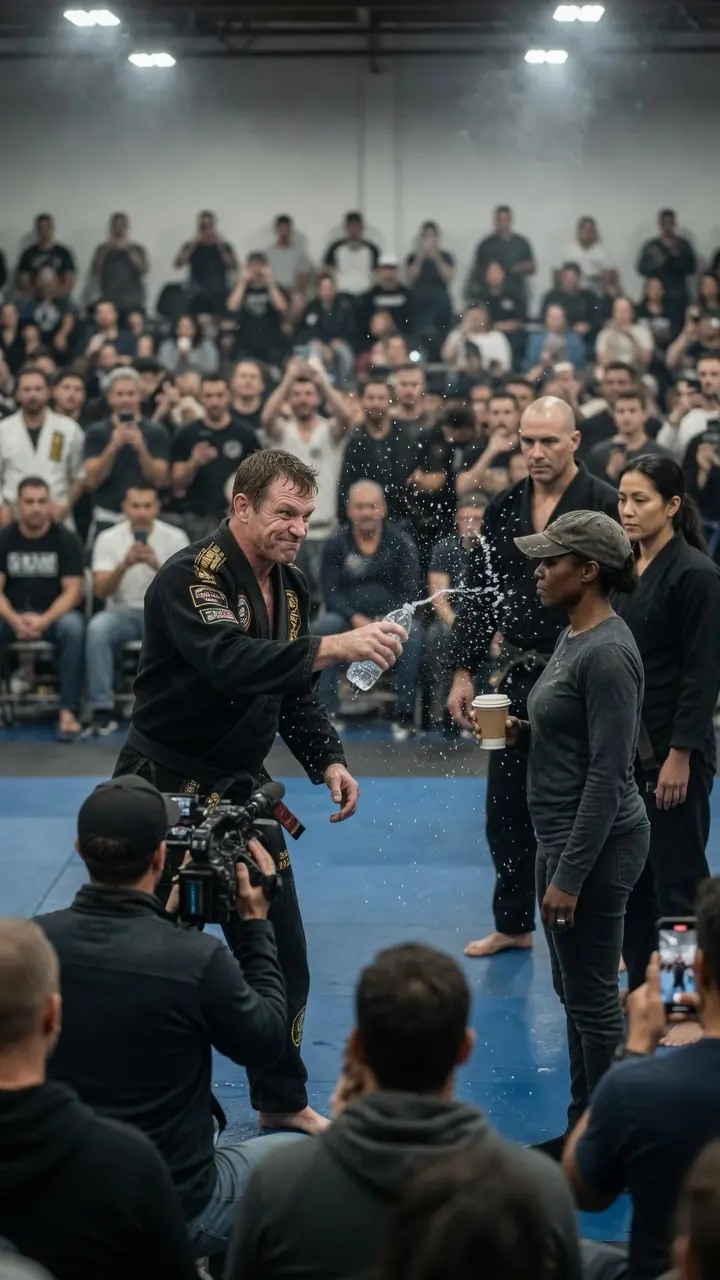
The vehicle was burning. I was unconscious. Sergeant Williams pulled me out through a broken window. She was under fire the whole time.
Was she awarded a medal for that action? Yes, ma'am. The Bronze Star with Valor, the one she is wearing today. The courtroom shifted.
Somebody in the back exhaled hard. A juror in the second row wiped her eyes. Diana sat down. No cross-examination.
Then Diana stood one final time. She walked to the projector. She pulled up one image, a magazine cover. Marine Corps Times, November 2016.
The headline read, "The scar that won gold." The cover showed a younger Whitney Williams bleeding through her gi, holding up a gold medal. Diana turned to face Tyler.
Mr. Anderson, you told 600 people that this woman was too weak for combat. You told them she did not belong in your world. Could you define combat for the court, please? Tyler did not answer.
Could you tell us, Mr. Anderson, your own combat record, your deployments, your service? Tyler's lead lawyer stood up. Objection. Relevance.
Judge Mendes looked at him over her glasses. Overruled. Mr. Anderson called the defendant too weak for combat in a public forum recorded by three news stations. He opened the door.
He will answer the question. Tyler's mouth opened. Closed. Opened again.
I never served. You never served. Diana repeated. And the woman you called too weak.
The woman you dragged onto your stage. The woman you poured water on and forced onto her knees. She is a three-time All-Marine Combatives champion. A level four MCMAP instructor.
A Bronze Star recipient for valor under enemy fire. She has earned the word combat. Have you, sir?
Tyler said nothing. Diana let the silence sit for ten full seconds. Then she said the words that would end Tyler Anderson's career. No further questions.
Judge Mendes looked at Tyler. Mr. Anderson, the court is going to give you one opportunity to address the bench before I rule. Would you like to say anything?
Tyler's pride broke. Six weeks of rage cracked open in his eyes. She had no business being a soldier. Women like her, they get in because of quotas.
She did not earn that scar. She did not earn that medal. She is a fraud. A welfare case in a uniform.
The courtroom gasped. Judge Mendes slammed her gavel. Whitney was offered one final chance to speak. Diana looked at her.
Whitney nodded once. She stood up. She walked to the witness stand. She did not sit down.
She looked directly at Tyler. Her voice was steady. I learned to fight so I would never have to. You made me have to.
Twenty-one words. She sat back down. Behind her, Colonel Whitaker stood up, then Brooks, then Lisa Brennan, then every veteran in the room.
Judge Mendes took 30 seconds. Then she ruled. The plaintiff's case is dismissed with prejudice. All claims denied.
I am referring Mr. Anderson's perjury and his fabricated video evidence to the district attorney's office for criminal prosecution. The fall came fast. Within 48 hours of Judge Mendes's ruling, Tyler Anderson's world began to collapse from every direction at once.
His insurance carrier dropped Anderson Elite Martial Arts. His landlord terminated the lease for cause. Three sponsors pulled their logos off his dojo walls. The crisis PR firm that had cost him $40,000 stopped returning his calls.
Two weeks later, the district attorney filed criminal charges: perjury, fabrication of evidence, assault, and false imprisonment from the original incident, civil rights violations under California Penal Code section 422.6. The case made the front page of every newspaper in the region.
The trial lasted four days. Twelve witnesses testified against him. The jury deliberated for less than two hours. Tyler Anderson was sentenced to 24 months in state prison.
He was ordered to pay $100,000 in restitution to Whitney Williams. He was permanently barred from owning or operating any martial arts business in the state of California. His two students, the ones who had dragged Whitney up the aisle, they were charged with assault and unlawful restraint.
Each was sentenced to six months in county jail. Both lost their black belts in formal proceedings before the regional Brazilian Jiu-Jitsu Federation. Anderson Elite Martial Arts closed its doors on a Tuesday in early December.
The sign came down on Wednesday. By Friday, the building was empty. Whitney did not attend the sentencing. She had something more important to do.
She had opened a class. She called it Sleeves Up. The first session was held in the back room of the Coral Bay Community Center. A converted basketball court, folding chairs, donated mats, hand sanitizer, and plastic pumps.
50 people signed up in the first week. By the second month, the list had grown to 212. Most of them were women. Many of them carried scars under their own long sleeves.
Scars from husbands, scars from strangers, scars from things they had never told anyone about before. Lisa Brennan came down from Sacramento every Saturday to assist. Gunnery Sergeant Brooks drove in from Bakersfield twice a month.
Colonel Whitaker showed up to the very first class in his Marines windbreaker. He carried a folding chair under one arm. He sat in the back. He never said a word.
He just watched. Whitney did not teach punches first. She did not teach kicks first. She taught breath.
She taught how to stand. She taught the word no. She taught her students how to say it out loud. Calm, steady, without apology.
The way she had said it in the ring six months earlier. On opening day when her first student, a 70-year-old grandmother named Ruth, who had survived three decades of abuse from a man now dead, finally said the word no without trembling. Whitney smiled at Ruth.
It was the first time anyone had seen her smile in the entire story, two full seconds long. Then it was gone again. But Ruth saw it and Ruth told everyone.
By spring, the Coral Bay City Council passed an ordinance. They called it the Williams Law. It required written consent from any audience member before commercial martial arts demonstrations could involve them physically. The law passed unanimously.
Within a year, five other California cities had adopted similar versions. The hashtag was the last thing to spread. It started inside the veterans community. Then it moved into the women's self-defense community.
Then it crossed over into everything. #JusticeForWilliams #TooWeakForCombat. By the six-month mark, the original news footage had been viewed 40 million times across every major platform.
The phrase that Tyler Anderson had used as a weapon, "too weak for combat," now belonged to every woman, every veteran, every survivor who had ever been underestimated, dismissed, dragged onto somebody else's stage against her will. Whitney never gave a single interview about any of it.
She declined every offer: talk shows, documentaries, book deals. The only public statement she made was a single line on a small handwritten sign she put up on the wall of the Sleeves Up classroom. The sign read, "I learned to fight so I would never have to. Now I teach so you never have to either."
She wore short sleeves to class that day. Standing at the front facing 50 students, the crescent scar caught the morning light. And not a single woman in that room looked away from it.
One year after the events at Anderson Elite Martial Arts, Whitney Williams was back at the Veterans Outreach Center. The board that had suspended her had been replaced. The new director personally drove to her apartment to deliver the apology letter.
Whitney accepted the job back on one condition. She would work four days a week. Friday was for Sleeves Up. By that summer, Sleeves Up had three locations across Coral Bay County.
All of them ran on donated mats and volunteer instructors. None of them charged a single dollar in tuition. Whitney refused to accept any payment for teaching.
She told the press exactly once in a written statement. You cannot put a price on the word no, so I do not. Colonel Frank Whitaker passed away peacefully in his sleep in March of the following year.
He was 70. At his funeral, Whitney Williams gave the only eulogy. It was four sentences long. She did not cry.
She said he had saved more lives in his retirement than most generals saved in their entire careers. She said he had saved hers twice. Once in 2016 with a roll of medical tape and again in a courtroom in Coral Bay with a phone call she did not know he had made.
Gunnery Sergeant Brooks opened his own Sleeves Up location in Bakersfield. Lisa Brennan started a sister program for female veterans in Sacramento. Together, the three programs have trained over 4,000 women in basic self-defense over the last two years.
Tyler Anderson served 18 months. He was released on good behavior. He moved to Arizona. He works at a hardware store now.
He does not teach anymore. He will never teach again. His two students, the ones who held Whitney's arms behind her back, both completed their six-month sentences.
One of them, the younger one with the tattoos, eventually wrote Whitney a letter from his cell. He apologized. He asked if there was any way to make it right. Whitney wrote back three sentences.
She told him there was. She told him to go find a Sleeves Up program in his city. She told him to sign up as a student. He did.
He has been training for 14 months now. He has not missed a single class. The crescent scar on Whitney's right arm is now visible in every Sleeves Up class photo.
Every student knows what it means. Every student is told the story on day one. The story of the woman who finished a championship match bleeding through her gi. The story of the woman who walked into a martial arts demonstration as a spectator and walked out as a movement.
The story of the woman they tried to drag down and could not.