The birthday cake hit the grass before anyone understood what Officer Ryan Caldwell had done, the clear plastic lid bouncing once against the patio before three blue candles rolled beneath the folding table. Pink frosting smeared across the inside of the cracked container, one tiny sugar planet broke loose near the edge, and the plastic number eight snapped cleanly in half beside a paper plate. Marcus Bennett had been standing near the grill when it happened, and before he could move, Caldwell stepped forward and brought the bottom of his black patrol boot directly through the center of the cake box. The entire backyard became so quiet that Marcus could hear the electric motor of the rented bounce house humming twenty feet away.
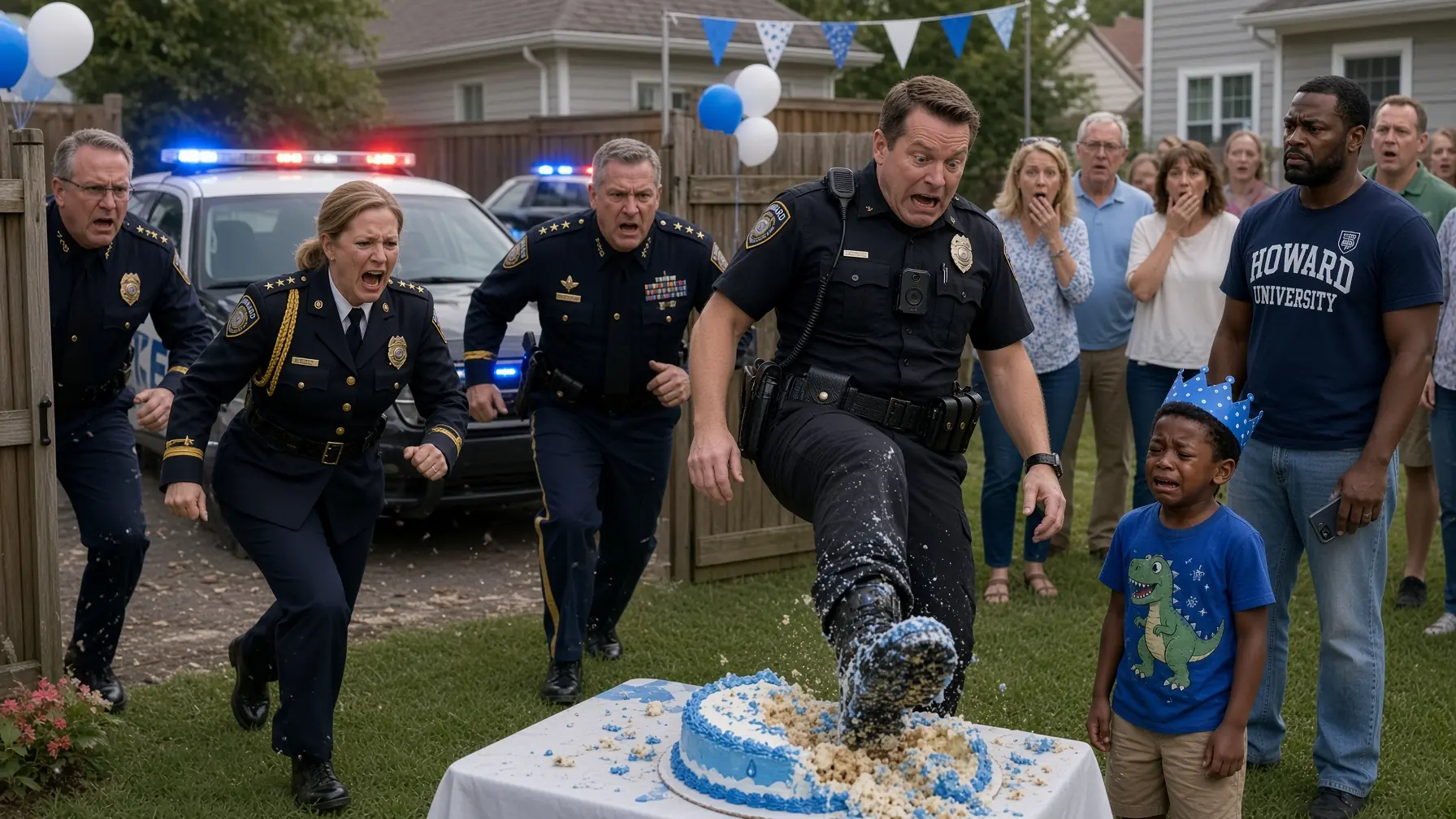
His son Caleb stood beside the table wearing the blue paper crown he had refused to remove since breakfast, both arms hanging beside his shorts while he stared at the ruined cake as though his mind could not yet accept what his eyes were showing him. Behind him, children wearing matching space-themed birthday hats stopped chasing one another through the yard, several moving automatically toward their parents while Marcus’s wife Renee covered her mouth with one hand. Seventy-four-year-old Samuel Greene, their next-door neighbor, lowered the barbecue tongs he had been holding, and Marcus’s older sister Denise slowly raised her phone higher. Caleb finally whispered, “Dad?” and that single word pulled Marcus forward harder than anything Caldwell had said all afternoon.
“Stay where you are,” Caldwell ordered immediately, his right hand resting near his duty belt as Marcus stopped halfway across the yard. Marcus saw the red indicator glowing on the officer’s body camera, and for reasons he could not fully explain in that moment, the tiny light became more important to him than the crushed cake, the surrounding phones, or even the anger rising through his chest. He lifted both hands slightly and said, “I’m going to my son,” but Caldwell repeated, “I said stay back,” with enough volume that several children flinched. Marcus looked at Caleb and said, “Come to me, buddy,” and the boy hesitated only a second before running the five steps separating them.
Marcus knelt as Caleb reached him, and the boy buried his face against his father’s shoulder so quickly that the blue crown folded beneath Marcus’s chin. “He ruined it,” Caleb whispered, his voice muffled by Marcus’s shirt, and Marcus closed his eyes because Renee had spent almost five hours decorating that cake with blue-and-white frosting and tiny planets after Caleb had asked for a space theme. Marcus had teased her that children would destroy the thing in less than ten minutes anyway, and Renee had answered that being destroyed by children after the birthday song was exactly what a cake was for. Now Marcus felt his son’s shoulders shake once and realized that whatever happened next, Caleb was going to remember the way his father responded.
“Are you hurt?” Marcus asked, and Caleb shook his head before wiping his eyes with both fists and whispering, “I just wanted my cake.” Marcus pressed one hand between the boy’s shoulder blades, waited until the trembling in his own fingers stopped, then stood slowly while Renee pulled Caleb close to her side. Caldwell removed his boot from the collapsed plastic and said, “Everybody needs to stay where I can see them until I finish figuring out what’s going on.” Marcus looked at the ruined frosting beneath the officer’s boot mark and asked, “What exactly are you still figuring out?”
Caldwell pointed toward the side gate and said they had received a complaint about noise, vehicles blocking access, and “possible illegal activity,” although the children’s music had already been turned down and the only complained-about car had been moved thirty feet down the street. Marcus asked what illegal activity had been reported, and Caldwell glanced toward the coolers beside the porch without providing an answer. Then he said, “You people always want to debate everything,” and something about those four words changed the expressions around the yard. Samuel’s jaw tightened, Denise’s phone rose another inch, and Marcus felt the officer’s name strike something old and unfinished inside his memory: Ryan Caldwell.
Three hours earlier, the backyard had looked completely different, with blue streamers running between two maple trees, foil stars swaying from the porch railing, and a rented inflatable rocket ship leaning slightly whenever three children landed against the same side. Caleb had spent the morning racing from window to window asking when his friends would arrive until Renee finally sent him upstairs to find socks simply because she needed five uninterrupted minutes. Marcus stood over the gas grill in a faded Howard University T-shirt while Samuel Greene argued that charcoal would have made the burgers better, and Marcus told him, “Charcoal is a hobby for retired men with nowhere to be.” Samuel lifted the barbecue tongs like a professor correcting a slow student and answered, “Flavor requires patience,” while Marcus pointed toward the hot dogs and said, “Eight-year-olds require food.”
Samuel had lived next door since Marcus and Renee bought the house nine years earlier, and over that time the two families had shared snow shovels, lawn equipment, hospital rides, Thanksgiving leftovers, spare keys, storm preparations, and more evenings on one another’s porches than either could count. Samuel’s wife had died five years earlier, after which the Bennetts quietly became the people who checked whether he needed groceries when the roads iced over and whether he had remembered his blood-pressure medication during heat waves. Caleb considered Samuel another grandfather, while Samuel described Caleb as the only person in the neighborhood who could break three things in one afternoon and still be invited back the next morning. Nothing about that Saturday had been meant to be complicated.
Renee carried the cake outside shortly before two o’clock, and everyone cheered because she had stayed up until nearly midnight finishing tiny edible planets around the edge. Caleb immediately reached toward Saturn, causing Renee to say, “Do not touch that,” while he pulled back and explained with a completely serious face that he had only been “checking quality.” Marcus laughed and told Renee, “Your child,” to which she answered, “Your vocabulary,” before moving the cake to the center of the patio table where nobody under the age of twelve could reach it easily. Caleb’s birthday had been planned for three months, and after a thunderstorm ruined the previous year’s celebration, Marcus had promised this one would be memorable.
By two-fifteen, almost forty relatives, friends, classmates, and neighbors had passed through the backyard, and cars lined both sides of Hawthorne Drive without blocking the fire hydrant or anyone’s driveway. Marcus had walked the street before guests arrived and placed two orange cones near the corner because years of homeownership had taught him that preventing a legitimate complaint was easier than arguing about one later. At 2:21, however, a resident two blocks away called county dispatch about loud music, children running between yards, and a silver sedan parked too close to the intersection. The caller admitted nobody was fighting, nobody had displayed a weapon, and nobody had threatened anyone, but the phrase “people are coming and going constantly” was enough for Officer Ryan Caldwell to volunteer for the call while finishing paperwork nearby.
Caldwell arrived thirteen minutes later and found Marcus carrying hamburger buns toward the backyard, so Marcus set them down and met him beside the driveway. The officer asked whether Marcus was hosting the gathering, and after learning it was his son’s birthday, he pointed toward the silver sedan and said the rear bumper appeared too close to the corner. Marcus answered, “No problem, I’ll have it moved,” called Michael Harris from the backyard, and watched as Michael immediately relocated the car thirty feet farther down the block. Caldwell then mentioned the music, so Marcus walked to the outdoor speaker and lowered the volume before the officer had finished explaining the complaint.
That should have ended almost everything the caller had actually reported, but Caldwell remained beside the driveway looking through the open side gate toward the gathering. “How many people are back there?” he asked, and Marcus said he had not counted, after which Caldwell asked whether alcohol was being served, whether marijuana was present, and whether anyone had brought weapons. Marcus answered yes to alcohol for adults and no to everything else, then waited for the officer to explain what issue remained. Instead, Caldwell looked toward the backyard and asked, “Mind if I take a look around?”
Marcus glanced through the gate at children throwing foam rockets near the bounce house and said, “You can see the yard from here.” Caldwell’s expression changed slightly as he asked whether Marcus was refusing to let him check, and Marcus replied, “I’m asking what you’re checking for.” The officer said the department had received reports of possible illegal activity, but when Marcus asked what activity had been specifically described, Caldwell answered, “They don’t have to hand me a full criminal case before I investigate.” Marcus felt the first real warning in his chest, yet Renee appeared behind him at that moment and quietly asked, “Everything okay?” before he could respond.
Marcus told her the silver car had needed moving and the music needed lowering, both of which were already done, while Caldwell continued staring into the yard. Renee nodded, assuming the interaction was finished, but Caldwell said, “I want to speak to the adults back there,” and Marcus asked again, “About what?” The officer’s irritation became visible as he said, “Why are you making everything a problem?” and Marcus pointed toward the moved car before answering, “I fixed the parking issue, lowered the music, and answered every question, so I’m asking what issue is left.” Caldwell stepped closer and said, “Sometimes the people asking the most questions are the ones trying hardest to control what I see.”