The first thing Jordan Brooks felt was the cold wetness of the car hood against his chest. The second was the pressure of a large hand between his shoulder blades, forcing him down hard enough that the edge of the metal pressed into his ribs.
Soap slid from the black paint onto his gray T-shirt, and the garden hose he had been holding fell across the driveway, spraying water toward the white garage door.
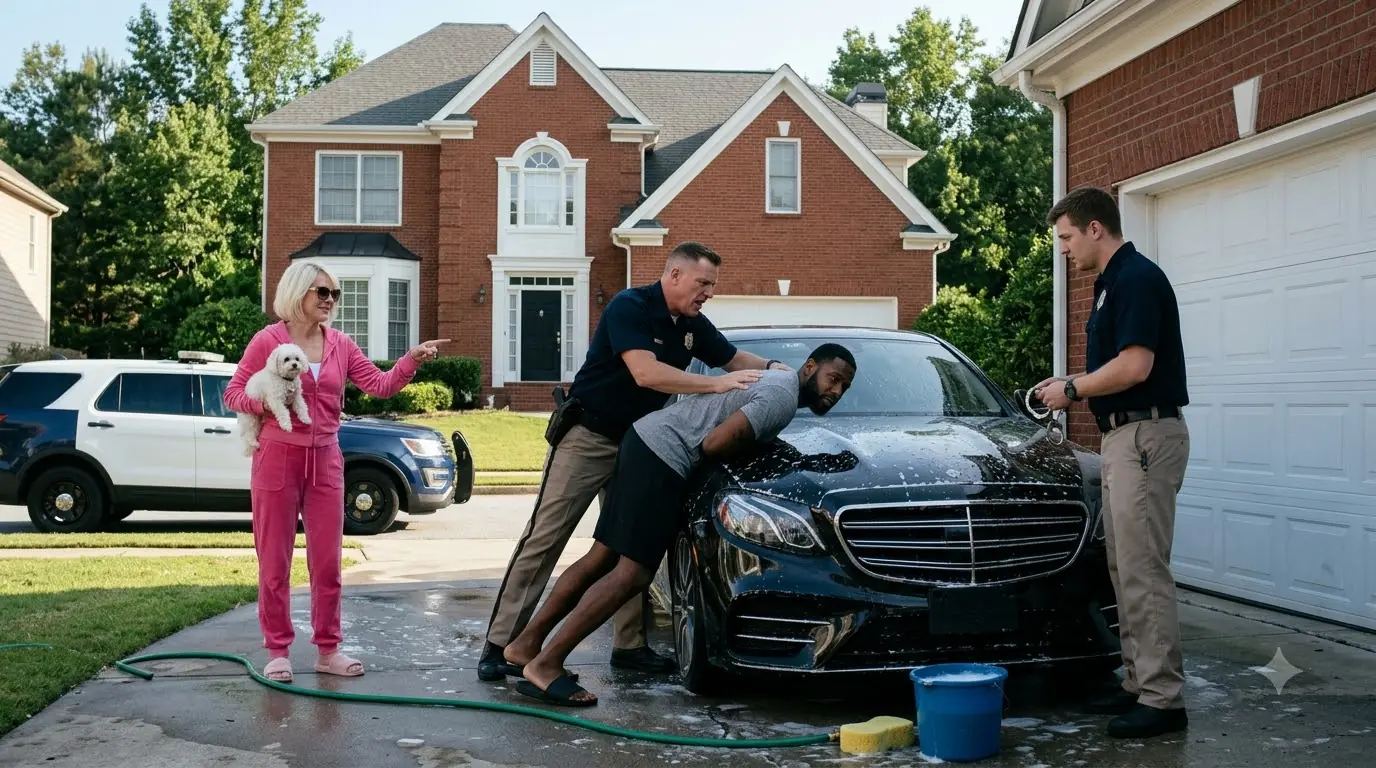
Somewhere behind him, a little dog barked in frantic, shrill bursts, and a woman laughed as though the entire scene had been arranged for her entertainment.
"You heard the lady," Officer Daniel Voss said. "Hands behind your back."
Jordan did not fight. He had spent enough years around frightened people and armed officers to understand how quickly a bad moment could become an irreversible one. He spread his fingers where the officer could see them and allowed his arms to be pulled backward, even as the second officer hesitated before fastening the handcuffs. From somewhere across the street came the faint sound of a woman saying, "Oh, my God," followed by the nearly inaudible tap of a smartphone camera being adjusted.
"That's what happens when people don't know their place," Karen Whitcomb said. She stood near the edge of the driveway in a pink velour tracksuit, her blonde inverted bob immaculate despite the warm Saturday morning, oversized sunglasses pushed onto her head. Her tiny white dog squirmed against her chest while she pointed triumphantly at the black luxury sedan. "I told you there was something wrong with him. Look at that car. Do you really believe he owns it?"
The front door of the two-story brick house swung open. A Black woman in her early thirties stepped onto the front steps, her hair twisted into a bun and a light pink robe thrown over a T-shirt. For a single moment she stood absolutely still, taking in the police SUV at the curb, the hose running across the concrete, her husband bent over their car, and the delighted expression on the neighbor's face. Then she walked down two steps and spoke with a steadiness that made the younger officer look up.
"That's my husband," she said. "Your new Chief of Police starts Monday."
Karen's smile disappeared. Officer Voss loosened his grip without meaning to, and Officer Luke Avery, who had just closed the handcuffs, stared at the woman as though he had missed a crucial piece of information. Jordan slowly turned his head, enough to see his wife's face without moving against the pressure on his back. He had spent the previous ten minutes asking the officers to listen, but his wife needed only one sentence to get their attention.
That was the part Jordan would remember afterward. Not the handcuffs, although he would remember those, too. Not the soap soaking through his shirt or the sharp pressure along his ribs. What stayed with him was how instantly the rules appeared to change when the officers learned that the man beneath their hands had a title they recognized. And the question that followed him through the months ahead was brutally simple: what would have happened if he had been exactly the ordinary homeowner they thought he was?