The first sound was not the scream of a woman or the roar of a passing truck. It was breaking glass, a sharp, violent crack that carried across the northbound lanes of Interstate 85 and made drivers instinctively touch their brakes.
A McLaren Senna sat on the shoulder with its left window collapsing into glittering fragments, and a Virginia state trooper stood beside it gripping a baton. Ten feet away, a second trooper looked as though he wanted to vanish into the asphalt.
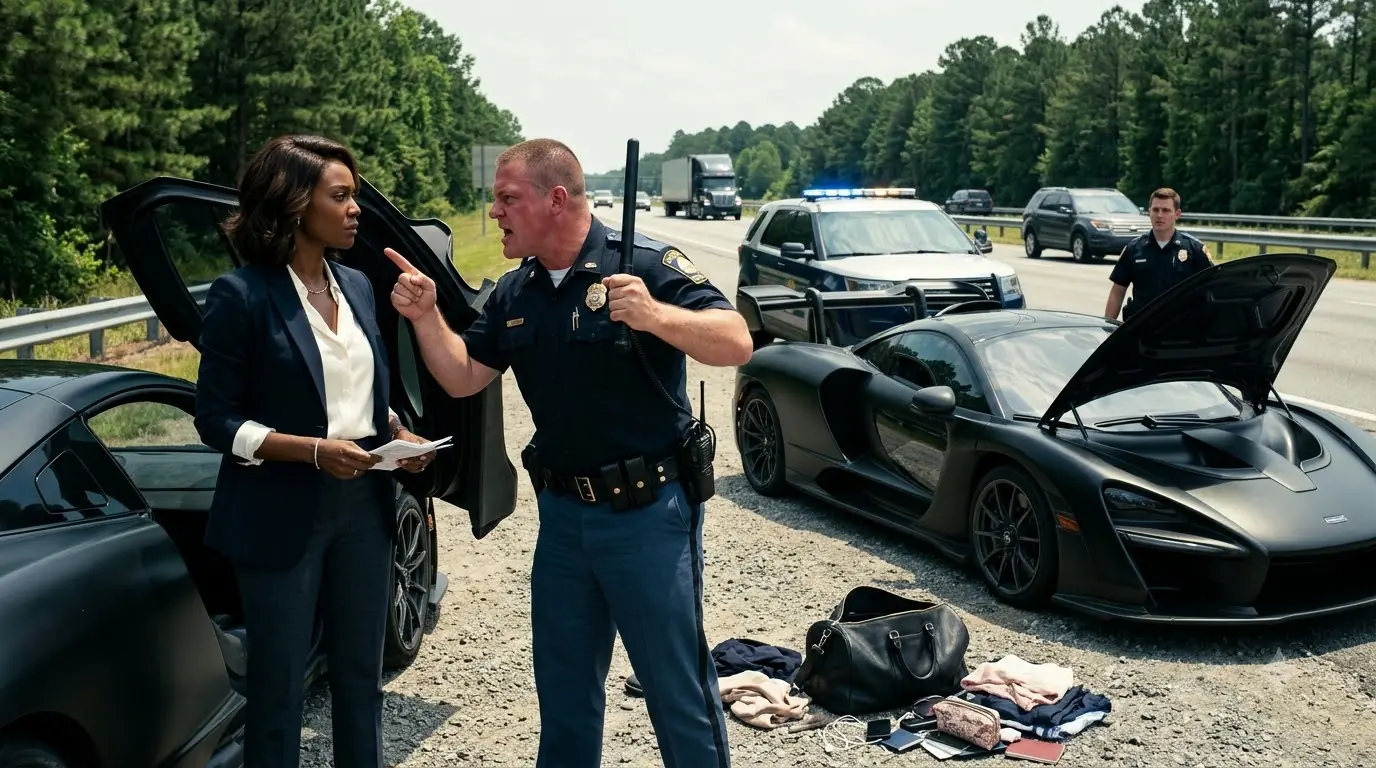
The woman who owned the car had already given the officers her license, registration, and insurance. They had checked the plate, searched the passenger compartment, emptied her luggage onto the gravel, and found nothing unlawful. Now Officer Bradley Nolan was shouting that he knew a thief when he saw one, even though his own dispatch records had already contradicted him. When she told him the search had proved nothing except that he was wrong, he swung at the car.
He grabbed her shoulder as she stumbled away from the shower of glass and forced her down onto the hot roadside. Morgan Owens caught herself with her palms, felt gravel bite her skin, and struggled for a breath while passing engines thundered in her ears. She knew enough about violence to understand how much worse one wrong movement might make the next few seconds. She remained still until his grip loosened, then told him she was injured and needed medical help.
Nolan ordered her to stop talking. When she finally raised the credentials she had kept out of sight, the change in his face was immediate and astonishing. The card identified her as Senior Special Agent Morgan Owens, a federal investigator assigned to a Justice Department civil-rights task force. The officer who had accused her of stealing a million-dollar automobile suddenly could barely say her name.
He would later insist that he had made a mistake about the car. That was not the part the investigators found hardest to explain. They wanted to know why the mistake had survived a valid registration check, a clean database return, an empty vehicle search, and repeated opportunities to stop. They also wanted to know what Bradley Nolan had done on other highways, to other people, when nobody with a federal identification card happened to be in the driver's seat.
Six hours earlier, Morgan had been standing barefoot on the carpet of a Charlotte hotel room, trying to decide whether she had the energy for breakfast. Her suitcase lay open across the bed, filled with careful piles of clothes and a conference program covered in handwritten notes. Beyond the window, the city was already gathering heat, and the air-conditioning unit hummed with the determination of an overworked aircraft engine. She had slept badly after three days of presentations, private meetings, and conversations that continued long after the scheduled sessions ended.