"No, sir. I just want to see if you can actually hit the note."
The theater erupted.
Gasps, scattered laughs.
Chase's face flushed red.
"Of course I can hit the note. I've been hitting it for 15 years."
"Then show me."
Chase's mouth opened, closed, his hand flexed.
"Fine," he said through his teeth. "You want a demonstration?"
He turned to his sound engineer.
"Kill the backing track. All of it."
The engineer hesitated.
"Do it."
The engineer pressed a button.
The music thinned. Exposed.
Chase raised his microphone and began to sing.
Chase's voice filled the theater, strong at first.
Confident, he moved through the verse with ease, his years of training evident in every controlled breath, every smooth transition.
The audience relaxed slightly.
Maybe this was just a misunderstanding.
Maybe the kid was wrong.
Then he reached the bridge.
The melody climbed. E4, G4, B4.
Chase's voice followed, still solid, still controlled.
But as the notes pushed higher, something changed.
His neck tensed.
His shoulders rose slightly, betraying the strain.
D5, E5, A5.
And then he reached for the C6.
His voice cracked.
It broke somewhere around A sharp, a full step and a half below the target, the sound splintering like glass.
He stopped abruptly, coughed, tried to cover it with a laugh.
"Sorry folks, dry throat." He smiled, but it didn't reach his eyes. "That's why we use the track, to protect the voice during long shows."
But Zara had heard enough, and so had everyone else.
"You didn't hit it," she said quietly.
Chase turned to her, his smile now a thin line.
"I told you my voice is tired."
"But on your album, you hit that note 27 times," Zara said.
Her voice was growing stronger now, fueled by something she didn't fully understand yet.
"I counted, and in every live video online, you hit it perfectly every single time."
The audience shifted.
Phones came out.
People started looking at each other.
"What are you trying to say?" Chase's voice had an edge now, the smooth veneer cracking.
"I have perfect pitch," Zara said. "I can hear frequencies. The note on your album, it's 1046.5 hertz. That's C6. But what you just sang was 932 hertz. That's A sharp 5."
Someone in the audience whispered, "Is she right?"
Chase's face reddened.
"Listen, little girl—"
"And the voice on the album," Zara continued, her words tumbling out now, unstoppable. "It doesn't sound like you. It's a woman's voice. I looked up your album credits. It says Sophia Mitchell. Additional vocals."
The theater exploded in whispers.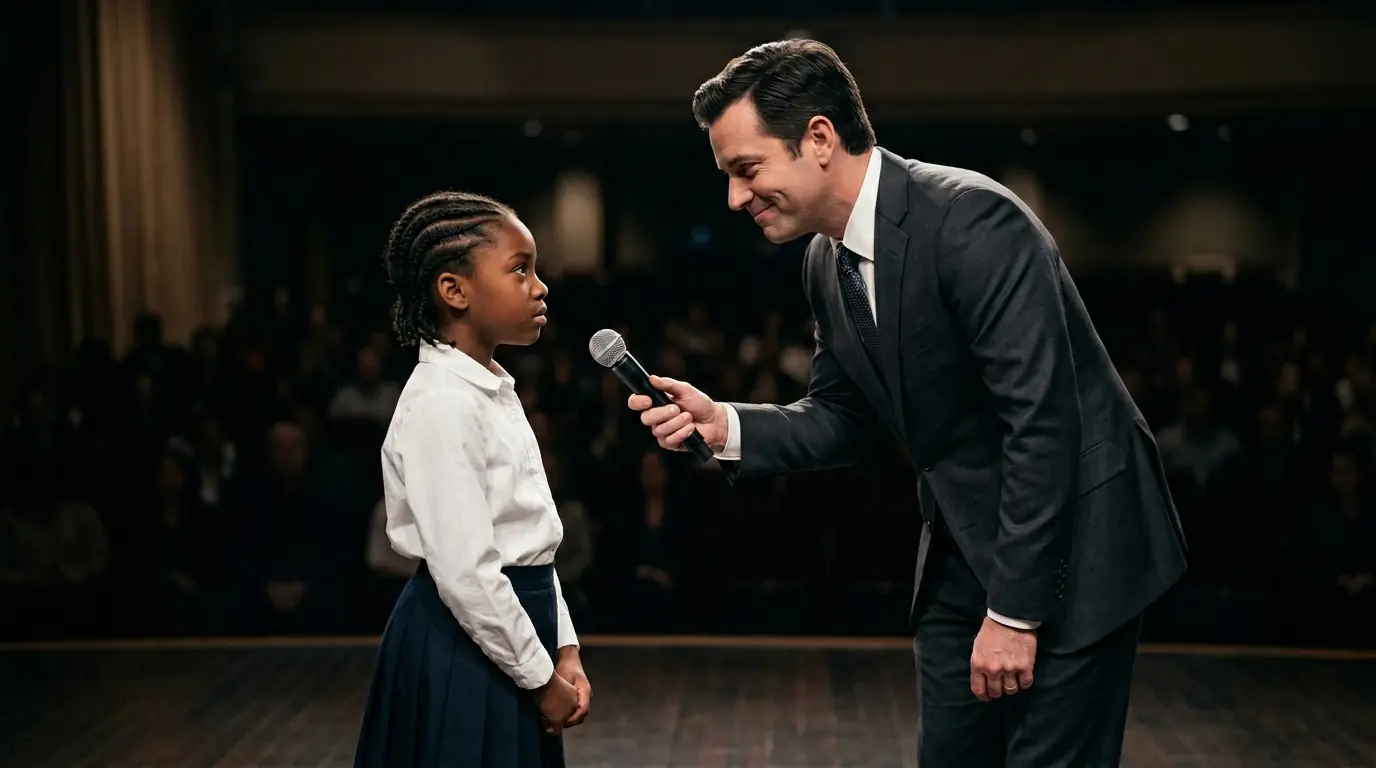
Chase stepped toward her, no longer smiling.
"You need to stop talking right now."
"Why?" Zara asked.
And for the first time since she'd been dragged onto that stage, she felt something other than fear.
"Because I'm telling the truth."
"Because you're 11 years old and you don't know what you're talking about."
"I know what I heard at soundcheck. I know what I'm hearing now."
Zara looked out at the audience, at the cameras, at the 2 million people watching.
"That note isn't yours. You've been lip-syncing it for 15 years."
Chase's hand shot out and grabbed her arm.
Not hard enough to hurt, but hard enough to control.
"We're done here."
But before he could pull her off stage, a voice came from the wings.
"Actually, she's right."
Everyone turned.
A man stepped into the light.
Chase's sound engineer, the one who'd been running the board all night.
His face was pale but determined.
"I've been your engineer for 5 years, Chase. Every single show, I've played that backing track. You've never sung that note live. Not once."
The theater went completely silent.
Chase's grip on Zara's arm loosened.
He stared at his engineer like the man had just driven a knife into his back.
"You're fired," Chase whispered.
"I know," the engineer said. "But she's 11 years old, and she's braver than I've been for 5 years."
The silence in the theater was absolute.
500 people held their breath.
2 million watched online.
Chase Hendricks stood frozen.
His sound engineer had just destroyed him in front of the world.
"This is ridiculous," Chase said, his voice shaking. "You're going to believe some kid over me? I have two Grammys. I've sold 4 million albums."
"Then prove her wrong!" someone shouted from the audience. "Sing the note."
Chase's face went from red to white.
"I just did."
"No, you didn't. You cracked. We all heard it."
The crowd was turning.
Chase looked at Zara standing there in her discount store blouse and something ugly twisted in his chest.
"Fine," he said. "You think you're so smart? You sing it right now. No preparation, no warm-up, no second chances."
Zara's hands trembled.
This was the moment where she either proved herself or became exactly what Chase said she was.
Ms. Johnson's voice carried from the choir section.
"You can do this, baby. Sing like you do at church."
Zara closed her eyes, took a breath, felt the air fill her lungs, felt her diaphragm expand, felt every lesson she'd learned in that small Baptist church settle into her bones.
She opened her eyes and nodded to the band.
They started again, the intro to 'Higher Ground' for the second time that night, but everything was different now.
Zara began to sing.
Her voice started soft, almost tentative.
The first verse was low, comfortable, well within her range.
She focused on the words, on the story the song was telling.
Some people in the audience exchanged glances.
She was good, sure, but nothing special yet.
Then she reached the pre-chorus.
Her voice opened up, gaining power without losing control.
There was something raw and honest in her tone that hadn't been there in Chase's polished performance.
She wasn't performing.
She was testifying.
The verse climbed higher. D5. E5. F5.
Her voice followed effortlessly, each note pure and clear.