The storm had passed by midnight, but the sea hadn't forgiven anyone yet. Malik Carter pushed his old boat through swells that still ran chest high, heading for the rock beds where the nets had been set two days before. He needed a good haul. He needed it badly.
The engine payment was three weeks late, Lena's school fees were due Friday, and the harbormaster had already left one warning notice on his dock post. He almost missed her. The sound came between wave breaks, not a cry exactly, more like something that had already given up on being heard. Malik cut the engine and listened.
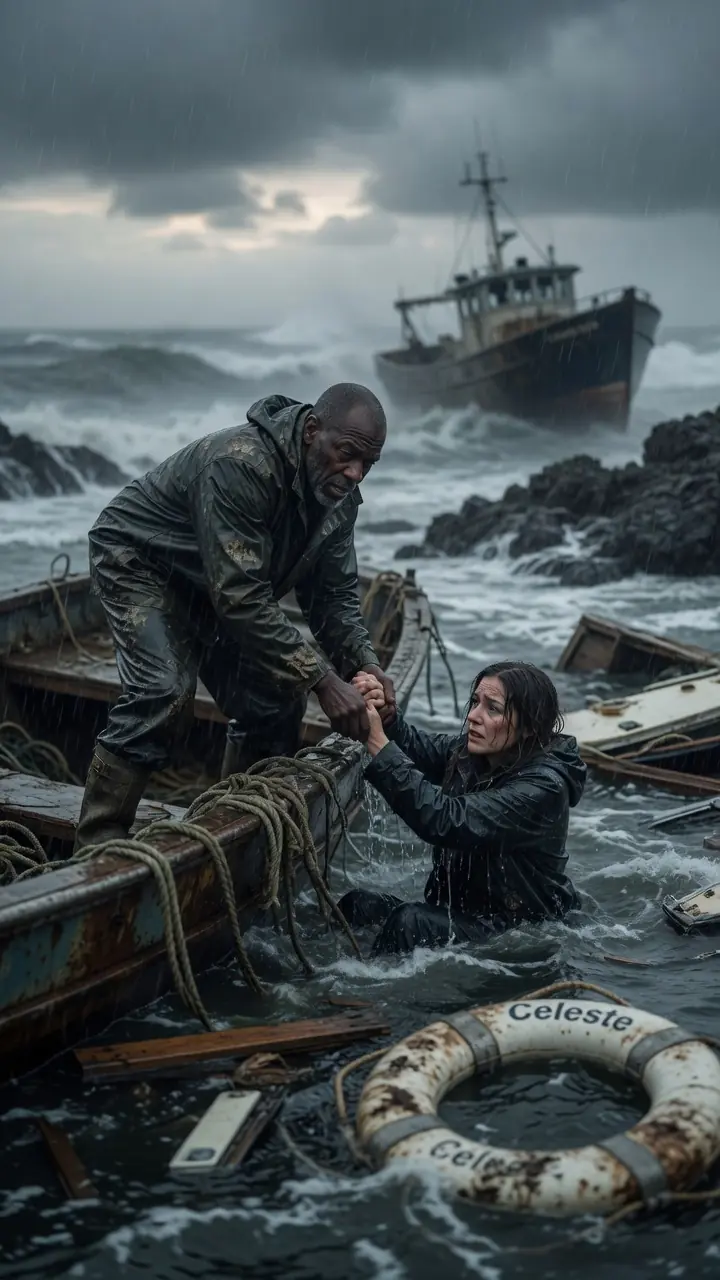
There it was again. He swung the spotlight toward the rocks and saw a hand pale against the dark water, fingers hooked around a length of frayed anchor rope. He went in without thinking. She was tangled in rope and broken hull planking, half her body submerged in water cold enough to stop a heart.
He pulled her up over the rail and she grabbed his wrist with a grip that surprised him. Her eyes opened. "Don't," she whispered. "Don't let them find me." Malik steadied her against his chest.
"Who's looking for you?" Her lips barely moved. "The person who pushed me in." Bay Hollow sat at the edge of the Carolina coast like something the rest of the world had decided to leave behind. The town had one gas station, one diner, a small harbor, and about 300 people who had all known each other too long to pretend otherwise. The fishing had been good once.
It wasn't anymore. Malik Carter had lived there his entire 38 years. He'd inherited the house from his father, the boat from his father, and the debts that came with both. His wife, Clara, had died three years ago from an illness that moved faster than their savings could keep up with.
Since then, it had had just Malik and Lena, his nine-year-old daughter who had her mother's eyes and her father's stubborn streak. Malik was not a man who complained. He woke before dawn, worked the water until his hands were raw, came home, made dinner, helped Lena with her homework, and did it all again the next day. The neighbors respected him.
The harbormaster tolerated him. The bank called him twice a month. What Malik wanted was simple. Keep the house, keep the boat, keep Lena safe.
What he had was an engine that needed replacing, a net with three bad patches, and a contract with Bay Hollow Fish Company that paid 40 cents a pound less than it had two years ago. The reason for that last part had a name, Grant Voss. Voss Development had arrived in Bay Hollow 1four months ago with glossy brochures and a smile that never quite reached the eyes. Grant Voss was 50, self-made, and genuinely believed this was the part that made him dangerous, that he was helping.
He'd grown up poor in rural Georgia, had clawed his way to wealth through real estate, and had decided somewhere along the way that transformation was always good, that progress was always forward, and that people who resisted it simply lacked vision. He wanted the coastline, every inch of it. The plan was a luxury resort and private marina that would, according to the brochures, bring jobs and prosperity to the region. What the brochures didn't mention was that those jobs would not go to the fishermen whose families had worked this water for generations, and that prosperity in Voss's model tended to flow in one direction.
Fishermen who resisted found their supply contracts quietly canceled. Those who pushed back harder discovered that the one bank in town had suddenly reconsidered their loan terms. Nobody could prove Grant Voss was behind any of it. That was the point.
Malik kept his head down. He didn't go to the town meetings where Voss gave his presentations. He didn't sign the petitions that never went anywhere. He just fished, paid what he could, and tried not to think about how much longer he could keep doing either.
The morning after the storm, Malik was on the water by 4:30. He hadn't slept well. The wind had rattled the shutters all night, and somewhere around 2:00 a.m. he'd heard Lena pad down the hallway and climb into his bed without a word, the way she still did when the thunder got bad. He'd pulled the blanket over her and lay awake until the rain stopped running numbers in his head that never added up the way he needed them to.
The nets near the rock beds were his best chance. If the storm had pushed a good school through, he might clear enough to cover the engine payment and still have something left for Lena's school. It wasn't a plan so much as a hope, but hope was what he had. He found her 40 minutes out.
The spotlight caught the wreckage, first scattered planking, a section of fiberglass hull, a life preserver ring with the name Celeste stenciled on it in blue. A luxury vessel from the look of the debris. Whatever had happened to it, the storm had finished the job thoroughly. Then he heard the sound.
She was caught in a twist of anchor rope and a length of broken railing, and the sea didn't want to let go. Malik got one arm under her shoulders and hauled until something gave way, and then they were both on the deck. Him on his knees, her barely conscious against the side bench. She was in her mid-30s, dark-haired, dressed in the kind of clothes people wore on boats that cost more than Malik's house.
One sleeve was torn to the shoulder. There was a gash along her left temple that had bled and dried and bled again. Her hands were the worst, scraped raw from fighting the rope, two fingernails torn back to the quick. No phone, no wallet, no identification of any kind.
On her right hand, a ring, gold with a small emblem pressed into the face. An anchor overlaid with a compass rose. Malik didn't recognize it, but it looked like the kind of thing that meant something to someone. He wrapped her in the emergency blanket from the storage locker and turned the boat for shore.
She came around twice on the way back. The first time she looked at him with an expression he couldn't read and said very clearly, "Don't take me back there." Then her eyes closed again. The second time she grabbed his forearm. "They'll say it was an accident," she said.
"It wasn't." Then she was under again. Malik brought her to his house because it was the closest and because the alternative was the clinic on Harbor Street, which was staffed by a rotating schedule of volunteers and had a waiting room that held four people. He carried her from the dock in the gray pre-dawn light, hoping none of his neighbors were awake yet. He was not lucky in that regard.
Old Darla May, who lived two houses down and seemed to sleep approximately never, was standing on her porch with a coffee mug and an expression that asked 17 questions at once. Malik said, "Found her in the water near the rocks. Help me get her inside." Darla May set down her mug and followed without another word. That was the thing about Darla May.
When it mattered, she moved. Lena woke up on her own at 6:30, came downstairs and found a stranger lying on the couch wrapped in blankets with Darla May pressing a warm cloth to her forehead. She looked at her father. Malik looked back.
"She was in the water," he said, "after the storm." Lena considered this for a moment, then went to the kitchen and put the kettle on. She was nine, but she had grown up in a house where problems arrived without appointments and she had learned to meet them practically. Within 20 minutes, she had produced hot water, found the first aid kit under the sink, and was sitting cross-legged on the floor beside the couch ready to hand Darla May whatever she needed next. The woman drifted in and out through the morning.
When she was conscious, she was confused. Not dramatically, not in the way people acted confused in movies, but quietly, carefully, like someone feeling their way through a dark room. She remembered fragments. Light on water.
An argument she could hear but not quite place herself inside. The sound of glass breaking. And then cold. Cold that went all the way through.
The kind that didn't feel like temperature anymore, but like erasure. She didn't remember her name. Not because her mind was playing games, but because the brain, when it absorbs too much terror at once, sometimes locks the door on everything behind it. The memory was there.
It was simply unreachable for now. What she did say twice, clearly enough that both Malik and Darla May heard it, "Don't send me back there." By midday, she was stable. Fever low. Breathing even.
The gash on her temple cleaned and closed with butterfly strips. Darla May had seen worse. She said so in the tone of a woman who had, in fact, seen worse. Then the truck came.
It was a black pickup, clean in the way that working trucks never were, and it rolled slowly down the harbor road in the early afternoon, like it was reading address numbers. Two men got out, both in collared shirts, both with the careful neutral expressions of people paid to have careful neutral expressions. They went door-to-door along the row of harbor houses asking questions. Malik watched from his window.
When they reached his door, he answered it. They were looking, they said, for a woman who had gone missing after a boating accident the previous night. They had reason to believe she might have come ashore in this area. They were very concerned.
She had a medical condition, they explained, that required specialized care. They wanted to bring her to a private facility where she could be properly treated. Everything they said was plausible. Everything they said was wrong.
Malik told them he hadn't seen anyone and closed the door. He went to the couch. The woman was awake, propped on one elbow, and she had clearly been listening. Her face had gone the color of old ash.
"Those men," she said. "They're gone," Malik said. "They're not gone." She pushed herself to sitting. Her hands were shaking, but her eyes were steady.
"I don't remember everything. I don't remember enough, but I know those men are not here to help me." Malik stood in the middle of his living room and thought about Lena upstairs doing her homework. He thought about the engine payment. He thought about how small his life was and how carefully he had built it to stay that size.
Then he said, "There's a storage shed behind the fish house at the end of the dock. "Nobody goes there in winter." Can you walk?" She could. By the second day, the pressure started. It came quietly at first, the way Grant Voss did everything through channels, through intermediaries, through the slow withdrawal of things Malik had assumed were stable.
The Bay Hollow Fish Company called at 8:00 in the morning to inform him that his supply contract had been suspended pending a routine review. The review had no timeline. The voice on the phone was apologetic and completely unmoved. By noon, the bank had left a voicemail.
The note on the engine repair loan, which had another four months on its original schedule, had been flagged for early review due to a change in risk assessment criteria. Someone would be in touch. That evening, Malik noticed a car parked at the far end of the harbor road, still engine off, nobody getting out. It was there when he walked Lena to Darla May's after dinner.
It was still there when he came back. He didn't sleep. The next morning, three of his neighbors stopped him on the dock. They weren't unkind about it.
Bay Hollow people rarely were face-to-face, but the message was clear. Word had gotten around that Malik had pulled a woman out of the water and hadn't reported it properly. People were nervous. Voss Development had already canceled the dock maintenance contract for the South Harbor, and everyone knew why.
One of the men, a fisherman named Pete Garner, who had worked the water for 30 years, put a hand on Malik's shoulder and said, "I like you, Malik, but I got three kids. You understand what I'm saying?" Malik understood. He didn't blame Pete. He also didn't move.
Inside the storage shed, the woman was getting better. She told them to call her Evelyn. It had come to her on the second morning, surfacing the way things did when she stopped trying to force them. Not her full name yet, just Evelyn.
Spoken with a kind of tentativeness, like she was testing whether it still fit. Her memory was returning in pieces, and not the pieces she wanted first. She remembered the layout of a boat, a large, expensive one in precise detail. The configuration of the deck, the location of the fire extinguisher, the pattern of teak inlay in the main cabin.
She remembered a meeting. Men in suits around a table. Documents. Her own signature on something she hadn't finished reading.
She remembered a voice. Slow, patient, reasonable. Every time that particular memory surfaced, her head would split with a pain that bent her forward. She told Malik about it, not to worry him, but because she thought it was information he he should have.
He listened without interrupting, which she was already learning was one of his defining qualities. What held Malik steady through all of it, the canceled contract, the bank voicemail, Pete Garner's sad eyes, was Lena. Not anything Lena said at first, just her presence, the ordinary fact of her, the way she ate her cereal in the morning and left her jacket on the wrong hook and argued about bedtime with the focused energy of someone who considered it a matter of principle. His daughter was here.
His daughter was safe. That meant something had to be worth protecting. Then on the second evening, Lena sat across from him at the kitchen table while he stared at his phone and said, "Dad, you always told me that if you see someone fall in the water, you don't ask if they're rich or poor before you jump in." Malik looked at his daughter for a long moment. "Yeah," he said.
"I did say that." On the third day, Evelyn remembered who she was. It didn't come all at once. It came the way the rest had, in fragments that suddenly clicked into place with the finality of a lock turning. She was sitting in the storage shed in the early morning watching light come through the gap in the planked wall when the name surfaced completely.
Evelyn Cross. She said it out loud to test it. It fit completely the way her own face would fit if she finally found a mirror. Malik was there when it happened.
He watched her sit up straighter, watched something shift behind her eyes. Not confusion clearing exactly, but weight arriving. The kind of weight that comes with knowing exactly who you are and exactly how much trouble that means. She told him everything she had.
Her full name was Evelyn Cross. Her father, William Cross, had built Cross Maritime into one of the largest independent shipping and coastal management companies on the Eastern Seaboard. He had died two years ago leaving Evelyn in control of the company and more relevantly in control of the coastal rights agreements that Cross Maritime held across four states. One of those agreements covered Bay Hollow.
The week before she had ended up in the water Evelyn had been preparing to block Grant Voss's acquisition of the Bay Hollow coastline permanently. Cross Maritime held legacy rights over the bay that predated Voss's claim by decades. All she'd needed to do was sign the document and file it. Voss had known that.
He'd invited her onto the Celeste, his boat, not hers, something she now understood she should have recognized as a warning under the pretense of a negotiation. There had been no negotiation. Malik listened to all of this without speaking. When she finished he was quiet for a moment, then he said, "So you're the only person who can stop him?" "Yes." Evelyn said, "And right now I can't prove any of it." Her phone was gone.
The documents she'd been working from were on servers that Voss's people now had access to through a board member he'd effectively purchased. The witnesses to the conversation on the Celeste were Voss's own crew. What she had was one thing before boarding the Celeste, she had transferred copies of the most critical files onto a USB drive including a recording she'd made of the conversation before things went wrong and sealed it in a waterproof case. She'd hidden the case near the rock beds some part of her already preparing for the meeting to go badly.
That case was still out there. Malik knew the rock beds. He'd been fishing them for 20 years but getting the data off a water-damaged drive was another matter. Evelyn thought for a moment then said, "There's someone who can recover it.
"His name is Ray Hooper." "He used to run data recovery for Cross Maritime before he left." "He had a falling out with the new board members that Voss influenced." He has the equipment, he has the skills, and he has no reason to protect Grant Voss." She paused. "If I can get the drive to him, he can do it." Outside, the situation was getting louder. Regional news had picked up the story of Evelyn Cross's disappearance, "Heiress missing after boating accident, search ongoing." The coverage was careful and consistent. She had been under significant stress.
There were concerns about her state of mind. Anyone with information was urged to contact the number on screen, which connected to Grant Voss's private security team. Malik had called it from a payphone two towns over just to confirm. A man answered on the second ring and asked for his name.
Malik hung up. He came back to the shed and sat across from Evelyn in the thin winter light. Two people who had run out of comfortable options. "Then we need to go get that drive," Malik said, "and we need to get it to Ray before anyone knows we have it." They went out before dawn on the fourth day.
Malik had thought it through carefully. Going in daylight was too visible. The harbor road had been watched, and the rock beds were open water with no cover. Before dawn gave them darkness on the way out and early light for the search itself.
He told Lena they were checking the nets. Lena looked at him with her mother's eyes and said, "Okay, Dad." In a tone that meant she knew it wasn't entirely true and had decided to trust him anyway. Darla May stayed with Lena. She'd asked no questions beyond the practical ones, which was one of the many reasons Malik trusted her with the only things in his life that mattered.
Before he left, he pulled Darla May aside and said quietly, "There's a wooden chest in the boatshed under the workbench. "My father's." Don't let anyone near it." He didn't know why he said it. Something about the photograph that had been sitting in the back of his mind since the previous evening, a detail he hadn't yet had time to think through properly. Darla May nodded once.
She didn't ask why. The boat ran rough. The engine was worse than it had been before the storm. Something in the timing had shifted and it coughed and stuttered every time Malik pushed it past half throttle.
He kept it slow and steady following the channel markers south by memory more than sight. Evelyn sat in the bow facing forward. She'd borrowed one of Malik's old jackets, dark green, salt-stained, two sizes too large, and wore it with an unselfconsciousness that he noticed without meaning to. She was scanning the water ahead with the systematic focus of someone trained to process large amounts of visual information quickly.
"There." She said when the rocks came into view. They anchored 30 yards out and Malik took the dinghy in. The rocks were slick from the storm surge, covered in dark weed that hid everything underneath. Evelyn directed him from memory.
Third formation from the left below the waterline at low tide, tucked into a crevice facing east. It took 40 minutes and two wrong crevices before his fingers found the case. He handed it up to Evelyn and she held it for a moment without opening it. Both hands wrapped around it like someone holding something they'd given up on seeing again.
They were back on the main boat when the other vessel appeared. A rigid inflatable with a center console and two men aboard, coming from the north moving faster than the conditions warranted. Malik had the engine running before he'd consciously decided to move. He pushed south keeping the throttle steady, watching the inflatable in his peripheral vision.
It slowed when they sped up. It turned when they turned. They made it back to the harbor, but just. The man was waiting on the dock.
One of the two from the collared shirts, the taller one, the one who had done the talking at Malik's door two days ago. He stood at the end of the pier with his hands in his pockets and watched them tie up with the patient expression of someone very sure about how things were going to go. "Mr. Carter," he said, "you're making this harder than it needs to be." Malik stepped off the boat and started walking.
The man moved to block him. "She doesn't belong here," the man said, still reasonable, still neutral. "You pulled someone out of the water, that was a decent thing. "Nobody's disputing that." "But this isn't your situation to manage." "Let us take her and whatever's been inconvenient for you lately gets resolved." That's a genuine offer." Malik stopped walking.
He looked at the man for a long moment at the clean shirt, the careful posture, the absolute confidence of someone who had never once been told that his presence was a problem. "Get off my dock," Malik said, quietly, the way he said most things. But something in it ended the conversation completely. The man stepped aside.
That evening in the storage shed, they opened the case. The USB drive was inside, but the seal on the case had not held perfectly. Moisture had gotten through and the drive's exterior showed corrosion along one edge. Evelyn turned it over carefully.
"I need to get this to Ray tonight," she said, "before anything else happens." Malik thought for a moment. "Write down his address. "I'll have Darla May drive it out." She knows the back roads and nobody's watching her." Evelyn wrote the address on the inside of a receipt from Malik's jacket pocket. Malik walked it to Darla May's house himself, explained what it was and where it needed to go without explaining more than necessary, and watched Darla May put on her coat without a word of complaint.
It was nearly 10:00 at night. Darla May drove 40 minutes each way to deliver the drive to Ray Hooper's workshop in person. Ray examined it under his bench light, looked at Darla May and said, "Tell whoever sent this that I'll have it by morning." Darla May drove home. She didn't mention any of it to anyone.
Back in the shed before Darla May had returned, Evelyn had found the photograph. It had been tucked beneath the USB drive in the case of 3x5 print, water-stained at the edges, but clear enough in the center. Two men standing in front of a large cargo vessel. One of them was William Cross.
Evelyn recognized her father immediately. The other man, broad-shouldered with a serious expression and Malik's exact jawline, she did not recognize. But Malik did. He took the photograph from her hands and stood very still.
"That's my father," he said. The fifth day began the way the others hadn't, with sunlight. It came through the shed's plank gaps in long, clean lines, and for a few hours the harbor looked the way it must have looked before any of this started. Quiet water, working boats, the smell of salt and diesel that Malik had grown up believing was just what air smelled like.
He and Evelyn had talked late into the previous night. Not about the photograph, not directly. That particular door had been opened and then quietly left ajar, both of them understanding that what was behind it required more time than they currently had. They had talked instead about Ray, about the drive, about what happened next if the data was recoverable.
They had also talked about other things. Evelyn had asked about Clara. She'd seen the photograph on the kitchen wall during one of her brief visits inside. Malik told her simply and without performance, "Illness three years ago, very fast." Evelyn said she was sorry, and it was the kind of sorry that didn't need anything added to it.
She told him something in return, something she said she hadn't told many people. That the company, the title, the weight of being Evelyn Cross of Cross Maritime, had made it almost impossible to know whether anyone near her was actually near her. "You learn to assess the position," she said, "not the person." Malik thought about that for a while, then he said, "Lena likes you." Evelyn smiled, not the composed expression she wore when she was managing something, but a real one that changed her whole face. "Lena is remarkable." "Yeah," Malik said, "she is." It was the closest they got to saying anything directly.
For now, it was enough. The warrant arrived at 9:00 in the morning. Four police cars and two vehicles that were unmarked but not police. The officers were apologetic, they always were.
Malik had noticed when they were doing something that deserved apology. He was placed in handcuffs on his own front porch while Lena stood in the doorway in her school clothes, very still. Her face doing something he had never seen it do before and hoped never to see again. The charge was kidnapping.
Grant Voss, through his legal team, had filed a complaint alleging that Malik Carter had taken Evelyn Cross against her will, had been holding her in an undisclosed location, and had been extorting the Cross Maritime estate through intermediaries. The complaint was detailed, internally consistent, and completely fabricated. It was also, Malik had to admit, exactly what the situation looked like from the outside if you started from the wrong assumption and worked backward. Evelyn was located in the storage shed within 20 minutes.
Malik watched through the rear window of the patrol car as she was guided, not roughly but firmly, toward a black SUV with medical-service plates. She looked back once toward the patrol car and their eyes met through the glass. She was taken to a private psychiatric evaluation facility. The paperwork had been prepared in advance.
The doctor who signed the intake form had done consulting work for Voss Development for the past three years. Lena was taken to Darla May's house. Malik heard one of the officers arrange it, and he was grateful for that specific mercy. In the SUV as it pulled away from Bay Hollow and onto the state highway, Evelyn Cross finally completely remembered the last thing that had happened on the deck of the Celeste.
Grant Voss's face, the railing at her back, his hand flat against her sternum, and then the water coming up to meet her. The boardroom was on the 14th floor of a building in Wilmington that Cross Maritime had owned for 30 years. Evelyn had been in this room hundreds of times. She knew the grain of the table, the way the afternoon light hit the east windows, the particular squeak of the third chair from the left that nobody had ever fixed.
She had sat at the head of this table since her father died and run meetings with the practiced authority of someone trained for exactly this. Today, she sat in the middle, flanked by two of Grant Voss's attorneys, and was not permitted to speak first. Grant stood at the head of the table, her place with the measured ease of a man who had already decided how the next hour was going to go. He spoke to the board in the same unhurried tone he used for everything.
The tone that made disagreement feel unreasonable by contrast. Evelyn Cross, he explained, had suffered a significant traumatic event. The accident on the Celeste had clearly affected her mental state. Her subsequent behavior, her disappearance, her association with a local man now facing serious criminal charges, demonstrated a troubling pattern.
He was not saying this to diminish her. He was saying it out of concern. The board had a fiduciary responsibility, and that responsibility required them to consider whether Evelyn was currently in a position to exercise sound executive authority. The vote to suspend her powers would be temporary, just until she had time to recover properly.
Three of the seven board members were looking at the table. Two were looking at Voss. One was looking at Evelyn. One was looking at his phone.
Evelyn kept her face still. Stillness in this room was its own kind of language. What Grant didn't know was that before her phone had been confiscated at the evaluation facility, Evelyn had made one call. The intake nurse had been young and uncertain and hadn't yet been told that Evelyn's phone was supposed to be taken immediately.
The window had been approximately four minutes. She had called Ray Hooper. She'd given him three things: her location, the name of the marina where Malik stored his equipment, and confirmation that Darla May had already delivered the drive. Ray had said six words before the call ended.
"I'll have it by morning." That had been 16 hours ago. Malik, meanwhile, was in a holding cell in the Bay Hollow Municipal Building. A single room with two benches and a window that looked out on the harbor he had worked his entire life. He could see his boat from there, the tape still across the bow.
He had been thinking about the photographs since they brought him in. And about the chest his father had left behind, the brown wooden one in the boatshed. The one he'd opened after Thomas Carter died and then never fully gone through. He hadn't been able to.
Grief had limits and so did time. He thought about it now. He thought about it hard. And three miles away, Lena Carter, nine years old with her mother's eyes and her father's stubborn streak, looked at Darla May across the kitchen table and said, "Dad told you not to let anyone near the chest." "He didn't say we couldn't open it." Darla May considered this logic for a moment.
"Get your shoes on," she said. Darla May held the lantern while Lena opened the chest. It was heavier than it looked, the wood swollen slightly from years of harbor air, and the latch required a flathead screwdriver that Lena found hanging on the tool board above the workbench. She worked it methodically, steady pressure, no forcing the way her father had taught her to approach things that didn't open easily.
The lid came up. On top were the things Malik had already seen, logbooks, a folded chart, a set of rigging tools wrapped in oilcloth. Lena set these aside carefully. Beneath them was a layer of waxed canvas tied at the corners.
Beneath the canvas was a wooden box the size of a shoebox, and inside that box wrapped in oilskin were two things. The first was a journal. Thomas Carter's name was written on the inside cover in his careful, deliberate handwriting. The entries ran from the early 1980s through to six months before he died.
The second was a document folded, aged, but intact. A legal agreement typed on Cross Maritime letterhead, signed at the bottom by William Cross, and witnessed by a notary whose stamp was still legible. Darla May read it first because her eyes were better in low light. She read it twice.
Then she looked at Lena and said, "Baby, we need to get to the police station right now." The duty officer at the Bay Hollow Municipal Building had worked the night desk for 11 years, and had developed a reliable instinct for the difference between trouble and serious trouble. When Darla May walked in carrying a legal document in a waxed oilskin wrapper, followed by a nine-year-old girl with her father's expression on her face, he recognized it as the second kind immediately. He called the supervising officer. The supervising officer read the document.
He made two phone calls, and by 10:00, Malik Carter was uncuffed and sitting with a cup of bad coffee and a copy of his father's legal agreement on the desk in front of him. The document was a covenant, the specific legal term used in Cross Maritime's coastal rights framework. Executed in 1987, it established that in recognition of an act of assistance rendered by Thomas Carter to William Cross during a maritime emergency, Cross Maritime voluntarily bound itself and its successors to a protective agreement covering the Bay Hollow coastal zone. No development rights over the designated area could be transferred, sold, or otherwise conveyed without the documented consent of the Bay Hollow fishing community represented by a quorum of registered harbor license holders.
Grant Voss's entire acquisition was contingent on rights that Cross Maritime did not legally have the power to transfer without that consent. The consent had never been sought because Grant Voss had not known the covenant existed. Evelyn had not known it existed, either, but Thomas Carter had kept a copy quietly, carefully, in a waxed oilskin in a wooden box in a chest in a shed by the water for 38 years. Malik arrived at the Cross Maritime building in Wilmington at 11:20 with Darla May driving Lena in the backseat and six Bay Hollow fishermen following in Pete Garner's truck.
He had read the covenant in full on the drive up, sitting in the passenger seat while Darla May navigated the highway with the focused calm of someone who had decided what needed doing and was doing it. He read it twice. The legal language was dense, but the meaning was not. His father, Thomas Carter, had once pulled William Cross out of the water after a maritime accident off the Carolina coast in the winter of 1986.
William Cross had survived. He had sent a letter afterward. There was a copy of it tucked inside the journal, and then he had done something more lasting. He had dispatched a lawyer to Bay Hollow with a document that converted his gratitude into a binding legal obligation.
The kind that outlasted both men. Malik sat with that for most of the drive. His father had never mentioned it. Not once.
Not when the bills piled up. Not when the bank called. Not when the harbormaster made it clear that small operators like Thomas Carter existed at the tolerance of larger interests. His father had done a good thing and put the paper in a box and gone back to work, and that had been enough for him.
Malik understood that. He was, in the end, his father's son. The board meeting was still in session when they arrived. Grant had extended it, working through the procedural requirements of the suspension vote with the thoroughness of a man who understood that legitimacy required the appearance of process.
He was on the final motion when the door opened. Malik set the covenant on the table. He didn't make a speech. He put the document down, told the board in plain language what it was and what it meant, and stepped back.
Behind him, through the glass wall of the conference room, he could see Pete Garner and the other fishermen standing in the lobby in their work clothes watching. They had driven two hours on a Tuesday night for this. That meant something. Evelyn picked it up.
She read it standing because sitting down would have required accepting the position Grant's attorneys had placed her in, and she was done accepting that. While she read, Ray Hooper's email arrived on the tablet of the board member who had been looking at his phone. Ray had sent it to every Cross Maritime board address he still had on file, a recovered audio file 42 minutes long, recorded on the USB drive's internal function. The board member pressed play.
He kept his face neutral for approximately 15 seconds before he stopped pretending. Grant Voss's voice filled the room, unhurried, reasonable, explaining to Evelyn in the particular tone he used when he wanted to seem patient exactly what would happen to her if she didn't sign. And then at the 41-minute mark, the sound of a struggle, breaking glass, and then nothing. The room was very quiet.
Grant Voss looked at the door. Malik was standing in it. The vote, when it came, was 7 to 0. Not on Evelyn's suspension, on an emergency resolution to preserve the Bay Hollow Coastal Covenant and refer the matter of the Celeste incident to the State Attorney General's Office.
Grant Voss was escorted from the building by his own security staff, which Malik thought had a certain justice to it. On the way out, Evelyn stopped beside Malik in the doorway. She looked like someone who had been through something serious and had come out the other side still standing, which was exactly what she was. "You didn't have to come," she said.
"I know," Malik said. She looked at him for a moment. "Thank you." He shook his head. "I didn't do it because of who you are.
I did it because you needed it done." Evelyn Cross had been thanked by a great many people over the course of her life. She had learned to receive thanks gracefully and mean very little by it. This was different. She didn't have a ready response for it, which, she was realizing, becoming a pattern around this man.
Spring came late to Bay Hollow that year, the way it sometimes did on the Carolina coast, grudgingly, in fits and starts, with cold mornings that made you doubt it was coming at all, before the afternoon opened up warm and wide and smelling of something new. By April, the South Harbor dock had been resurfaced. The work was funded through a Cross Maritime community investment initiative that Evelyn had pushed through the board in February. The dock work employed 11 Bay Hollow residents, four of whom were fishermen who had been watching their income shrink for the better part of two years.
Grant Voss had been indicted on three counts in March, attempted murder, fraudulent misrepresentation in a commercial transaction, and obstruction. His trial would take time, but the acquisition was dead. The Coastal Covenant had been formally registered with the state, and Bay Hollow's waterfront was not going anywhere. Pete Garner shook Malik's hand on the dock the morning after the board meeting and didn't say much because Pete was not a man who said much when he was ashamed of himself.
Malik shook his hand back. He understood the position Pete had been in and didn't need the apology spelled out. Lena received a letter in March informing her that she had been awarded a full academic scholarship through the Cross Maritime community education fund established to support children in coastal communities with demonstrated academic potential. The letter did not mention that Evelyn Cross had personally reviewed the initial list of recipients.
Lena showed it to her father at breakfast and then went to school without making a production of it, which was very much her style. Thomas Carter's boat, the Bay Lady, which Malik had renamed back to its original name after years of just calling it the boat, was restored over the winter by a wooden boat specialist from Beaufort. The work was part of a traditional vessel preservation project that Evelyn helped structure with a local maritime museum. The Bay Lady came back to the water in late March looking the way Malik imagined she had looked when his father first put her in dark hull clean lines, the kind of boat that knew what it was for.
Malik still went out every morning. That hadn't changed. The water was the water. It didn't care about covenants or board resolutions or indictments.
It just did what it did and you worked with it or you didn't. What had changed was the weight. The specific grinding pressure of a life held together by fraying rope. The payment always late.
The contract always uncertain. The sense that one bad week could undo everything. That weight was gone and its absence was something he noticed every morning when he woke up. The way you notice silence after a sound that's been running so long you'd stopped hearing it.
Evelyn came back to Bay Hollow in February and then again in March and then she stopped leaving on a fixed schedule. She had taken a room at the only inn the town had. A six-room place run by a woman named Mrs. Pruitt who had strong opinions about breakfast and none whatsoever about her guests' personal lives which suited everyone involved.
She and Malik talked in the evenings, walked the harbor road, sat on the dock some mornings before he went out. They were careful with each other in the way that people are careful when they understand that what they're handling has value. Neither of them rushed it. Neither of them needed to.
Lena was not careful about it at all in the way that nine-year-olds are not careful about things they've already decided. The morning Malik remembered best came in late April. He was loading the last of the gear onto the Bay Lady in the gray pre-dawn quiet when he heard the screen door. Lena came down the dock at a run, her jacket half-zipped, carrying a second jacket over her arm.
Behind her, moving at a more measured pace, was Evelyn. Lena reached the boat first and held the second jacket out toward Evelyn with the solemn purposefulness of someone completing an important transaction. "Are you coming with us?" Lena asked. Evelyn looked at the jacket.
She looked at Malik who was watching her from the stern with an expression that committed to nothing and invited everything. She looked out at the water, which was going gray to pink at the horizon, the way it did in those minutes before the sun made up its mind. "Last time I was in the ocean," Evelyn said, "I didn't choose it." She took the jacket from Lena's hands and put it on. "I'd like to try it the other way." Malik untied the bowline.
Lena climbed aboard and went immediately to her usual spot at the bow. Evelyn stepped onto the deck with the careful confidence of someone learning a new language, uncertain of the grammar, but committed to the attempt. The Bay Lady moved out of the slip and into the open harbor, her hull cutting the dark water cleanly. The lights of Bay Hollow fell behind them.
Ahead, the horizon was brightening in the east, the sky going from gray to something that hadn't decided what color it wanted to be yet. Malik set the throttle and looked out at the water he had known his whole life. Beside him, Evelyn Cross stood at the rail and watched the same water with new eyes. Behind them both at the bow, Lena Carter faced forward into the wind with the absolute confidence of someone who had never doubted, not for a single moment, that this was exactly where they were all supposed to be.
Malik didn't save Evelyn because he knew who she was. He saved her because she needed saving, and that was enough for him. That's the thing about real decency. It doesn't calculate.
It doesn't weigh the odds or check the bank balance first. It doesn't ask whether the person is worth the trouble. It just moves. Thomas Carter once wrote in his journal, "A man who helps only when it's convenient isn't helping.
He's just waiting for the right deal." He wrote that the year he pulled William Cross out of the water, a stranger, a rich man, a man from an entirely different world. He asked for nothing in return. He didn't brag about it at the diner or use it as a favor to call in later. He just brought the man home, made sure he was breathing, and went back to work the next morning.
38 years later, his son did the same thing without even knowing the story. That's not coincidence. That's not luck. That's character passed down not through money or titles or grand speeches, but through the quiet daily example of how a person chooses to live when nobody important is watching.
We live in a world that measures people by what they have, what they own, what they earn, what their last name opens. Malik Carter had none of that. What he had was a boat, a daughter, and a set of values that held even when everything else was being taken from him. He didn't save Bay Hollow because he was powerful.
He saved it because he refused to look away. There are people like Malik in every town. They don't make headlines. They don't give TED Talks.
They fix the engine, pay what they can, show up before dawn, and when they find someone drowning in the water or otherwise, they don't stand on the shore and calculate the risk. They go in. Those are the stories worth telling.
END