When the floodwater finally disappeared from the Bell family's lower pasture in the spring of 1989, it left behind forty acres of mud, a quarter mile of broken fence, three drowned hay bales, and a crooked wall of enormous black logs that nobody on the farm remembered seeing before.
The biggest trunks were so wide that fifteen-year-old Norah Bell could not have wrapped both arms halfway around them, and most were buried deep enough that only rounded backs and sawn ends showed through the gray Mississippi Delta clay.
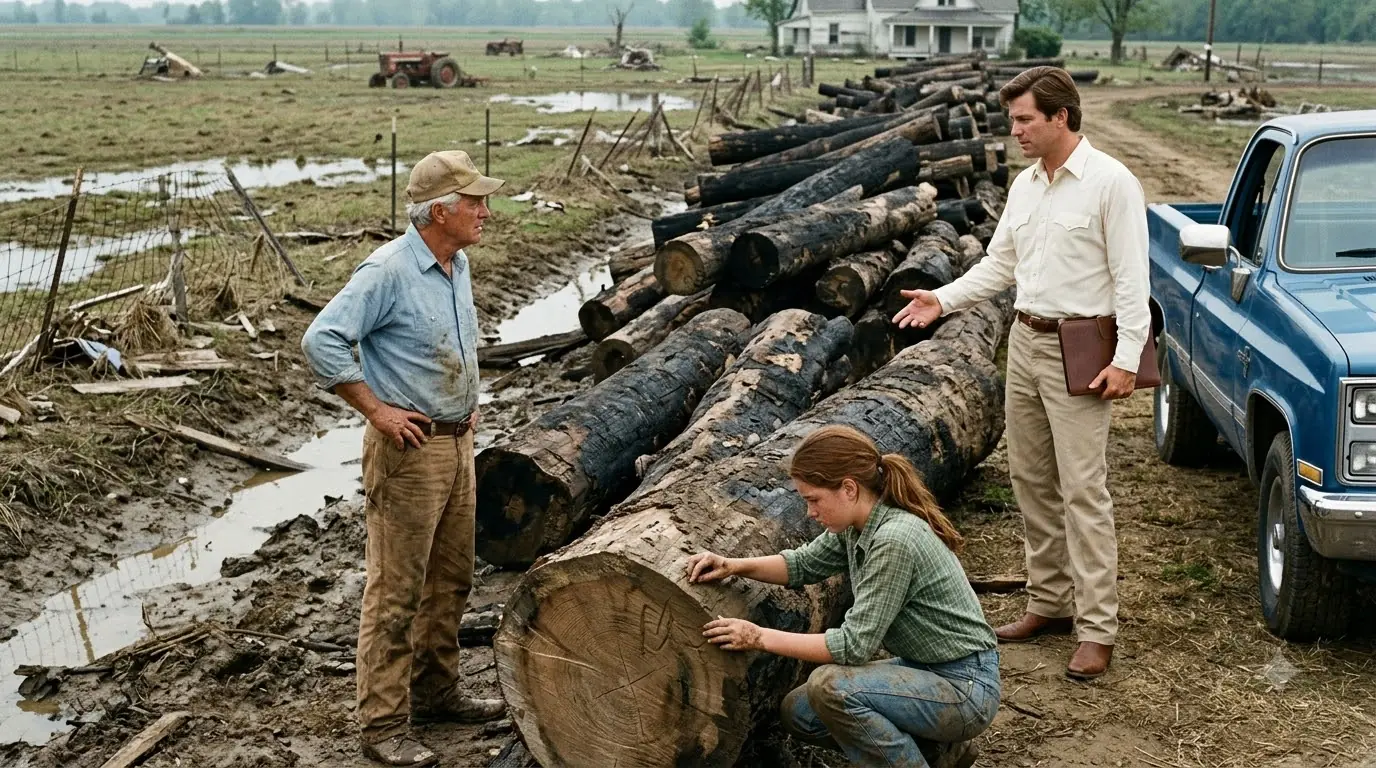
Her grandfather, Eli Bell, stood at the edge of the mess with his hands planted on his hips, studying the field the way a man studies a bill he already knows he cannot afford. After nearly a minute he shook his head and called the logs river junk.
The neighbors agreed with him. In the Delta, floods brought everything a river could carry: fence posts, propane bottles, dead branches, loose boards from sheds, whole trees torn from banks, and sometimes things nobody could identify until the mud dried.
The spring water had come fast after days of rain farther north, spilling out of drainage channels and spreading over the Bell family's sixty acres with enough force to flatten woven wire, twist gate hinges, and leave strips of pale silt where grass had been. By the time the water began dropping, everybody was tired enough to accept the simplest explanation for what remained.
Norah did not. She had spent most of the three days of waiting on the porch, watching the brown water retreat inch by inch from the fence posts, and when the pasture finally became safe enough to cross in boots, the logs were the first thing that bothered her. Fresh driftwood looked torn and violent to her, all splinters and ragged bark, but these trunks looked different. Their outer surfaces were black and smooth in long places, almost polished, and the exposed ends were dark around the edges while the wood beneath looked pale, dense, and strangely intact.
Eli noticed her staring. "Don't get ideas about keeping any of that," he said. "I've got enough to move without you turning a tree trunk into a science project."
"I'm just looking."
"That's how your projects start."
Norah stepped closer to the largest trunk, sinking almost to her ankles. "Then maybe don't let me look."
Eli snorted. "Too late for that fifteen years ago."
The morning sun was already turning the mud warm, releasing the heavy smell of wet earth, rotting grass, and diesel from the tractor Eli had parked near the lane. The flood had rearranged the pasture so completely that familiar distances looked wrong. A gate that used to stand straight now leaned inward, a section of fence had vanished entirely beneath the debris, and the old drainage swale at the southern edge of the field had widened into a gouged channel lined with branches and black water.
The logs were jammed along that swale in a mass perhaps seventy feet long. Some lay crosswise. Some pointed downstream. Several were stacked two or three deep, and one had been driven beneath the old fence line hard enough to lift two posts from the ground. It did not look like a pile someone had made, but it also did not look random.
Norah climbed onto a drier patch beside the biggest trunk and brushed clay from its sawn end. The black surface flaked away beneath her fingers. Underneath was a pale oval where the old cut had been protected from the air, and across that oval she saw a shallow symbol made of two intersecting lines and a curved notch. It was not natural. It was not a crack.
She stopped moving.
Years earlier, when she was nine or ten, Eli had shown her a block of old wood wrapped in burlap at the back of his workshop. He had taken it down only because she had been asking why one piece of timber on a high shelf was treated as though it might break if somebody breathed on it. The block was dark on the outside and golden-brown within, heavy for its size, and one end carried almost the same mark.
"What does it mean?" she had asked.
Eli had rubbed his thumb over it. "Means somebody wanted to know whose timber it was."
"Whose?"
"Depends on the mark."
"Whose mark is this?"
He had looked at her then with a seriousness she remembered better than the answer. "I don't know for certain. And when you don't know where old wood came from, you don't cut into the mark just because you're curious. Once you cut something away, you don't get to ask it another question."
That sentence returned now as clearly as if he had spoken behind her shoulder.
Norah wiped more mud away.
The symbol sharpened.
"Granddad."
Eli was fifty yards away examining a washed-out corner post. He did not turn.
"Granddad."
Something in her voice made him look.
He walked over slowly, boots sucking at the mud. "What?"
Norah pointed.
For a moment he said nothing. Then he crouched with a soft grunt, reached into his pocket for a folded handkerchief, and wiped the cut end more carefully. The lines did not disappear. They were weathered, shallow, and old, but deliberate.
"You've seen that before," Norah said.
"I've seen marks like it."
"On the piece in the shop."
Eli's eyes shifted toward her. "Maybe."
"That means yes."
"It means maybe."
Norah smiled despite herself. "You're bad at lying."
"I'm not lying. I'm refusing to let a fifteen-year-old turn one scratch into buried pirate treasure before breakfast."
"I didn't say treasure."
"You were thinking it."
"I was thinking timber."
"Same thing to your imagination."
Before she could answer, an old blue Ford pickup rattled down the farm lane, its suspension complaining over every rut. Norah recognized it before the driver stepped out. Marcus Sterling owned Sterling Timber & Hauling twelve miles east of the Bell farm and bought everything from storm-fallen oak to small tracts of pulpwood. He was in his early fifties, square-shouldered, always clean-shaven, and known for wearing light-colored work shirts that somehow stayed cleaner than anyone else's by noon.
He parked where the ground was still firm and stepped down in boots without a trace of mud on them. "Heard the water treated you rough, Eli."
"Heard right."