I don't let animals touch my feet. Vincent Moore looked at Mara up and down like she was something stuck to his shoe. And that's all your kind ever were. Animals. The whole diner went silent. He flicked a folded bill at her feet. Pick it up. Crawl for it. Amara Wilson set the coffee pot down. Soft voice. Sir, I don't want to do this. Do what? You can't do anything. Then let me walk away. But Moore didn't want her to walk away. He wanted a show. He rose from his booth, arms spread wide, his six men circling the table. Fight me right here, right now. He didn't know two things. First, what she did before this job. Second, within a minute, every man here would be on the floor.
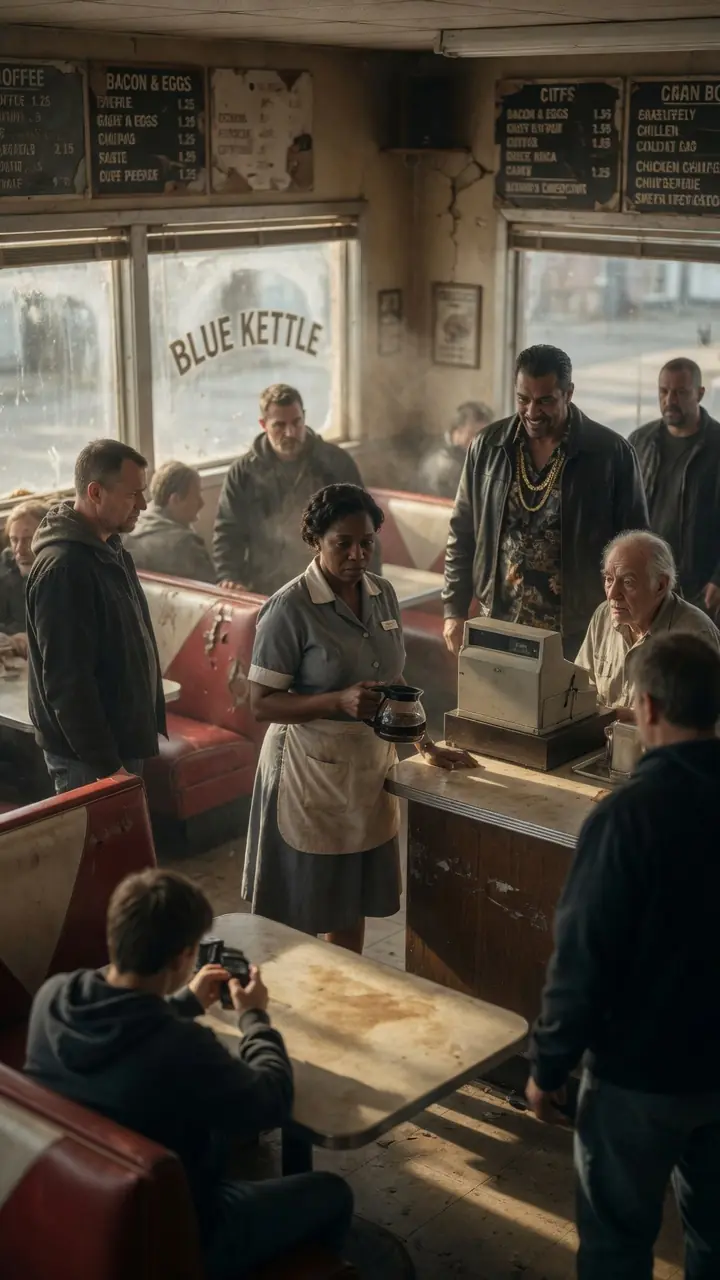
Rewind 6 hours. Before any of this, the Blue Kettle sat on a tired corner of a workingclass block, the kind of place where the coffee was cheap and the booths had seen better decades. Ruth Taylor had owned it for 30 years. She ran it like a living room, and she treated her staff like family. Amara Wilson had worked there for almost a year. She came in before sunrise, tied her apron tight, and moved through the morning rush without a wasted step. Regulars liked her. She remembered their orders, their kids' names, the way they took their eggs, but she never talked about herself. That was on purpose. Amara worked doubles she didn't have to. Every other Friday, she wired money to her younger sister, Naomi, two states away, who was the first in their family to reach college. Just focus on your books, Amara told her on the phone. I've got the rest. She lived small. one room, one duffel bag's worth of things, a mattress on the floor. She didn't keep photos on the walls. She slept badly, and when a chair scraped too sharp behind her, she turned before she could stop herself. People thought she was shy. She let them think it. Being invisible kept her safe, and it kept her job, and the job paid Naomi's tuition. That was the whole math of her life. What they didn't see was how much she noticed. She always knew how many people were in a room. She read hands before faces and watched for the ones who sat with their backs to the wall. Old habits, the kind you don't choose, the kind that choose you and never let go. One slow afternoon, a trucker started choking on a bite of steak two tables over. Before anyone else stood up, Amara was behind him. Three sharp pulls and the meat came loose. The man gasped. The diner clapped. Amara just refilled his water like nothing had happened and walked back to the kitchen. Ruth watched that. She didn't say anything, but she watched. "Where'd you learn that, honey?" she asked later, drawing a glass. "You pick things up," Amara said. Ruth let it go. "She'd learned that some people carry their past like a closed door. And you don't go knocking unless they hand you the key." "You're a good one, Amara," Ruth said. Whatever you ran from, you landed somewhere safe. Amara smiled soft and tired. Safe is all I want. She believed that, too. For almost a year, it had even been true. Across town, a different kind of man was doing his own kind of math. Vincent Moore ran three blocks like he owned the people on them. [clears throat] He called it protection. Everyone else called it what it was. He drove slow past the storefronts, deciding who paid and who got reminded why they should. To him, a place like the Blue Kettle wasn't a diner. It was a payday that hadn't come due yet. He'd noticed Ruth was getting older. He'd noticed the diner had no security, no cameras worth a thing, and one quiet waitress who kept her eyes down. Soft target, easy money. That was how he saw it. That place is overdue, Moore told his men, tapping the wheel. Old woman, empty till nobody who matters. We start this week. His right hand, a heavy man named Dale, smirked. And the waitress? What about her? Moore almost laughed. Women like that don't make trouble. They make coffee. He was a man who measured a room by who he could break. And when he looked at Amara Wilson, all he saw was someone small, someone tired, someone who'd never push back. He had no idea he was reading the most dangerous person in the building. This week, Moore decided the blue kettle would start paying. 2 days later, they came. It was the dead hour after lunch. Three of Moore's men walked in like they owned the floor. Dale led them. He didn't sit. He leaned over the counter where Ruth was counting receipts and put one thick hand flat on the register. "Mr. Moore runs this block now," he said. "500 a week. Keeps the windows from breaking." Ruth's hands went still. "30 years." And her voice barely shook. "I don't have that kind of money." "Then you'll find it." Dale knocked a salt shaker off the counter. It shattered. or we find it for you. Amara had been refilling sugar jars by the window. She set the jar down and crossed the room slow and easy, putting herself between Dale and the old woman. She said, "No," Amara said, soft, even. "Leave her alone." The room held its breath. Dale turned, looked Amara up and down, and started laughing. "Or what?" He stepped close. close enough that she could smell the cigarettes on him. You gonna do something, sweetheart? Every regular in that diner was watching. And here was the part that made it hurt. Amara could have ended him right there. She knew six ways to put him on the floor before he finished that sentence. Her body knew it. Her hands knew it. She did none of them. Because the second she fought back, there'd be a record, a name in a system, a reason for someone to look into who Amara Wilson really was. And if that door opened, she'd lose the job, lose the apartment, lose the money that kept Naomi in school. Two states away, her sister was counting on a check that only existed if Amara stayed invisible. So, she swallowed it. She looked at the floor. "We don't want trouble," she said quietly. Dale grinned. Victory cheap and easy. He swept a stack of menus to the ground and dropped a card on the counter. Friday 500. Tell the old lady. They walked out laughing. Ruth was shaking. Amara picked up the broken glass piece by piece, her face calm and her jaw tight. What none of them knew was that Dale had just made the worst mistake of his life, and his boss was about to make a bigger one. Friday came. Ruth didn't have the money. She'd scraped together $200 and left it in an envelope by the register, praying it would be enough. It wasn't. Dale slid the envelope back across the counter without counting it. Mr. Moore wants to talk to you himself now, he said. He likes to meet the people who waste his time. That afternoon, Vincent Moore walked into the blue kettle for the first time. He moved through the diner slow, touching things that weren't his. He ran a finger along the counter and checked it for dust. He sat in the best booth, the corner one, and put his feet up on the seat across from him. Six men spread out around the room. The regulars went quiet. A few got up and left, leaving food on their plates. More like that. Fear was a language he spoke fluently. So, this is the place, he said to Ruth. 30 years and you can't make rent on a Friday. sad. "Please," Ruth said. "Business is slow. Give me two more weeks." "Two weeks," Moore smiled like he was being generous. Then he turned his head and his eyes found Amara standing by the kitchen door with a coffee pot. And something in him changed. "Here is what was going through Vincent Moore's mind. He'd spent 30 years reading people for weakness, and this waitress didn't read right. She was too calm, too still. The fear in the room didn't touch her, and that bothered him in a way he couldn't name. So, he did what men like him always do with something they can't understand. He decided to break it. "You," he said, snapping his fingers. "Coffee now." Amara crossed the room and filled his cup without a word. He took one sip and spat it back out onto the floor an inch from her shoes. "Cold? You served me cold coffee." He held the cup out and tipped it over, letting it pour onto the clean floor. Clean it up. The gang chuckled. Amara got a rag and knelt down and wiped it up. That should have been enough. It wasn't. Over the next 20 minutes, Moore made a show of her. He ordered food and sent it back twice. Then a third time, complaining the eggs were touched by the wrong hands. Each time, Amara took the plate, calm, silent. Each time the men laughed louder. Each time Moore leaned back, enjoying it more. "Look at her," he told his crew loud enough for the whole room. "Trained well, knows her place. My grandfather had people like her. They knew not to look you in the eye." A young regular named Eddie, barely 20, stood up from his stool. Hey, that's enough, man. One of Moore's men put a hand on Eddie's shoulder and pushed him back down hard. Eddie sat. He didn't get up again. Nobody did. Smart kid, Moore said, not even looking at him. You learn fast who runs a room. He turned back to Amara. He wanted more than silence now. He wanted her to beg. Say it. He told her. Say, "Thank you for the lesson. Go on in front of everybody." Amara's knuckles whitened on the rag. She said nothing. "She can't even talk." Dale laughed. "Boss, I think you broke her. Moore smiled, but inside the smile felt thin. Three words. He'd asked for three words and gotten stone. Men begged him. Grown men cried in front of him. This woman wiped a counter and acted like he wasn't there. It gnawed at him. He told himself she was simple. He almost believed it. And here is what made it unbearable. Amara took all of it. She wiped the counter. She refilled the water. She kept her eyes down. Every insult landed and she let it because she was doing math in her head that none of them could see. Naomi's tuition was due in 3 weeks. A fight meant police. Police meant fingerprints. Fingerprints meant the end of the quiet life she'd bled to build. So she held the line inside herself. The hardest fight there is, the one nobody films. But Moore saw her silence as proof. proof that he was right. Proof that she was exactly what he'd called her, something small and beaten that would never push back. And the more she gave him nothing, the more he wanted to take. He stood. He walked a slow circle around her. The way a man circles something he's bought. "You know what I think?" he said. "I think people like you only understand one thing," he leaned in close to her ear. "And it isn't words." Then he went further than even his own men expected. He reached out and tipped the coffee pot in her hand, pouring hot coffee across the front of her apron, soaking it through. She flinched just once, a sharp breath through her teeth. The diner gasped. Ruth cried out, and in that flinch, for half a second, something moved behind Amara's eyes. Not fear, the opposite of fear, a cold, trained stillness that Dale, standing closest, actually noticed. For one strange moment, the biggest man in the room felt a chill he couldn't explain. It passed. Amara set the pot down and stepped back. "I'd like you to leave now," she said, quiet, steady. All of you, Moore, laughed in her face. But that night, alone in his car, he kept thinking about that look. He'd spent his life making people afraid. He didn't have a word for what it felt like when for one second the fear ran the other way. So he decided to come back to finish what he'd started to prove in front of everyone that the quiet waitress was nothing. 3 days later, he would walk back through that door and the camera in a teenager's hand would be ready. What Moore had threatened, though, was about to reach someone he hadn't planned on. Because that night, two states away, his men were already looking up a name. Naomi Wilson. That night, Amara didn't go home and cry. She went home and got to work. She called Naomi first. "Listen to me," she said. "Don't walk to class alone. Stay where there are people. I'll explain later." Then she hung up before her sister could ask questions. She sat on the floor with a notebook and did the thing she'd been trained to do years ago in another life. She stopped reacting. She started planning. She wrote down every date, every threat, the $200 in the envelope, the card Dale had left. The exact words Moore used while they were still sharp in her memory. The next morning, she made two quiet phone calls. The first was to Grace Anderson, a lawyer who'd helped people in her old unit.
Document everything, Grace told her. Don't throw a single punch you can't defend in court. The second was to an old friend who still wore a badge, a detective named Daniel Brown, who'd seen Moore's name on too many files that went nowhere. Then Amara bought three small cameras and mounted them herself in corners no one would think to look. She wasn't running anymore. She was setting a trap, and she was the patient kind of hunter. She didn't know Moore was already on his way back. And this time, he wouldn't come alone. 3 days later, on a Tuesday, the door of the blue kettle opened and the room went cold. Vincent Moore walked in with six men behind him. This was the scene from the very beginning, the one you've been waiting for. Now you know how they got here. It was past the lunch rush. A dozen regulars sat scattered at the tables. Ruth was at the register and in the corner booth, a 16-year-old named Eddie's little brother, a quiet kid with a phone, felt something wrong in the air and started filming under the table. He didn't know why. He just knew he should. Moore didn't sit this time. He walked straight to Amara. I've been thinking about you, he said, all weekend. You embarrassed me in my own town. He smiled. So today, you're going to fix that. You're going to get on your knees in front of everyone and apologize. I'm not going to do that, Amara said. The diner held its breath. I don't let animals touch my food, Moore said the same words as before, savoring them. And that's all your kind ever were. Animals. He flicked a folded bill at her feet. Pick it up. Crawl for it. Amara set the coffee pot down. Soft voice, steady hands. Sir, I don't want to do this. Do what? He laughed. You can't do anything. Then let me walk away, she said quietly. But Moore didn't want her to walk away. He wanted a show. He rose up onto his toes, arms spread wide, his six men circling the table. "Fight me!" he shouted. "Right here, right now." And then he made the mistake. He nodded to Dale, and Dale swung first. A heavy fist aimed straight at Amara's face. What happened next took 4 seconds. Slow it down. Watch it frame by frame because this is the part the whole internet would watch a 100 million times. Amara's head moved 2 in. Just two. Dale's fist sailed past her cheek and met empty air. Her left hand came up and caught his wrist, light as a handshake. Then her hip turned and the biggest man in the room left the ground. Dale hit the floor flat on his back. The air punched out of him in one loud hoop. Plates rattled. A glass tipped and rolled off the counter and shattered. Somewhere a woman screamed. A chair scraped as a regular scrambled backward. For one full second, nobody moved. Then two men rushed her at once. She didn't step back. She stepped in. The first man's own momentum carried him past her as she guided his arm down and folded him over a table. Cups and ketchup bottles went flying. The second she met with a short, clean strike to the inside of his knee. He dropped, grabbing his leg, howling. A fourth man pulled something from his belt. A knife, the metal catching the light. The diner screamed. Ruth pressed both hands over her mouth. Eddie shot up from his stool, but there was no time to reach her. This is the second moment to watch in slow motion. The knife came at her in a low arc. Amara didn't pull away from it. She moved toward it, trapped the wrist with both hands, rolled it over, and the blade clattered to the floor and spun under a booth. One twist, and the man was on his knees, his own arm bent behind him, gasping. She held him there, controlled exactly as hard as she needed, and not one ounce harder. That was the difference. Watch her face in the footage. There's no rage in it, no joy, just focus the way a surgeon focuses. Every move was defense. Every move stopped the second the threat stopped. Two men left. They looked at their boss. They looked at three of their own on the floor, groaning, clutching wrists and knees, and they backed toward the door, hands up, eyes wide. The whole thing was over in under a minute. The diner was dead silent, except for the men moaning on the tile. Then from a back booth, somebody started clapping. Then another. Eddie was on his feet, and so was Ruth, tears running down her face. The regulars who'd sat frozen in fear 3 days ago were standing now because they just watched the thing they thought was impossible. Somebody small had stood up to somebody powerful, and one more stood frozen in the middle of his wrecked crew. The man who measured rooms by who he could break had just watched a waitress half his size dismantle six armed men without throwing a single wild punch. "What are you?" he whispered. Amara let go of the man's wrist and stepped back, breathing even. She didn't gloat. She picked up a fallen chair and set it upright. "I'm someone who asked you to leave," she said. Moore's face went red, [music] then white. He pointed a shaking finger at her. "You think this is over? You put your hands on my men. You assaulted us. I've got six witnesses." He looked around at his groaning crew, and a new, uglier idea lit up his eyes. Six witnesses who will say whatever I tell them to say. And just like that, the man who'd lost the fight started planning to win the war. He pulled out his phone and dialed. Yeah, he said, staring straight at Amara. I need to report an assault. The blue kettle on Mercer. Crazy woman attacked me and my friends were hurt bad. Amara's stomach dropped. She defended herself perfectly. She'd controlled every move. But Moore had connections, money, and a phone. And he was already rewriting the story. In the corner, the 16-year-old kid sat frozen, phone still recording, having captured every single second. He didn't go to the police. He went home, hands shaking, and he uploaded the video that night with 11 words. Mafia boss told a waitress to fight him. She did. By morning, it had 2 million views. By that afternoon, it had 30 million. And the world had a new hero whose name they didn't even know yet. People watching it on loop. They slowed it down. They froze the frame where the knife left the man's hand and pointed at the calm on her face. Self-defense instructors broke it down move by move and said the same thing. This woman was trained somewhere serious by someone who knew exactly what they were doing. Strangers argued in the comments about who she might be. Nobody guessed the truth. They were calling it the bravest thing they'd ever seen. They were sharing it under one hashtag that climbed to the top of every feed in the country. #standup waitress. But while the internet celebrated, a police car was already pulling up outside Amara's building, and the officers getting out of it were not coming to thank her. They arrested her on her own doorstep. Two officers, an apology in their eyes, but handcuffs in their hands. Amara Wilson, you're under arrest for aggravated assault. She didn't resist. She turned around and offered her wrists, calm as ever, because she'd known this was coming. She just hoped it wouldn't come this fast. Here is what Vincent Moore was doing while she sat in a holding cell. He was working the phones. Moore had spent 20 years buying small pieces of a city. A clerk here, a councilman there, a detective who owed him. None of it was enough to own a place. All of it was enough to bend a story. And a bent story was all he needed. By the next morning, three of his men had filed sworn statements. They didn't match the video. They told a better tale. In their version, Amara was unstable. She'd flown into a rage over a complaint about her service. She'd attacked customers without warning. Moore, they swore, had been trying to calm her down. "She's dangerous," Moore told a reporter on the courthouse steps, holding his arm in a sling he didn't need. "I went in for a cup of coffee. I came out attacked. What kind of woman does that? There's something wrong with her. And then he played his smartest card. He went after the video. That clip is edited, his lawyer announced. It starts in the middle. It doesn't show what my client's men endured before they were forced to defend themselves. The public is being manipulated. It was a lie, but it was a clever lie because it gave people permission to doubt, and doubt spreads faster than truth. The tide began to turn. The same internet that crowned Amara a hero on Monday started asking questions on Wednesday. New accounts appeared posting the real story. They dug up nothing about her because there was nothing to find. And somehow that emptiness became the suspicious part. Why no social media? Why no history? What is she hiding? A woman with no past, the post said, is a woman with something to hide. #standup waitress started sharing space with a new tag # who is she really? The TV shows piled on. A morning host held up a still from the video and frowned. Heroic or terrifying. Where does a waitress learn to disarm an armed man? Our next guest says that should scare you. Talking heads who'd never set foot in the diner argued about Amara like they knew her. A body language expert studied her calm face on the footage and called it cold and detached. The look, he said, of someone who feels nothing. The very stillness that had saved lives was twisted into proof that something was wrong with her. Moore's people fed the fire. Anonymous tips, doctorred timelines, a leaked police source claiming she had a violent history which no one could produce, but everyone repeated. By Thursday, half the country that had cheered her on Monday wasn't sure anymore, and uncertain was all Moore needed them to be. Then it got worse. Moore filed a civil suit. $2 million in damages for himself and his men. The number was absurd. That was the point. Amara had $400 in a checking account and a sister's tuition due in 2 weeks. Moore knew it. He didn't expect to collect. He expected to bury her. The diner felt it, too. A health inspector showed up the next day, an inspector, Daniel Brown, later learned, had golfed with Moore twice that month, and wrote the blue kettle up for 11 violations. Ruth was ordered to close for review. 30 years shut down in an afternoon. This is my fault, Amara told Ruth through the visiting glass, her voice breaking for the first time in the whole story. You took me in and I brought this to your door. Ruth pressed her wrinkled hand flat against the glass. You stood up for me when nobody else would. Don't you dare apologize for that. Don't you dare. But the walls were closing in. The district attorney, feeling the heat of a viral case, charged Amara with aggravated assault. If convicted, she faced years in prison. Her bail was set high. Naomi wired back the very tuition money Amara had sent her just to cover part of it. And Amara wept in the cell when she found out because the whole reason she'd swallowed her pride for weeks was to keep her sister in school. And now it was gone anyway. Everything she'd protected was being stripped away one piece at a time. The job, the diner, the money, the quiet, all of it exactly as she'd feared on day one. And the crulest part, she'd done everything right. She'd warned them. She'd asked them to leave. She'd defended herself and stopped the moment the threat stopped. She had a video proving it. And it still wasn't enough. Because the man she was fighting didn't play by the rules she'd respected her whole life. Let me tell you what was going through Moore's mind in those days. Because it matters. He wasn't worried. He was enjoying it. To him, this was the real fight. the only kind he ever won. The kind fought with money and lawyers and favors instead of fists. She beat my men, he told Dale over dinner, smiling. Fine, let her be strong. Strength doesn't matter in a courtroom. In a courtroom, the man who owns the room wins, and I own this room. He truly believed that. And for a few dark days, he was right. Every headline, every closed door, every frightened regular proved it. Amara sat in a cell, name dragged through the mud, sister's future spent. The only family she had left, Ruth, shut down and broken. The hero of the internet had become its villain in under a week. Public opinion is a current, and Moore had learned to swim it. But here is what Vincent Moore didn't know. The one card he'd never even thought to check. Amara Wilson had spent 8 years in the military. Not in a kitchen, not behind a counter. in military intelligence. Her job, her actual job, the thing she was trained to do better than almost anyone alive, was to take a pile of scattered facts and find the one thread that unravels everything. He dragged her onto the one battlefield where she was even more dangerous than she'd been in that diner. And while he celebrated, she sat in her cell, quiet, eyes closed, doing what she did best. She was building the case that would end him. She just needed one phone call to a lawyer named Grace Anderson, and the trap she'd started setting weeks ago would finally be ready to spring. The trial opened to a packed courtroom and a country watching. Moore arrived first in a suit that cost more than Ruth's monthly rent. Still wearing the sling, he smiled for the cameras. He'd done this before. His lawyer was expensive and smooth, and he opened by playing the doubt like a piano. You've seen a video, the lawyer told the jury. A short edited video, but you haven't seen the truth. My clients were victims. This woman, a stranger with no past she's willing to share, attacked them. Ask yourselves what kind of person hides who they are. It landed. You could see it land on the juror's faces. Then Grace Anderson stood up. Quiet, unhurried. [music] She set a thick folder on the table. "My client has nothing to hide," Grace said. She has been hiding to protect people. And today, with her permission, I'm going to show you exactly who Amara Wilson is. But first, let's talk about the men who say she attacked them. That's when the trap began to close. Grace called the first of Moore's men to the stand, the one whose knee Amara had struck. Under oath, he repeated the story. He'd been an innocent customer. Amara attacked without warning. Grace nodded along, patient, then asked one simple question. You testified you were seated at the counter when the attack began. Is that correct? Yes. Then how did your blood end up on a knife found under booth 4 15 ft away? Silence. Grace held up an evidence photo. The knife? The one Amara had disarmed. This was logged by the responding officers. It has your fingerprints on the handle. Would an innocent customer bring a knife to breakfast? The man's mouth opened and closed. He looked at Moore. Moore looked at the floor. That was the first crack. Here came the flood. Grace turned to the jury. Mr. Moore promised these men something to lie for him today. I'd like to know what. She faced the witness again. Three weeks ago, $1,000 moved from Mr. Moore's account into yours. The memo line said, "Consulting? What exactly were you consulting on?" "I I do odd jobs for him," the man stammered. "Like testifying?" Grace let the question hang. The juror in the second row wrote something down. "No further questions for this witness, though I suspect we'll be hearing from him again when the perjury charges are filed." The man left the stand gray-faced. Two of Moore's other witnesses, watching from the gallery, quietly stood up and walked out before they could be called. They had seen which way this was going, and they wanted no part of it. Grace had spent weeks doing what Amara directed from her cell, pulling one thread at a time. She produced the diner's books showing the protection demands. She produced the health inspector's golf records timestamped beside the inspection. She produced phone records showing Moore's number calling that inspector the night before the diner was shut down. And then she produced the cameras. Remember the three small cameras Amara had mounted herself in corners no one would think to look. They had recorded everything. Not the edited phone clip the world had argued about. The whole thing from the second Moore walked in to the slur to the bill on the floor to fight me to Dale throwing the first punch. The courtroom watched it on a large screen in total silence. They watched Amara ask three times to be left alone. They watched the first fist come at her face. There was no doubt left in the room. There was no edit. There was only a woman defending herself and stopping the instant she could. But Grace wasn't finished. She had one more thread, and it was the one that would clear Amara's name for good. The defense has spent this trial asking who my client really is, Grace said. As if a quiet life is a crime, as if having no record is suspicious. So, let me answer their question. She turned to the judge. Your honor, with the court's permission, and with my clients, I'd like to read a single document into the record. Amara closed her eyes. This was the part she'd protected her whole life, the door she swore she'd never open. She nodded. Amara Wilson served eight years in the United States Army, Grace read. Six deployments, a specialist in military intelligence and close quarters defense. She was awarded the Bronze Star for pulling four wounded soldiers out of an ambush under fire, sustaining injuries herself. The courtroom went still. She left the service to raise her younger sister after their mother passed. She took a job as a waitress because it was quiet and honest and far from everything she'd survived. She never told anyone what she'd done because she didn't want to be seen as a weapon. She wanted to be seen as a person. Here is the moment to remember. Watch the jury. Watch the gallery. The cold, detached face the experts had mocked on television. They understood it now. It wasn't emptiness. It was a soldier carrying things most people never have to carry. Choosing peace over and over, even when peace cost her everything. A woman in the front row began to cry. Then another. Eddie, sitting beside Ruth, wiped his eyes with his sleeve, and Amara, for the first time in the entire story, let one tear fall. Not because she was ashamed, because for years she'd believed that if people knew what she was, they'd only ever see the violence. and instead this room full of strangers was looking at her with something she never expected. Respect. Across the aisle, Vincent Moore felt the room turned against him like a tide going out. He leaned to his lawyer and hissed, "Do something." But there was nothing to do. You cannot cross-examine a bronze star. You cannot doubt a woman the whole courtroom just watched beg for peace. Grace closed her folder. "My client didn't attack anyone," she said. She protected an old woman, a room full of strangers, and finally, only when she had no other choice, herself. That isn't a crime. In every state in this country, that is a right. Then she delivered the line that would be quoted everywhere by morning. She turned and looked straight at Moore. The only person on trial here should be the man who walked into a diner, called a decorated veteran an animal, and ordered her to crawl. He didn't lose to a waitress. He lost to someone far braver than he'll ever be. The judge called a recess. And as the room emptied, something had shifted in Amara's face. The hiding was over. For 8 years, she'd been afraid of who she was. Now, in the worst place imaginable, she'd finally been seen. All of her. And the world hadn't recoiled. It had stood up. But the verdict wasn't in yet, and Moore, cornered and furious, had one last card hidden up his sleeve, the dirtiest one of all. Moore's last card came out that afternoon. His lawyer requested an emergency sidebar, and produced a new witness, a man who claimed Amara had threatened him in a bar two years earlier. It was a lie, a paid one, scraped together overnight. But Moore had learned that lies only need to be loud, not true. He'd forgotten who he was up against. Grace was ready. Detective Daniel Brown took the stand and laid down the bar's own records. The bar this witness named had closed 3 years before the night he described. It didn't exist on the date of his story. Then Brown produced the man's bank statement showing a payment from a Shell company, a company traced through two more steps back to Vincent Moore. The last lie didn't just fail. It detonated in Moore's own hands. The judge had seen enough. She ordered Moore detained on the spot, pending charges for witness tampering, bribery, and extortion, and referred the entire pattern to a grand jury. The room watched the man who owned the room get walked out of it in handcuffs. He didn't smile for the cameras this time. The jury came back the next morning. It took them less than an hour. Not guilty on every count. The word landed and the courtroom erupted. Strangers hugged strangers. Ruth wept into Eddie's shoulder, and Amara just sat there very still and breathed, like someone setting down a weight she'd carried for eight long years. Here is the part that matters most, the part that separates this story from a revenge story. Amara didn't win with her fists. She'd won that fight in under a minute, and it had nearly destroyed her. She won the war with patience, with evidence, with the law, with people who stood beside her. She beat a violent man without ever becoming one. That was the whole point. That was always the point. In the months that followed, everything Moore had torn down was built back stronger. The extortion case against him grew as more shop owners, no longer afraid, came forward. Vincent Moore, who had spent 20 years making an entire neighborhood pay, was convicted on a stack of felonies and sent to prison for a long time. The empire of fear he'd built collapsed the moment one person refused to crawl. The blue kettle reopened. The bogus violations vanished once Daniel Brown's evidence reached the right desk. On opening day, the line stretched around the block. people who'd seen the video, people who'd followed the trial, people who just wanted to shake the hand of the woman who'd stood her ground. Ruth cried at the register all morning and called it the best day in 30 years. Naomi got her tuition back, every dollar, plus an anonymous scholarship from a veterans fund that had watched the trial. She stayed in school. She's studying law now, and the country that had turned on Amara in a week turned back, this time for good. Because now they knew the whole story. Now they understood the calm. The hashtag that had doubted her # who is she really got buried under a new one. A movement that spread to diners and shops and small towns everywhere. People were tired of being pushed around. Hashtag seen and standing. It wasn't a call to fight. Amara made sure of that every time a reporter put a microphone in her face. Don't go looking for a fight, she'd say. Walk away if you can. Get cameras, get help, get the law. Use everything before you ever use your hands. I won because I had proof, not because I had fists. The movement became something real. Self-defense classes filled up, the kind that teach deescalation first and technique last. Towns passed ordinances, making it easier to report extortion anonymously. Out of one ugly afternoon in a diner, something good was spreading. Person to person, block to block. Amara Wilson, the woman who'd spent her life trying to be invisible, had become impossible to ignore. Not because she was the most dangerous person in any room, though she was, but because she'd shown a frightened country that the quiet ones are not the weak ones, and that dignity, once a person decides to keep it, cannot be taken by any amount of money or cruelty or noise, and that sometimes the bravest thing a strong person can do is stay gentle for as long as humanly possible, and stand up only when there's truly no other way. But the story doesn't quite end in that courtroom or that diner because Amara did one more thing, something nobody saw coming. And it's the reason her name still means something today. 6 months later, on a quiet Saturday morning, the back room of the blue kettle filled up with people. This was the thing nobody saw coming. Amara hadn't gone back to just waiting tables. With Ruth's blessing, she'd cleared out the storage room behind the diner, laid down some old mats, and started teaching a free class. No charge ever. Anyone could come. The class wasn't really about fighting. On the first morning, a dozen people sat on those mats. A retired teacher, a single mom, two teenagers, an old man who'd been robbed twice on his own street. They expected punches and kicks. That isn't what Amara taught. The goal is to go home safe, she told them, walking the room slow, not to win. Winning is for movies. Going home is for real life. She taught them to read a room, to find the exits, to use their voice before their hands, to walk away when walking away was possible, and it almost always was. "Your first weapon is your feet," she'd say. And people laughed, and then they understood. used them to leave. Only at the very end of every class did she teach a single technique, one clean way to break free and create distance. The same calm she'd shown in that diner. Defense, never offense. Stop the threat, then stop. Eddie's little brother, the kid who'd filmed the video, was there every week in the front. He'd grown about an inch. He still carried his phone everywhere, but now he used it to film the classes, posting little clips so people who couldn't make it could still learn. Ruth ran the coffee, of course. She'd never been busier or happier. The blue kettle had become something more than a diner. It had become a place where a frightened neighborhood came to remember it wasn't powerless. Naomi visited one weekend and watched her big sister teach. Afterward, she stood in the doorway with tears in her eyes. Mom would have loved this," she said. Amara just put an arm around her and didn't say anything because some things don't need words. Vincent Moore is still in prison. The neighborhood he terrorized for 20 years runs free of him now. His name is a footnote. Hers is the one people remember. And that's the whole story. A mafia boss walked into a diner and told a black waitress she was an animal, ordered her to crawl and dared her to fight. He thought he was looking at the weakest person in the room. He was looking at the strongest. And her strength wasn't in her hands. It was in how long she chose not to use them. So here's the question worth sitting with. How many people walk past us every day? The quiet ones, the invisible ones, the ones we underestimate without a second thought, who are carrying a story we'd never believe. That waitress refilling your coffee, that janitor mopping the hall. We decide who matters in half a second, and we are wrong more often than we'll ever know. Maybe the lesson is simple. Be kind to the quiet ones. You have no idea what they've survived. and be the kind of person who stands up for the ruth even when it costs you something. Now, here's where you come in. Have you ever watched someone get underestimated and then watch them prove everyone wrong? Have you ever been that person yourself? Drop your story in the comments below. Those comments are the best part of this channel, and someone reading today needs to hear what you've lived through. If this story moved you, share it with one person who needs the reminder that the quiet ones are not the weak ones. Send it to someone who's being pushed around right now and needs to believe they can still stand up the right way. And if you want more true-to-life stories about ordinary people who turned out to be extraordinary, hit subscribe and ring the bell so the next one finds you. Because for every bully who thinks he owns the room, there's a quiet person near the door who's about to prove him wrong.