Luke Bennett’s pickup truck rattled like a dying animal as he pushed it past sixty on Route 12.
The Indiana rain turned the asphalt into a river of reflected headlights.
Water lashed sideways across the windshield, and the wipers fought back with a tired squeal that made every second feel more fragile. 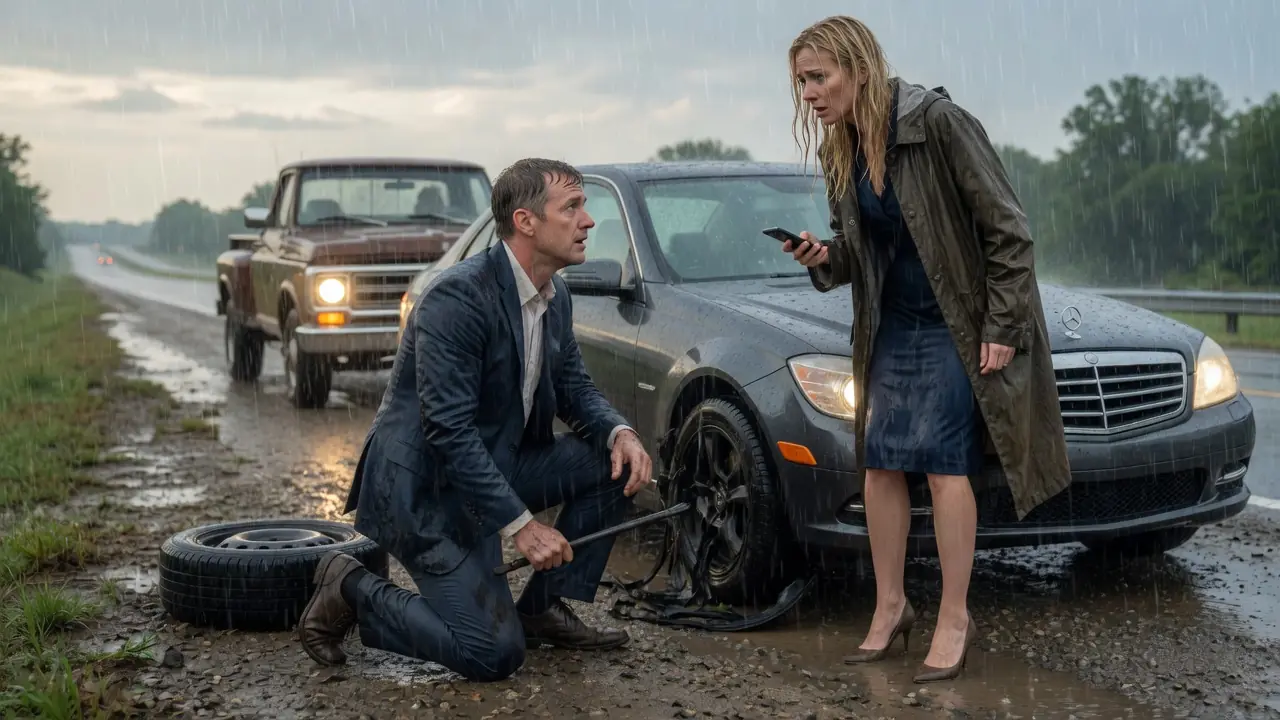
The truck shook through the steering column, through the floorboards, through Luke’s knees, as if the whole machine was begging him not to ask for one more mile.
His dashboard clock glowed.
8:43 a.m.
Seventeen minutes until the interview that could change everything.
Seventeen minutes to reach Brooks Engineering headquarters.
Seventeen minutes to escape the poverty that had been suffocating him and his daughter Grace for the past three years.
“Come on, baby,” he whispered to the truck, his voice barely audible over the rain and the struggling engine. “Just hold together for seventeen more minutes.”
The suit jacket hanging behind him swayed with each pothole.
It was not his jacket.
His neighbor Miguel had loaned it to him the night before, standing in the doorway of his own trailer with a cigarette tucked behind one ear and a look of serious responsibility on his face.
“You get that job, Luke,” Miguel had said, holding out the plastic garment bag like it contained a holy relic. “And when you’re rich, remember who made you look respectable.”
Luke had laughed then.
Not because it was funny.
Because if he did not laugh, he might have cried.
The jacket was a size too large in the shoulders, and one button was a slightly different shade from the others, but it was the best thing he had. Luke had pressed it three times that morning, trying to smooth out evidence of every life it had lived before him. He had ironed his white shirt twice. He had polished his shoes until they reflected the dim kitchen light. He had scrubbed his hands for nearly an hour, trying to remove the permanent stains of motor oil from his knuckles.
Some stains did not leave.
Some lives marked you too deeply.
His fingers tightened on the steering wheel as another wall of rain swept over the windshield and blurred the road into silver streaks.
Grace’s voice echoed in his mind from that morning’s breakfast.
“You’re going to get it, Dad. I know you will.”
She had said it while eating generic cereal from a bowl with a crack down the middle. Eleven years old, hair still damp from the shower, eyes bright with a faith no child should have to carry for a parent. She had smiled like success was already settled, like the job was simply waiting for him to arrive and claim it.
She had not asked about the electricity bill marked Final Notice tucked behind the toaster.
She had not mentioned that her shoes were held together with duct tape painted black to match the leather.
She had not complained that the cereal tasted stale, or that the milk had been watered down to make it last one more morning.
Grace Bennett had learned too early how to make hope easier on adults.
That hurt Luke more than hunger ever had.
He had kissed the top of her head, tasting the faint strawberry scent of the shampoo they had watered down to stretch another week.
“I’ll do my best, princess.”
Grace had looked up at him with her mother’s eyes.
“Your best is better than anyone else’s.”
God, how he wanted that to be true.
The fuel gauge hovered just above empty.
He had put in exactly enough gas to make it to Brooks Engineering and back, with maybe a dollar’s worth to spare if the old truck did not drink too heavily in the rain. Every cent mattered when a person lived on the knife’s edge between surviving and drowning.
The factory job at Mitchell’s Auto Parts kept them fed.
Barely.
It paid enough for rent on the trailer, some groceries, utilities if they juggled due dates, and medication when Grace got sick. It did not pay enough for savings. It did not pay enough for emergencies. It did not pay enough for dignity, at least not the kind a man wanted when his daughter pretended not to notice their life shrinking around them.
The medical bills from Susan’s cancer had created a hole that seemed to grow deeper every month, even two years after they had lost her.
Susan Bennett had been light.
That was how Luke always described her when people asked, though the word was too small. She had a laugh that filled rooms and a habit of singing half the wrong words to songs she loved. She pulled over for turtles crossing the road. She bought birthday cupcakes for coworkers who annoyed her. She carried granola bars in her purse in case someone needed food.
When the diagnosis came, she had sat in the doctor’s office with her hand in Luke’s and said, “We fight with joy, okay? No letting this make us cruel.”
She fought for twenty-two months.
She lost.
But cancer never managed to make her cruel.
It left Luke with a daughter, a mountain of bills, and a promise whispered from a hospital bed.
“Keep living,” Susan had told him, her voice thin but fierce. “Not just surviving. Grace needs to see you live.”
For two years, Luke had failed that promise.
He had survived.
He had worked.
He had packed lunches, paid what he could, fixed what broke, and slept in short stretches broken by worry. He had loved Grace with everything in him. But living was something larger, and Luke had forgotten how to reach for anything larger than the next bill.
Brooks Engineering had become the first real chance.
Senior mechanical engineer.
Seventy-eight thousand dollars a year.
Full benefits.
Dental.
Vision.
A retirement plan.
The number was almost impossible to imagine. More than double what he made at Mitchell’s. Enough to breathe. Enough to let Grace join the school orchestra instead of sitting outside the music room after class listening to other kids practice. Enough for fresh fruit instead of canned. New shoes. A working heater before winter. Maybe, someday, a college fund.
College.
The word felt like a door to a country he had never visited.
Thunder cracked overhead.
Luke instinctively checked the rearview mirror and caught his own reflection.
Thirty-four years old, but the bags under his eyes and the premature gray at his temples made him look older. He had shaved twice that morning, trying to remove every shadow of stubble. He had even borrowed Miguel’s cologne to mask the permanent scent of motor oil that seemed to live in his skin.
He looked nervous.
He looked tired.
He looked like a man trying to outrun his life.
“Senior mechanical engineer,” he muttered, practicing the title. “Luke Bennett, senior mechanical engineer.”
It sounded too clean for him.
Too polished.
Too far from the trailer park on Maple Street where rain leaked through the laundry room ceiling and the neighbor’s dog barked at everything that moved.
The windshield wipers dragged across the glass, creating brief windows of clarity before the world blurred again.
Luke leaned forward, squinting through the storm.
That was when he saw her.
The Mercedes sat crooked on the shoulder, hazard lights painting the rain in rhythmic orange pulses. It was silver, expensive, sleek even stranded, and entirely out of place on that lonely stretch of Route 12. A woman stood beside it, her navy blue dress soaked through, blonde hair plastered to her face as she held a cell phone in one hand and pressed the other against the car as if trying to hold herself upright.
Even from fifty yards away, Luke could see defeat in her posture.
Her shoulders shook from cold or tears.
Maybe both.
His foot moved instinctively toward the brake.
“No,” he told himself, pressing back on the accelerator. “Not today. It cannot be today.”
But as he drew closer, he saw more.
Her expensive heels were sinking into the muddy shoulder. The raincoat she did not have. The way she lifted the phone higher, searching for signal. The way passing cars threw water toward her and kept going.
She was alone on a stretch of highway known for bad cell service even in good weather.
The pickup continued past the Mercedes.
Luke caught her face in the side mirror.
She had seen him.
She raised one hand in a desperate wave, then let it fall when he did not stop.
The resignation in that small gesture hit him like a physical blow.
“Damn it,” Luke muttered.
His father’s voice filled the cab like a ghost.
“You help folks when they need it, son. That is what separates good men from everyone else.”
Robert Bennett had lived by those words. He had died by them too, heart giving out while helping a neighbor move furniture on a hot July afternoon. He left behind no money, no property, no retirement account, but his funeral had filled the church and spilled into the parking lot. Hundreds came. Men cried openly. Women brought casseroles for weeks. Children he had coached in Little League, now grown, stood in line to shake Luke’s hand and say, “Your dad helped me once.”
That had meant something.
Luke checked the clock.
8:45 a.m.
Fifteen minutes.
He could make it.
He could pretend he had not seen her. He could race to his interview. He could secure his and Grace’s future. The rational part of his brain screamed at him to keep driving.
This woman with her Mercedes and designer dress would be fine.
Someone else would stop.
Someone who could afford to be late.
Someone whose daughter did not need new shoes.
Someone whose life was not balanced on a final notice behind a toaster.
Then he thought of Grace.
He thought of her small face over generic cereal, telling him she believed in him.
He thought of what he was teaching her every day through actions more than words.
What kind of man did he want her to see when she looked at him?
What kind of father would come home with a job but without the courage to stop for a stranded woman in the rain?
What would Susan have done?
That question settled everything.
Susan would have stopped before thinking.
Susan once made him pull over in a snowstorm to move a half-frozen dog off the road. Another time, she gave their last five dollars to a veteran outside a pharmacy and then made grilled cheese for dinner because she said, “Cheese is better than guilt.”
Luke closed his eyes for one second.
“God, Susan,” he whispered. “You always did make things hard.”
Then he signaled and turned around at the next break in the median.
The U-turn took him back two minutes in the wrong direction.
By the time he pulled up behind the Mercedes, his dashboard clock read 8:48 a.m.
Twelve minutes to the interview.
It was five minutes back to the last exit, then twenty-five minutes to Brooks Engineering in good weather.
If he hit every light perfectly, if traffic cooperated, if miracles existed for people like him, he still would not make it.
Luke killed the engine and sat for one moment, watching the woman through his rain-streaked windshield.
He pulled Susan’s old raincoat from behind the seat.
He had kept it all these years, unable to give away something that still smelled faintly of her perfume when the air was damp. The coat was faded green, worn at the cuffs, and too soft from years of use. It had hung behind the seat like a memory he could not store anywhere else.
He stepped out into the storm.
Rain hit him like a thousand tiny fists, immediately soaking through his white shirt and borrowed suit pants. His polished shoes sank into mud as he approached the woman.
“Ma’am,” he called over the rain. “You okay?”
She turned to face him fully, and Luke was struck by her eyes.
Green like sea glass.
Red-rimmed from crying.
But intense.
Focused.
Alive with a force that seemed at odds with her vulnerable position.
She was younger than he expected, maybe early thirties, with refined features that spoke of privilege, but also something harder around the edges. Like someone who had fought battles in rooms where voices stayed polite and knives stayed hidden.
“My tire,” she said, raising her voice over the storm. “It just exploded. I was...”
She stopped and collected herself.
“I have a meeting. An important meeting. I cannot get anyone on the phone.”
“AAA?” Luke asked, already knowing.
“Two-hour wait. They said two hours.”
Her voice cracked slightly.
“I cannot wait two hours.”
Luke nodded.
He glanced at the front passenger tire.
Completely shredded. Rubber peeled back like a ruined flower.
“You hit something.”
“I do not know. Maybe. There was debris on the road from the construction zone.”
She wrapped her arms around herself, shivering.
“I don’t suppose you know how to change a tire.”
The question was so absurd that Luke almost laughed.
He had been rebuilding engines since he was twelve. He could change a tire blindfolded, half asleep, in a snowbank. Instead, he pulled off Susan’s raincoat and held it out.
“Put this on. You’re freezing.”
She hesitated, looking from the coat to his face.
“But you’ll get soaked.”
“Already am,” Luke said.
It was true. His interview clothes were ruined. The borrowed jacket hanging in the truck might still be dry, but his shirt and pants were lost. Miguel was going to kill him, then forgive him, then probably lecture him in Spanish too fast to follow.
The woman pulled on the raincoat, and it engulfed her smaller frame.
“I’m sorry. I do not even know your name.”
“Luke,” he said, already moving toward the trunk. “Luke Bennett.”
“Emily,” she replied.
Something flickered across her face when she said it.
Hesitation.
Calculation.
“Emily Madison.”
Luke did not notice enough to care.
He popped the trunk and found the spare. One of those temporary donut tires that would get her maybe fifty miles if she drove slowly. He also found the jack and tire iron, both pristine, clearly never used.
Everything about the car screamed money.
Leather interior.
Advanced dashboard.
Emergency kit still sealed in factory plastic.
A woman like Emily Madison probably lived in a world where problems were solved with phone calls and credit cards.
“This is going to take a few minutes,” Luke said, positioning the jack. “You might want to wait in my truck. Get out of the rain.”
“I’ll stay,” she said, pulling the raincoat hood up. “Least I can do is keep you company while you ruin your suit for a stranger.”
Luke glanced down at himself.
The white dress shirt was nearly transparent with rain. The borrowed pants clung to his legs. His tie hung crooked and wet against his chest.
“Job interview,” he admitted, not sure why he was telling her. “Kind of an important one.”
Her face changed.
“Oh God. What time?”
“Nine.”
She looked at her phone.
“It is 8:52. You could still make it if it were twenty-five minutes from here in good weather.”
“And if I abandon you here,” Luke said, loosening the first lug nut. “Which I’m not doing.”
“But your interview.”
“Will have to wait,” Luke said firmly, though the words felt like swallowing glass. “Or they will have to find someone else. Either way, I’m not leaving you stranded on Route 12 in a storm.”
Emily went quiet.
Rain had softened slightly, becoming a steady shower instead of a punishing wall, but the shoulder was muddy and the tire iron kept slipping in Luke’s wet hands. He braced one knee near the ruined tire and worked with deliberate efficiency.
“What kind of job?” Emily asked.
“Senior mechanical engineer,” Luke said, grunting as the lug nut finally gave. “Brooks Engineering.”
Emily went very still.
“Brooks Engineering?”
“Yeah. You know it?”
“I have heard of it.”
Her voice had changed.
Carefully neutral.
“Good company, from what I understand.”
“The best,” Luke said, moving to the next lug nut. “They do work in renewable energy, sustainable manufacturing, industrial efficiency. It is not just about the money, though God knows I need that too. It is about being part of something that matters.”
“And you are missing the interview to help me.”
It was not a question.
Luke did not treat it as one.
He focused on his work, trying not to think about the clock ticking away.
About Grace’s face when he came home with the same life instead of a new one.
About another month choosing between electricity and groceries.
“Why?” Emily asked suddenly.
Luke paused.
“Why what?”
“Why would you do this? You do not know me. I am nobody to you.”
Luke stared at the tire iron in his hand, rain sliding down his face.
“My wife,” he said slowly. “She used to say we are all just walking each other home. That every person we meet is fighting some battle we know nothing about, carrying some weight we cannot see. She said the least we can do is not add to it. And if we can, maybe help carry it for a while.”
Emily’s expression softened.
“Used to say?”
“Cancer,” Luke said simply. “Two years ago.”
“I’m sorry.”
“Me too.”
He went back to work.
“But she was right about helping people. My dad said the same thing, different words. You help folks when they need it. Simple as that.”
“Even when it costs you everything?”
Luke thought about the interview.
The seventy-eight thousand dollars a year.
The orchestra Grace wanted to join.
The bill behind the toaster.
The shoes held together with duct tape.
“Everything is relative,” he said. “Yeah, this job would have changed my life. Would have meant my daughter could have things I cannot give her now. But what would it cost me if I drove past you? What would it cost her, knowing her dad saw someone who needed help and chose his own interests instead?”
Emily watched him work in silence.
The spare tire went on. Luke tightened the lug nuts in a star pattern, making sure the pressure was evenly distributed. Professional even in the rain. Professional even with his future washing away in the runoff at his feet.
“Your daughter,” Emily said. “Tell me about her.”
Luke’s face transformed before he could stop it.
A smile broke through despite the cold.
“Grace. She’s eleven. Smartest kid you’ve ever met. Gets it from her mother, thank God. Wants to be a doctor or an astronaut. Maybe both. She changes her mind every week, but it is always something big, something that helps people.”
He gave the last lug nut a final turn.
“She’s the reason I do everything. The reason I was trying for this job. The reason I stopped to help you. I want her to grow up knowing her dad did the right thing even when it was hard.”
“She sounds amazing.”
“She is.”
Luke stood, knees cracking from kneeling on wet asphalt.
“Okay, you are good to go. This spare will get you about fifty miles, but keep it under fifty-five. Get to a tire shop as soon as you can. There’s a good one at the Brookfield exit. Honest prices.”
Emily stared at him through the rain.
“Luke, I do not know how to thank you.”
“Don’t need thanks,” Luke said, carrying the ruined tire to her trunk. “Just pay it forward sometime. Help someone else when they need it.”
He was turning toward his truck when Emily caught his arm.
Her hand was small, but her grip was surprisingly strong.
“The interview,” she said. “Call them. Explain what happened. Any company worth working for would understand.”
Luke gave a short laugh, bitter despite himself.
“You do not know corporate America very well. They have three hundred applications for this position. They do not need to understand anything. They will just move on to the next person who showed up on time.”
“You might be surprised,” Emily said quietly. “Brooks Engineering, from what I have heard, values character.”
“Character does not pay the electric bill.”
He regretted the harshness immediately.
“Sorry. It is not your fault. This was my choice.”
“Yes,” Emily said with odd intensity. “It was. And that matters more than you might think.”
Luke did not know what to say.
He nodded and headed back to his truck.
He was reaching for the door handle when Emily called out.
“Luke, wait.”
He turned.
She jogged toward him through the rain, Susan’s raincoat flapping around her.
She pressed a business card into his hand.
“My number,” she said. “Call me later, please. I might know some people. Other opportunities.”
Luke looked at the card, but rain had already begun to blur the ink. He could make out Emily Madison and a phone number.
Nothing else.
“You do not owe me anything.”
“No,” she agreed. “But that is not what this is about. Just call me. Promise?”
There was urgency in her eyes he did not understand.
But Luke Bennett kept promises.
“Okay,” he said. “I’ll call.”
Emily smiled, the first real smile he had seen from her, and it changed her whole face.
“Good. Thank you, Luke Bennett. For everything.”
She ran back to her Mercedes.
Luke climbed into his truck.
The engine struggled to life, coughing like an old man with pneumonia.
His dashboard clock read 9:07.
The interview had started seven minutes ago.
Even if he drove there now, he would be almost forty minutes late.
It was over.
Luke sat for one moment, watching Emily’s Mercedes pull carefully back onto the highway, the spare tire making it list slightly.
His shirt was ruined.
His shoes were ruined.
Miguel’s suit was probably ruined.
And the job that could have solved almost every problem in his life was gone.
But as he put the truck in gear and headed back toward Maple Street, toward Grace and their small life, Luke found he did not regret it.
His father would have been proud.
Susan would have been proud.
And tonight, when he tucked Grace into bed, he could tell her he had done the right thing.
That had to count for something, even if he could not deposit it in the bank.
The rain began to lighten as Luke took the exit toward home.
He did not know that Emily Madison was actually Amanda Brooks.
He did not know she was already on the phone with her head of HR.
He did not know his act of kindness had set in motion a chain of events that would change everything.
He just drove home in his rattling truck, wet and tired and unemployed in spirit, but strangely at peace with the choice he had made.
The storm was passing, and through the breaking clouds a single ray of sunlight illuminated the road ahead.
Luke took it as a sign.
Not that everything would be okay.
But that he had chosen correctly.
Sometimes the best decisions were the ones that cost the most.
Sometimes the right path led away from what you wanted and toward who you really were.
As he pulled into the trailer park, he saw Miguel standing on his porch with coffee in one hand and concern all over his face.
The Maple Street trailer park was not the worst place in Indiana, but it was the kind of place people described with apologies. Gravel roads. Sagging porches. Bikes with flat tires leaning against aluminum siding. Stray cats sleeping under steps. Good people doing hard things quietly.
Miguel’s eyebrows rose when he saw Luke soaked and muddy.
“Brother,” Miguel called, “please tell me you got the job and this is just some weird rich-people initiation.”
Luke shut off the truck.
The engine coughed twice more after the key left the ignition.
“I did not make it.”
Miguel’s face fell.
“The suit?”
“Ruined.”
“The interview?”
“Missed.”
Miguel came down the steps.
“What happened?”
Luke held up one hand.
“I stopped to help a woman with a flat tire.”
Miguel stared at him.
Then he closed his eyes.
“Of course you did.”
“I’m sorry about the jacket.”
Miguel looked at the soaked fabric, then at Luke’s face.
“Forget the jacket. Did she get home?”
“She got back on the road.”
Miguel sighed, then pulled Luke into a hard hug despite the rainwater.
“You are too good for this world, Bennett.”
“No,” Luke said. “Just too broke to be good comfortably.”
Miguel laughed once and clapped him on the shoulder.
“Go inside. Your daughter has been watching the road since eight-thirty.”
Luke’s heart sank.
The trailer door opened before he reached it, and Grace flew out, her face bright with expectation.
“Dad, how did it...”
She stopped.
She took in his soaked appearance, his muddy shoes, the ruined shirt, the defeat he thought he was wearing like a sign.
But instead of disappointment, her face softened.
“You helped someone,” she said.
It was not a question.
Luke blinked.
“How did you know?”
“Because you’re you,” Grace said simply.
Then she wrapped her arms around his wet waist, not caring that he was soaking her sweater.
Luke held his daughter tight and felt the warmth of her against the cold that had settled into his bones.
“I’m sorry, princess,” he whispered. “I know you were counting on this.”
Grace pulled back and looked up at him with Susan’s eyes.
“Mom used to say good things happen to good people. Maybe not right away, but eventually. The universe keeps score.”
“Your mother was an optimist.”
“And she was usually right,” Grace countered. “Come on. You need dry clothes. I made soup.”
“You made soup?”
“Well, I opened a can and heated it up, but that counts.”
She tugged him toward the door.
“And Dad?”
“Yeah?”
“I’m proud of you for helping whoever you helped. That job was not worth changing who you are.”
Luke followed his daughter into their tiny home, marveling at the wisdom of an eleven-year-old who understood what many adults never learned.
The interview was over.
The opportunity gone.
But standing in his small kitchen while Grace ladled tomato soup into chipped bowls and lined crackers along the edges like a restaurant garnish, Luke felt richer than any salary could have made him.
He pulled out the business card once more.
The ink was smeared, but he had memorized the number before it disappeared completely.
Emily Madison.
Something about her felt unfinished.
Tomorrow, he would call.
Not because he expected anything.
Because he had promised.
Outside, the storm finally broke, and afternoon sunlight streamed through the trailer’s small windows.
It was beautiful in its way.
Not the beauty of glass towers and executive offices.
The beauty of a life lived by principles that mattered.
The beauty of choosing others over yourself.
The beauty of teaching your daughter through actions that some things were worth more than money.
That night, Luke tucked Grace into bed after she finished her homework at the small kitchen table. She had hummed while writing, the same off-key tune Susan used to hum while folding laundry.
Luke paused in the doorway.
Grace looked up.
“Dad?”
“Yeah?”
“You’re still sad.”
“I’m okay.”
“That’s not what I said.”
He smiled faintly and walked back to sit on the edge of her bed.
“I wanted that job for you.”
“I know.”
“I wanted you to have more.”
Grace reached for his hand.
“I want more too. But I want you more than I want more.”
The sentence nearly broke him.
He kissed her forehead and turned off the lamp.
Later, he stood alone in the kitchen and touched the final notice behind the toaster. He did not move it. He did not open it. He already knew what it said.
He stared at Susan’s raincoat hanging over the back of a chair, damp and wrinkled from saving a stranger.
“I hope you were right,” he whispered to the quiet room.
The next morning arrived like an unwelcome guest.
Gray drizzle tapped the trailer roof. Luke stood at the counter making Grace’s lunch, his hands moving automatically.
Peanut butter on wheat bread.
A bruised apple.
A juice box bought in bulk when they were on sale.
A plastic bag washed and reused so many times the zip barely held.
Grace appeared in the doorway, dressed for school in jeans that were getting too short and a sweater that had belonged to one of Miguel’s daughters.
“You okay?”
“Fine, princess. Just tired.”
“Did you call that lady yet?”
Luke glanced at the number scribbled on a napkin beside the phone.
“It is too early. Business people do not start until nine.”
“It’s 8:45,” Grace said, shouldering her backpack. “And you’re stalling.”
“When did you get so smart?”
“Tuesday,” she said with a grin that was pure Susan. “Call her, Dad. What’s the worst that could happen?”
Luke could think of several worst things.
Emily Madison could be a salesperson. She could offer charity he could not accept. She could not remember him. She could pity him.
Pity felt heavier than poverty some days.
But after walking Grace to the bus stop and watching until the yellow bus carried her away, Luke returned to the trailer and stared at his phone.
Finally, he dialed.
A polished voice answered.
“Amanda Brooks’s office. How may I direct your call?”
Luke nearly dropped the phone.
“I’m sorry. I must have the wrong number. I was trying to reach Emily Madison.”
A pause.
“May I ask who is calling?”
“Luke Bennett. She gave me her card yesterday.”
Another pause.
Different this time.
“Oh, Mr. Bennett. Yes. Ms. Brooks has been expecting your call. Please hold.”
Before Luke could process what was happening, classical music filled his ear.
Vivaldi, he thought, though his knowledge of classical music came from Susan’s old CDs and a library documentary Grace once watched for school.
His mind raced.
Amanda Brooks.
CEO of Brooks Engineering.
But the woman had said her name was Emily Madison.
Why would a CEO be stranded on Route 12?
Why would she lie?
Why had she looked at him like his missed interview mattered so much?
“Luke?”
The voice was familiar.
The same one from yesterday.
But different too.
More controlled.
More authoritative.
“Thank you for calling.”
“I’m confused,” Luke said honestly. “The receptionist said Amanda Brooks, but you told me your name was Emily Madison.”
A sigh traveled through the phone.
“I owe you an explanation and an apology. Could you come to my office today? Brooks Engineering headquarters. The same place you were supposed to interview yesterday.”
“Why?”
The word came out harsher than intended.
“Is this some kind of game? Rich CEO pretends to be stranded to test the help?”
“No,” Amanda said quietly. “It was not a game. I was genuinely stranded. The tire genuinely blew out. I genuinely needed help. The only lie was my name, and that is complicated. Please, Luke. Let me explain in person. I promise it will be worth your time.”
“I have work at two. Real work at a real job where real people depend on me.”
“I understand. Could you come now? I’ll make sure you are out by one-thirty.”
Luke wanted to hang up.
Wanted to tell Amanda Brooks, Emily Madison, whoever she was, that he did not have room in his life for rich people’s mysteries.
But he thought about Grace.
The final notice.
The shoes.
The gas gauge.
Pride was a luxury for people with savings accounts.
“Fine,” he said. “But I’m coming in my work clothes. The suit you saw yesterday was borrowed, and it is ruined now.”
“Come as you are,” Amanda said. “That is actually perfect.”
An hour later, Luke stood in the marble lobby of Brooks Engineering feeling like a fraud.
His cleanest jeans still had a faint oil stain near the pocket. His work shirt had been washed so many times the collar had softened and frayed. His boots were polished but old. Every person who walked past seemed cut from a cleaner world.
The lobby was all glass, steel, polished stone, and quiet money. A living green wall rose behind the reception desk. Sunlight poured through floor-to-ceiling windows. People moved with tablets and confidence.
The security guard checked Luke’s ID, looked skeptical, made a call, then straightened slightly.
“Yes, Mr. Bennett. Ms. Brooks is expecting you.”
The elevator rose so smoothly Luke barely felt motion.
The executive floor was even worse.
More windows.
More silence.
Modern art that probably cost more than his trailer.
A receptionist in her fifties smiled warmly.
“Mr. Bennett, Ms. Brooks is waiting for you.”
The office door was already open.
Luke stepped inside and found Amanda Brooks standing by the windows, her back to him.
She wore a cream-colored suit that looked like it had been sewn directly onto her body. Her blonde hair was pulled back in a style that was professional but softer than he expected. When she turned, he saw the same green eyes from yesterday.
Everything else was different.
The soaked, stranded woman in Susan’s raincoat was gone.
In her place stood a CEO.
“Luke,” she said. “Thank you for coming.”
“Should I call you Emily or Amanda?”
“Amanda. Emily was my mother’s name. I use it sometimes when I do not want to be the CEO. When I just want to be a person.”
She gestured toward a sitting area with leather chairs that looked more expensive than his truck.
“Please sit.”
Luke stayed standing.
“Why am I here?”
Amanda studied him, then nodded once, accepting that he deserved directness.
“Because you missed your interview yesterday to help me. Because that interview was important to you, and you chose to help a stranger instead.”
“Anyone would have.”
“No,” Amanda said. “They would not have. Do you know how many cars passed me before you stopped? Seventeen. I counted. Seventeen people saw a woman stranded in the rain and kept driving. You were the only one who stopped.”
“So what? This is guilt. You feel bad that I missed the interview, so you are going to offer me a consolation prize?”
Amanda’s eyes flashed.
“I do not do consolation prizes, Mr. Bennett. And I do not make business decisions based on guilt. Sit down, please.”
This time, Luke sat, though he perched on the edge of the chair as if ready to leave.
Amanda took the chair across from him.
“Tell me about Grace.”
Luke’s jaw tightened.
“How do you know her name?”
“I had HR pull your file after I got back yesterday. You have applied to Brooks Engineering three times in the last two years. Each time you made it further than most candidates. Each time something prevented the hire from happening.”
She lifted a folder from the table.
“Once, you missed the final interview because Grace was in the hospital with pneumonia. Another time, you declined because the position required relocation, and you could not move her away from her support system so soon after losing her mother.”
Luke looked at the folder like it was a violation.
Amanda’s voice softened but did not apologize for doing the research.
“A pattern emerges. You consistently choose people over advancement. Relationships over profit. Responsibility over ambition. That is rare, especially in someone with your qualifications.”
“My qualifications are a community college degree and fifteen years fixing other people’s mistakes.”
“Your qualifications include sixteen patents filed while you were at Mitchell’s Auto Parts, all assigned to the company for a fifty-dollar bonus each because you needed the money more than the credit,” Amanda said. “Your qualifications include redesigning their assembly line process on your own time, saving them approximately three hundred thousand dollars a year. Your qualifications include being the only person in the last five years to score perfectly on our technical assessment.”
Luke stared at her.
“How do you know about the patents?”
“Because unlike Mitchell’s, I pay attention to talent.”
She leaned forward.
“You are wasting yourself there, Luke. You are a brilliant engineer working as a mechanic because you cannot afford the risk of changing jobs. Because you have a daughter to support, bills to pay, and no safety net.”
“Must be nice to see all that from your tower,” Luke said before he could stop himself. “Analyze little people and their little problems.”
Amanda’s expression did not change, but something in her eyes did.
“My father built this company from nothing,” she said. “Started in a garage smaller than your trailer, actually. Worked eighteen-hour days, missed most of my childhood, had his first heart attack at forty-five. Before he died, he told me, ‘Amanda, I built you an empire, but I forgot to teach you how to be human.’”
Her voice lowered.
“He was wrong about that. He taught me plenty about being human. He taught me that when you see someone who needs help, you help them. He taught me character matters more than credentials. He also taught me the best business decisions often look like the worst ones at first.”
She stood and moved toward the windows.
“Yesterday, when you stopped, you did not know who I was. You had every reason to keep driving. A crucial interview. Your daughter’s future. Your own desperate situation. But you stopped anyway.”
“It is basic decency.”
“Exactly,” Amanda said, turning back to him. “And basic decency is the one thing I cannot teach, cannot train, cannot buy. Skills can be learned. Experience can be gained. Character is what you are when no one is watching, when it costs you something, when there is no reward waiting at the end.”
Luke shifted uncomfortably.
“So what are you saying?”
“I am saying the position you would have interviewed for was filled yesterday afternoon.”
The words hit Luke like a physical blow.
He had known it was probably gone.
Hearing it still hurt.
“Then why am I here?”
“Because I have a different proposition.”
Amanda returned to her chair, and her whole demeanor changed. More animated. More alive.
“I am creating a new position. Director of Manufacturing Innovation. It is not an engineering role exactly. It is bigger. I need someone who understands both technical systems and human systems. Someone who can look at our processes and see not only how to make them more efficient, but how to make them more humane.”
Luke’s mouth went dry.
“I don’t understand.”
“I have been trying to bridge the gap between executive level and manufacturing teams for years. Consultants come in with MBAs and beautiful presentations. Their ideas fail because they do not understand the reality of the people doing the work. You do.”
“You want to hire me because I’m poor.”
“I want to hire you because you are brilliant and you are poor,” Amanda corrected. “Because you have technical skill and lived experience. Because you chose to help a stranger in the rain even though it cost you what you thought was everything.”
“What is the catch?”
Amanda smiled faintly.
“You report directly to me. I am demanding. I am impatient. I have high standards. The role requires some travel, though we will work around Grace’s schedule. You will start at management level, which means corporate politics, which you will probably hate.”
She picked up another paper.
“The salary is ninety-five thousand to start. Full benefits. Dental. Vision. Company car, since yours is a 1998 Ford F-150 with over three hundred thousand miles. College fund contribution for Grace. If you last a year and perform well, we renegotiate up.”
Luke could not breathe.
Ninety-five thousand.
A car.
Benefits.
College fund.
Everything.
More than everything.
Impossible.
“This is because you feel guilty,” he said weakly.
“This is because I am a businesswoman,” Amanda said. “I see an undervalued asset, and I acquire it. Mitchell’s has been stealing from you, paying a fraction of your worth while profiting from your innovations. I am offering fair market value for your talent, plus a premium for your character.”
“I need to think about it.”
“Of course. But while you are thinking, consider this. Grace needs to see you valued properly. She needs to see that doing the right thing does not mean accepting less than you deserve. You have taught her sacrifice and hard work. Maybe it is time to teach her success too.”
The words hit home harder than Amanda could know.
Luke thought of Grace watching other kids join orchestra, go to movies, wear shoes without duct tape.
“When would I start?” he asked.
“Monday, if you can. That gives you time to give notice at Mitchell’s, though they do not deserve it.”
“They have been good to me.”
“They have exploited you,” Amanda said flatly. “They paid thirty-five thousand a year while your ideas saved them millions. That is not good to you. That is theft with a smile.”
Luke’s phone buzzed.
A text from the factory.
Where are you? Henderson’s looking for you.
“I need to go,” Luke said, standing. “I have a shift.”
Amanda stood too.
For a moment, they faced each other across the expensive carpet.
“The offer stands,” she said. “Call me when you decide. But Luke, do not take too long. I am patient, but not that patient.”
As he turned to leave, Amanda spoke again.
“For what it is worth, yesterday after you drove away, I sat in my car and cried. Not because of the tire. Because I realized I had forgotten what it looked like when someone did something simply because it was right. You reminded me of my father. Of why he started this company. Of what we are supposed to be about.”
Luke did not know what to say.
So he nodded and left.
The elevator carried him down from marble and glass to the parking lot where his truck took three tries to start.
The factory loomed ahead forty minutes later, all concrete, corrugated metal, and tired men smoking near the side entrance. Mitchell’s Auto Parts did not look evil. That was the problem. Most places that drained people did not look dramatic. They just looked ordinary.
Henderson was waiting by the time clock, face red with irritation.
“Bennett, where the hell have you been? We’ve got a crisis on line three.”
“Sorry, Mr. Henderson. Family emergency.”
“There’s always something with you, isn’t there? Get suited up. Thompson’s ready to shut the whole line down.”
Luke bit back his answer and went to the locker room.
His coveralls hung in the same dented locker he had used for five years. His name was embroidered over the pocket in thread coming loose at the edges.
Roberts from line two leaned against the adjacent locker.
“Heard you had an interview at Brooks yesterday. How’d it go?”
“Didn’t make it.”
“Figures,” Roberts said. “Guys like us don’t get jobs at places like that. They want college boys with clean hands and soft voices. We’re the muscle, Bennett. Sooner you accept that, happier you’ll be.”
Luke almost told him.
About Amanda.
About the offer.
About ninety-five thousand dollars and a badge that could change everything.
But he kept quiet and walked out to line three.
The conveyor system had seized. Thompson stood beside it with a clipboard and a sour expression.
“About time, Bennett. This mess is costing us thousands per hour.”
Luke examined the system and saw the problem almost immediately.
A bearing had overheated because someone had ignored the maintenance schedule he recommended three months ago. It would take hours to fix properly, but he could get it temporarily running in thirty minutes.
He slid under the conveyor.
Oil dripped onto his cheek.
Thompson’s voice cracked overhead.
“Stop daydreaming and fix the damn machine.”
Luke froze.
Amanda’s words returned.
Theft with a smile.
He slid out from under the conveyor and sat up.
“This would have been prevented if you approved the maintenance I requested.”
Thompson frowned.
“What?”
“This bearing was on the replacement list three months ago.”
“We don’t pay you to make lists. We pay you to fix things when they break.”
“And then fix them again because you refuse to invest in proper maintenance.”
The floor quieted.
Thompson stared at him.
“You got something to say, Bennett?”
Three days earlier, Luke would have backed down. Apologized. Remembered he needed the job.
But something had changed.
An offer sat in his pocket like a key.
“Yeah,” Luke said. “I do. This factory runs on equipment held together with prayers and duct tape. You ignore every recommendation I make because it costs money up front, then act surprised when everything falls apart. I have saved this company hundreds of thousands with my improvements, and I get thirty-five grand a year and lectures about knowing my place.”
Workers turned.
Machines hummed around them.
Thompson’s face darkened.
“You are walking a thin line.”
“No,” Luke said, surprising himself with the calm in his voice. “I am walking out.”
The words hung in the air like thunder.
“I quit.”
Thompson actually stepped back.
“You can’t quit. You have a daughter to support. You need this job.”
“I need a job,” Luke corrected. “I do not need this one.”
He set down his tools carefully.
“Fix your own machines, Thompson. Or hire someone else for thirty-five thousand and see how that works out.”
Luke walked back to the locker room, aware that half the factory was watching.
Roberts stood near the lockers, mouth open.
“Bennett, what the hell are you doing?”
“Something I should have done years ago.”
“You’ll regret it.”
Luke opened his locker.
“Maybe. But not as much as I would regret staying.”
He changed, folded the coveralls, and left them on the bench.
As he walked out of Mitchell’s Auto Parts for the last time, terror and exhilaration moved through him together.
He had no backup plan if Amanda changed her mind.
He had just bet everything on a woman he met in the rain.
But as he drove home, truck rattling and spirit strangely lighter, Luke knew he had made the right choice.
Grace was already home when he arrived, doing homework at the kitchen table. She looked up and immediately saw something in his face.
“Dad, what happened?”
“I quit the factory.”
Her pencil fell.
“You what?”
“Because Amanda Brooks offered me a job. Director of Manufacturing Innovation. Ninety-five thousand a year. Full benefits. Company car. College fund contribution for you.”
Grace stared at him.
“Amanda Brooks? The CEO?”
“Yes.”
“But I thought her name was Emily.”
“It is a long story.”
Grace stood slowly.
“Everything is going to change?”
Luke felt his throat tighten.
“Everything.”
Grace flew out of her chair and threw her arms around him.
“I knew it,” she said into his shirt. “I knew something good would come from helping her. Mom was right. The universe keeps score.”
Luke held his daughter tight.
“We’re going to be okay, princess. More than okay.”
“Can I get new shoes?” Grace asked, pulling back just enough to look at him. “The ones without duct tape?”
Luke laughed.
Really laughed.
For the first time in months.
“You can get whatever shoes you want.”
That evening, they celebrated with pizza.
Delivery.
Not frozen.
Luke called Amanda after Grace insisted he not wait.
Amanda answered on the first ring.
“I accept,” Luke said.
“Good,” Amanda replied. “I heard you made quite an exit from Mitchell’s today.”
“How did you hear that?”
“I have sources everywhere. Part of being a CEO.”
“I might have burned that bridge.”
“Some bridges need burning. Monday morning, nine. Executive entrance. Your ID badge and parking pass will be waiting.”
“Amanda, thank you.”
“Do not thank me yet. I told you I am demanding. You might hate me in a month.”
“I doubt that.”
“We will see. And Luke?”
“Yes?”
“Bring Grace to the office sometime next week. I would like to meet the daughter who inspired such loyalty.”
After he hung up, Grace looked at him with shining eyes.
“We’re really going to be okay, aren’t we?”
Luke nodded.
“Yeah, princess. We really are.”
Saturday morning, someone knocked on the trailer door.
Luke opened it to find a man in a suit holding a set of keys.
“Mr. Bennett, I’m from Brooks Engineering. Ms. Brooks asked me to deliver your company vehicle.”
Luke stepped outside.
A brand-new navy Ford Explorer sat near the gravel road, rain droplets shining on its hood.
Grace came running out in pajamas and circled it in awe.
“This is ours?”
“Company car,” Luke corrected, though his voice was barely steady. “But yes. We get to use it.”
The man handed over paperwork.
“Insurance and maintenance are covered. Ms. Brooks said reliable transportation is essential for your position.”
After the man left, Luke and Grace sat in the Explorer.
It smelled new.
Like possibility.
Grace ran her hands over the seat.
“Can we drive somewhere? Anywhere?”
“Where do you want to go?”
“The mall. We could look at clothes for your new job and maybe shoes for me.”
At the mall, Luke bought Grace three pairs of shoes.
Sneakers for school.
Dress shoes for special occasions.
Pink boots because she loved them so much she hugged the box.
He bought himself two suits that fit properly, three dress shirts, ties he did not know how to tie yet, and a belt that was not cracked.
Every purchase made him nervous until he remembered.
This was not reckless.
This was provision.
At lunch in the food court, Grace looked down at her new shoes lined beside her chair.
“Dad?”
“Yeah?”
“Do you think Mom knows?”
Luke swallowed.
“I think she does.”
“I dreamed about her last night. She said to tell you she was proud of you for stopping in the rain.”
Luke looked away quickly.
Grace reached across the table and touched his hand.
“She also said Amanda Brooks needs a friend.”
Luke laughed softly, though tears stood in his eyes.
“Did she?”
“She said she is lonelier than she looks.”
“Your mother always saw things other people missed.”
Monday morning arrived with unusual sunshine.
Luke stood before the bathroom mirror, adjusting his new tie for the third time. Grace sat on the closed toilet seat, offering commentary with the seriousness of a fashion consultant.
“A little to the left. There. Perfect. You look like you belong in a magazine.”
“I feel like I’m wearing a costume.”
“It is not a costume if it is who you are supposed to be,” Grace said. “Mom used to say sometimes we have to grow into our blessings.”
Luke turned to look at her.
“When did you become the parent?”
“Someone has to make sure you don’t chicken out.”
The drive to Brooks Engineering felt surreal.
No engine noise.
No worried glances at gauges.
No prayers at red lights.
His name was already on a reserved parking spot near the executive entrance.
Luke Bennett.
Director, Manufacturing Innovation.
He sat there for a moment, gripping the steering wheel.
Days ago, he had been racing toward an interview he never reached.
Now he walked in as a man the company expected.
Patricia, his administrative contact, met him near the desk with a badge, laptop, phone, and a smile.
“Mr. Bennett. Welcome.”
The badge had his photo from the application.
Under his name, bold letters read:
Director, Manufacturing Innovation.
It felt like fiction.
Conference Room A on the twentieth floor held Amanda and five other people.
Jennifer from quality control.
Marcus from engineering.
David from operations.
Sarah from finance.
Tom from human resources.
They all smiled and shook his hand, but Luke saw the questions in their eyes.
Who is this?
Where did Amanda find him?
Why does he matter?
“Everyone,” Amanda said, “this is Luke Bennett. He comes from the manufacturing floor, and he brings the perspective we desperately need. His first assignment is the Southside facility. Production is down, morale is worse, and every traditional solution has failed.”
Tom cleared his throat.
“The union situation makes it complicated. They resist changes from management.”
Luke spoke before he could overthink.
“Because most changes from management make their lives worse.”
The room went still.
Amanda’s mouth twitched.
Luke continued.
“Workers resist changes when they know the people making decisions have never done the work. You want them to listen, start by asking what hurts, what breaks, what wastes time, and what they already know how to fix.”
Marcus leaned back slightly.
“That sounds simple.”
“It is,” Luke said. “That does not mean it is easy.”
Amanda looked around the table.
“Luke will spend the first week on the floor. No consultants. No scripts. No reports written before questions are asked.”
After the meeting, Amanda asked him to stay.
When the room emptied, her professional mask slipped.
“How are you doing? Really?”
“Terrified.”
“Good,” she said. “Stay a little terrified. The day you get too comfortable is the day you stop noticing what matters.”
His office was on the fifteenth floor.
It was larger than his living room.
Windows overlooked the city. A desk gleamed under soft light. His name sat on the door in bronze.
On the desk was a framed photo.
Luke and Grace at last year’s school science fair, where she had won second place with a homemade water filtration project.
Amanda’s touch.
He did not know whether to be grateful or overwhelmed.
Maybe both.
The next morning, Luke arrived at Southside at six a.m. wearing khakis, a polo, and steel-toed boots.
The facility was huge, three times Mitchell’s size, with production lines that should have hummed with efficiency but instead stuttered and stopped with alarming frequency. The smell of hot metal, coolant, dust, and tired coffee made him feel strangely at home.
He positioned himself near the break room and watched shift change.
Night shift workers trudged out.
Day shift workers dragged themselves in.
Body language told him more than any report.
“You the new suit?” a voice asked.
Luke turned.
A man about his age stood behind him, weathered face, tired eyes, calloused hands. Universal look of a factory lifer.
“I’m Luke Bennett. You?”
“Carl Rodriguez. Line supervisor. What I supervise changes depending on what’s broken.”
“Show me.”
Carl blinked.
“Show you what?”
“Everything. What’s broken? What’s held together with prayer? What keeps you up at night?”
For the next six hours, Carl showed him the truth.
Ancient equipment that should have been replaced years ago.
Safety shortcuts that made Luke’s skin crawl.
Workers doing the jobs of three people because hiring was frozen.
Maintenance requests denied until failure became inevitable.
“You want to know why efficiency is down?” Carl said beside a conveyor held together with wire and stubbornness. “Because people stopped caring. Brooks keeps sending consultants who tell us to work smarter. We already work smart. We are just working with garbage.”
“What would fix it?”
“You got fifty million dollars?”
“If you had to start with one thing?”
Carl studied him.
“You are not like the other suits.”
“Three days ago, I was changing tires for thirty-five grand a year.”
“No kidding?”
“No kidding.”
Carl’s demeanor changed.
“Okay. One thing. Main bearing on line one. It will fail within the week. When it does, it may take out half the line. Maybe hurt someone. We reported it for three months. Nothing.”
“Show me the reports.”
Carl handed him a battered folder.
Luke photographed every page.
Then he drove straight back to headquarters, took the stairs to the twentieth floor two at a time, and found Amanda in a meeting with three board members.
Patricia tried to stop him.
He knocked anyway.
Amanda looked up.
“Luke?”
“Southside line one will fail catastrophically within a week. Minimum two million in damages if we are lucky. Possible injuries if we are not. I need forty thousand and two days to prevent it.”
One board member with silver hair stood sharply.
“This is highly inappropriate.”
“Richard, sit down,” Amanda said without taking her eyes off Luke. “Are you certain?”
Luke spread Carl’s reports on her desk.
“Three months of warnings ignored. This is no longer efficiency. It is safety.”
Amanda read fast.
Her face hardened.
“Richard, Southside operations are under your oversight. Why were these ignored?”
“Budget constraints.”
“We had a net profit of eighty million last year,” Amanda said coldly. “We can afford forty thousand to keep workers alive.”
Richard flushed.
“Luke, you have approval,” Amanda said. “What else?”
“I need hiring authority. Skeleton crews are creating unsafe conditions.”
“Done.”
“Trust,” Luke said. “They do not trust management, and they should not. We have given them no reason.”
Amanda looked at the board members.
“Gentlemen, we continue this later. Luke, walk with me.”
She led him to the elevator.
“Where are we going?” Luke asked.
“Southside. If we are fixing this, we are doing it right.”
Amanda arrived at Southside in a cream suit and heels, walking onto the factory floor like she owned the place because she did, and then ruining the illusion by kneeling next to the bearing with Carl and Luke.
Workers stopped to stare.
The CEO of Brooks Engineering leaned close while Carl explained, asking intelligent questions, touching the housing, looking at the ignored reports.
“This is criminal negligence,” she said, rising with a streak of grease on her sleeve. “Luke, full audit of every critical system. Whatever needs replacing gets replaced. Whatever needs maintenance gets maintained.”
Richard, who had followed in a separate car, looked horrified.
“This will cost millions.”
Amanda turned to him.
“So will a funeral.”
The floor went silent.
Then Amanda faced the workers.
“I owe you an apology,” she said. “Brooks Engineering failed you. I failed you because I trusted reports instead of walking the floor. That changes now. Mr. Bennett has full authority to identify and correct critical issues. Anyone who interferes answers to me.”
That day became the first crack in the old Brooks culture.
Not the last.
A week later, Grace punched Tommy Morrison in the nose.
Luke received the call from school while reviewing maintenance schedules.
“Mr. Bennett, there has been an incident with Grace.”
His heart stopped.
“She okay?”
“Physically, yes. We need you to come in.”
Grace sat outside the principal’s office, new pink boots swinging, chin lifted with defiance that was pure Susan.
“What happened?” Luke asked gently.
“Tommy Morrison said we were trailer trash playing dress-up. He said his dad saw us at the mall buying things with money we do not have. He said people like us don’t get real jobs at Brooks.”
Her voice trembled.
“Then he said Mom probably died because we could not afford good doctors. So I punched him.”
Luke closed his eyes.
“Grace.”
“I know it was wrong.”
“It was.”
“I know violence does not solve anything.”
“It doesn’t.”
“But Dad, he was so mean.”
Luke pulled her into his arms.
Over her head, he saw Principal Morrison approach with Tommy and his parents. Tommy held tissue to his nose. His father looked furious.
“So,” Mr. Morrison said, “you are the father filling your daughter’s head with delusions.”
Luke moved Grace gently behind him.
“My daughter’s head is filled with math, science, and more kindness than your son showed today.”
Mr. Morrison’s face tightened.
“Someone needs to teach that girl her place.”
Luke’s voice went quiet.
“Her place is wherever she decides it should be. Right now, that is the top of her class, which I believe is several places above your son.”
Principal Morrison stepped between them before the air caught fire.
Both children received consequences.
Grace for fighting.
Tommy for bullying and cruel comments.
On the drive home, Grace stared out the window.
“Are you mad?”
“Yes.”
Her face fell.
“Not because you defended your mother,” Luke said. “Because you used your fists. You are too smart to let cruel people choose your response for you.”
“I’m sorry.”
“I know.”
After a long silence, she whispered, “Do you think Mom heard what he said?”
Luke’s hands tightened on the wheel.
“I think if she did, she was more worried about your heart than his nose.”
Grace nodded.
“Fair.”
When Luke returned to Brooks, Amanda was waiting in his office.
“Everything okay?”
He told her.
Amanda laughed before catching herself.
“She punched him?”
“I am supposed to discourage violence.”
“Yes, of course,” Amanda said, composing her face badly. “Violence is wrong. However, defending her mother’s dignity is not.”
Luke stared.
“You are not helping.”
“I am not trying very hard.”
Then she softened.
“She sounds extraordinary.”
“She is.”
“Bring her by this week. I want to meet her properly.”
As weeks passed, Brooks Engineering changed fast enough to make enemies.
Luke’s audits revealed deferred maintenance across three facilities. Amanda approved repairs that made the board furious. She visited factory floors. She spoke to workers without cameras present. She learned names. She listened.
Luke became both respected and resented.
Workers respected him because he knew their world.
Executives resented him because he made ignorance harder to hide.
Richard began gathering support behind closed doors.
Board members started muttering about reckless spending.
Amanda ignored them until she could not.
At an investor dinner at the Meridian, the most exclusive restaurant in the city, Luke stood in a tuxedo he did not know how to wear and listened while men with expensive watches discussed workers like numbers.
Harrison Wells, lead investor, looked at him with polite disdain.
“So you are the floor-level philosopher Amanda has been telling us about.”
Luke smiled without warmth.
“I prefer director, but philosopher is fine if it comes with benefits.”
Amanda nearly choked on her water.
Wells narrowed his eyes.
“You believe spending millions on deferred maintenance creates value?”
“I believe not spending it destroys value,” Luke said. “Every worker injured because someone cheaped out. Every machine that fails because maintenance was postponed. Every skilled employee who leaves because they are treated like replaceable parts. That cost does not always show up on quarterly reports, but it kills companies slowly.”
The table went silent.
Amanda looked proud enough to be dangerous.
Later, on the balcony overlooking the city, Amanda stood beside him under cool night air.
“You did well tonight.”
“I think Harrison Wells hates me.”
“He hates what you represent. Change. Accountability. The end of certain comfortable lies.”
“Do you ever get tired of fighting?”
She laughed softly.
“I am exhausted all the time.”
“Then why keep doing it?”
She looked out over the lights.
“Because my father built this company with his hands. Somewhere along the way, we turned it into something he would not recognize. I want to give it back its soul.”
Luke looked at her profile, the curve of her face against the city glow.
“You already are.”
She turned toward him.
For a moment, neither moved.
Then Luke touched her arm without thinking.
“You are not failing him,” he said. “You are fighting for him.”
Amanda looked at his hand, then into his face.
“Luke.”
“I know.”
“You work for me.”
“I know.”
“This is inappropriate.”
“Very.”
Neither stepped back.
The city lights witnessed what both were too careful to name.
The board vote came three weeks later.
Amanda had announced a fifty-million-dollar infrastructure commitment after a flood at Southside exposed another preventable failure. She had stood before reporters in jeans and a Brooks sweatshirt and said, “Profits do not matter if the people creating them are treated as disposable.”
The clip went viral.
Workers loved it.
The board did not.
Richard organized a vote of no confidence.
Luke was at Southside when Amanda called.
“It is over,” she said.
Her voice was steady, but he heard tears beneath it.
“They voted six to four. I am out effective immediately. Richard is interim CEO.”
Luke closed his eyes.
“I’m coming.”
“No. Do not risk your job.”
“What job? You think I work for Richard?”
“Luke, Grace needs stability.”
“Grace needs me to be someone she can respect.”
Twenty minutes later, he found Amanda in her office packing personal items into boxes while two security guards watched.
Her eyes were red.
Her head was high.
“You did not have to come.”
“Yes,” Luke said, picking up a box. “I did.”
She lifted a framed photo of her father from the desk.
“I failed him.”
“No. You honored him. The board failed him.”
As they carried boxes into the hallway, employees began to gather.
Luke expected silence.
Avoided eyes.
The careful cowardice of people protecting paychecks.
Instead, someone started clapping.
Jennifer from quality control.
Then Marcus.
Then Patricia.
Then an entire floor.
By the time Amanda reached the lobby, hundreds of employees had gathered, applauding so loudly the sound filled the glass building like thunder.
Richard appeared red-faced.
“Get back to work,” he shouted. “This is a business, not a theater.”
No one moved.
“You are risking your jobs.”
“Then fire us,” Carl Rodriguez called from near the front entrance. “See how many machines you can run with board members.”
A laugh rippled through the crowd.
Amanda stopped near the door and turned to them.
“Thank you,” she said. “All of you. Keep fighting for what is right, especially when it costs you.”
Outside, in the parking lot, Amanda finally let tears fall.
Luke loaded her boxes into the Tesla.
Then he held up one finger.
“Wait here.”
He went back inside, took the elevator to his office, and packed his few personal items into a box. The photo of him and Grace. The coffee mug Grace had made him. The badge he had worn less than a month.
Patricia stood in the doorway.
“You are leaving?”
“I cannot work for Richard.”
“He will ruin your reference.”
“Then I will build a better one.”
When Luke returned to the parking lot, Amanda saw the box.
“You quit.”
“The second they voted you out. It just took me a minute to pack.”
“You needed that job.”
“I needed dignity more.”
Amanda crossed the space between them and kissed him right there, in full view of the building where half the company was probably watching.
The kiss was grief and gratitude and defiance all at once.
When they separated, her forehead rested against his.
“What do we do now?”
“Pick up Grace from school and tell her we are both unemployed.”
Amanda laughed through tears.
“That sounds terrible.”
“Then we figure out what comes next.”
Amanda’s phone buzzed.
Then Luke’s.
Messages began arriving.
Carl: Thirty of us just quit.
Jennifer: Quality control is walking.
Marcus: Engineering department is leaving in waves.
Patricia: Richard is yelling at a printer.
Amanda stared at the messages.
Luke looked at her.
“You started something.”
“No,” she said. “We did.”
Grace took the news with remarkable composure.
She sat at the kitchen table, hands folded like a tiny board member.
“So you are both jobless because you stood up for what was right?”
“That is about it,” Luke said.
Grace nodded.
“Good.”
Amanda blinked.
“Good?”
“Mom always said the right thing is usually not the easy thing. Besides, you have money, right? We will not starve.”
Amanda laughed, startled.
“No. We will not starve.”
“Then what is the problem? You have time to figure out something better.”
Grace stood and hugged Amanda.
Amanda froze for one second, then hugged her back carefully, as if she had been handed something fragile and priceless.
“Thank you for fighting for those workers,” Grace said. “They needed someone to care.”
That evening, Amanda stayed for dinner.
Boxed macaroni and cheese with hot dogs cut into it.
She proclaimed it delicious.
Luke was embarrassed.
Amanda took another bite.
“This is comfort food.”
“We have it all the time,” Grace said. “Dad also makes the best grilled cheese. Three cheeses.”
Amanda raised an eyebrow.
“Three?”
“American for meltability,” Luke said. “Cheddar for flavor. Swiss for complexity.”
Amanda looked amused.
“You have a grilled cheese philosophy.”
“Everyone needs standards.”
After Grace went to bed, Luke and Amanda sat on the trailer’s front steps. The night air smelled of wet gravel and someone’s barbecue.
“My whole life,” Amanda said quietly, “I was told Brooks Engineering was my father’s legacy. Today I lost it.”
Luke looked at her.
“Maybe you did not lose his legacy. Maybe you lost the company that was standing in its way.”
The next morning, Harrison Wells arrived in a black town car.
He was accompanied by Patricia Williams, who ran a foundation for ethical manufacturing, and David Chen, a young tech investor who had sold his company and now funded what he called conscious capitalism.
Luke’s small living room had never hosted such an unlikely gathering.
Billionaires and millionaires sat on patched furniture, drinking coffee from mismatched mugs beneath the ceiling stain from last winter’s leak.
“Mr. Wells tells us you have a vision,” Patricia Williams said. “We would like to hear it.”
Luke looked at Amanda.
She nodded.
He had no formal pitch.
No slides.
No polished words.
So he told the truth.
“We want to build a manufacturing company that proves treating workers well is not just ethical, it is profitable. Living wages. Real benefits. Safety first. Maintenance before failure. Training. Profit sharing. No one on the floor treated like an expendable part.”
David leaned forward.
“That is idealistic.”
“Yes,” Luke said. “It is also practical. People who are valued work better. Machines that are maintained fail less. Workers who can afford to live stay longer. Respect pays dividends.”
Amanda took over from there.
Business structure.
Capital requirements.
Facility options.
Projected margins.
Sustainable practices.
Worker ownership models.
Training partnerships.
Luke watched her come alive.
Not as a fired CEO.
As a founder.
By the end of two hours, Harrison Wells tapped his cane once against the floor.
“I am prepared to lead the first investment round.”
Patricia Williams nodded.
“My foundation will fund the worker training program.”
David Chen smiled.
“I want in. This is exactly the kind of trouble I like.”
Grace, who had been listening from the hallway because subtlety had never been her strength, stepped into the room.
“So what are you going to call it?”
Everyone looked at her.
She shrugged.
“You need a name.”
Amanda looked at Luke.
Luke looked around the trailer, at Susan’s raincoat hanging by the door, at Grace, at the people who had come because one blown tire had changed everything.
“Homeward Manufacturing,” he said slowly.
Amanda’s face softened.
“Why?”
Luke thought of Susan’s words.
We are all just walking each other home.
“Because work should help people get home with dignity.”
No one spoke for a moment.
Then Patricia Williams smiled.
“That is the name.”
One year later, Homeward Manufacturing opened its first facility in a renovated warehouse near Southside.
The opening day was not fancy.
That was deliberate.
No red carpets.
No champagne.
No speeches about maximizing shareholder value.
There were folding chairs, coffee, donuts, union representatives, former Brooks workers, local press, community college students, and a banner Grace had helped design.
HOMEWARD MANUFACTURING
Built With Skill. Run With Respect.
Carl Rodriguez became plant manager.
Jennifer ran quality.
Marcus led engineering.
Patricia became director of training.
Amanda was CEO.
Luke was chief operating officer and co-founder.
Equal partners.
Fifty-fifty.
The first machine they installed was not new, but it was rebuilt properly, maintained properly, and blessed by Carl tapping the side with a wrench and saying, “Don’t embarrass us.”
Workers laughed.
Then they got to work.
Within six months, Homeward secured its first major contract.
Within eight months, productivity numbers outperformed projections.
Within ten months, Brooks Engineering lost two more facilities to resignations and Richard stepped down after the board realized cruelty was not a business plan.
Brooks tried to buy Homeward.
Amanda read the offer once.
Then handed it to Luke.
He looked at the number, whistled, and passed it back.
“That is a lot of money.”
“Yes,” Amanda said.
“You tempted?”
“No.”
“Good. Me neither.”
Grace was twelve by then, taller, still wearing the pink boots when weather allowed. Her duct-taped shoes had been placed in a shadow box on a shelf in Luke’s new home office, not as a symbol of shame, but as a reminder.
They had moved from the trailer park into a small house with a porch, a yard, and a bedroom Grace painted sky blue.
Miguel cried when they left, then complained that Luke was making the neighborhood less interesting.
Luke paid off the final notice.
Then every medical bill.
Then started Grace’s college fund properly.
One evening, almost exactly two years after the rain on Route 12, Luke drove Amanda and Grace back to the spot where it happened.
The highway was dry that day.
Late sunlight stretched across the shoulder.
There was no Mercedes.
No storm.
No desperate woman in a navy dress.
Just a stretch of road where one man had chosen to stop.
Amanda stood beside him, her hand in his.
Grace looked at the shoulder, then at her father.
“This is where it happened?”
Luke nodded.
“This is where I missed the interview.”
Amanda smiled.
“This is where you passed the real one.”
Grace rolled her eyes.
“That was cheesy, Amanda.”
“It was accurate.”
Luke laughed.
Amanda leaned against him.
“I was so angry that day,” she said softly. “At the tire, at the rain, at my life, at myself. Then you stopped and gave me Susan’s coat. I thought kindness like that had disappeared from the world.”
“It was Susan’s kindness,” Luke said.
Amanda shook her head.
“No. It became yours when you chose to use it.”
Grace looked down the highway.
“Mom would like this.”
Luke put an arm around her shoulders.
“She would.”
“She would like Amanda too.”
Amanda’s eyes filled.
Grace stepped closer and took her hand.
“She told me in a dream.”
Luke smiled through the ache in his chest.
“Your mother has been very active in your dreams.”
“She has opinions.”
“She always did.”
That autumn, Luke and Amanda married in the courtyard outside Homeward Manufacturing.
Not at a country club.
Not at a luxury hotel.
At the factory they had built with people who had believed in them when both were unemployed and afraid.
Grace stood beside Luke as his best girl, wearing a blue dress and pink boots under it because some traditions mattered.
Miguel walked Amanda down the aisle after declaring that somebody needed to represent the trailer park properly.
Carl officiated because he had gotten ordained online and would not stop mentioning it.
Harrison Wells cried quietly and denied it when David Chen pointed it out.
Amanda’s vows were simple.
“I thought success meant standing at the top alone. Then you stopped in the rain and taught me that strength can kneel beside a flat tire, that leadership can smell like motor oil, and that love can arrive in a truck that barely runs. You reminded me how to be human. I choose you, Luke Bennett. Not because you saved me once, but because you make me want to save what matters every day.”
Luke had written his vows on paper, but his hands shook too badly to read them.
So he spoke from memory.
“Susan once told me we are all just walking each other home. For a long time, I thought my walk had ended with grief. I thought my job was to survive and raise Grace and not ask life for too much. Then I met you on the side of Route 12, and somehow helping you brought me back to myself. You did not replace what I lost. You helped me believe I was allowed to keep living. I choose you, Amanda. As my partner, my wife, my friend, and the woman who saw value in me before I remembered how to see it in myself.”
Grace cried.
Then pretended she had dust in both eyes.
At the reception, served in the factory cafeteria with food trucks outside and string lights hung above the assembly floor, Luke danced with Grace first.
“Mom would be proud,” Grace whispered.
Luke held her close.
“Of you most of all.”
“Of you too.”
Across the room, Amanda danced with workers, investors, Miguel’s daughters, and once with Harrison Wells, who moved carefully with his cane and looked happier than any billionaire had a right to look.
Later, Luke stepped outside for air.
The evening sky was deep blue.
The factory hummed behind him, alive with music and laughter.
Amanda joined him, slipping her hand into his.
“Thinking about the rain?”
“Yeah.”
“Regret stopping?”
He looked at her.
At the woman who had been Emily Madison in the storm and Amanda Brooks in the tower, who had lost an empire and built something better, who loved Grace without trying to replace Susan.
“Not for one second.”
Years later, when Homeward Manufacturing expanded to its fifth facility, Luke told the Route 12 story to every new leadership class.
Not as a romance.
Not as a fairy tale.
As a lesson.
He stood before young supervisors, engineers, managers, and floor leads and said:
“You will have moments when doing the right thing looks expensive. It may cost time. Money. Status. Opportunity. But every company, every family, every life is built on the choices people make when nobody is guaranteeing a reward.”
Then he would tell them about the rain.
The Mercedes.
The missed interview.
The daughter waiting at home.
The woman who used a false name because she wanted to be human for one day.
And the truck that barely made it past sixty.
Sometimes Grace sat in the back of the room, now older, with college brochures in her bag and her mother’s eyes still bright with impossible faith.
Sometimes Amanda stood near the door, smiling quietly.
And every time Luke reached the end, he would say the same thing.
“I thought I lost the future I wanted that morning. I thought I had chosen soul over success. What I did not know was that the right kind of success can only be built by people who refuse to sell their souls to get it.”
Then he would look toward the framed photo on the wall near the training room entrance.
It showed Route 12 after a storm.
Wet asphalt.
Breaking clouds.
A single ray of sunlight across the road.
Under it were Susan Bennett’s words, engraved in simple black letters.
We are all just walking each other home.
Luke Bennett had stopped in the rain for a stranger because that was the man his father raised, the husband Susan loved, and the father Grace believed in.
He thought he was giving up his chance.
He was really stepping into it.
And everything good that followed began with one ruined suit, one flat tire, one frightened woman under a borrowed raincoat, and one ordinary man who chose to help when he had every reason to keep driving.