A Neighbor Broke the Gas Station Window — Then Called 911 and Blamed the Black Owner
Chapter 3
Reader Theme:
Font Size:
24px
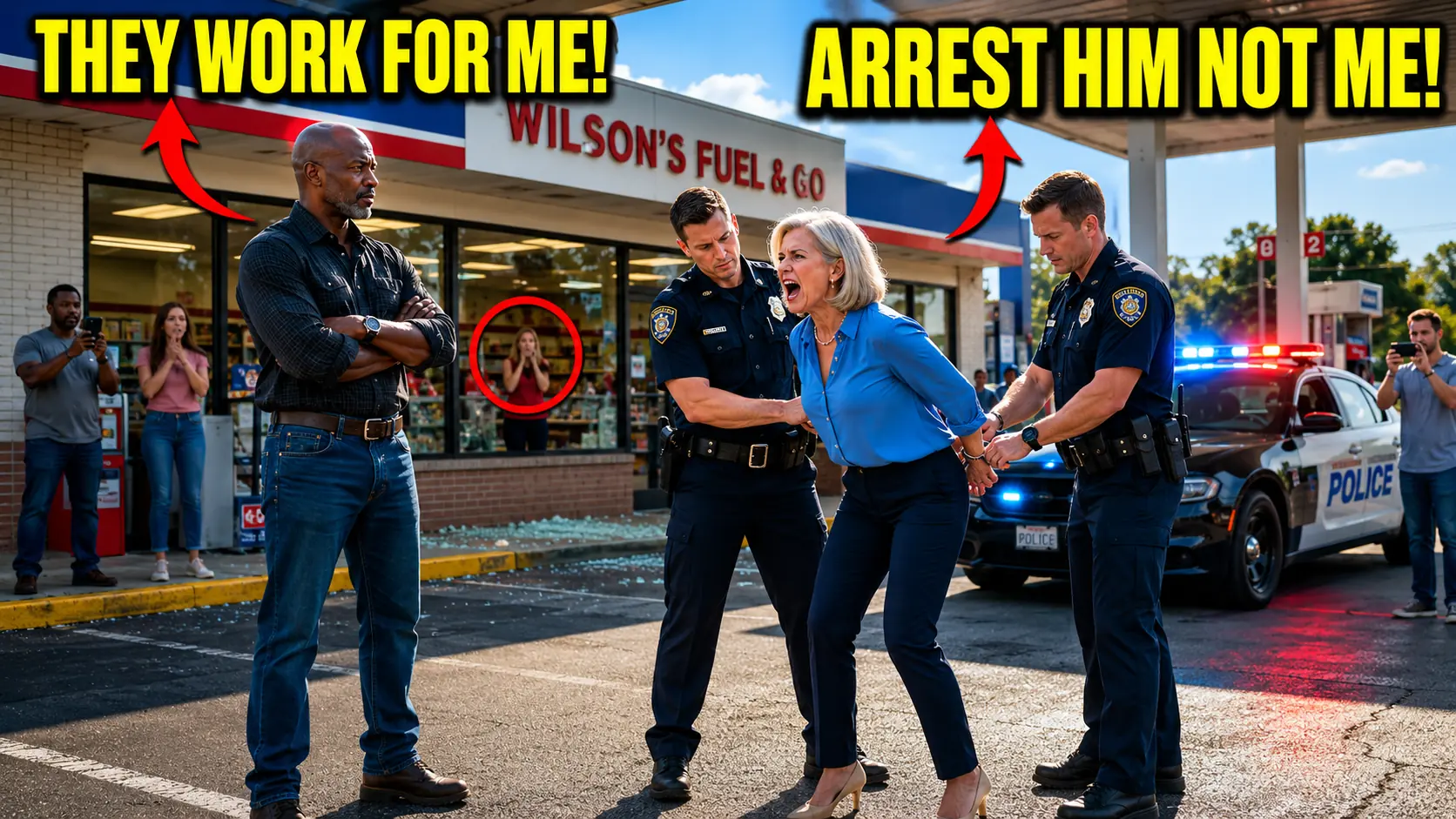
She twisted around, scanning the parking lot for one sympathetic face. One person who might step in. One person who might say this was wrong. Nobody moved. The man in the gray hoodie was recording. The woman across the street was recording. A teenager who had walked over from the bus stop was recording. Brenda was placed in the back of Crawford's cruiser. The door shut with a heavy, final thunk. Through the window, she could see Grant Wilson, still standing in the same spot, still calm, still steady.
His arms folded again, his face unchanged. And then, just for a moment, he looked directly at her through the glass. He didn't smile, didn't gloat, didn't say a single word. He didn't need to. The cops she called had arrested her on his order because every badge on that lot existed because of him. The cruiser pulled out of the lot at 8:23 in the morning. Brenda was in the back seat, hands cuffed, mascara destroyed, mouth still moving, but nobody was listening anymore.
At the county precinct, she was walked through the side entrance, the same entrance Grant Wilson had walked through a thousand times as chief. Same hallway, same fluorescent lights, same smell of stale coffee and floor cleaner. But this time she wasn't walking in to file a complaint. She was being booked. Fingerprints, mugshot. The camera flash made her flinch. Her blouse was wrinkled. Her hair was falling apart.
Her eyes were swollen shut from crying. "I want a lawyer. This is a setup. That man provoked me." The booking officer didn't look up from his keyboard. "Ma'am, you'll have the opportunity to contact an attorney after processing." "He's not who he says he is. He's just a gas station worker. He can't order you people to" The officer stopped typing, looked at her for the first time. "Ma'am, Chief Wilson served this department for 25 years, 12 as our commanding officer. Every person in this building knows exactly who he is."
He paused. "Do you want to keep talking or do you want that lawyer?" Brenda shut her mouth. For the first time all day, down the hall detectives were already reviewing evidence. Grant's security footage, his phone video, three bystander recordings, all uploaded to cloud storage before the cruiser even left the lot. Every frame told the same story. Brenda threw the brick. Brenda destroyed the property. Brenda made the call. Grant never moved, never raised his voice, never came within 15 ft of her.
Then they played the 911 audio, her exact words in black and white. "There is an aggressive black man here. He attacked me. He grabbed me." They matched it to the video. Grant standing motionless, arms folded 20 ft away. One detective looked at the other. She lied on a 911 call against a retired police chief while being recorded from four angles. He leaned back. This might be the dumbest criminal I've ever seen.
Brenda's daughter Diane arrived at 1:15. She walked through the front door already crying. Not angry crying, ashamed crying. The kind where you can't look anyone in the eye. "I'm so sorry." She told the desk sergeant. "My mother I don't even know what to say." That evening Diane called Vanessa Wilson, Grant's wife. "Mrs. Wilson, I'm Diane Hoffman, Brenda's daughter. What my mother did was inexcusable. I'm not calling to make excuses, I'm calling to apologize."
Vanessa thanked her, told her Grant held no personal hatred, but the law would take its course. Diane said she understood. She hung up and cried for another hour. Meanwhile, something Brenda couldn't see from her holding cell was happening. The community was showing up. It started around 5:00 in the afternoon. A pickup truck pulled into Wilson's Fuel and Go, then another, then a minivan. By 6:00 the lot was full.
People filling their tanks, buying coffee, buying snacks they didn't need, leaving $10 tips in the jar by the register. Tommy was behind the counter, bandage on his hand, eyes still red, ringing up customers as fast as he could. "Mr. Wilson, there's a line out the door." Grant looked up from his mop, saw the faces, old friends and total strangers standing shoulder to shoulder. He leaned on the handle and let it wash over him.
Then retired officers started arriving. Men and women who had served under Grant. One drove 45 minutes across the county. Another brought a framed photo from Grant's swearing-in ceremony and set it on the counter without a word. Someone started a GoFundMe. Repair the window at Wilson's Fuel and Go. Goal: $2,000. It hit 15,000 in 24 hours. Grant took what he needed for the glass, donated every penny of the surplus to the county youth center.
A local news crew showed up the next morning. A reporter shoved a microphone toward Grant. Mr. Wilson, what do you want people to know? Grant looked into the camera. Same calm eyes. I didn't want this attention. I just wanted to run my business in peace. But if someone wrongs you, don't scream. Don't fight. Make sure the truth is on the record. The truth doesn't need volume. It just needs light.
That clip aired at 6:00. By morning, it had been shared 40,000 times, and Brenda Hoffman was still in a holding cell waiting for a lawyer who was already dreading the case. Brenda hired an attorney named Gerald Pratt. Cheap suit, billboard lawyer. He took the case because Brenda's family paid up front. He regretted it by page two of the discovery file.
Four camera angles, three bystander phones, one 911 audio recording, and a victim who happened to be the most respected law enforcement officer in the county's history. Pratt called Brenda the next day. The footage is clear. The 911 recording is clear. There is no angle here. Then find one. Ma'am, you threw a brick through a window on camera. You filed a false report on camera. The man you accused was standing 20 feet away with his arms crossed from four different angles. Silence.
I want a plea deal. The DA already rejected one because this wasn't a normal case anymore. The district attorney, Katherine Moore, had fast-tracked the prosecution. A white woman smashed a black business owner's property, lied on a 911 call, tried to weaponize the police, and the man she targeted was a retired police chief who served the community for 25 years. This wasn't going away quietly.
By the time the trial date was set, 4 months later, the entire country was paying attention. The trial opened on a Tuesday in January, courtroom 3B, Judge Harold Preston presiding, gallery packed, local press in the front rows, national outlets in the back, three sketch artists, and in the front row, sitting quietly with Vanessa beside him, was Grant Wilson, dark suit, blue tie, no badge, no uniform, just a man watching the system he built do its job. Katherine Moore stood, walked to the center of the courtroom.
"Ladies and gentlemen, on September 14th, Brenda Hoffman drove to Wilson's Fuel and Go. She demanded free gasoline. She was refused, and in response, she destroyed property, terrorized a teenage employee, and fabricated a crime that never happened." She clicked the remote. The courtroom screen lit up, security footage, Brenda picking up the brick, the throw, glass exploding, Tommy hitting the floor, the kicked sign, the thrown trash can, then the 911 audio through the speakers. "There is an aggressive black man here. He attacked me. He grabbed me." Moore paused it.
Let the silence sit. Then clicked again. Split screen, left side the 911 timestamp, right side security footage at the exact same moment. Grant Wilson, motionless, arms folded, 20 ft away. Jurors shifted in their seats. One woman closed her eyes and shook her head. Moore called witnesses, the construction worker, the woman in the blue sedan, Tommy Ellis, bandage still on his hand, voice shaking but never breaking.
Then the moment the courtroom was waiting for. The prosecution calls Grant Wilson. Grant stood, buttoned his jacket, walked to the stand the way he walked through every room, slow, steady, sure. Moore walked him through the events. Grant answered every question short and precise. No emotion, no embellishment. Facts. Then she asked the question that stopped the room. Mr. Wilson, in your 25 years of law enforcement, including 12 as police chief, have you ever seen a false police report used as a weapon in this manner? Grant paused. I have, many times.
Against black men, against Latino men, against people guilty of nothing except being in the wrong place with the wrong skin color. He looked at the jury. That's why I knew to start recording, because I've seen what happens when there's no camera. It doesn't end with a trial. It ends with a funeral. Dead silence. A woman in the gallery started crying. Defense had nothing. Pratt put Brenda on the stand. A mistake. She said Grant intimidated her with his size and presence, said she felt threatened, said the neighborhood used to be safe. The jury saw through every word. 12 people who had watched the footage, heard the 911 call, and seen Grant speak with more dignity in 5 minutes than Brenda had shown in 50 years.
Deliberation took less than 2 hours. Guilty. All counts. Vandalism, destruction of property, false police report, theft of services, disorderly conduct. Judge Preston read the sentence. 18 months probation, $12,000 restitution, 200 hours of community service, mandatory anger management, permanent restraining order, 500 feet from Wilson's Fuel and Go, and any Wilson family member for life. The false report conviction on her record permanently. Every background check, every job application, every rental agreement, forever. Preston removed his glasses. Mrs. Hoffman, filing a false police report wastes critical resources. It endangers innocent lives. It erodes the public trust that holds our justice system together. You used that system as a weapon against an innocent man. This court will not tolerate it. Brenda stared at the table, didn't cry, didn't speak. She had nothing left. The story didn't end in that courtroom. It exploded.
Footage hit social media that evening. 2 million views by midnight, 11 million by the end of the week. The headlines wrote themselves. Woman calls cops on black gas station owner, turns out he's their former chief. She threw a brick through his window. He threw the book at her. Brenda's social media was unearthed within hours. Years of posts. This neighborhood is changing and not for the better. Photos of Grant's station with captions like another one bites the dust. Dog whistles so loud they were foghorns. She lost her job at a real estate office by Thursday.
Her church released a statement distancing themselves. Neighbors stopped returning our calls. Op-eds poured in. Legal analysts called it a textbook case of weaponizing emergency services against black Americans. Civil rights organizations cited it in policy briefs. Grant was invited to speak at a regional law enforcement summit on bias and false reporting. Chief Ashford issued a statement the day after the verdict. Chief Wilson built this department on integrity and service. What happened to him is a reminder of why we do this work and who we are sworn to protect. Every officer in this county stands with him. The county DA announced a formal review of false report penalties citing Grant's case.
Two neighboring counties followed within the month. And the city council unanimously passed a resolution supporting minority-owned businesses. They named it after the gas station on Pine Street, the Wilson resolution. Six months later, Wilson's Fuel and Go was still standing, stronger than ever. The window had been replaced weeks after the incident. Brand new glass, thicker than before. And right next to it, bolted into the brick wall, was a small bronze plaque.
Built on respect, sustained by the community. Grant paid for it himself. Didn't tell anyone it was coming. Just showed up one morning, drilled four holes, and hung it before the sun came up. By noon, someone had posted a photo of it online. By evening, it had been shared 12,000 times. The station was thriving. Grant had hired a second employee, a young woman named Clara, 21, studying accounting at the community college.
She and Tommy worked alternate shifts. Grant still opened up every morning at 5:45, still brewed the dark roast, still knew every regular by name. But something had changed. The parking lot was busier Not just locals, people drove from two counties over just to fill their tanks at the station they saw on the news. They'd buy a coffee, shake Grant's hand, and tell him what his story meant to them.
He never knew what to say to that. So, he just nod and say, "Appreciate you stopping by. Tommy got his scholarship." A full ride to the state university. The recommendation letter Grant wrote was three pages long, and the admissions office later told Tommy it was the most compelling letter they had received in a decade. Tommy cried when he found out. Called Grant from the parking lot of the financial aid office. "Mr. Wilson, I got in. Full ride. I got in." Grant was quiet for a moment. Then he said, "I know you did. Now, go make it count." The retired officers still came by every morning, coffee and conversation.
They had turned the bench out front into an unofficial gathering spot. Earl, the mailman, was still there, too. Still talking about the weather, still complaining about his knees. Vanessa joked that Grant was the most famous gas station owner in the Carolinas. Grant would just shake his head and pour another cup of coffee. "I'm not famous," he told her once. "I'm just stubborn." She laughed. "Same thing, baby." As for Brenda Hoffman, her world had collapsed in on itself like a house made of wet cardboard.
She completed her 200 hours of community service. The court assigned her to a food bank on the east side of the county. A food bank that served predominantly black and Latino families. Every Tuesday and Thursday for 5 months, Brenda Hoffman sorted canned goods, packed boxes, and handed meals to the very people she had spent her whole life looking down on. Nobody at the food bank knew who she was. They just saw a quiet woman in a hair net who never smiled and never made eye contact. The volunteers were kind to her anyway. That might have been the hardest part.
Her daughter Diane had publicly apologized on behalf of the family. A written statement, short, sincere, no excuses. Diane and Vanessa Wilson had become cordial acquaintances over the months. Not friends exactly, but something close to mutual respect. Diane sent a card to the station on its anniversary. Vanessa sent one back. Brenda sold her house 3 months after the trial. Quietly. No farewell. No note to the neighbors. She moved to a town 40 miles south where nobody knew her name.
Or so she hoped. Because the internet never forgets. And the video of a woman throwing a brick through a black man's window and then getting arrested by the cops she called wasn't going anywhere. Grant Wilson didn't yell, didn't swing, didn't pull rank until the moment it mattered. He pressed the record. He stayed calm. And he let the system he spent his life building serve him back. That's not a weakness. That's power. The kind that doesn't need to announce itself.
So here's my question for you. Have you ever watched someone try to tear down what another person built? Just because they couldn't stand who built it? Drop your story in the comments. I want to hear it. And if this one hit different, if you felt that knot in your stomach, that heat in your chest, that moment when the officer said, "Chief Wilson." And everything flipped. Then smash that like button. Share this with someone who needs to hear it. And subscribe so you never miss the next one. Because the next one, it's going to hit even harder. I promise. Grant Wilson pressed record, stayed calm, and let the system he spent 25 years building serve him back.
But here's what keeps me up at night. She stood 20 ft from a man who hadn't moved, hadn't spoken, hadn't raised a hand, and she picked up the phone and called him aggressive, called him a threat. That's not a mistake. That's a weapon, and Grant knew it because she'd seen it destroy lives for 25 years from the other side of that bench. That's why the camera was already rolling. That's why he never flinched. He knew the truth only survives if someone captures it.
And how many people out there don't get that chance? No camera, no witnesses, no proof, just their word of the good a lie, and a system that doesn't always listen. So, I want to ask you something. What is it about someone else's success that makes certain people reach for a brick? And when the world throws that brick at you, what keeps you from throwing one back? Drop your answer in the comments. If this story hit different, like, share, and subscribe so you don't miss what's next. Because the truth doesn't need volume, it just needs light.
News in the same category
A Manager Refused to Respect a Black Couple in Casual Clothes — Then He Saw Their Picture Hanging on the Wall
Restaurant Manager Humiliated a Black Couple Over Their Clothes — Until He Realized Who They Were
A Restaurant Manager Looked Down on a Casually Dressed Black Couple — Then Their Photo on the Wall Changed Everything
Restaurant Manager Mocked a Black Couple for Their Casual Clothes — Until He Noticed Their Photo on the Wall
The Fighter Shoved the Quiet Dad to the Ground — Then Mocked Him in Front of His Daughter
The Billionaire Laughed at the Old Man’s Plea — Then Told Him, “There’s Nothing You Can Do.”
Eight Armed Men Rode Onto Her Ranch — And Told the Widow to Hand Over the Only Evidence She Had
She Thought the Police Would Take Her Side After Smashing His Window — She Was Dead Wrong
HOA Karen Kept Driving Through My Fence — Then Her Shortcut Backfired
She Humiliated the Quiet Old Mechanic in Front of Everyone — Then She Saw His Tattoo
HOA Karen Kept Smashing Through My Fence — So I Made Sure It Never Happened Again
The Black Belt Made Fun of the Old Mechanic’s Stance — Then One Tattoo Changed Everything
The Black Belt Humiliated His Daughter in Front of the Whole Class — Then Shoved Her Father
They Threw Her Out Into the Rain — Then the Private Elevator Opened
She Thought the Old Mechanic Was an Easy Target — Then His Sleeve Rolled Up
HOA Karen Refused to Stop Driving Across My Property — Then She Regretted It
She Smashed a Black Man’s Gas Station Window and Called the Cops — Biggest Mistake of Her Life
HOA Karen Kept Using My Yard as Her Personal Shortcut — Then Everything Changed
News Post

After 60, I Stopped Chasing These 5 Things—and Started Protecting What Actually Matters
I’m 63, and I Stopped Explaining Myself—But There’s One Boundary I Won’t Cross
Restaurant Manager Judged a Black Couple by Their Appearance — Seconds Later, Their Photo on the Wall Left Him Speechless
A Manager Refused to Respect a Black Couple in Casual Clothes — Then He Saw Their Picture Hanging on the Wall
Restaurant Manager Humiliated a Black Couple Over Their Clothes — Until He Realized Who They Were
10 Things I Do Every Day I Wish Someone Had Told Me to Do at 40
A Restaurant Manager Looked Down on a Casually Dressed Black Couple — Then Their Photo on the Wall Changed Everything
10 Things I Do Every Day I Wish Someone Had Told Me to Do at 40
Restaurant Manager Mocked a Black Couple for Their Casual Clothes — Until He Noticed Their Photo on the Wall
I’M 72—10 BORING THINGS I DO DAILY TO STAY STRONG AND INDEPENDENT

Creamy Garlic Stuffed Chicken Breast – Juicy, Cheesy & Filled with Garlic Herb Cream Cheese
Brown Butter Pecan Chocolate Chunk Blondies – Chewy, Buttery & Loaded with Toasted Pecans and Melty Chocolate
Salted Caramel Apple Crumble Cheesecake Bars – Creamy, Buttery & Loaded with Cozy Apple Pie Flavor
The Fighter Shoved the Quiet Dad to the Ground — Then Mocked Him in Front of His Daughter
The Billionaire Laughed at the Old Man’s Plea — Then Told Him, “There’s Nothing You Can Do.”
Eight Armed Men Rode Onto Her Ranch — And Told the Widow to Hand Over the Only Evidence She Had
She Thought the Police Would Take Her Side After Smashing His Window — She Was Dead Wrong
HOA Karen Kept Driving Through My Fence — Then Her Shortcut Backfired
She Humiliated the Quiet Old Mechanic in Front of Everyone — Then She Saw His Tattoo
A Neighbor Broke the Gas Station Window — Then Called 911 and Blamed the Black Owner
3 Part