The letter arrived at Coverdale Park on a Tuesday in late September, and Henry Vance, 8th Duke of Coverdale, set it aside three times before he opened it. He was at his desk in the library, the morning light coming in flat and gray across the lawn, and the post had brought the usual: two requests for subscription to charitable concerns he did not care about, a note from his solicitor in London, and a thin letter in a hand he did not know, addressed in a careful schoolroom copperplate that had been corrected once and rewritten.
He opened the solicitor first. He opened the subscriptions, then he opened the third. "Your Grace," it began, and then after a pause he could feel in the ink, "I write on a matter your late brother spoke of often and which I now find myself obliged to raise, the alternative being a dependence I am not willing to accept. My husband, Captain Edward Ashford of the 10th, was given by your brother in the summer of 1813 the assurance that in the event of his death in service the use of Withy Lodge on the western edge of your estate should be mine for my lifetime. The promise was made in writing. I enclose a copy."
"I shall be in Yorkshire on the 27th of this month and would be obliged for an interview at your convenience." She had signed it Charlotte Ashford. Henry read it twice, then he set it on the desk and looked out of the window. The western fields were visible from where he sat, the line of beeches that screened the lodge already turning copper at the tips.
He had spent the past month with Reeves drawing up the lease that would let those fields and the lodge and the strip of pasture beyond to Sir Robert Carney, whose own land bordered them. The income would re-roof 11 cottages his brother had let go to ruin. Reeves had the papers ready for signature on Friday. He pulled the bell.
Reeves came at once. He was a man who had not been more than three rooms from his Duke for 30 years and stood inside the door with his hands behind his back. "So, you knew Captain Ashford?" Henry said. "I did, Your Grace." "You knew of this promise?" Reeves did not answer immediately. That was his way.
When the silence had told Henry what he needed to know, Reeves said, "His Grace, your brother spoke of it more than once. I never saw it set down." "It is set down, or a copy is." "Then I should have asked, Your Grace. I did not. I was sorry for the captain when he died, and I confess I did not think the lady would come." "Why not?" "Because she is a clergyman's daughter, Your Grace, and I assumed she would be too proud."
Henry looked at him. "And now she is not too proud?" "Now she is perhaps, Your Grace, in a position where pride is a luxury." Henry let that sit. Reeves was a careful man and chose his words with the care of someone who had been corrected by three generations of Vances and did not intend to be corrected by a fourth. "She wishes to call on the 27th," Henry said. "That is Friday." "Yes, Your Grace." "The leases?" "Yes, Your Grace." "Send word to Sir Robert that I am detained. I will sign nothing this week."
Reeves bowed. He was almost at the door when Henry said, without turning, "What sort of woman is she?" Reeves stopped. "I have not seen her, Your Grace, since her wedding. I should not like to say." "You have already said three things, Reeves." A pause. "She struck me then as a woman who would not have married the captain unless she meant it."
Henry, who had spent much of his adult life developing instruments by which to measure such statements, registered this one and said nothing further. When Reeves had gone, he picked up the letter again. "I am not willing to accept." It was a phrase that, in his experience, women in her circumstances did not write because they had been advised against it by everyone who loved them. Either she had no one to advise her, or she had been advised and had decided otherwise. He could not yet tell which would prove the worse.
He turned the page over. There, in a different ink in his brother's hand, that careless slanting hand he had not seen in two years and had not expected to see again on his desk on a Tuesday, was the promise. "To Edward on the occasion of your marriage, the lodge is yours and hers if it comes to that. J." Henry read it three times. Then he folded the letter, put it in the top drawer of the desk, locked the drawer, and went out to ride.
When he came into the drawing room, she was standing at the window with her back to him, and he had a moment to take her in before she turned. She was tall, taller than he had pictured, though he had not realized he was picturing, and dressed in half mourning, a dove gray gown that had been good two seasons ago and was now merely respectable. Her hair was dark and pinned without ornament.
She held her gloves in one hand and a reticule in the other, and she had been looking at the lawn rather than the room, which told him something he did not yet know how to use. "Mrs. Ashford." She turned. Gray eyes. A face that took a second longer to assess than he had allowed for. "Your Grace." She did not curtsy deeply. She inclined her head with the precise economy of a woman who had been a captain's wife and knew how to greet a colonel.
"Please." He gestured to a chair. He did not sit until she did. "I have your letter," he said. "I assumed so." "And the enclosure." "Yes." He had meant to begin with the document. He found himself instead looking at her face and finding it harder to dismiss than was convenient. He recovered. "Mrs. Ashford, I shall be plain with you because I think plainness will save us both time. My brother made a great many promises in his life. He kept some of them."
"The promise enclosed in your letter is, on the face of it, a generous one, and it was made in circumstances I cannot now investigate to a man who is no longer alive to be questioned. You will understand that the document, while affecting, is not a will. It is a note. It binds me morally, perhaps. It does not bind me legally." "I have not asked you to be bound legally, Your Grace." "You have asked me for a house." "For the use of one, for my lifetime, as your brother promised my husband."
"And if I decline?" She looked at him steadily. "Then you decline, and I shall not write to you again." That answer was not what he had braced for, and he resented her briefly and unfairly for not giving him the answer that would have made this easier. "Mrs. Ashford, forgive me. You have come a great distance, and I do not wish to detain you longer than necessary, but I must ask you to consider my position. I am newly come to this estate. I have inherited a property that was, in my brother's hands, run on charm and informal arrangement. I am attempting to put it on a more orderly footing."
"The western fields, of which the lodge is part, are the subject of negotiations that would substantially benefit 11 of my tenants. To grant your request is to abandon those negotiations." "I see." "Do you?" "You wish me to feel responsible for 11 cottages?" He had not expected that. He felt the line land and absorbed it, and made the decision in that moment that he had perhaps misjudged what kind of conversation this was going to be.
"I wish you to understand," he said, "that I am not a man given to refusing widows for sport." "I had not assumed sport, Your Grace." "What had you assumed?" "Inconvenience." He almost smiled. He did not. "Mrs. Ashford, may I see the original?" She opened the reticule. It was a smaller bag than was the fashion and stuffed, and as she drew out the folded letter, the watch came with it and dropped onto the carpet between them with a small definite sound.
She bent for it before he could move. She picked it up, set it on the arm of her chair, and held out the letter. Henry did not take the letter. He was looking at the watch. It was a plain gold hunter, gentlemanly, not new. The case was scratched along one edge he knew because he had made it. He had dropped the watch on a flagstone at Eton in 1801, and his brother had laughed at him for a week.
He had given the watch back to James the next day, and James had carried it for the rest of his life. And Henry had not seen it since the day he had stood in his brother's room in this house and been told that the personal effects had gone by James's standing instruction to the captain. "Your Grace." He looked up. He had been silent too long. "Forgive me." He took the letter.
He read the document. He had read it three times already. He read it again now because he needed a moment in which his face was directed at paper rather than at her. When he looked up, he found that she had picked up the watch and was holding it in her lap in both hands the way a woman holds a thing she does not want commented on. "I shall consider your application," he said. "Your Grace, I have not made an application. I have presented a fact."
The line was so quiet and so exact that he felt for a second as though she had reached across the room and put her hand on his sternum. He set the letter down on the table between them. "A pretty face," he said, and even as the words were forming, he knew they were the wrong ones, but he had spent 34 years arming himself against women he found himself looking at, and the armor came up faster than the judgment. "A pretty face, Mrs. Ashford, will not help you here."
She looked at him. She did not flush, and she did not stand, and she did not produce the small offended laugh he had heard from a hundred women in drawing rooms when men spoke to them like that. She looked at him for what was perhaps 4 seconds, and then she said in the same level voice, "I had not planned to use one, Your Grace. I am at the Coverdale Arms until Monday. I shall not call again. If you wish to send word, send it there. If you do not, I shall understand your answer."
She put the watch back into her reticule. She picked up her gloves. At the door she paused and looked back, not at him, but at the desk. "Your brother," she said, "was kind to my husband. I came because I believed his kindness was a thing that could be honored by his successor. I see I was mistaken in the second half of that sentence, but not, I think, in the first." She went out.
Henry stood where he was for a long minute after the door had closed. Then he sat down in the chair she had left, which was still warm, and put his hand flat on the table beside the letter, and did not move for some time. He sent word to the Coverdale Arms on Sunday morning. He sent it, in fact, at half past nine, having spent Saturday in a state of containment his household recognized and gave a wide berth.
The note was short. "Mrs. Ashford, the lodge is at your disposal for the remainder of your lifetime on the terms set out in the enclosed letter, which I return to you. Mr. Reeves will wait upon you Monday morning to put the matter in order. Coverdale." He did not apologize for the line. He had considered it for an hour and decided that to apologize in writing was to make her read it twice.
She moved into Withy Lodge on the 2nd of October. She brought with her two trunks, a writing desk, a shelf of books, a tea service that had been her mother's, and a maid named Bessie who was 19, sturdy, from her father's parish in Cumbria, and afraid of nothing except cows. The lodge had been shut up for 11 years. Mrs. Pell had sent two girls down to air it. The chimneys had been swept. A bed had been made up in the larger of the two upstairs rooms. The kitchen range had been lit and was smoking.
Charlotte stood in the parlor on the first afternoon and looked around at six rooms that were hers and felt for the first time in two years that she could exhale a breath she had been holding without knowing she had been holding it. She did not see the duke that week. She saw instead his cousin. Miss Sophia Lyle came down the path from the main house on the Friday afternoon in a green pelisse that did not suit her coloring and a bonnet that did, carrying a basket with a jar of honey in it and a bunch of late asters that had clearly been cut by a gardener who had been told to cut them.
"Mrs. Ashford, I am Sophia Lyle. I am Henry's cousin. I have brought you honey, which is the most useless gift I could think of, but my aunt insisted and one does not argue with my aunt." Charlotte, who had been in the garden examining a rosemary bush that had survived the 11 years better than anything else on the property, straightened up and dusted her hands on her apron. "How do you do?" "Very well. Are you settled? May I come in? I shall not stay if you would rather I did not, but I would like very much to come in."
Charlotte found that she was almost smiling. "Please." They had tea in the parlor. Sophia talked. She talked about the weather, the village, the curate whom she did not like, the curate's wife whom she did, the road from York, the dampness of the house in autumn, her own dislike of riding side-saddle, and her cousin Henry, whom she described as the kindest cross man in England, which is not a contradiction once you know him. Charlotte poured tea and listened.
"You will think I am chattering," Sophia said. "I am chattering. I have been at Coverdale four weeks and I have spoken to no one under 50 except the curate's wife, and you cannot count her because she only speaks of the curate. I do not mind chatter." "Do you not? Most people do." "I have lived in barracks and parsonages, Miss Lyle. I find chatter restful." Sophia laughed. It was a real laugh, surprised out of her. "I think we shall be friends, Mrs. Ashford." "I think we may."
It was while Sophia was on her second cup of tea that her eye fell on the mantelpiece. The watch lay there beside a small wooden box and a candlestick. Charlotte had set it down that morning to wind it and had not put it away. "Oh," Sophia said, "what a handsome watch. Was it your husband's?" "It was." "It is a gentleman's watch." "Yes." "My uncle had one very like."
Charlotte hesitated. The truth was small and harmless, and she had no reason to withhold it. Only she had spent six years married to a man whose dignity was bound up in things that had been given to him by men who outranked him, and she had grown careful with such information. "The late duke gave it to my husband at school. They were friends there. My husband kept it all his life." Sophia set down her cup. "James gave it to him?" "Yes."
"How extraordinary." "It was a long friendship. My husband spoke of him often." "No, I do not mean I mean I knew James was at school with a with someone. I had not realized it was your husband." She paused. "I shall not speak of it, or I shall speak of it only if you wish." Charlotte considered her. "You may speak of it, Miss Lyle, as you find natural. I have not come here to be a secret." "No," Sophia said slowly, "I see that you have not."
When she had gone, Charlotte put the watch in the drawer of the writing desk and stood for a moment with her hand on the drawer and then took it out again and put it back on the mantel. That evening, Sophia mentioned the watch to Henry over dinner. She mentioned it lightly in the middle of an account of her visit between the asters and the rosemary. She was not a girl who knew how to make an entrance with information, which was why on this occasion the information landed harder than she had intended.
Henry was lifting his glass. He set it down. "A gold hunter, you say?" "With a chain, quite plain." "She said James gave it to her husband at school." "Did she?" The Dowager Duchess Cecily, who had come up from the Dower House for dinner because she did so on Fridays and had done so on Fridays for 40 years, looked at her son over the candles and did not speak. "She seems," Sophia said, "very pleasant." "Not at all. I had thought she might be" "What had you thought, Sophia?" "I had thought she might be sharp. People said, but she is not sharp. She is" Sophia searched. "She is steady." "Steady?" "Yes."
Henry did not answer. He picked up his glass again, drank from it, and set it down with more care than the action required. "Mother," he said, "if you have an opinion you wish to share, I am ready to hear it." Cecily Vance, who at 61 wore her white hair high and her diamonds small, and had been in her day the most painted woman in three counties, regarded her younger son with the calm of a woman who had outlived being asked her opinion and found, rather to her own surprise, that she still had one.
"I have not met her, Henry." "That has not previously prevented you." "No, but on this occasion I shall wait." "For what?" "For an introduction." It was the first time in 2 years that his mother had asked him for anything. He recognized it as a request and was annoyed by it and said, after a pause, "Very well. I shall arrange it."
Sophia, who had been looking from one to the other, said, "Mrs. Ashford does not know anyone here. She might be glad of" "Yes, Sophia, thank you." After dinner, he went to the library and sat at his desk and did not read. After an hour, he opened the top drawer and looked at the place where the letter had been and was not and shut the drawer again.
He found a reason to ride out to the lodge on the following Tuesday. The reason was a dispute about a hedge between Withy Lodge and the home farm, which Reeves had reported to him that morning, and which Reeves was perfectly capable of resolving alone. Henry took it on himself. He arrived at half past 11:00. The lodge gate had been mended, he noticed. There was washing on the line behind the kitchen, and a thin column of smoke rising straight from the chimney into a still autumn sky.
He explained the question. It was not in truth a complicated one. She listened. She suggested quietly that the simplest answer was to leave the hedge where it had stood for 40 years, and to ask the home farm to put a stile in for the use of the shepherd. He found that her suggestion was better than the one he had come with. They walked back along the stream together.
"Mrs. Ashford," he said. "Yes." He had meant to say something else. He said, "I owe you an apology for the words I used in our first interview." She did not answer at once. "You owe me," she said, "nothing, Your Grace. The lodge is more than enough." "That is not the same thing." "No, it is not."
They walked on. He was conscious of his own footfalls on the gravel, and of hers, and of the fact that she had not accepted the apology and had not refused it. "I had not intended," he said, "to be insulting." "I know you had not." "How do you know?" She glanced up at him. She had gray eyes and a small considering line between her brows that he had not noticed in the drawing room because she had been holding herself very still. And that he noticed now because she was not.
"Because, Your Grace, a man who intended to insult me would not have written to me on Sunday morning." He had nothing to say to that. They had reached the front of the lodge. Through the parlor window he could see on the mantel inside the watch. "Mrs. Ashford, may I" "Yes." She opened the door. He went in.
He picked up the watch. He had not asked. He had walked across the small room to the mantel and lifted it and stood with it in his palm, the chain falling between his fingers, and turned it over to where the scratch on the case was. She watched him do this. She did not speak. He pressed the catch. The case opened. Inside the cover was an inscription he had forgotten was there in his own boyish hand of 15 years ago copied out by Hollis as he had written it. "To JV on his coming of age from H."
He had paid for the inscription himself. He had been 17 and had saved for 2 years. He shut the case. He set the watch back on the mantel. "Mrs. Ashford." "Your Grace." "Forgive me." "There is nothing to forgive." He looked at her then properly for what was perhaps the first time and found that her face had changed in the past 10 minutes and that he could not have said how.
"Good day, Mrs. Ashford." "Good day, Your Grace." He went out. Halfway back to the main house riding through the beeches that had now turned fully copper, he realized that he had not in the end said his brother's name aloud.
The dowager called at Withy Lodge on a Thursday in her own carriage with her own footman and she stayed 40 minutes. Charlotte did not know she was coming. She was at the parlor table when the carriage drew up mending a tear in Bessie's apron because Bessie was hopeless with a needle and Charlotte was not. And she had time to put the apron away and to wash the ink off her fingers before Bessie came in white-faced to say that the Dowager Duchess was at the door.
"Show her in, Bessie, and bring the tea. Do not drop it." "No, ma'am." Cecily Vance came into the parlor with the slow measured tread of a woman who had been beautiful for so long that she had forgotten how to enter a room any other way and stopped in the middle of the rug. "Mrs. Ashford." "Your Grace, please." Charlotte indicated the better of the two armchairs. Cecily sat. She arranged her gloves on her knee.
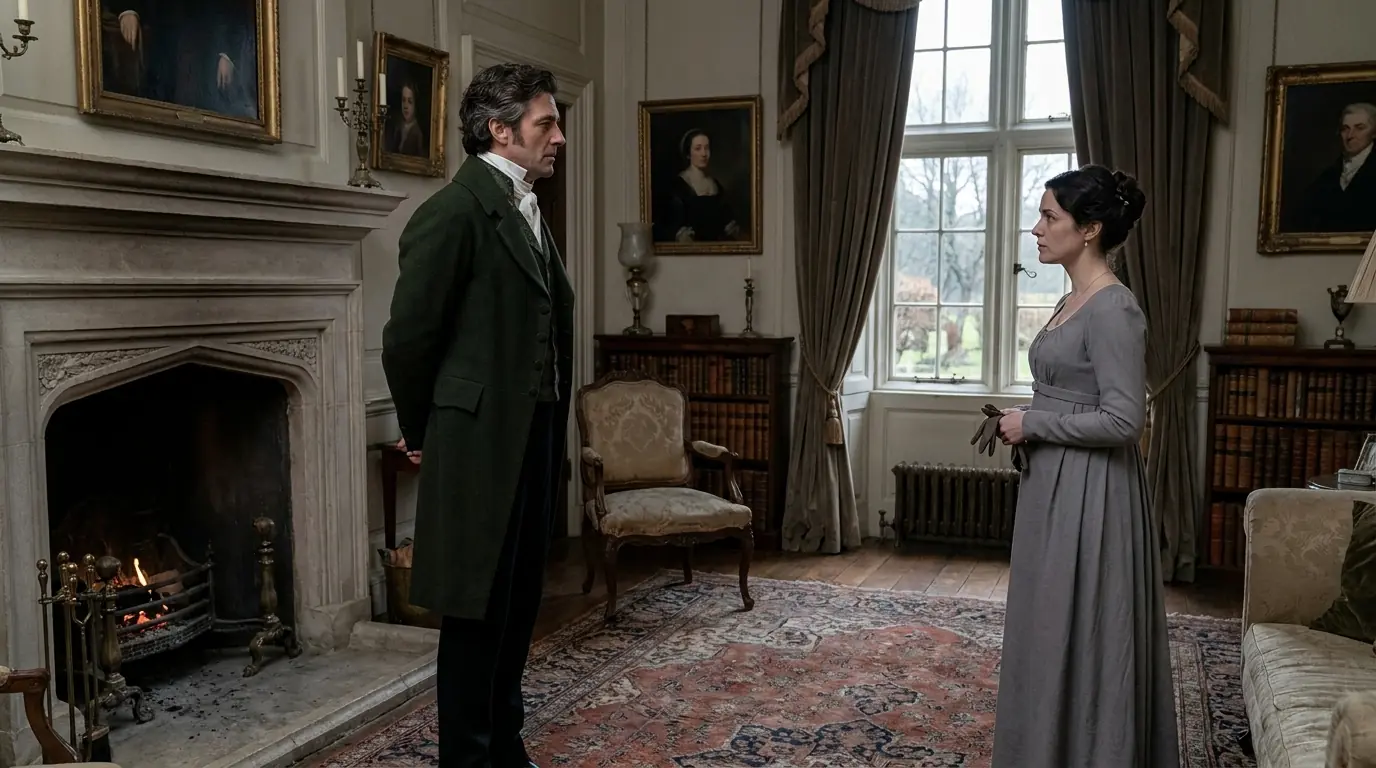
She looked around the parlor at the bookshelf, the writing desk, the small painting of a Cumbrian church over the mantel, the watch beside it, and she looked at Charlotte. "You are not what I had been led to expect, Mrs. Ashford." "I am sorry to disappoint you, Your Grace." "Then you have not. You have done the opposite." "May I ask what you were a miss of before you were Mrs. Ashford?" "A Miss Hartley, Your Grace. My father was rector at St. Begas near Keswick."
"I knew a Hartley at Cambridge in '78. He took orders. A reading man." "My father, Your Grace." "Ah." Cecily sat with that for a moment. "He was a good man. I am sorry to hear of it in the past tense." "He died 7 years ago." "And your mother?" "The year after." Cecily nodded once.
Bessie came in with the tea, set it down with the breathless concentration of a girl carrying gunpowder, and went out backwards. "I shall pour, Your Grace, if you will permit." "Please." They drank tea. Cecily asked without preamble, "Did your husband speak of my elder son?" "Yes." "Often?" "Yes, Your Grace. He admired him very much." "My elder son was admirable in some respects and disastrous in others."
"I should be obliged if you would tell me which respects your husband admired." Charlotte considered. She had been asked harder questions in her life, but not many and not by women in diamonds. "He admired his courage, Your Grace, and his his lightness. My husband was not a light man. He found in your son's company a relief from his own seriousness." "I see." "And your son was kind to him in a particular way. He never made him feel the difference between them." "That is the kindest thing anyone has said of him in two years, Mrs. Ashford."
"I am sorry it has been two years before it was said." Cecily looked at her. And Charlotte saw for one instant beneath the diamonds and the white hair and the long composure the face of a woman who had outlived her elder son and not been permitted to mourn him in the language she would have chosen. "Mrs. Ashford, I shall be direct. My younger son has not spoken of his brother since the funeral, not once. I had begun to wonder whether he would. Your arrival appears to have made it more difficult, not less, for him to do so."
"I do not, however, conclude from this that your arrival is unwelcome to me. I conclude the opposite." "Your Grace." "I have not finished. I shall not interfere. I shall not call again unless you invite me. But I wished you to know that you have in this house one ally and I am she." Charlotte set down her cup. "Thank you, Your Grace." Cecily rose. "Sophia tells me you have a shelf of books. May I ask what is on it?" "Boswell, Cowper, the sermons of Dr. Donne, Mrs. Radcliffe, which I have hidden behind the sermons, my father's Greek Testament, a novel by a lady." "Which novel?" "Emma, Your Grace, by the author of Pride and Prejudice." "I have not read it." "I should be honored to lend it to you when I have finished." "I shall accept the loan."
She went out. When the carriage had gone, Charlotte stood for some time at the window, and then she sat down at the writing desk and put her face in her hands, not because she was crying, but because she had not realized until that moment how long she'd been waiting for a woman of any rank to be kind to her without a price.
The wind came up that night and did not drop for 3 days. It rained on the Friday, rained harder on the Saturday, and on the Sunday afternoon, Charlotte, attempting to wind the watch by the parlor fire, felt the small click in her fingers that meant the spring had gone. She tried it again. Nothing. The hands stood at 20 past 4, which was not the time and would not be the time again until the watch was mended.
She set it down on the table and looked at it for a long while. Then she fetched her cloak. "Bessie, alarmed, 'Ma'am, in this rain?'" "It is half a mile, Bessie. I shall not melt." She walked the path through the beeches with her head down and her hood up, and the wind drove the wet leaves against her boots, and by the time she reached the side door of the main house, her hem was 6 inches deep in mud and her hands were cold inside her gloves.
Mrs. Pell, scandalized, took her into the small parlor off the hall and put her by the fire and went to fetch the Duke. He came at once. "Mrs. Ashford, what has happened?" "Nothing has happened, Your Grace. I have come to ask if there is a clockmaker in the village." He stood in the doorway and looked at her, at the wet hem, the loosened hair, the gloves she was holding up to the fire, and he did not for a second answer. "A clockmaker?" "Yes, I have broken. The watch has stopped. The spring, I think. I did not wish to send Bessie out in this weather, and I had thought to walk to the village." "You had thought to walk to the village in this?" "I had thought to inquire here first."
He came into the room and shut the door behind him. "There is a man in Coverdale who can do it. He is good. He mended a longcase clock for my grandfather. Will you give it to me? I I shall take it tomorrow." "Your Grace, that is not what I came for. I came only to ask the direction. I should not have come to the house at all in this state. I had not thought" "Charlotte." She stopped. He had not meant to say it. He heard himself say it, and he saw her hear it. And the room became very small and very quiet. And the fire in the grate made the only sound in it for what seemed a long time. "Forgive me," he said. "Mrs. Ashford." "No, do not do not take it back." He looked at her. "I beg your pardon." "Do not take it back, Your Grace. Once a thing is said, it has been said. I should rather you said it on purpose than took it back by accident."
He stood with his hand on the back of the chair. "Then I shall say it on purpose. Charlotte, will you give me the watch?" "Yes." She drew it out of her reticule and held it across the space between them. And he came forward and took it. And his fingers briefly touched hers. And he did not look down. And he did not look away. He closed his hand around it. "I shall take it tomorrow." "Thank you." "I shall send the carriage to bring you home. You will not walk back in this." "Your Grace." "Henry." She did not say it. But she did not refuse it either. She inclined her head once. The way she had inclined it in the drawing room on the day they met. And went out to the carriage that Mrs. Pell by some miracle of the household telegraph had already ordered to be brought round.
He stood at the window of the small parlor and watched the carriage go down the drive in the rain. With the watch in his closed hand. And he was aware for the first time in two years that his brother had been dead for two years and that he was angry about it. And that the anger was not, as he had told himself, a private failing, but a piece of unfinished business. He had been carrying in his pocket exactly the way she had been carrying the watch.
He opened his hand. He looked at the case. The scratch he had made in 1801 was still there. "James," he said aloud to the empty room. It was the first time he had said the name since the funeral. He took the watch to the village himself on the Monday morning. He could have sent Reeves. He could have sent a groom. He went instead in his own person on horseback with the watch buttoned into the inside pocket of his coat and the rain still falling in a thin sideways drift that had not stopped since the Friday.
The clockmaker's name was Hollis. He kept a shop on the High Street with a bow window and a sign that had not been repainted in his lifetime. He was 68. He had been apprenticed to his own father and he had, as Henry had said, mended a long case clock at Coverdale Park in 1797 that was still keeping time to the minute. Henry put the watch on the counter.
Hollis took it up, opened the case, looked at the inscription, and looked at Henry. "You bought this of me yourself, sir." "I did." "You were 17. You had been saving two years. You paid me 14 guineas and you would not be talked down to 13." "I remember." "His Grace, your brother, carried it for 16 years. He showed it to me once at the inn. He said it was the best thing his brother had ever given him."
Henry did not for a moment answer. "He never told me he said that, Hollis." "He would not have, sir, not to your face. But he said it to me and I'm telling you now because I am 68 and there is no one else left to tell you." Henry looked down at the watch on the counter. "The spring has gone, Hollis." "I shall have it for you Friday. Will you have it sent?" "I shall fetch it." "By yourself, sir?" "Yes."
Hollis, who in 68 years had developed a face that did not register surprise at the doings of dukes, did not register surprise. He wrote a docket. He gave Henry a copy. He wrapped the watch in a square of black cloth and put it in a drawer. Henry rode home through the rain. He did not tell Charlotte he had been. He told himself this was because Friday would come soon enough and the watch would be mended and there was no purpose in raising her hopes before the thing was done.
He knew even as he told himself this that the reason was something else. That he wished for four days to be in possession of a thing of hers and to know it and to say nothing of it and to feel the small private pressure of the knowledge inside his coat whenever he sat at his desk. He was, he discovered, not as old as he had supposed. He was not, in fact, past being foolish. He had been congratulating himself for two years on a dignity that turned out to be only the silence of a room nobody had entered.
She entered the room on the Tuesday afternoon in person and he was at his desk and he had time to compose his face before she came in. "Mrs. Ashford." "Henry." He set down the tray. He sat down opposite her. He did not pick up his cup, and neither did she pick up hers. "I have come," he said, "to ask you to read your husband's letters with me." "Today?" "Today, if you will." She looked at him. "Why today, Henry?" "Because I have been waiting for some other day and I have understood this week that there is no other day. There is this one."
She set down the pen. "Bring them." He fetched the packet from where she had set it aside two weeks before. He untied the red tape. There were 43 letters. The first was dated 1801 and was written in the hand of an 18-year-old. The last was dated 1814, 3 months before James's death, and was written in the hand of a man who was tired. They read for 2 hours. They read them in order. They read them aloud by turns. She read one, he read the next.
And they did not, by unspoken arrangement, comment on what they read until they had read them all. Edward Ashford had been on the page a different man from the one Charlotte had married, and a different man again from the friend Henry had lost. And yet he had been recognizably the same man in three lights for 15 years, and the letters made of him a person more complete than either of them had known.
The last letter was from June of '14. Edward had written it from his quarters at Hounslow before sailing for Belgium. He had written it, he said, because he did not know whether he should come home. "If I do not, James, look after her. She is better than I deserve and she does not know it, which is part of why I love her. She is also tired, James. I have made her tired. I have not been the husband she would have chosen if she had been free to choose, and she has never said so and that is the cruelest gift she has given me. Do not let her be lonely. Do not let her be poor. I should not write this to anyone but you. E."
Charlotte read the letter aloud. Her voice did not break. She finished it. She set it down. Put her hand over her eyes. Henry did not move. After a moment, she took her hand away. She was not crying. Her eyes were dry and her face was not the face he had known a week ago. "He knew," she said. "Yes." "He knew and he never said." "He could not have said it without making you say it back." "Yes." "He chose to spare you." "Yes."
She picked up the letter again. She folded it. She put it back into the pile. "I have spent two years, Henry, ashamed of having loved him less than he loved me. I thought it was a thing I had hidden from him. I see now that I hid it from no one but myself. He knew. He forgave me before I knew I needed to be forgiven. And he asked your brother to look after me. And your brother did in the only way he could think of, which was to give him a lodge for me, and then died before he could tell anyone about it. And so the looking after fell to you."
"Charlotte." "Wait." She put up her hand. "I am not finished. I have one more thing to say and then you may speak. I have lived in your lodge for six weeks. I have eaten your coal. I have used your candles. I have read your brother's letters in your muniment room and drunk your coffee. And I have allowed you to write to your cousin on my behalf. And I have allowed your mother to be kind to me. I am no longer in a position to pretend that I am only your tenant. I do not know what I am. I am asking you to tell me."
He looked at her across the table. "You are the woman," he said, "I should have spoken to in the drawing room on the 27th of September if I had been the man I have spent six weeks becoming." "Henry." "You are the woman who came into my house with a letter from my brother and made me read it. You are the woman who did not flinch when I was rude to you and who did not punish me when I apologized. You are the woman I have been thinking of every morning for 40 days and most evenings and on three occasions in the middle of the night."
"Henry." "I have not finished." "You said you had one more thing, so have I." "I do not ask you to answer me today. I do not ask you to answer me this week. You have been a widow for two years and you are entitled to be a widow for as long as you choose. But I shall ask you when you are ready to be asked whether you will be my wife. I tell you so now because I do not wish you to live another week in a lodge half a mile from my house and not know that the question is on its way."
She did not answer at once. She picked up her cup of coffee. It was cold. She set it down again. "Henry." "Yes." "I shall not make you wait long." "You may wait as long as you wish." "I shall not wish to." "But I shall not be hurried into it either. I have one thing to do first." "What is it?" "I have to go down to the lodge and sit in my parlor by myself for an afternoon and decide whether I am answering you because I love you or because I am tired of being alone or because you have been kind to me or because all three and in what order. I do not yet know. When I know I shall come back. I shall."
He inclined his head. "That is the answer of the woman I asked." "Yes." She rose. He rose with her. At the door she turned. "Henry." "Yes." "Say his name." He looked at her. "James," he said. "Again." "James, my brother James." She nodded once. "Thank you." She went.
She came back on the Friday. She did not come up to the house. She sent a note in the morning by Bessie. "Henry. Will you walk with me at 3:00? I shall be at the stile by the home farm. C." He was there at 5 minutes to 3:00. She came down the path through the beeches at 3:00 exactly. She was in the dove-gray gown. She had on a darker shawl against the cold and a pair of stout boots and her hair was pinned with the same plain pins she had worn on the day they had met.
And he had never in his life seen a woman walk towards him whom he wished more to be walking towards him. She came up to the stile. She did not climb over it. She stood on her side and he stood on his and they looked at each other across the bar. "Henry." "Charlotte." "I have decided." "Yes." "I shall tell you in a moment. First, I have to give you something." She drew the watch out of her pocket. She held it out across the stile. He did not take it.
"It is yours, Henry. It always was. Your brother gave it to my husband, and my husband carried it for the rest of his life. And when he died, it came to me, and I have carried it for 2 years, and I am giving it back to you because it was never, at any point, mine. It was the thing the two of them had between them that I was not part of. I have been part of enough things now. I do not need it any longer." "Charlotte." "Take it, Henry."
He took it. He held it in his hand for a moment, and then he opened the case, and he looked at the inscription, and he closed the case, and he held it out across the stile to her. "Then, I am giving it to you." "Henry." "I am giving it to you, Charlotte. Not because it was your husband's, because I bought it of Hollis when I was 17, and gave it to my brother, and my brother gave it to your husband, and I have been carrying it in my pocket for a fortnight, and I have understood that the watch is not the thing between two men who are no longer alive. It is a thing that one living person gives to another living person, and asks them to keep. I gave it to James. James gave it to Edward. I am giving it to you. You may give it to whomever you choose. I should be glad if it were me, but it is yours."
She took it. She held it in her hand. She climbed over the stile. She came down on his side. She stood in front of him on the grass with the watch in her hand, and the wind in the beeches above them, and the light beginning to slant the way it slants on November afternoons, and she said, "I love you, Henry." He said nothing for a moment. "Say it again." "I love you." "Charlotte." "I have decided I love you. I have decided it sitting in my parlor for two afternoons. I have decided it is not because I am tired and not because you have been kind and not because you have been the head of your house in the matter of a debt. It is because you came to the lodge on a Tuesday on the pretext of a hedge and you walked back along the stream with me and you asked to come into my parlor and you picked up a watch off my mantel and put it back exactly where it had been and at no point in any of those things did you look at me and see anybody but the woman who was in front of you. I have not been seen like that in eight years. I had stopped expecting it. You did it without trying. I should like to live the rest of my life with a man who can do that and I should like that man to be you."
He took her face in his hands. He did not kiss her at once. He looked at her at the gray eyes and the small considering line between her brows and the mouth that had said "Your Grace" on the 27th of September and "I had not planned to use one" and "do not take it back" and "Henry" and "I love you." And he understood with the clarity that comes only to men who have been wrong in public and forgiven in private that he had walked into his own drawing room six weeks ago and been told the truth by a woman who had no reason to tell it to him and that he had spent every day since trying to deserve the second sentence she had given him.
He kissed her. It was a long kiss and it was a quiet one. There was no one in the field to see. The watch was in her hand between them. When he drew back she was smiling which was a thing he had not seen her do and which changed her face in the way he had been waiting 40 days to see it changed. "Henry." "Yes." "I should like to be married in the village not in London not in the chapel at the house in the village by the curate whom Sophia does not like." "Then we shall be married in the village." "And I should like your mother to give me away because my father is dead and my brother is in India and she is the only person in this country who has been kind to me without a price." "She will be honored." "And I should like Sophia to stand up with me because she came to my door with honey on the first Friday and made me laugh when I had not laughed in a year." "She will be insufferable about it." "Yes, I am prepared."
He laughed. He had not laughed at the stile or in the muniment room or at the gate of the lodge. He laughed now and she laughed and he put his forehead against hers for a moment and then he stepped back and offered her his arm. "Walk with me." "Where?" "To the lodge. I should like to sit in your parlor for an hour and not ask permission to be there." "You have never asked permission." "I have always asked permission, Charlotte. You have not always heard me ask it." She took his arm.
They walked back along the path through the beeches. The leaves were nearly all down now. The lodge chimney was smoking against a flat gray sky. Bessie was at the door. She saw them coming, took one look at the two of them on the path, said, "Oh, ma'am." And went back inside. And by the time they reached the gate, the parlor fire had been built up and the tea things had been laid out and the kettle was on.
They sat in the parlor. Charlotte put the watch on the table between them. "There," she said, "we shall decide whose pocket it lives in afterwards." "It will live in yours, Charlotte. I have decided." "It will live in mine on Sundays, yours on weekdays. We shall be sensible about it." "As you wish." She poured the tea. He watched her pour it. He watched the line of her wrist and the place on the third finger of her right hand where the ink had been on the Wednesday and was almost gone today. He watched her set the cup in front of him. He watched her sit back in the chair across from him with her own cup in her hands and look at him with an expression he had not yet learned all the meanings of and would, he thought, spend a number of years learning.
"Henry." "Yes." "I should tell you the 800 pounds." "Yes." "I have written to my brother in India. He has, I find, been wishing for some time to send me a sum of money and being prevented by the fact that I have been refusing it. I have written to tell him I shall now accept it. He will be relieved and I shall be solvent and your cousin will be paid before Christmas." "You have decided this." "I decided it on Wednesday afternoon in the parlor before I decided the other thing."
"Charlotte." "Yes, Henry." "Marry me soon." "I shall." "How soon?" "After Christmas. I should like to be married after Christmas in the new year in a dress that is not gray." "What color?" "I have not decided." "Decide." She considered. "Blue." "Then blue."
The watch lay on the table between them ticking quietly keeping time at last. Outside the window the last leaves came off the beeches in a slow soft fall against a flat sky and the smoke from the lodge chimney rose straight and at the main house half a mile away Henry's library window stood empty for the first afternoon in two years because the man who had been in the habit of standing at it and looking at the smoke from the lodge was no longer in the house. He was in the lodge. He was where he had been going without knowing it since the 27th of September.