Bradley was already at the conference room door. He hadn’t seen the article, hadn’t slowed down. He pushed the door open and walked in like he owned the room. A long mahogany table, 12 leather chairs, floor to ceiling windows overlooking the Chicago skyline. At the far end of the table, a man sat in the chairman’s seat, dark suit, silver cufflinks, hands folded calmly on the polished wood. Bradley froze. His brain needed three full seconds to process what his eyes were seeing. The jawline, the calm, steady eyes. The hands, the same hands he had slapped a crumpled $5 bill into. The same face he had filmed on the driveway. The same man he had grabbed by the collar and thrown onto the cobblestone. The delivery man sitting in the CEO’s chair. Malcolm Turner looked up at Bradley Harrington. His expression didn’t change. No anger, no satisfaction, just stillness. We’ve met before, Malcolm said. Sit down. Bradley’s phone slipped from his hand and cracked against the marble floor. He didn’t pick it up. Richard and Eleanor appeared in the doorway behind him. Eleanor was gripping Richard’s arm so tightly her knuckles had gone white. Richard’s jaw was locked. His eyes moved from Malcolm to the name plate on the table. Malcolm Turner, chairman and CEO and back to Malcolm. The room was silent for 6 seconds. 6 seconds that felt like 6 hours. Malcolm gestured to the chairs across from him. Please sit. They sat, all three of them, like students, called to the principal’s office. Bradley on the left, hands trembling beneath the table. Eleanor in the middle, her pearl necklace suddenly feeling like a noose. Richard on the right, his best suit now feeling like a costume.
Malcolm opened a leather folder in front of him. Inside was the structural report, the foundation diagrams, the 90-day timeline, and beneath all of it, a printed screenshot of Bradley’s live stream, the one with the caption, “Smile, delivery boy.” He didn’t show them the screenshot. Not yet. He let it sit there face down like a card he wasn’t ready to play. Three weeks ago, Malcolm began his voice calm and measured. I delivered a package to your residence as part of a routine quality assessment for my logistics division. I was wearing a courier uniform. I was carrying a standard parcel. I rang your doorbell. He paused. What happened next? I don’t need to describe. You were there. Eleanor opened her mouth to speak. Malcolm raised one finger. She closed it. Your foundation is failing,” he continued. “You know this. Your engineers know this. The city knows this. You have 83 days left before the property is condemned. And you’re here because every firm you contacted told you the same thing. Only Turner Construction can save your house.” He closed the folder. “They’re right. I designed that foundation. I poured it with my own hands when I was 23 years old. I know every beam, every joint, every loadbearing wall in that structure. No one else on this continent can repair it.” Malcolm leaned back in his chair and looked at the three of them. The woman who told him to lower his gaze, the man who called the police on him, and the boy who threw him onto the driveway and filmed it for entertainment. So, here’s what’s going to happen. I’m going to tell you my decision and you’re going to sit there and listen the same way I stood on your driveway and listened. Bradley’s leg was bouncing under the table. Eleanor’s hands were clasped so tightly in her lap that her rings were cutting into her fingers. Richard stared straight ahead, his face the color of ash. None of them said a word.
Malcolm reached into the leather folder and pulled out a tablet. He set it on the table screen facing the Harringtons and pressed play. The video was from his body cam, the one embedded in his courier uniform. High definition crystal clear audio. It captured everything. Bradley’s voice. Get your dirty black hands off my doorbell. Eleanor’s voice. Get this trash away from our guests. Richard’s voice. Get off my property before I call the police. The shove, the fall, the knees cracking on cobblestone. The crumpled $5 bill thrown at Malcolm’s face. Bradley’s phone aimed downward, laughing. Smile, delivery boy. The video ran for 4 minutes and 18 seconds. No one in the conference room breathed. When it ended, Malcolm closed the tablet. Richard was the first to speak. His voice cracked on the first word. Mr. Turner, I we didn’t know who you were. If we had known. If you had known, Malcolm said, you would have treated me differently. That’s the problem, Mr. Harrington. Not the solution. Richard swallowed. This was a misunderstanding. We can. There was no misunderstanding. Your son called me trash. Your wife told me to lower my gaze. You called the police because a black man stood on your porch. There’s nothing to misunderstand. Eleanor leaned forward. Tears were running down her cheeks. Her mascara had started to streak. Mr. Turner, please. I’m sorry. I am so deeply sorry. We were wrong. We were horrible. But our home, our family’s home, please, we’ll do anything. Malcolm looked at her for a long moment. He remembered her face at the door, the way she had looked down at him from the elevated porch, the way she had waved him away like an insect, the way she had smiled at her guests and called him the help. Now she was crying. “Mrs. Harrington.” Malcolm said, “Three weeks ago, you told me to lower my gaze when I spoke to you. You told me I was a delivery boy and to act like one. Do you remember that?” Eleanor nodded. Her chin trembled. “I want you to know that when you said those words, I had already built your house, grown a company worth $300 million, and employed over 400 people. I had done all of that and you told me to lower my gaze.” He let that sit.
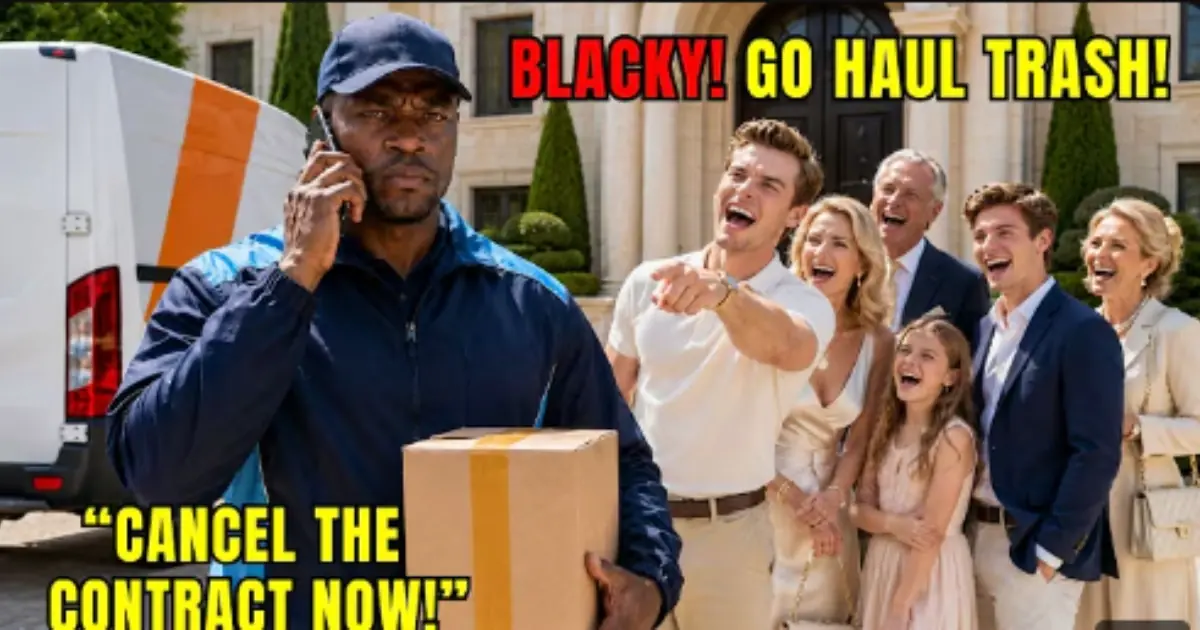
Bradley hadn’t spoken. He was staring at the table, his hands flat on the mahogany, his face drained of color. His cracked phone was still on the floor where it had fallen. He hadn’t picked it up. Mr. Turner. Richard’s voice was barely above a whisper now. Name your price. Whatever it costs, double, triple, we’ll pay it. Just please save the house. Malcolm shook his head slowly. I’m declining the project. The words hit the room like a detonation. Eleanor gasped. Richard’s mouth opened and closed. Bradley finally looked up, his eyes wide. You can’t, Richard started. I can, Malcolm said. And I am. Turner Construction will not be performing any work on the Harrington estate. My company does not enter into contracts with clients who have demonstrated discriminatory behavior toward our personnel. That is a company policy. I wrote it myself. He stood up. You have 83 days. I suggest you use them wisely. Richard stood too. His chair scraped against the floor. Mr. Turner, please be reasonable. Without your firm, we lose everything. I know, Malcolm said. The house will be condemned. I know. We’ll have nowhere to go. Malcolm paused at the door. He turned back and looked at Richard, a man in a $3,000 suit, begging. 3 weeks ago, your son threw me onto a driveway and told me to stay down. Your wife told me I wasn’t welcome at your front door. You called the police on me for standing on the porch of a house I built with my own hands. He adjusted his cufflink. Now you’re asking me to save it. He opened the door. The answer is no. The door closed behind him with a soft click. Not a slam. Malcolm Turner didn’t need to slam doors. He just closed them.
Inside the conference room, no one moved. Eleanor’s tears had stopped. She wasn’t crying anymore. She was staring at the blank tablet screen, seeing her own reflection in the dark glass. Distorted, unfamiliar, ugly. Bradley reached down and picked up his cracked phone. The screen was shattered. Through the web of broken glass, a notification glowed. Someone had tagged him in a tweet. He didn’t open it, but it was already too late. The tweet went viral on a Sunday. It started with a repost from a civil rights account with 2 million followers. The caption was simple. Watch what this rich family did to a black delivery man at their mansion. Then find out who he really is. By Monday morning, the video had 14 million views. Bradley’s face was everywhere. The polo shirt, the gold watch, the mimosa, the phone aimed downward at a man on his knees, his voice crystal clear in the recording. Smile, delivery boy. The internet did what the internet does. It identified him within hours. Bradley Harrington, Vice President Harrington Holdings, son of Richard Harrington, grandson of William Harrington, the man who had built the family name 60 years ago. Then they found Malcolm. It took one journalist, a reporter at the Chicago Tribune, to connect the dots. She pulled construction records. Cross-referenced Turner Construction’s project history with the Harrington estate address. Found the original building permits from 15 years ago. Found Malcolm’s name on the crew manifest. Not as an architect, not as an engineer, but as a laborer, a 23-year-old day worker who carried bricks. Her headline landed like a bomb. The delivery man they mocked built their mansion and he’s the only one who can save it.