Nobody in Mercer Falls would remember the exact moment it started because nothing about it looked on the surface like a beginning. There was no siren, no raised voice loud enough to carry past the parking lot. No single dramatic gesture anyone could point to later and say, "There, that's where it all came apart." There was only a quiet diner on a gray Tuesday morning, a man who had spent 22 years believing his badge made him untouchable, and a woman he didn't recognize sitting alone by the window, who already knew considerably more about him than he would have liked. By the time anyone in town understood what had actually happened that morning, it would already be too late to matter.
But for now, three weeks before any of it surfaced, Mercer Falls was simply waking up the way it always did, slow, unbothered, and entirely unaware of what was already sitting quietly in one of its booths. The town of Mercer Falls woke up slow on weekday mornings, the way small towns do when nobody is in a hurry to be anywhere except exactly where they already are. Mist still clung to the gutters along Main Street at 20 minutes to 7. And the only light spilling onto the sidewalk came from a buzzing neon sign that read the copper top grill in faded orange letters, half of which hadn't worked properly since sometime during the previous decade.
Inside the diner smelled like bacon grease and burnt coffee, a combination that had probably never once been described as pleasant, and yet somehow always was. A ceiling fan turned lazily overhead, doing nothing useful except making a faint clicking sound every third rotation. A small television mounted in the corner played the local morning news on mute, the anchor's mouth moving soundlessly through a story about road construction on Route 14. Donna Whitlock sat alone in a booth near the window, a cup of black coffee steaming in front of her, a laptop open and angled so the screen wasn't visible to anyone passing by. She wore jeans scuffed at one knee and a gray fleece jacket zipped halfway, the kind of outfit that drew exactly zero attention in exactly the way she wanted.
Supervisory Inspector Federal Oversight of the Mercer Falls Police Department, effective the 9th of the month pursuant to a consent decree. Following a 2-year pattern and practice review, she closed the folder again and wrapped both hands around her coffee cup instead, letting the heat seep into her palms. Three years, she thought. Three years of citizens filing complaints against this department, and almost every single one of them closed without action, without explanation, without so much as a letter home to the person who'd filed it. She had read the case files on the drive up, not skimmed, read every page, every redacted line she could still make sense of around the black bars. Excessive force complaints that vanished into internal review and never came back out.
A racial profiling complaint from a delivery driver that was marked unsubstantiated in 11 days flat with no interviews logged. An illegal search complaint from a teenager that simply stopped existing in the file after his family moved out of town 3 months later as if the complaint itself had been waiting for them to leave so it could disappear along with them. Whoever ran this department she thought had been allowed to run it like a kingdom for a very long time. And kingdoms in her experience did not give up their borders quietly. They had to be shown piece by piece that the kingdom had never actually belonged to them, that it belonged and always had belonged to the people living inside it. She had taken this particular kind of assignment before three times now over the course of her career, and each time she'd learned the same lesson in a slightly different town with a slightly different name on the door.
Departments that had operated without real oversight for years didn't usually announce their culture in the official records. The official records were always clean or clean enough properly formatted. Denials, properly worded closures, the bureaucratic equivalent of a fresh coat of paint over rot that had been spreading underneath for a decade. The only way to see the actual structure of a department was to walk through its town the way an ordinary person walked through it, unprotected by any badge, and watch what happened when nobody official was supposedly looking. She thought briefly of her own father, a postal worker in Ohio, who had spent 31 years delivering mail in a town that had never once in all those years made him feel like he fully belonged there. Not through anything dramatic, nothing that would have made a headline, just the accumulated weight of a thousand small moments where he'd had to decide again and again whether a slight was worth naming out loud or easier to simply absorb and carry home.
She had grown up watching him make that calculation daily, watching the particular exhaustion it left behind, even when he never once complained about it directly. It was in some quiet way she rarely spoke about part of why she'd ended up doing this exact work. Not out of anger, though there was some of that buried in it, too, but out of a stubborn practical belief that somebody had to be the one walking into rooms like Mercer Falls, and writing down plainly and officially what those thousand small moments actually cost, the people forced to absorb them. She wanted to see Mercer Falls before it knew her name. She wanted to see how the department's culture moved when it thought nobody Federal was watching because that was the only way to know what she was actually walking into come Monday morning. Tomorrow she would put on the windbreaker with the gold lettering across the back.
Tomorrow she would carry the badge clipped visibly to her belt. But this morning, in this diner, with this coffee going lukewarm in her hands, she was simply a woman passing through unnoticed, the way she preferred it. The bell over the door jingled. She didn't look up right away. She'd learned a long time ago that the moment you looked up too fast at a sound, you told the room something about yourself, that you were watching, that you were waiting, that you weren't quite as relaxed as you appeared. So she let her eyes finish the sentence on her screen first, and only then did she glance toward the door, casual, unhurried, the way anyone glances at a bell. A man had walked in wearing a crisp tan uniform shirt, gold buttons catching the dim overhead light, a badge pinned high on his chest that read chief in black letters beneath the department crest. He was broad through the shoulders in the particular way of a man who'd once been an athlete and had since let muscle slide comfortably into bulk with a ruddy weathered face and a close-cropped gray mustache that twitched faintly when he smiled, which he was doing now at no one in particular simply because smiling was part of how he walked into rooms.
This was Chief Gerald Hutchkins, and the moment he crossed the threshold of the Copper Top Grill, the entire rhythm of the diner shifted to accommodate him. Morning, Chief called the waitress behind the counter, already reaching for the coffee pot without being asked. Chief nodded, a man in a flannel jacket, two booths down, lifting two fingers off his own coffee mug in something between a wave and a salute. Hutchkins moved through the diner the way water moves through a channel it has carved for itself over many years without resistance, without even the memory of resistance. Because the channel had been worn so deep and so smooth that resistance was no longer a concept anyone in Mercer Falls applied to him.
He'd held this badge for 22 years. He'd been chief for the last 15 of them. In a town of 4,000 people, 22 years was long enough to stop being a person who held power and start being power itself. Indistinguishable from the office, indistinguishable from the badge, indistinguishable, in his own mind, at least from the law. He settled into his usual booth near the register, the one with the good view of the door, the one the waitress kept clear for him out of habit rather than instruction, and accepted his coffee with a grunt that passed in Hutchkins's particular dialect for gratitude. Behind the counter, a young man in a stained apron kept his eyes down on the dish rack, scrubbing a pan that didn't especially need scrubbing. His name was Marcus Webb, 19 years old, working mornings at the diner to help cover community college tuition two towns over. He didn't say good morning to the chief. He'd learned in the 8 months he'd worked here that it was safer not to be noticed by Gerald Hutchkins at all than to be noticed and found wanting.
In some way, Hutchkins hadn't bothered to explain in advance. Marcus had heard things. Mercer Falls was small enough that everyone heard things eventually, even the things people tried hard to keep quiet. He'd heard about a man two streets over who'd had his car searched on the side of the road for 40 minutes over a broken tail light and who'd filed a complaint that went nowhere. He'd heard about a woman who'd called the department to report a break-in and ended up somehow being the one questioned for an hour about where she'd been the night before. He'd heard the way certain names were said in certain tones around town quietly, carefully the way you talk about weather systems you can't control and can only hope to avoid. Marcus kept scrubbing the pan. He kept his head down. That was the agreement Mercer Falls had quietly made with Gerald Hutchkins.
A long time ago, an agreement nobody had ever voted on and nobody had ever signed. But everyone understood you didn't look directly at the chief unless the chief looked first. The diner went on around him in its ordinary rhythm, oblivious to the particular calculation Marcus was running behind the counter every single morning. An elderly couple in the corner booth split a plate of eggs the way they had every Tuesday for as long as anyone could remember their conversation low and unhurried. A trucker near the door read a newspaper folded into quarters. His boots still damp from whatever lot he'd parked in overnight, the waitress moved between tables with the kind of practiced weary grace that came from working the same six table section for longer than she probably wanted to admit, refilling cups without being asked, calling two of the regulars by name before they'd even sat down. It was on its surface an entirely unremarkable American morning in an entirely unremarkable American town.
And that was Marcus had come to understand exactly the problem. The unremarkable surface was where men like Hutchkins did their best work because nothing about an ordinary breakfast crowd ever looked from the outside like the kind of place where someone's rights were being quietly managed down to nothing. At the window booth, Dana watched all of this without appearing to watch any of it. She'd clocked the difference in the room the second the bell rang, the way three separate people had greeted him before he'd said a single word, the way the waitress moved with the practiced efficiency of someone serving a man who didn't like waiting. The way the bus boy had gone very still and very focused on a pan that was by any reasonable measure already clean. She'd seen this pattern before in other towns, in other departments. It had a particular shape to it, a particular weather. You could feel it in a room before you understood what it was.
A kind of pressure that settled over ordinary people and made them smaller, quieter, more careful with their eyes. Simply because somewhere along the way they'd learned that visibility in this town came with a cost that wasn't worth paying. She didn't write anything down. She didn't need to. She had a memory built for exactly this kind of work. Trained over a career to catalog rooms the way other people cataloged grocery lists automatically completely without conscious effort. She filed it away. The difference, the silence, the bus boy lowered eyes. Data. Just data for now. Hutchkins, for his part, had noticed her too, the way he noticed most new things in his town, which was to say immediately and with a faint automatic suspicion that he would have described if asked as simply being thorough. A black woman he didn't recognize, sitting alone with a laptop and a folder of papers, dressed like she didn't want to be looked at twice. In a town of 4,000 people, where Hutchkins genuinely believed he could name every regular face at every diner counter, a stranger registered the way a foreign object.
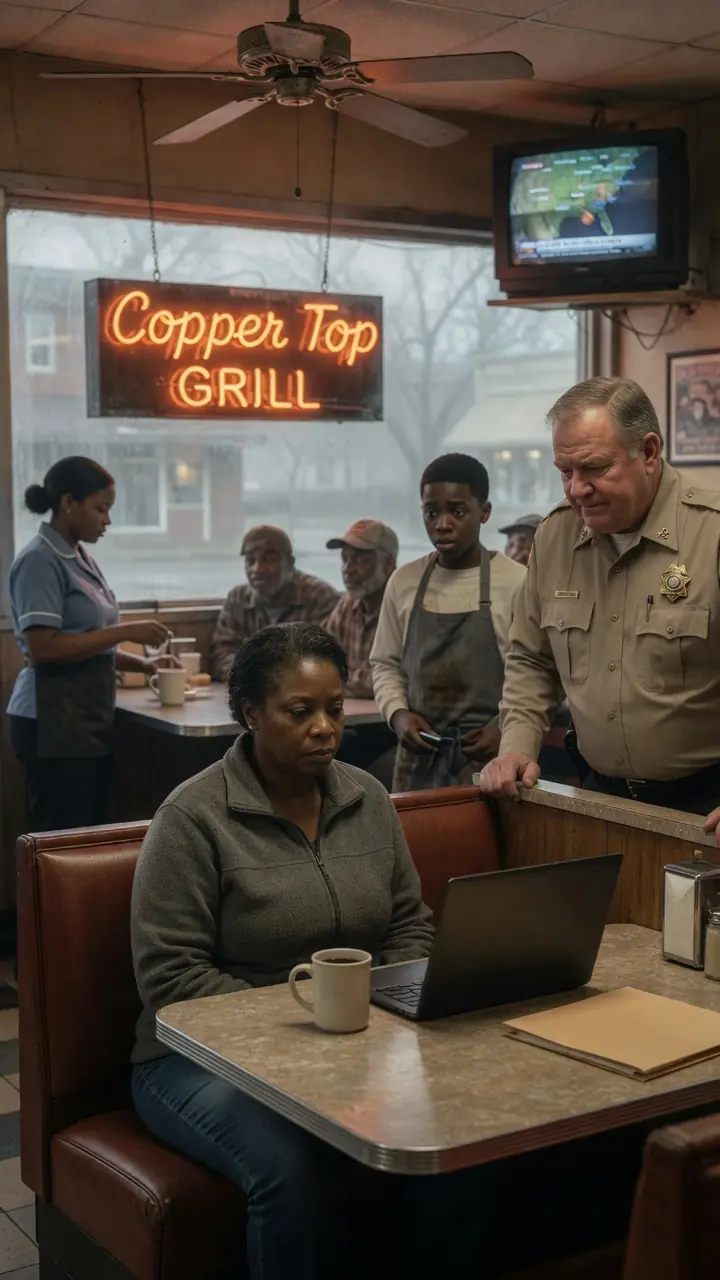
Registers in a body not necessarily dangerous, but immediately instinctively flagged. He sipped his coffee. He watched her over the rim of the cup for a moment longer, then was polite, the way men who have never once had their gaze questioned tend to watch things that catch their attention. Then he set the cup down, adjusted his belt, and started across the diner floor toward her booth. With the easy rolling gate of a man who had never in his adult life worried about whether he was welcome somewhere, Marcus, from behind the counter, looked up just long enough to see where the chief was walking. Then he looked back down at the pan, his stomach tightening in a way he couldn't have explained to anyone who hadn't lived in Mercer Falls long enough to learn the weather. Hutchkins stopped at the edge of Dana's booth, one hand resting on the back of the seat across from her, not quite asking permission to sit. Not quite not asking either. "Don't think I've seen you around," he said in the tone of a man making friendly conversation. Though something underneath the friendliness sat slightly wrong, slightly too pointed like a smile with too many teeth in it. "You passing through, or you got people here in Mercer Falls?" Dana looked up from her laptop with the unhurried calm of someone who had been asked harder questions by far more dangerous people. Just passing through, she said. Her voice was even pleasant, giving away exactly nothing. Needed coffee before the road. M. Hutchinson's eyes drifted almost involuntarily to the folder beside her laptop. the edge of a letterhead, just visible, official looking, the kind of paper that didn't belong to a tourist or a salesperson, or anyone passing through Mercer Falls on the way to somewhere more interesting. "What's all that then? Paperwork for what?" "Work!" Dona said simply, and closed the folder another inch. "Not dramatically, not defensively, just enough." Hutchinson's mustache twitched. He didn't like vague answers. In 22 years on this job, he'd developed a near religious conviction that vague answers were the first sign of someone with something to hide, and that conviction had calcified over time into something closer to instinct than reasoning. He didn't ask himself what kind of work might require a federal folder and a careful tone of voice. He simply filed her the way he filed most things. he didn't immediately understand under the heading of probably trouble. Where you headed exactly? He pressed, leaning his weight slightly onto the back of the booth seat. Here and there, Dana said, and took a slow sip of her coffee, watching him over the rim with an expression that gave nothing away at all. It was, she would think later, almost a kindness the way she let him have this moment, this small illusion of control, before everything he believed about this town, and his place in it came apart at the seams. But that was still weeks away. For now, she simply sat calm and unreadable, while Gerald Hutchkins stood at the edge of her booth, already deciding in the quiet machinery of his own certainty, that something about this woman didn't add up, and that he intended to find out exactly what, never once imagining that the answer to that question would cost him everything he had spent 22 years building. Hutchin straightened up from the booth, but he didn't walk away. Instead, his eyes drifted back to the folder one more time, and something in him, the same something that had built a 22-year career out of treating suspicion as a virtue, decided that a polite question hadn't gotten him an answer, so a less polite one might. Mind if I take a look at that? He [clears throat] said, already reaching. I do mind, actually, Dana said, and moved her hand to rest flat on the folder, not grabbing, not panicking, simply present. It was the wrong move to make in front of Gerald Hutchkins, though it was by any reasonable standard the only sane response to a stranger reaching for your private papers in a diner. But Hutchkins didn't process it that way. He processed resistance the way he processed everything else as confirmation. A polite request had been met with refusal, which meant in the warped arithmetic he'd been running for two decades, that there was something worth hiding underneath that refusal. "See, that's interesting," he said, his voice rising just slightly, just enough to start drawing attention from the nearby booths. "Folks who got nothing to hide, they usually don't mind showing a man their paperwork." He glanced around the diner, theatrically playing now, to an audience that hadn't asked to be one. We got a stranger in town this morning carrying around some governmentl looking folder. Won't tell me what it is. Won't tell me where she's headed. That sound about right to the rest of you. A few heads turned. The man in the flannel jacket lowered his coffee mug slowly watching. The waitress froze midpour at the counter, the coffee pot tilted at an angle that was starting to drip onto the lenolium and which she did not for several seconds notice or care about. Dana kept her hands flat on the table, her voice level. I haven't done anything that requires an explanation. Chief, she said, "I'm having coffee, chief," he repeated. And something about the way she said his title, not differential, not impressed, simply factual. The way you'd address any other stranger by the badge pinned to their chest, needled at him in a way he couldn't quite name. That's right, I am. And in my town, when I ask a question, folks generally find it in their interest to answer it. It would have been the easiest thing in the world in that exact moment for Donna to reach into her jacket pocket, produce the federal credentials she was carrying, not yet activated for this assignment, not yet meant to be shown, but real valid, sitting 2 in from her hand the entire time, and end this before it went any further. 10 seconds. That was all it would have taken to make Gerald Hutchkins's mustache stop twitching and his voice drop into the particular register men like him reserved for people they suddenly remembered to fear. She didn't reach for it. This was she understood with a clarity that felt almost clinical the entire point of arriving in Mercer Falls a day early and a rank lower than she actually was. She wasn't here to win an argument in a diner booth. She was here to see with her own eyes and without the distorting effect of a badge changing the temperature of the room exactly how Gerald Hutchkins treated the people of this town when he believed there would be no consequence for it. If she stopped him now she would learn something about how he treated federal officers. She would learn nothing at all about how he treated everyone else. the delivery driver, the teenager, the woman who called about a break-in and ended up being questioned herself, and it was the everyone else that the consent decree existed to protect. So, she stayed seated. She stayed calm, and she let Gerald Hutchkins keep walking toward the edge of a cliff he had no idea was there. "I'd like to finish my coffee in peace," she said simply. Hutchin's hand moved before she'd finished the sentence. He reached past her arm and snatched the folder off the table, flipping it open with the rough, dismissive motion of a man inspecting something he'd already decided was worthless. "Let's just see then," he said, scanning the top page. His eyes caught on a few lines of dense official language, the kind of bureaucratic phrasing that meant nothing to him beyond the vague impression that it was the language of people who thought they were smarter than him. What is this? Some kind of lawyer talk? You one of those activist types come up here to write some article about my department? It's work, Dana repeated. And this time there was the faintest edge underneath the calm, not anger exactly, but the specific patience of someone watching a man dig himself a hole with great enthusiasm. And I'd like it back, please. You'd like it back? Hutchkins said, mimicking her tone with an ugly little smile. And that was when his elbow, whether by accident or by the kind of carelessness that men in his position rarely bother to distinguish from accident, caught the edge of her coffee cup. The cup tipped. Hot black coffee spread across the table in a widening dark stain, soaking instantly into the loose pages of the folder. He was still holding halfopen sheeting off the table's edge onto Dana's sleeve and the strap of her bag where it hung on the booth seat. The smell hit first bitter sharp, the kind of smell that fills a small space immediately and completely. Then the heat soaking through the fleece at her wrist, an unpleasant prickling warmth that made her jaw tighten for exactly half a second before she controlled it. The diner had gone almost entirely silent. Even the muted television in the corner seemed for a moment louder than it should have been, simply because nothing else in the room was making any sound at all. "Oops," Hutchkins said without a trace of apology in his voice, setting the dripping folder back down on the table with deliberate carelessness, as if the coffee staining it further was simply a fact of physics he had no responsibility for. clumsy of me. Some small distant part of him registered even as he said it, that the gesture had been deliberate, that his elbow had found her cup with a precision that had nothing to do with clumsiness, and everything to do with 22 years of learning exactly how much damage he could inflict on a person, while still keeping a plausible word like accident available to hide behind afterward. He didn't examine that part of himself too closely. He never did. It was a skill he'd perfected so thoroughly over the years that it no longer felt like a skill at all. Simply the natural shape of how he moved through the world. Provoke, deny, provoke again, and let the next provocation bury whatever discomfort the last one might have left behind before it had time to settle into something he'd have to actually account for. Dana didn't move for a moment. She looked down at the spreading stain at the curling soaked edges of pages that had taken two years of federal investigation to compile now bleeding ink into a diner tabletop because a man with a badge had decided her silence was an insult he was entitled to punish. She reached for a napkin from the dispenser and began calmly to blot at the worst of it, saying nothing. Hutchkins, perhaps mistaking her silence for defeat, rather than discipline, decided he had room to keep going. "You know what? I think he said louder now, addressing the room as much as her. I think people like you come rolling through small towns like Mercer Falls, thinking you're somebody important, thinking you can sit here with your little folder and your attitude and not answer a simple question from the chief of police." He leaned in slightly close enough that she could smell the coffee on his own breath. But you're not in whatever city you crawled out of anymore. You're in my town. And in my town you answer when I ask. I haven't broken any law, Chief. Dana said quietly, still blotting at the coffee, her voice never rising to match his. And neither has anyone else in this diner this morning. I'd appreciate it if you let me finish cleaning up the mess you made. The word landed harder than she'd intended, or perhaps exactly as hard as she'd intended. The mess you made simple, factual, undeniable, and Hutchinson's ruddy face flushed a shade darker. "Watch your mouth," he snapped. And for the first time, his voice carried real heat instead of performance. "You don't get to talk to me like that. Not in this town, not anywhere. I've been chief of this department for 15 years, and I built this place into something. Nobody, and I mean nobody, walks in here with that kind of mouth on them, and doesn't have a reason to regret it. Behind the counter, Marcus Webb had stopped pretending to scrub the pan. He stood frozen dish rags still in hand, watching the booth with the particular paralysis of someone who desperately wants to do something and has spent his entire life in this town learning exactly why he shouldn't. Beneath the table, out of sight, Dana's hands remained pressed flat against her thighs. Fingers spread deliberately still. It was a technique she had developed years ago in another town during another confrontation that had taught her exactly how much could leak out through hands left unmanaged a tremor in the fingers a clench of the knuckles any small involuntary signal that a man like Hutchkins would read as fear and feed on accordingly. She controlled her breathing the same way, slow and even, four counts in four counts, out of rhythm she had practiced so many times over the years, that it no longer required conscious thought to maintain. Even now, even with the bitter smell of spilled coffee still sharp in the air, and the heat of public humiliation settling over her skin, in a way that had nothing to do with the room's actual temperature. Underneath that careful stillness, something colder and more focused than anger was taking shape. Not the heat of an insult absorbed, but the methodical, almost clinical calculation of a woman cataloging every detail of the room for later use the exact words, the exact tone, the exact moment the coffee had tipped, filed away with the same precision she'd once used to memorize license plates and badge numbers in situations considerably more dangerous than a diner booth. Whatever came next for Gerald Hutchkins, she understood already would not come from rage. It would come from documentation patient and complete the kind of accounting that men like him never saw arriving until it had already arrived in full. He thought about the delivery driver. He thought about the teenager whose complaint disappeared the same month his family moved away. He thought about every story he'd ever heard. Whispered low and careful in this town. Never spoken above a certain volume. Never spoken to anyone who might repeat them to the wrong person. Slowly, carefully, keeping his body angled so the motion wouldn't draw attention. Marcus slid his phone out of his apron pocket and thumbed the camera open. His hand was shaking slightly. He pressed record anyway, propping the phone against the edge of the napkin dispenser on the counter, angled just enough to catch the booth without obviously pointing at it. It wasn't bravery exactly, or not only bravery. It was the simple, stubborn conviction that if nobody else in this town was going to write down what happened here, somebody had to. He'd watched enough of these moments evaporate into the town's collective silence. To know that without proof, this morning would become just another story, whispered carefully over the years, unverifiable, deniable, eventually forgotten. Not this time, he thought, not if he could help it. Dana, for her part, had clocked the bus boy's movement. Without turning her head, a small shift in posture, a hand disappearing into an apron pocket, and reappearing with something rectangular and dark. She didn't acknowledge it. She didn't need to. Whatever was happening behind that counter was its own quiet act of courage, and she had no intention of doing anything that might draw Hutchkins's attention toward it. Hutchkins, oblivious, was still talking. his voice climbing now, performing for the room in a way that suggested he'd long ago stopped being able to tell the difference between asserting authority and simply enjoying the sound of his own dominance. Stand up, he said abruptly. Let me see some ID for what charge exactly, Dana asked, not moving. for being a smart-mouthed stranger in my town who won't answer a simple question," Hutchkins said, and reached toward her bag, where it sat soaked on the booth seat, as if he intended to search it himself. Dana's hand moved first, not to stop him with force, simply to slide the bag a few inches further down the bench out of easy reach, while keeping her eyes on his. "You don't have probable cause to search my belongings, Chief," she said. Her voice had not risen once through the entire exchange, and the steadiness of it more than anything else seemed to be what infuriated him most. And I'd remind you that knocking over a stranger's coffee and rifling through her papers isn't really the community policing moment you might think it is. A few of the regulars in nearby booths exchanged glances. The man in the flannel jacket had set his coffee down entirely, now watching with the wideeyed discomfort of someone witnessing something he knew somewhere underneath. His own careful silence was wrong, and someone who also knew with the same certainty that he was not about to be the one who said so out loud. Hutchkins straightened up, breathing hard through his nose, his jaw working. For a moment it looked as though he might escalate further, still might actually reach for the radio clipped to his shoulder, might actually attempt to manufacture some charge out of thin diner air simply because his pride demanded it. There's a moment in every story like this where the person doing wrong has a choice. Back away with whatever dignity is left or keep pushing because pulling back feels too much like losing. What do you think makes someone choose to keep pushing even when every signal in the room is telling them to stop? If you've ever watched someone double down instead of deescalating, you know exactly the feeling building in this diner right now. Drop your thoughts in the comments. And if this story already has you hooked, go ahead and hit that like button. It helps more people find stories exactly like this one. But then, almost as quickly as the heat had risen in moss, Hutchkins seemed to catch himself glancing around the diner at the small crowd of witnesses that had assembled without his fully noticing, and something more calculating slid across his face. "You know what? Forget it," he said, waving a dismissive hand, his voice dropping back into something almost jovial, almost generous, the practiced tone of a man who knew exactly how to make a room exhale. I got better things to do than babysit some outoftowner with an attitude problem. He straightened his belt smoothed down his uniform shirt with both hands and turned to address the diner at large with a broad, easy smile. Sorry for the disturbance, folks. Just having a little fun. Y'all enjoy your breakfast. The room exhaled audibly collectively the particular relief of people who had been holding their breath. Without quite realizing it, the waitress resumed pouring coffee at the next booth. Over her hand, still faintly trembling. The man in the flannel jacket picked his mug back up. Conversations, quiet and careful, began to resume their normal volume. Donna said nothing. She continued blotting at the ruined papers with a fresh napkin, gathering what could still be salvaged into a damp stack, sliding it back into the coffee stained folder, for a moment, watching Hutchkins stroll back toward his usual booth. With the loose, satisfied gate of a man who believed the matter closed. It genuinely did look as though the confrontation was over. She gathered her things. She stood. She left a few bills on the table for her coffee, more than the bill required, because the waitress hadn't done anything to deserve a morning like this either. She walked toward the door folder, tucked under one armbag over her shoulder, her sleeve still damp and cooling against her wrist. She was three steps from the door when Hutchin's voice rang out behind her one more time louder now, performing again for an audience he could not resist one final encore for. Hey," he called, and she heard the scrape of his boots as he half rose from his booth to make sure the whole diner caught this part, too. Let me give you some advice free of charge since you're new in town. People like you coming through here with that little attitude, that little folder, acting like you're somebody, you don't last long in Mercer Falls. So, do yourself a favor. Get back in your car and keep driving. And if I happen to see that car parked downtown again, I'll have it impounded on principle just to make a point. The diner had gone quiet again, watching, waiting to see if this stranger would finally crack, finally turn around with tears or fury or some satisfying collapse that would let Hutchkins close the morning out. On the note of total victory he so clearly craved, Dana stopped at the door. She turned around slowly, and for the first time that morning she looked directly at Gerald Hutchkins, not with fear, not with the simmering anger he might have half hoped to provoke, but with something far more unsettling to a man who built his entire identity on being feared or respected. Simple, careful attention. The look of someone memorizing a face for later, the way you'd memorize the layout of a room you intended to come back to. She said nothing. She held his gaze for three full seconds long enough that his easy smile faltered just slightly, just for an instant, though he would never have admitted it to anyone, not even himself. Then she turned, pushed the door open, and walked out into the gray Mercer Falls morning, the bell jingling once behind her the cold air outside a relief against her coffee damp sleeve. Hutchkins watched her go, his earlier confidence already reasserting itself, already rewriting the morning in his memory as a clean, uncomplicated win. He sat back down in his booth, picked up his coffee, and let out a short, satisfied laugh. "Another one handled," he said, to no one in particular, and the diner, eager to move past the discomfort of the last 10 minutes, let the moment slide back into the ordinary hum of a Tuesday morning. Behind the counter, Marcus Webb quietly stopped his recording, slid the phone back into his apron pocket, and exhaled a breath he felt like he'd been holding since the coffee cup tipped. His hands were still shaking slightly as he went back to the dish rack. He didn't know in that moment what he would eventually do with the video sitting in his phone. He only knew with a certainty that surprised him that he was glad he had it. Outside in the gray morning light, Donna Whitlock walked to her car, set the ruined folder on the passenger seat, and sat for a long moment behind the wheel before starting the engine. She didn't feel anger exactly. She felt something quieter and more useful than anger, the particular focused clarity of a person who has just watched firsthand exactly what she came to this town to find. She thought of the case files again, the buried complaints, the vanished paper trails. She had wondered on the drive in what kind of department she was walking into. Now she knew. She pulled out of the parking lot and drove east out of Mercer Falls, back toward the interstate, back toward the 3 weeks of preparation that stood between this morning and the day she would walk back through that town wearing a different jacket entirely. 3 weeks later, the Mercer Falls Police Department headquarters looked exactly the way it always looked on a Thursday morning. Fluorescent lights buzzing over a bullpen of mismatched desks. The smell of old coffee and gun oil settled so deep into the walls. It had become part of the building structure, a radio scanner murmuring low in one corner, half listened to by everyone and fully listened to by no one.
Chief Gerald Hutchkins sat at his desk near the back uniform pressed badge polished, going through overtime paperwork with the particular boredom of a man who had done this exact task more times than he could count, and had long since stopped pretending to find it interesting. He'd received a call the day before from the mayor's office, a brief and vague mention of a community policing satisfaction review scheduled for that morning. federal liaison routine visit. Nothing to worry about. He hadn't worried about it. Worrying about things was in Hutchinson's experience what other people did. The bullpen carried its usual Thursday rhythm. Officer Renee Castillo at her desk near the window finishing an incident report from the night before glancing up occasionally at the clock. Two older officers near the coffee station trading complaints about the broken vending machine down the hall. The dispatcher's voice occasionally crackling over the radio with routine calls, vendor benders, and noise complaints. The unremarkable static of small town policing, sunlight cut through the blinds in thin, dusty bars across the lenolium floor. Nobody in the room had any reason to believe this particular Thursday would be different from any other. At 9:14 a.m., the front doors of the precinct opened, and four people walked in together with the unhurrieded, purposeful stride of people who had done this exact kind of entrance many times before, and felt no need to rush it. At the front of the group walked Dana Whitlock, no longer in jeans and a fleece jacket, but in a tailored Navy windbreaker with US Marshall stamped a bold gold lettering across the back, her dark hair pulled back neatly, a laminated federal credential clipped visibly to her belt, though not yet held up for inspection. Behind her walked two deputy marshals, broad-shouldered men in plain dark suits who said nothing and needed to say nothing, and beside them a D. OJ Civil Rights Division liaison, carrying a slim leather portfolio. The desk sergeant near the entrance rose halfway out of his chair, uncertain. Can I uh can I help you folks? Inspector Dana Whitlock, US Marshall Service, Dana said. and her voice carrying easily across the bullpen without needing to be raised. We're here for the scheduled federal liaison visit. I believe Chief Hutchkins is expecting us. The desk sergeant's eyes flicked toward the back of the room toward Hutchkins's desk, then back to the badge clipped at Dana's belt, then back toward Hutchkins again, as if seeking permission for a thought he hadn't yet finished forming. Hutchkins looked up from his overtime paperwork at the sound of new voices in the bullpen, the particular irritation of a man interrupted from tedious work, who was nonetheless glad on some level for the interruption. He saw the windbreaker first. Federal fine. The mayor had mentioned something about a review. He saw the two deputy marshals next standing with the kind of stillness that came from training rather than nerves. And then he saw the woman at the front of the group, and something in the recognition refused for a moment, to fully assemble itself in his mind, a flicker gone almost as soon as it arrived, dismissed before it could finish forming into a thought. He pushed back from his desk, and stood smoothing his shirt down with both hands, already composing his face into the practiced easy authority he wore, for every visitor who walked through that door, federal or otherwise. Chief Hutchkins, he said, extending a hand as he crossed the bullpen floor. Wasn't expecting federal marshals for a community satisfaction review, but I appreciate you folks making the trip. We run a tight operation here in Mercer Falls. I think you'll find everything in order. Dana shook his hand once firm brief and did not return the warmth. We'll need access to your case files, she said. specifically internal affairs complaints filed against department personnel over the past four years. Hutchkins's easy smile held but something behind his eyes recalibrated slightly. That's uh that's a pretty broad request for a satisfaction review, he said. Usually these things are more of a conversation, community feedback, that sort of thing. Dana turned to the DOJ liaison who had already begun pulling a folder from the leather portfolio without waiting for Hutchkins to finish his sentence. This isn't a usual visit, Chief. Let's start with case numbers 4471,4502 and 4588. Hutchin's jaw tightened almost imperceptibly. He knew those numbers. Of course, he knew those numbers. They were the kind of numbers a man memorized whether he wanted to or not simply by virtue of how many times he'd personally made sure they went nowhere. The excessive force complaint from 2 years back. The racial profiling complaint from the delivery driver. The illegal search complaint from the teenager whose family had moved away before anyone had to answer for anything. Those are closed cases, he said. His tone shifting now defensive in a way he tried to disguise as simply being helpful. Reviewed internally found unsubstantiated. Standard procedure. We'll be reviewing the standard procedure that produced those findings. Nothing in her voice suggested she was asking permission. Something about her voice nagged at Hutchkins in a way he couldn't immediately place a steadiness underneath the words, a particular cadence to how she delivered bad news without raising her volume to match its weight. He told himself it was nothing. He told himself federal officers all sounded a little alike. After enough years on this job, all of them trained into the same flat procedural calm that he'd long resented in every inspector and auditor who'd ever walked through his door. He pushed the half-formed recognition down before it could finish surfacing the same way he'd pushed down a hundred smaller doubts over 22 years, not because he'd examined them and found them groundless, but because examining them had never once been required of him before. Across the bullpen, officer Renee Castillo had stopped typing entirely, watching the exchange with a tight, uneasy feeling building low in her stomach. She was 26,3 years on the force, young enough still to feel the gap between what she'd been taught policing should look like in the academy, and what she'd actually watched it become inside these walls. She'd heard about case 452. Everyone in the department had heard about it in the careful sideways way department gossip traveled when nobody wanted to be the one who said something out loud. She'd always assumed the way you assume things you'd rather not investigate too closely that there was probably more to the story than what got whispered in the breakroom. Watching Inspector Whitlock request that exact case number by memory without hesitation, without checking a list, Castillo felt something shift in her chest. a small cold certainty that the woman in the federal windbreaker already knew things about this department, that the department had spent years making sure nobody outside it would ever find out. She rose from her desk and crossed the bullpen, quickly catching Hutchkins near the coffee station as he stepped away from the marshals to give them a minute to get settled, a transparent excuse to regroup his thoughts in private. Chief," she said quietly, glancing back toward where Dana stood, reviewing files with the DOJ liaison. "Something's not right here," she asked for those case numbers like she already had the files memorized. "I don't think this is a routine visit." Hutchkins waved a dismissive hand, though his eyes kept drifting back toward the windbreaker, toward the badge at the woman's belt, toward something he still couldn't quite name. "It's fine, Castillo. Federal types like to come in and throw their weight around, make themselves feel important. We've had auditors before. We'll get through it. But even as he said it, he found himself watching Dana Whitlock more closely than he intended to. His eyes following the line of her jaw. the particular way she stood with her weight settled evenly on both feet, hands loosely clasped patient in a manner that pricricked at something buried in the back of his memory, like a splinter he couldn't quite locate. Castillo returned to her desk, but she didn't go back to typing. A cold, uneasy feeling had settled into her stomach. The specific discomfort of watching a federal officer request three case numbers by memory without hesitation. numbers Castillo herself had only ever heard whispered carefully in the breakroom. She didn't need to pull up the files to know what she'd find. She'd spent 3 years telling herself the gossip was probably exaggerated. Watching Inspector Whitlock move through this building with that kind of certainty. She understood all at once that she'd simply chosen not to look too closely. He crossed the bullpen floor toward her, his earlier composure thinning at the edges, replaced by the particular irritation he reserved for anyone who threatened even slightly, his sense of total control over his own building. "Look," he said, planting himself a few feet from where she stood close enough to loom, the same posture he'd used on a thousand traffic stops and a thousand diner booths over 22 years. I don't know who authorized this or what exactly you think you're going to find digging through four-year-old paperwork, but I'll remind you this is my department, my town. I've run this place for 15 years without federal interference, and I'd appreciate a little professional courtesy while you're standing in my building." Dana didn't step back. She didn't raise her voice. She simply turned to face him, fully meeting the proximity he'd closed between them, with a stillness that refused to be crowded. And it was in that exact stillness, in the particular way she didn't blink, didn't flinch, didn't perform any of the small defensive movements he'd grown so accustomed to provoking in people that something in Gerald Hutchkins's body recognized her before his conscious mind caught up. A prickle crawled up the back of his neck, cold and sudden, the physical sensation of deja vu arriving a full half second before the memory attached to it. He knew this stillness. He had stood this close to this exact stillness before in whether he could almost feel again if he let himself rain soaking through a raincoat collar. A flashlight beam cutting through mist. a voice that hadn't risen even once, no matter how hard he'd pushed it. He blinked hard once, trying to shake the feeling loose, telling himself it was nothing telling himself. Federal officers all carried themselves the same controlled way, telling it himself anything at all that would let him keep standing here, believing he was still the one in control of this room. "This is my department," he repeated. Though the conviction in his voice had thinned by a noticeable degree, the words coming out slightly more clipped than before. Whatever you're looking for, you're not going to find anything here except a department that does its job. Dana said nothing for a moment. She reached into the leather portfolio the DOJ liaison was holding open beside her and withdrew a single page sealed inside a clear evidence sleeve, the kind used to preserve documents that might later need to be authenticated in court. She set it down on the nearest desk between them turning it so the visible side faced him. It was a single sheet of paper badly water stained. The ink bled and feathered across half the page. In long brown streaks, the unmistakable ghost pattern of spilled coffee soaked through cheap printer paper and left to dry. For a moment, Hutchkins simply looked at it without understanding. Then his eyes tracked to the corner of the page to a fragment of letterhead, still legible beneath the staining partial federal seal, partial case heading, and the memory that had been clawing at the edge of his mind for the last several minutes, finally broke through whole and entire arriving, not as a vague unease anymore, but as a complete devastating certainty. the diner, the folder, the coffee cup tipping, the woman in the gray fleece jacket, who hadn't raised her voice once, who had looked at him at the door, with an expression he'd told himself for 3 weeks, meant nothing at all. He stared at the stain, his mouth opened slightly, no sound coming out yet, his mind racing backward through every word he'd said in that diner booth, every insult, every threat, the particular satisfaction he'd felt, walking back to his seat afterward, certain he'd handled another, nobody exactly the way Mercer Falls required. The bullpen around them had gone very quiet. There's a particular kind of dread that comes from realizing all at once that the moment you thought was already over is about to come back around and demand a reckoning. Have you ever had a memory hit you like that sudden complete and impossible to talk yourself out of? If you've been waiting for this exact turn since the diner scene, you already know how good it's about to feel. Smash that like button if you're as invested in this as we are, and stick around. what happens in the next few minutes is the whole reason this story exists. That doesn't Hutchkins started his voice cracking slightly in a way he immediately hated and he cleared his throat hard trying to reassert the authority that had carried him through 22 years of never once having to take responsibility for anything. That doesn't mean anything. Lots of folks pass through this town. Lots of women come through Mercer Falls. It was October the 12th, Donna said quietly, evenly, not moving her eyes from his face. The Copper Top Grill, 6:40 in the morning. You took a folder off my table without permission, spilled coffee across 2 years of federal casework, and told me to get back in my car and keep driving. You said if you saw my car parked downtown again, you'd have it impounded on principal. Sweat had begun beating along Hutchkins's hairline. a thin cold sheen that he could feel forming and could do nothing to stop. "I don't I don't recall the specifics of every conversation I have in a given week," he said, the bluster in his voice thinning with every word transparent even to himself. "If there was some kind of misunderstanding, "There was no misunderstanding," Dana said. There was a bus boy named Marcus Webb who recorded the entire interaction on his phone because he'd watched this department bury enough complaints over the years to know that without proof, nothing in this town ever sticks. Near the doorway to his office, Hutchkins's deputy chief, a heavy set man named Russ Callaway, who had worked under Hutchkins for nearly a decade, had gone very still watching the exchange with an expression that had shifted in the span of about 90 seconds from mild curiosity to something closer to dawning alarm. He had heard vaguely about a diner incident three weeks back. Hutchkins had mentioned it briefly, dismissively framed as nothing a smartmouth stranger who'd needed putting in her place. Callaway had nodded along at the time the way he nodded along at most of Hutchkins's stories without much thought the way you nod along at weather reports watching now watching the federal credentials clipped at this woman's belt and the careful devastating precision with which she was laying out exactly what had happened that morning. Callaway understood with a sinking, sickening clarity just how much more exposed this department was than he'd allowed himself to consider. He took a half step backward away from Hutchkins's office doorway, away from the center of whatever was about to happen. The particular instinct of a man who has just realized the building he's standing in might be about to come down around him, and would rather not be standing too close to the chief when it does. the bullpen which moments earlier had carried its ordinary Thursday murmur phones ringing faintly in the dispatch room. The low static of the radio scanner, the shuffle of paperwork had gone almost entirely silent now. Officer Castillo had stopped pretending to type altogether, her hands resting flat on either side of her keyboard, eyes fixed on the unfolding scene with an expression somewhere between vindication and dread. The two older officers by the coffee station had drifted closer without quite seeming to mean to coffee cups forgotten in their hands. Somewhere behind a cubicle partition, the faint telltale glow of a phone screen lifted into view angled toward the center of the room, though nobody acknowledged it directly. Conversations that had been idling at normal volume moments before simply stopped mid-sentence. The way conversations stop when every person in a room senses almost simultaneously that something significant is about to happen and that whatever it is, it will be easier to explain later if they can say they watched it happen rather than heard about it secondhand. Castillo's eyes moved briefly from Hutchkins's reening face to the badge clipped at the inspector's belt, and something in her settled into a decision she hadn't fully realized she'd been quietly building toward for three long, careful years on this particular job. She thought about every report she'd filed exactly the way she'd been trained to every small irregularity she'd noticed and quietly let go because raising it would have meant raising it with him directly. She had told herself more than once that staying quiet and doing her own job well was its own kind of integrity. watching the inspector lay out case number by case number exactly what that silence had cost Castillo, understood there was a real difference between being a good officer and simply being a careful one, and that she had spent three years choosing the second without ever quite admitting that to herself. Hutchinson's hands had curled into loose fists at his sides, not [clears throat] in aggression now, but in something closer to the helpless physical response of a man whose body understood faster than his mind, was willing to admit that the ground beneath him had already shifted. Whatever happened at that diner, he said, his voice, climbing again, desperate now, rather than commanding, that was a misunderstanding between two civilians. It's got nothing to do with this review with this department. It has everything to do with this department. Chief Hutchkins Dana said and for the first time something in her voice sharpened not louder but harder the soft edge of patience finally giving way to something closer to verdict. Because 3 weeks ago you didn't humiliate some random stranger passing through your town. You humiliated the federal officer assigned to oversee every decision this department makes from this point forward. Every word you said to me in that diner, you said to the person who now has the authority to dismantle everything you've built here piece by piece starting today. The silence that followed lasted only a handful of seconds, but to everyone standing in that bullpen, it felt considerably longer. The particular suspended quiet of a room, collectively realizing that the floor it had been standing on for years, had just been revealed as considerably less solid than anyone had assumed. Nobody reached for a phone. Nobody spoke. It was the kind of silence that arrives only once or twice in a career. The kind that announces without a single word that the room has already changed permanently before anyone in it has had time to fully understand why Hutchkins's breathing had gone shallow and uneven. He glanced toward Callaway, half hoping for some reflexive show of support, some loyal deputy stepping forward to vouch for him the way subordinates were supposed to when the chief needed cover. Callaway didn't move. He stood near the office doorway with his arms loosely crossed, eyes fixed somewhere on the floor between them, offering nothing because there was in that moment nothing left in his career long loyalty to Hutchkins worth risking his own position to defend. 15 years of difference had run out exactly when it mattered most, and Hutchkins, scanning the room for an ally, found only the particular isolating silence of people deciding one by one that they would rather watch than participate quietly. Even the radio scanner in the corner seemed to have gone quiet, though nobody could have said exactly when. The dispatcher's last routine call had faded out, only that the bullpen now held no sound at all beyond the low hum of fluorescent lighting and the faint unsteady rhythm of one man's breathing. Dana let the silence hold for exactly as long as it needed to hold. And then she reached up and unclipped the federal credential wallet from her belt, flipping it open with a single practiced motion and holding it up at chest height angled so the entire bullpen could see it as clearly as Hutchkins could. The badge inside caught the fluorescent overhead light in a way that seemed for a moment almost deliberate. a flat gold star, the metal slightly worn at the points from years of handling stamped with the raised eagle crest of the United States Marshall Service at its center wing spread wide above a shield bearing the scales of justice. Beside it sat her laminated identification card, the federal seal embossed in the corner, catching the light at a slightly different angle than the badge itself. A faint holographic shimmer rippling across the surface as she tilted it. The kind of security feature designed specifically to be impossible to fake under exactly this sort of fluorescent scrutiny. Her full title sat printed in clean block lettering beneath her photograph. Supervisory Inspector, Office of Federal Monitoring, United States Marshall Service. Gerald Hutchkins stared at the badge the way a man stares at an object that has just confirmed beyond any further possibility of denial the exact shape of his own ruin. his ruddy weathered face, the same face that had smiled so easily, walking into a diner three weeks earlier, certain of its welcome in every room. It entered, drained of color in stages, the deep red flush of his earlier anger, fading first to a dull, blotchy pink, and then further still into a sickly ashen gray that seemed to settle into the lines around his mouth and eyes like dust. A visible tremor started in his jaw, small at first, then spreading until his lower lip trembled slightly, with the effort of trying to hold an expression that no longer had anywhere true to land. His mouth opened. No sound came out. He tried again, his throat working visibly, and still nothing emerged beyond a thin, strangled breath. Around them, the bullpen reacted as one body. A collective gasp rippled through the room, audible even over the hum of the fluorescent lights. Several officers half-risising from their chairs without seeming to fully register that they'd moved. Near the cubicle partition, where a phone screen had been glowing discreetly, the device lifted fully into view, now no longer hidden angled directly at the center of the room. Its owner, having apparently decided that whatever consequence might follow from documenting this moment, was worth far less than the cost of not having proof of it. Officer Castillo's hand had risen halfway to the mouth, frozen there, her eyes wide, flicking between the badge and Hutchkins's me collapsing face, as though trying to physically reconcile the two. Even Callaway, who had spent 10 years learning to keep his expression carefully neutral around his chief, let his composure slip entirely, his arms falling open from their crossed position, his mouth slightly a gape. The room itself seemed to hold its breath in a way that went beyond simple silence. The dispatcher's radio, which had been murmuring low and constant since morning, had gone unaccountably quiet, as though even the routine traffic of the outside world understood there was nothing for it to compete with in this particular minute. The smell of old coffee and gun oil that had settled into the walls of this building for decades, seemed suddenly more present than it had any right to be, the way ordinary sensations sharpen at the edges. in moments the body recognizes as significant before the mind has finished processing why. Somewhere outside a delivery truck downshifted on Main Street, the low growl of its engine drifting faintly through the precinct's old windows, the only reminder that the rest of Mercer Falls was still moving forward at its ordinary pace, while the room inside this building had stopped entirely. and Dana. Dana felt none of the satisfaction the room might have expected from her, none of the triumphant heat that comes with finally being vindicated in front of an audience. What settled over her instead was something quieter, steadier, the particular calm of a person who has been handed exactly the confirmation she came here looking for, and now simply needs to do the next necessary thing correctly, without theater, without cruelty, without anything that might later be mistaken for revenge rather than justice. Five full seconds passed in absolute silence. Nobody in the bullpen moved. Nobody spoke. The only sound in the entire room was the faint continuous hum of fluorescent lighting overhead, and somewhere beneath it, the unsteady rhythm of Gerald Hutchkins's own breathing, ragged and audible, in a way it had never once needed to be in 22 years of standing in rooms exactly like this one, always certain until this precise moment that he was the one who decided how every encounter in this building would end. 5 seconds of silence might not sound like much when you read it on a page, but in a room full of people who all just watch the ground disappear out from under someone, it can feel like an eternity. If you were standing in that bullpen right now, do you think you'd be able to look him in the eye or would you look away? Let us know down in the comments. And if you've made it this far into the story, do us a favor and subscribe because the next few minutes are exactly what you came here for. Finally, Dana spoke her voice carrying clean and level across the silent room. Chief Hutchkins, I'm Supervisory Inspector Dana Whitlock, United States Marshall Service Office of Federal Monitoring. As of this morning, I am the federally appointed monitor assigned to oversee the Mercer Falls Police Department under a consent decree entered following a 2-year pattern and practice investigation by the Department of Justice. She paused, letting the words settle fully before continuing. That appointment became effective the same week you spilled coffee across my casework told me to get back in my car and threatened to have it impounded if you saw it downtown again. Every word you said to me in that diner chief, you said directly to the federal officer now empowered to oversee every decision made inside this building going forward. Hutchkins's mouth finally produced sound, though what emerged was less a sentence than the wreckage of one. I I didn't. There's no way I could have. You didn't know, Dana said, not unkindly, simply factually. That's correct. And it didn't matter because the way you treated me that morning had nothing to do with who I turned out to be. And everything to do with who you believed, you could treat that way without consequence. That's the part this department is going to have to answer for, not just what happened to me. what's been happening in this town for years to people who never got a federal badge to even the field. Hutchkins felt his mind lurch backward through 22 years of his own career. Every traffic stop, every detained motorist, every complaint he'd personally ensured disappeared into the quiet machinery of internal review. All of it surfacing at once in a single vertigenous rush. He had always told himself a version of his own story in which none of it was hidden exactly. It had simply never been examined closely enough to matter, and he had mistaken that absence of examination for innocence. The way a man mistakes the absence of a storm for the absence of weather entirely. Standing here now, watching the federal credentials still held steady in front of him, he understood with a clarity that arrived far too late to be useful, that nothing he had ever done in this town had actually been hidden. It had simply never been punished, and the distance between those two things which he had spent two decades comfortably ignoring, had just collapsed to nothing at all. This is he tried again, his voice cracking fully now. All pretense of command gone from it. This can be handled. Whatever happened at the diner, I can apologize. We can There's no need to involve the whole department in something that was just a misunderstanding between two people. It stopped being a misunderstanding between two people the moment you use the authority of this badge to threaten a stranger in a public diner over nothing more than her silence. Donna said, "And it stopped being containable the moment a 19-year-old bus boy decided he wasn't willing to let this town's silence protect you the way it's protected you for 22 years." A small audible reaction moved through the back of the bullpen at the mention of Marcus, a few officers glancing toward each other. The particular discomfort of people realizing that the courage shown by someone with far less power and far more to lose had quietly outpaced their own. Dana turned slightly, addressing the room rather than Hutchkins alone. This department has three internal affairs complaints on record. Over the past four years, case 4471, excessive force closed in 9 days with no body camera footage logged despite policy requiring it. Case 45502, racial profiling closed in 11 days with no interview transcripts on file. Case 4588. Illegal search closed the same week the complainant's family relocated with no explanation recorded for the timing. Every one of those complaints was closed without the documentation this department's own policy requires. That is not an accident that happens three times. That is a pattern and patterns are exactly what consent decrees exist to correct. Hutchinson's hands had begun trembling visibly now, no longer able to mask the tremor that had started in his jaw and spread outward until it reached his fingers. "You can't just This is still my department," he said, the words coming out smaller now, almost pleading the last reflexive grasp of a man trying to hold on to an identity that had defined him for two decades and was now visibly dissolving in front of a room full of witnesses. I built this department 15 years as chief. You can't just walk in here and I'm not walking in here and taking anything that was ever rightfully yours to begin with, Chief Hutchkins, Dana said. And for the first time, something in her voice carried real weight rather than simply procedure. This badge, this department, this town, none of it was ever supposed to be a kingdom. It was supposed to be a public trust. You've spent 22 years treating the difference between those two things as if it didn't exist. As of this morning, under federal authority, it exists again. Hutchkins made one last attempt to claw back some footing, reaching for the only lever he had left. "I'm calling the mayor," he said, fumbling for the phone clipped at his hip, his hands shaking badly enough that he nearly dropped it. "Thomas will straighten this out. He's known me for 20 years. He'll tell you exactly how this department runs and why this is completely out of line. Mayor Reyes's office was notified an hour ago before we arrived. Donna said evenly, he's already agreed to full cooperation with the consent decree, including immediate access to municipal financial records connected to this department's budget. If you'd like to call him, you're welcome to. I don't think you'll find the conversation goes the way you're hoping. Hutchinson's hand froze halfway to the phone, then dropped back to his side, the last visible flicker of resistance draining out of him in real time. He looked for the first time in anyone's memory in that bullpen genuinely small a man whose entire physical presence had always seemed to fill whatever room he stood in suddenly diminished shoulders rounding forward the practiced authority gone out of his posture as completely as if someone had simply unplugged it. This department had every opportunity to address what was happening inside it. Donna continued her voice quieter now, but no less certain. Three documented complaints in four years, each one closed, without the paperwork your own policy required. That's not a department that didn't know. That's a department that knew and chose silence anyway because silence was easier than accountability. And for 22 years, nobody made it more costly to stay silent than it was to do the right thing. That changes today. She nodded once to the deputy marshal standing nearest the office doorway. Begin the formal relief of duty. The deputy marshall stepped forward, his voice calm and procedural, utterly without theater. Chief Hutchkins, I need you to surrender your service weapon and your badge. Hutchkins did not move for a long moment, his eyes flicking around the bullpen one final time, searching perhaps out of pure habit rather than any real hope for someone who might step forward on his behalf. Callaway remained where he stood, arms loose at his sides, offering nothing. The two officers by the coffee station looked away, entirely unwilling to meet his eyes. Even the desk sergeant near the front door, who had greeted Hutchkins every single morning, for the better part of a decade, with the same easy difference everyone in this building had learned to perform, kept his gaze fixed firmly on the floor. It was Officer Renee Castillo who finally moved. She rose from her desk, crossed the bullpen with steady, deliberate steps, and stopped in front of Hutchkins, her hand extended palm up, waiting. She did not say anything cruel. She did not gloat. She simply held her hand out steady, despite the way her pulse was hammering beneath her uniform collar, and waited for her chief, her soon tobe former chief, to do what federal authority had just required of him. For a moment Hutchkins looked at her the way a drowning man looks at the only hand extended toward him, even when that hand belongs to someone he never once thought to value. Then slowly, his fingers trembling, he unclipped his service weapon from its holster and placed it in her open palm. He reached up next to his chest and unpinned the badge he had worn for 22 years, the metal warm from his own body heat, and set it down into her waiting hand beside the weapon, his fingers lingering on it for one final half second before he let go entirely. Nobody in the bullpen spoke. Dana did not order Hutchkins removed from the room, did not have him escorted out through a back door to spare him the visibility of his own unraveling. He remained standing exactly where he was in the center of the bullpen floor in front of every officer who had spent years deferring to him, stripped of rank and weapon and title in real time in full view of the department he had spent two decades believing belonged to him alone. It was Dana understood exactly where he needed to remain. Justice that happened somewhere out of sight in a private office or a quiet hallway allowed a man like Hutchkins to preserve some private version of the story in which his fall had been smaller, gentler, less total than it actually was. Justice that happened here in front of the exact room that had spent 15 years watching him operate without consequence left no room for a softer version to take root. Castillo stepped back the weapon and badge held carefully in both hands, and for a moment her eyes met Donna's across the bullpen, not triumphant, not smug, simply the quiet, steady look of someone who had just done the one thing in this entire morning that had actually been hers to do. The DOJ liaison, who had remained quietly near the doorway through the entire exchange, stepped forward now and spoke for the first time, his voice calm but carrying its own weight. Chief Hutchkins, there's one more thing you should hear before the marshals processed the relief order. He glanced toward Dana, who gave a small nod. 3 days ago, a federal grand jury in the district returned a sealed indictment naming you alongside Mayor Thomas Reyes and city manager Patricia Lel. Wire fraud, falsification of municipal records, conspiracy to obstruct a federal civil rights investigation. For a moment, nobody in the bullpen breathed. Hutchkins's already ashen face seemed to lose what little color remained in it, his mouth opening and closing once without producing any sound at all. The mayor, he finally managed his voice barely above a whisper. Thomas, he knew about this. He knew you were coming today. He's known for 3 days. The liaison said he's been cooperating with our office since the indictment was unsealed. He didn't warn you, Chief Hutchkins, because by then he was already negotiating the terms of his own plea agreement. He paused, letting that settle into the silence. Whatever protection you believed this town's leadership offered you, it stopped existing the moment it became more useful to them than you were. It was Dana thought the precise moment Gerald Hutchkins finally understood the full shape of what had happened to him, not simply that a stranger from a diner booth had turned out to be a federal officer, but that the entire structure he'd spent 22 years believing would always close ranks around him had already quietly begun closing ranks against him instead. One week later, Brennan Federal Courthouse stood under a cold, clear morning sky, its limestone columns catching the early light in long, pale stripes across the courthouse steps. Inside in a thirdf flooror hearing room panled in dark oak, the formal proceedings to enter the consent decree and address the criminal referral against Gerald Hutchkins moved forward with the particular efficiency of a case the prosecution had no real fear of losing. Hutchkins sat at the defense table beside his attorney, Walter Dunore, a man with a reputation for finding loopholes in cases that other lawyers had already written off as unwinable. Dunore had tried in the days leading up to the hearing every angle available to him, arguing that the diner interaction was a private civil matter unconnected to Hutchkins's official duties. Arguing that Inspector Whitlock's decision not to identify herself constituted some form of entrapment, arguing that qualified immunity shielded routine law enforcement judgment calls, even when those judgment calls turned out to be embarrassing in hindsight. None of it held. Marcus Webb's video subpoenenaed and authenticated. Within days, the audio, enhanced just enough by federal forensics to remove any ambiguity about what had been said in that diner booth, left no room for interpretation. Hutchkins's own voice captured clearly repeating the words, "Get back in your car and keep driving, and if I see that car downtown again, I'll have it impounded on principle played for the courtroom." In a silence considerably heavier than the one that had filled the diner 3 weeks earlier, federal prosecutor Raymond Cole built his case methodically. Case 4 4714502 and 4588 laid out one after another. Each closure traced back through the department's own incomplete paperwork. Each gap in procedure documented with the kind of patient exhaustive precision that left Dunore with nothing substantial left to argue against. Judge Eleanor Basque, a sharp non-nonsense jurist with a long-standing reputation for having little patience for police misconduct, dressed up in procedural language, listened to the full record without visible sympathy for the defense's increasingly thin objections. By the time the hearing concluded, the outcome had become close to a formality. Hutchkins was stripped of his law enforcement certification permanently barred from holding any sworn policing position in the state and his municipal pension was suspended pending the outcome of separate criminal charges tied to falsified internal affairs records. The consent decree formally entered Dana's office and the broader office of federal monitoring as the controlling authority over the Mercer Falls Police Department until such time as the department could demonstrate sustained verified compliance with constitutional policing standards. Judge Basque read the final terms of the order in a clear, unhurried voice, the kind of voice that had clearly delivered hard sentences to powerful men before, and had long since stopped finding any satisfaction in the act treating it instead as simply necessary the way a surgeon treats a difficult incision. Mr. Hutchkins, she said, looking down from the bench for 22 years. The people of Mercer Falls trusted you with the authority to protect them. The record before this court demonstrates repeatedly and without serious dispute that you used that authority instead to insulate yourself from consequence while ordinary citizens absorbed the cost of your conduct. That arrangement ends today. Dunore rose for one final attempt. His voice noticeably thinner than it had been at the start of the hearing. Your honor, my client's 22 years of service to this community should factor into it has factored in Mr. Dunore. Judge Basque said cutting him off without raising her voice. It is precisely why this court finds the conduct so troubling. A rookie officer who panics under pressure is one thing. A chief of police with two decades of experience who used that experience to ensure three separate complaints disappeared without proper documentation is something else entirely. Motion granted in full in the gallery. A handful of Mercer Falls residents who had driven the two hours to attend the hearing sat quietly, some of them recognizing for the first time in years that the system they had long assumed would never actually hold Hutchkins accountable had in fact just done exactly that. One older woman near the back dabbed at her eyes with a folded tissue. And when a reporter outside the courthouse later asked her why, she said only that her grandson had been one of the names buried in case 4 588 and that she had stopped believing somewhere around the third year of silence that anyone was ever going to say his name out loud in a room that mattered. Today finally someone had. The consequences had not stopped with Hutchkins alone. Of course, that much had already become clear in the bullpen the morning of his arrest when the DOJ liaison named the sealed indictment against Mayor Thomas Reyes and city manager Patricia Lel out loud for the first time. What this hearing formalized was simply the next stage of it. Both men's plea negotiations were entered into the record. Their cooperation agreements with federal prosecutors made official. The full scope of the conspiracy finally written down in language a courtroom could act on. The reckoning that had begun with a spilled cup of coffee in a small town diner had widened by the time the gavl came down into something considerably larger than any one man's career. Outside the courthouse, under the cold, clear sky, deputy marshals walked Hutchkins down the front steps toward a waiting transport vehicle, his wrist secured in front of him, his uniform replaced now by plain civilian clothes that seemed somehow to make him look smaller than the badge ever had. The path to the vehicle carried him directly past where Dana stood near the courthouse entrance, finishing a brief conversation with Raymond Cole. Hutchins slowed as he passed her the deputy marshals, allowing the moment without rushing it. And for a few seconds the two of them stood close enough to speak without anyone else easily overhearing. I didn't know who you were, he said quietly, his voice stripped of every trace of the booming authority it had once carried so easily. It was Dana understood the closest thing to an apology he was capable of producing. not a request for forgiveness, simply an explanation, as if the not knowing were the actual offense rather than everything he'd chosen to do. In the absence of knowing, Dana looked at him for a long moment, remembering the mud and rain that hadn't actually been part of this story, but might as well have been remembering instead the bitter smell of spilled coffee soaking through 2 years of casework. The particular arrogance in his voice when he'd told her to get back in her car. That was your mistake, Chief Hutchkins, she said quietly, her voice perfectly level, carrying only as far as it needed to, not the not knowing. You shouldn't have needed to know who I was to treat me like a person. She held his gaze for one final moment and then added, "Pick up your trash, Chief Hutchkins, and get out of my sight." The words landed exactly where she intended them to land. his own sentence handed back to him whole, except now it carried the full accumulated weight of everything that had happened since he'd first said it. A federal consent decree, a stripped badge, a department in the process of being rebuilt from the ground, up all of it folded into four words he had once thrown at her like garbage, and which now returned to him felt considerably heavier than he had ever imagined words could be. Hutchkins's face crumpled the last of his composure, finally breaking entirely, and the deputy marshals guided him forward into the waiting vehicle, the door closing with a heavy final sound that seemed to echo slightly longer than it should have against the courthouse steps. Dana watched the vehicle pull away, then turned back toward the courthouse entrance, where Raymond Cole was waiting with a small, tired smile. In the gallery behind them, the small crowd of Mercer Falls residents, who had stayed through the entire hearing, began filing slowly out into the cold morning air, their conversations hushed, but unmistakably different in tone than they had been walking, in less resigned, less careful the particular relief of people who had spent years assuming a certain outcome was simply how things worked in their town, and were only now beginning to consider that it might not have to be. A young man near the back held the door for an older woman, the same one who had dabbed at her eyes during the verdict, and as she passed him, she said something quiet that made him nod and glance back just once toward the spot where the transport vehicle had been parked moments before. "Good work, Inspector," he said. "The easy part's over," Raymond Dina replied, adjusting the strap of her bag over one shoulder. Now we've got an entire department to rebuild completely from the ground up. Training protocols to rewrite. A town that's going to need a long time before it trusts a Mercer Falls badge again. And honestly, I don't blame them one bit for that. The following Monday, Dana walked back into Mercer Falls Police Department headquarters, not as a stranger in a diner booth, not as a visiting inspector conducting a surprise review, but as the person now formally responsible for what this department would become. Officer Castillo greeted her near the front desk with a small genuine nod. The first of what would become over the following months a long working relationship built on something closer to trust than fear. The work ahead was by any honest measure considerably less dramatic than the morning that had set it in motion, and Dana had long since learned not to mistake that for it being any less important. There were training protocols to rewrite from the ground up, beginning with mandatory documentation standards for every complaint filed, regardless of how minor it might seem to the officer receiving it. There was a body camera policy to actually enforce rather than simply have on paper after the discovery that Hutchkins had quietly allowed officers to leave their devices uncharged or unworn for years without consequence. There was an entirely new community liaison office to establish one whose explicit purpose was making sure a complaint filed by a delivery driver or a frightened teenager never again simply evaporated into a closed file with no documentation attached. Interim leadership of the department fell temporarily to Deputy Chief Callaway, who Donna watched carefully over the following weeks, not with suspicion exactly, but with the particular attentiveness she reserved for anyone who had spent a decade in close proximity to the kind of culture Hutchkins had built. To his credit, Callaway seemed to understand the weight of the moment in a way that surprised her. He cooperated fully with every records request, sat through every uncomfortable interview, and admitted more than once that he had spent years choosing not to ask questions. He now understood he should have asked a long time ago. It wasn't redemption exactly. Donna didn't deal much in redemption, but it was at minimum the beginning of the kind of honest accounting the department had avoided for far too long. Officer Castillo, for her part, was promoted within the month to a newly created role overseeing internal complaint review. A decision Dana made not as a reward, though it functioned as one, but as a practical recognition that the department needed urgently, at least one person in a position of authority, who had already proven she was willing to look directly at uncomfortable truths rather than around them. On her way out that afternoon, Dana stopped at the Copper Top Grill, the same booth by the window, the same buzzing neon sign outside, though it looked somehow a little less ominous in the daylight than it had on that gray morning weeks earlier. Marcus Webb was working the counter again, and when he saw her come in, something in he in his posture changed, not nervous the way it once might have been, but proud, standing a little straighter than he had the first time she'd watched him scrub a pan that didn't need scrubbing. She told him quietly that the Department of Justice's witness protection liaison wanted to meet with him not because he was in danger, but because his courage in recording that morning had mattered more than he likely understood, and because there were resources available to make sure nothing about coming forward cost him anything he couldn't afford to lose. Marcus, for once, didn't look down at his shoes. He looked at her directly and nodded, and the gratitude in his expression said more than either of them needed to put into words. Behind the counter, the same dish rack still sat in its usual spot. The same lazy ceiling fan still clicked faintly on its third rotation, but something in the room felt different to Dana now, lighter in a way she suspected it would take Mercer Falls considerably longer than a week to fully recognize in itself. The waitress, who had frozen midpour three weeks earlier, caught her eye from across the counter and offered a small, genuine smile, the kind that hadn't needed to be performed for anyone's benefit. Even the elderly couple in the corner booth splitting their usual plate of eggs seemed to look up and nod toward her in a way that felt less like recognizing a federal badge and more like recognizing simply a person who had finally done something this town had needed done for a long time. It was a small thing that smile, but Dana had learned a long time ago that towns rebuilt themselves one small thing at a time, long before they ever managed the larger ones. Dignity. Dana thought walking back out into the cool afternoon air costs nothing at all to give. It only ever seems expensive to the people who have spent their whole lives refusing to spend it. And it costs everything, every ounce of safety, every quiet morning, every small assumption that the world will treat you fairly to the people forced to live without it, for reasons that never had anything to do with who they actually were. She thought of the case files she had read on the drive into Mercer Falls all those weeks ago, the names redacted behind black bars, and understood that the real measure of this job would never be the one dramatic morning in a precinct bullpen. It would be every quiet Monday after every small repair, every name finally written down and taken seriously instead of quietly erased. There would be other towns after this one other diners. Other men convinced their badge made them untouchable, and she would carry Mercer Falls with her into every one of them, not as a victory to relive, but as a reminder of exactly how much silence a town could absorb before someone finally arrived, willing to write it all down. If this story moved, you do us a favor and like this video, share it with someone who needs to hear it, and subscribe our channel so you never miss the next one of these stories. Thank you for watching this story with us. Stories like this one matter not because they're easy to sit through, but because they remind us that dignity was never supposed to be conditional, no matter what badge is standing across from you. We're grateful for every one of you who stayed until the very end. We'll see you in the next one. And we hope this story stays with you long after the screen goes dark.