The boy had not eaten in almost two days.
And still, the first thing he did when he saw the old man struggling with two grocery bags on the corner outside Marshall Foods was step forward and say:
“Let me carry that for you, sir.”
No one around them slowed down.
No one looked twice.
In East Cleveland, people learned early how to walk past small moments that looked complicated.
A thin Black child talking to an elderly white stranger on a freezing November sidewalk was exactly the kind of thing most people ignored on purpose.
But Elijah Monroe didn’t ignore it.
Ten years old.
So skinny his elbows pressed sharply against the sleeves of a jacket that had already belonged to two other children before him.
Sneakers too large for his feet, stuffed with folded newspaper so they wouldn’t slide off while he walked.
Hungry enough that the smell drifting out from the grocery store made his stomach feel hollow and painful.
Still…
he crossed the street to help.
Because before his mother died, she taught him one thing over and over again:
“When somebody needs help, baby, you help if you can.”
Even if you have nothing yourself.
Especially then.
The old man turned slowly at the sound of Elijah’s voice.
Tall.
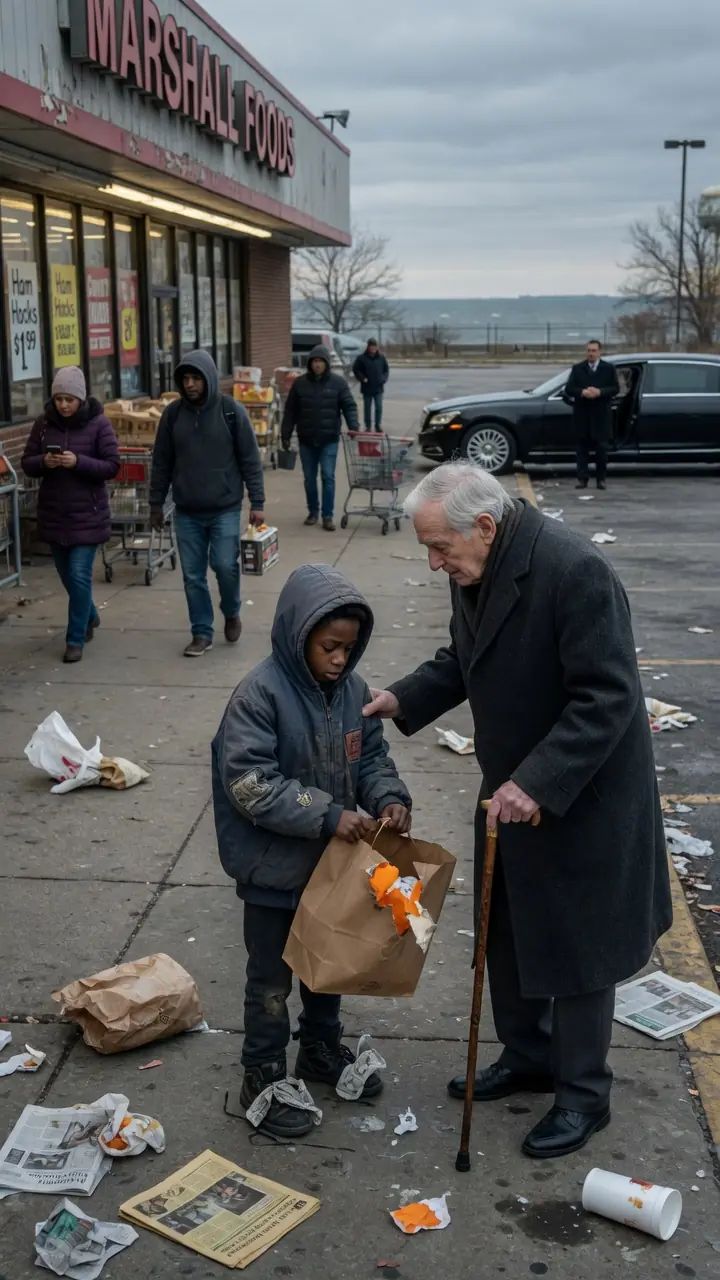
Silver-haired.
Long charcoal-gray coat old enough to look expensive without trying.
The grocery bag in his left arm had already started tearing along the bottom seam.
One orange bulged against the weakening paper.
“Well,” he said quietly, “I suppose you noticed before I did.”
Elijah slid both thin arms carefully underneath the bag before it split completely.
The groceries were heavier than he expected.
For a second the sudden weight made his empty stomach twist sharply.
But he held steady.
The old man noticed that too.
Not just the hunger.
The determination hiding underneath it.
“My car’s near the lake,” the old man said after studying Elijah for a long moment.
“About six blocks.”
“I don’t mind, sir.”
And something about the way the boy said that…
without hesitation…
without calculation…
made the old man pause internally.
Because very wealthy men spend most of their lives surrounded by people calculating value.
This child wasn’t.
The old man’s name was Harold Whittaker.
Seventy-eight years old.
Founder of one of the largest privately owned manufacturing companies in the Midwest.
A billionaire whose business empire stretched across nine states.
A man who had appeared on the cover of financial magazines more times than he cared to remember.
And standing there in the Cleveland cold…
none of that mattered to him nearly as much as the fact this starving little boy offered help before asking for anything in return.
They started walking together through the gray November streets.
Wind off Lake Erie cut through everything.
Street signs rattled softly.
Plastic bags rolled along gutters.
People hurried past with their collars pulled high against the cold.
Elijah concentrated on holding the torn grocery bag steady so the orange wouldn’t fall through.
Harold concentrated on the child beside him.
The oversized shoes.
The cracked red knuckles.
The exhaustion carefully hidden behind polite eyes.
After a few blocks Harold finally asked:
“What’s your name, young man?”
“Elijah Monroe, sir.”
“Elijah.”
Harold repeated the name slowly.
“That’s a strong name.”
“My mother picked it.”
The slightest change touched Elijah’s voice when he said mother.
Harold heard it immediately.
“What does your mother do?”
Elijah stared ahead at the sidewalk.
“She passed, sir.”
Silence settled between them.
Most people rushed to fill silences like that because grief made them uncomfortable.
I’m sorry.
That’s terrible.
Poor thing.
Harold didn’t say any of those things.
He simply nodded once and said quietly:
“Then she’s still choosing your name correctly every time someone says it.”
The sentence hit Elijah so hard he nearly dropped the groceries.
Because nobody had ever spoken about his mother like that before.
Not like she still existed somehow inside him.
They kept walking.
The old man’s cane tapped slowly against the sidewalk.
And for the first time in weeks…
Elijah no longer felt invisible.
Eventually they reached the gravel parking lot beside the lake.
That was when Elijah saw the car.
Long black sedan.
Driver waiting beside it.
The kind of vehicle children from his neighborhood only saw outside hotels or courthouses.
His steps slowed instantly.
Harold noticed.
“That’s Marcus,” he said gently.
“He drives me.”
Marcus tipped his cap respectfully when they approached.
“Mr. Monroe,” he said seriously, “thank you for helping Mr. Whittaker.”
Elijah almost froze.
Nobody had ever called him Mr. Monroe before.
Not teachers.
Not strangers.
Certainly not a man in a suit standing beside a luxury car.
For one strange second…
he felt important.
Marcus carefully took the damaged grocery bag from him.
The orange finally settled safely back into place.
Then Harold reached into his coat pocket.
Elijah immediately stepped backward.
“I didn’t do it for money, sir.”
The words came fast.
Almost desperate.
Because suddenly he realized he didn’t want this moment turned into charity.
Harold paused.
Then slowly removed his hand from the coat.
Empty.
A small almost-smile touched his face.
“I know you didn’t.”
Instead he handed Elijah a simple white business card.
Heavy paper.
Plain black lettering.
Harold J. Whittaker.
One phone number.
Nothing else.
“If you ever find yourself in trouble,” Harold said softly, “call this number.”
“It rings to a woman named Dorothy.”
Pause.
“You won’t have to explain anything. Just tell her your name.”
Elijah stared down at the card.
He had no idea who Harold Whittaker really was.
No idea the name appeared regularly in national financial newspapers.
No idea the man standing beside him could have purchased every building on that entire block without noticing the expense.
He only knew someone important had looked directly at him instead of through him.
And somehow…
that felt bigger than money.
Then Harold asked gently:
“Elijah… have you eaten supper yet?”
The hesitation before the boy answered told him everything.
An hour later Elijah sat inside a small warm restaurant on Larchmere Boulevard called Anna’s.
The smell of fresh bread nearly broke him.
Not emotionally at first.
Physically.
His entire body reacted to it.
Warm yellow lighting.
White tablecloths.
Soup steaming in bowls.
The owner, Anna, greeted Elijah with the same warmth she showed Harold.
No pity.
No performance.
Just kindness.
And when the bread basket arrived at the table, Elijah tried very hard not to eat too quickly.
Harold pretended not to notice anyway.
That became the thing Elijah remembered most for the rest of his life.
The old man let him keep his dignity while helping him.
Anna brought soup.
Roasted chicken.
Potatoes.
Warm milk.
More bread.
Elijah ate slowly at first.
Then with growing hunger he could no longer hide.
Still Harold never stared.
Never made him feel ashamed.
Instead he quietly spoke about ordinary things.
The weather.
A baseball game Marcus took him to over the summer.
Trees losing their leaves later than usual that year.
He filled the room with gentle conversation so the child could eat without feeling watched.
Halfway through supper Elijah finally asked softly:
“Sir… why are you doing this?”
Harold sat quietly for a moment before answering.
“When I was about your age,” he said slowly, “I lived in a town in Pennsylvania after the mill shut down.”
“My mother sewed clothes for families who still had money.”
“There were days I went hungry too.”
Elijah looked up immediately.
“One afternoon I saw an old woman drop a sack of apples on the sidewalk.”
Harold smiled faintly at the memory.
“The apples rolled everywhere.”
“I could have taken one. She never would’ve known.”
Pause.
“But instead I picked them up and walked her home.”
Another pause.
“She fed me supper that night.”
“Then she fed me twice a week for four years.”
Elijah stayed completely still listening.
“Her name was Mrs. Kowalski,” Harold said quietly.
“She’s the reason I survived long enough to become the man sitting across from you tonight.”
The restaurant fell softly silent around them.
“You helped me outside Marshall Foods today,” Harold continued.
“So now I’m doing for you what Mrs. Kowalski once did for me.”
Elijah stared down at the table for a long time after that.
Because suddenly the world no longer felt random.
One hungry child helping an old woman decades earlier somehow connected directly to one hungry child helping an old man now.
Kindness moving through time from person to person.
Like a light refusing to go out.
That night after supper Harold offered Elijah something else.
A guest room.
Clean sheets.
A warm bed.
A door that locked from the inside.
Elijah nearly cried hearing those words.
Because children who have slept afraid understand immediately how valuable safety sounds.
So he said yes.
And that single yes changed both their lives forever.
Over the following years Harold quietly rebuilt the broken pieces of Elijah’s life.
School.
Stability.
Safety.
His grandmother received proper medical care.
Elijah eventually moved permanently into Harold’s home with Dorothy helping raise him.
And Harold…
the billionaire businessman who had spent decades inside boardrooms and factories and financial meetings…
found something he hadn’t realized he lost.
Purpose that felt personal again.
The story never became national news.
No security cameras captured the moment outside the grocery store.
No viral video spread online.
Most important things happen quietly.
Years passed.
Harold lived long enough to see Elijah graduate high school.
Long enough to see him accepted into college.
Long enough to watch him become the kind of man his mother hoped he would be.
But he did not live long enough to see Elijah graduate university.
Harold died peacefully one winter night in the stone farmhouse while Dorothy held one hand and Elijah sat beside the bed reading aloud from a book Harold loved.
In his will, Harold left Elijah a handwritten letter.
Inside were only three sentences.
“Your mother chose your name correctly.”
“You carried my groceries when nobody else would.”
“And the world gets better only when people decide to become the better part of it.”
Elijah Monroe is forty-three years old now.
He runs a foundation in Cleveland helping homeless children find shelter, food, legal assistance, and safe housing.
He named it Kowalski House…
after the woman in Pennsylvania he never met…
the woman who once fed a hungry little boy and unknowingly changed the future of another hungry little boy decades later.
And all of it began because one starving child on a cold Cleveland sidewalk saw an old man struggling with a grocery bag…
…and decided to help him anyway.
[HẾT TRUYỆN]