At the 4-minute mark, Terrence paused. For the first time, he looked up from the screen. He glanced at the notebook beside the keyboard. The same notebook that had been on the floor 5 minutes ago with a boot print still visible on the corner of one page. He read something. He nodded to himself. He typed one more function, then he compiled. The room held its breath. 40 engineers, a VP, two security guards, and a receptionist, all of them standing perfectly still watching a screen. The compiler ran. Zero errors. Zero warnings. Terrence executed the patch. The wall-mounted monitoring dashboard, the one that had been flashing red for 72 hours, flickered. One by one, the red indicators turned green. Server clusters in Virginia, data centers in Frankfurt, nodes in Tokyo, Sao Paulo, Sydney. Green. Green. Green. Like lights coming on across a city after a blackout. The timer on the wall screen read 4:38. Terrence pushed back from the terminal. He stood up. He picked up his notebook. “Done.” he said.
Nobody moved. Cole Bennett was the first to speak. “Run the verification suite.” he said, his voice cracking slightly. “Full diagnostic. Every node.” An engineer at the next terminal typed the command. The verification suite took 45 seconds to complete. When it finished, the results filled the screen in green text. Every system restored. Every vulnerability sealed. Not just sealed, the patch had optimized three critical pathways that the original code had left inefficient. The system was running faster than it had before the breach. “How?” Harper Reed asked. She was looking at Terrence like he was something she’d never seen before. “How did you find it? We had 200 people looking at the same code.” Terrence held up the notebook. “You were looking at the code. I was looking at the architecture. The vulnerability wasn’t in what was written, it was in what was missing. A race condition in the authentication handshake. The original developers never accounted for simultaneous session calls exceeding the buffer threshold. Everyone kept patching the symptoms. Nobody traced back to the root.” Silence. “It’s in this notebook.” Terrence said, “Page 47. I wrote the theory 8 months ago.” He opened the notebook and held up the page. Dense handwriting, diagrams, arrows pointing to a flaw that 200 of the world’s best engineers had spent 72 hours failing to find.
Grant Hollister’s face had gone the color of wet cement. He stared at the monitoring dashboard, all green, steady, humming with restored life. He stared at the verification results. He stared at the 18-year-old in the torn hoodie holding a notebook with a boot print on it. Then he straightened his tie. “Interesting.” he said. His voice was flat, controlled. “But we can’t just take this at face value. There’s a verification process, internal review, compliance checks. We need to confirm the patch doesn’t introduce new risks.” “The verification suite just confirmed it.” Cole said. “The internal verification suite.” Grant corrected. “I’m talking about a full independent audit. That takes time, days, maybe weeks.” He turned to Terrence. “You’ll need to leave the premises while we conduct our review. We’ll contact you when we’ve completed the assessment.” “And the bounty?” Terrence asked. “Pending review.” Grant said. “If the patch holds and passes all compliance requirements, the bounty will be processed through the appropriate channels.” “When?” “When we’re satisfied.” Grant’s eyes were hard. You should be grateful you’re not being investigated. A teenager who just happens to know exactly where a zero-day vulnerability lives. That raises questions. Serious questions. The implication hung in the air like smoke. Briana Wells felt her stomach drop. She looked at Terrence’s face. He understood exactly what Grant was suggesting. I didn’t plant it, Terrence said quietly. I found it. There’s a difference. We’ll see. Grant nodded at the security guards. Escort him to the lobby. He can wait there until legal clears him to leave the campus. The guards flanked Terrence. He walked between them, the notebook under his arm, his backpack over one shoulder. The engineers watched him go. Some of them looked at Grant. None of them said anything. Briana followed at a distance. Her phone was in her pocket. The video was still backed up in three locations.
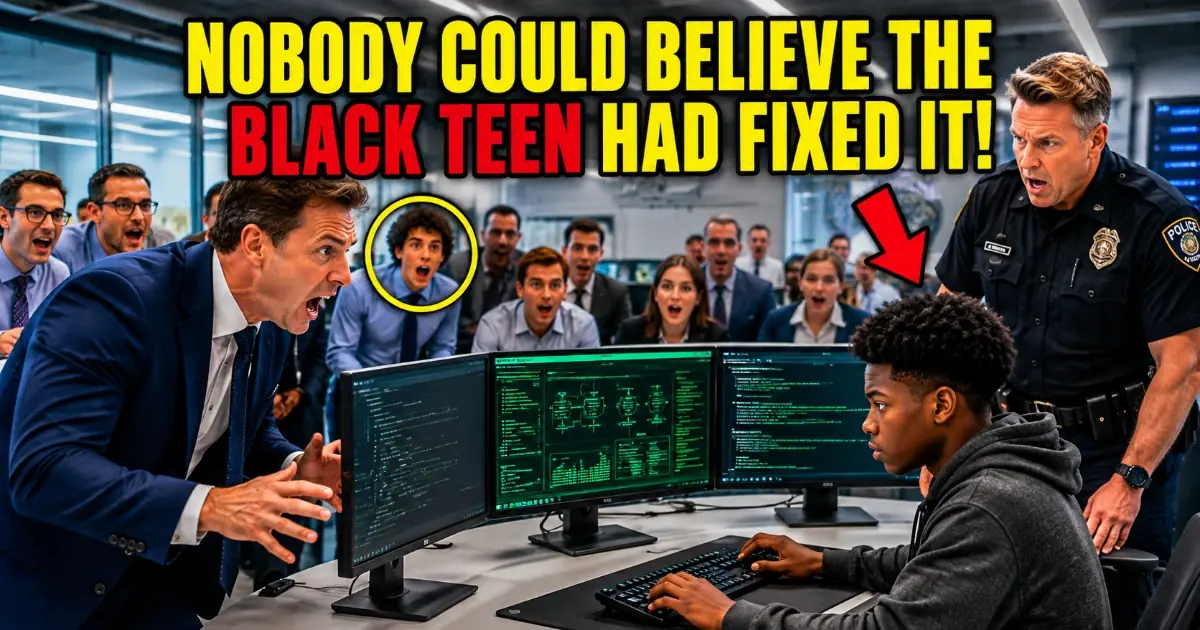
In the lobby, Terrence sat on a bench near the glass doors. He put the notebook on his lap. He pulled out his phone, cracked screen, 3% battery, and called the only number that mattered. Grandma. Baby, did you do it? I did it, Grandma. I fixed it. A pause. He could hear her breathing. The oxygen machine humming in the background. Then why do you sound like that? Terrence looked through the glass at the building full of people who had watched him solve their problem in 4 minutes and 38 seconds. People who had laughed when his notebook hit the floor. People who were now at this very moment deciding whether to pay him or bury him. They’re not sure they want to give me the money. The line went quiet. Then Evelyn Walker said something her grandson would carry with him for the rest of his life. They never are, baby. They never are. While Terrence sat on a bench in the lobby, Grant Hollister was three floors above him destroying his life. The conference room on the 12th floor had no windows. Grant had chosen it for exactly that reason. He sat at the head of the table with Nexus’s chief legal counsel, a woman named Diane Mercer, and two senior engineers he trusted to keep their mouths shut. “The kid is a plant,” Grant said. “Nobody walks in off the street and patches a zero-day in under 5 minutes. Not unless they put it there in the first place.” Diane Mercer tapped her pen against her legal pad. “Do you have evidence of that?” “I don’t need evidence. I need a narrative.” Grant leaned forward. “A black teenager from Oakland with no degree, no credentials, no employment history in tech. He just happens to know exactly where the vulnerability lives. That’s not talent. That’s a confession.”
He laid out his plan. First, withhold the bounty pending an internal investigation that would take months. Second, file a formal complaint with the FBI’s cyber crime division alleging that Terrence had planted the vulnerability as part of an extortion scheme. Third, leak the complaint to the press before the FBI even reviewed it so that by the time anyone looked at the actual evidence, the public narrative would already be set. “Once his name is associated with cyber crime, nobody will touch him,” Grant said. “No company, no university, no law firm willing to take his case. He becomes radioactive.” Diane hesitated. “Grant, if the patch is legitimate and he’s cleared.” “He won’t be cleared. Not in time. We control the timeline. We control the investigation. By the time anyone proves he’s innocent, he’ll be broke, blacklisted, and forgotten.” He picked up his phone and called building security. The kid in the lobby, don’t let him leave. Tell him it’s standard procedure during an active cybersecurity investigation. Hold his ID. If he pushes back, remind him that leaving during an investigation could be considered obstruction. Downstairs, a security guard walked over to Terrence and asked for his identification. Terrence handed over his state ID, the only government-issued document he owned. The guard took it and disappeared behind the reception desk. “Standard procedure.” The guard said when Terrence asked why. “You’ll get it back when the investigation is complete.” “What investigation?” The guard didn’t answer. Terrence sat back down. His phone was dead now. He couldn’t call his grandmother. He couldn’t call anyone. He was 18 years old, alone in a building full of people who wanted him gone with no ID, no phone, and no way to prove that what he’d done was anything other than extraordinary.
Three floors above him, Briana Wells was doing something that would change everything. She had spent the last hour in her cubicle not working on code, but searching through Nexus’s internal email archives. She had a hunch. Grant’s reaction to Terrence’s patch hadn’t been the reaction of a man surprised by failure. It had been the reaction of a man terrified of exposure. She found what she was looking for in a chain of 14 emails buried in Grant’s sent folder dated 4 months earlier. The subject line read, RE: Authentication Layer, Potential Vulnerability, Urgent. The emails were between Grant and three engineers on his team. The engineers had identified the vulnerability. They had flagged it as critical. They had recommended an immediate patch and public disclosure. Grant had responded with a single directive. Bury it. We’re 3 weeks from my quarterly review. Nothing touches the board until after my numbers are locked. 3 weeks became 3 months. The vulnerability sat in the code like an undetonated bomb. When it finally exploded, it took down 31% of the world’s cloud infrastructure. And Grant Hollister had known it was there the entire time. Briana copied the email chain to her personal drive. Then she copied the video from the lobby. The one showing Grant throwing a teenager’s notebook on the floor and threatening to blacklist him from the entire tech industry. She uploaded both to Twitter at 6:47 p.m.
The video hit 1 million views in 40 minutes. By 8:00 p.m., it was on every major news network. CNN, MSNBC, Fox, BBC. The footage played on split screens. Grant’s face as he dropped the notebook. Terrence kneeling to pick up the pages. The security guard’s boot on the corner of a page. Commentators replayed the moment Grant said, “Your kind.” And the moment he threatened permanent blacklisting. They replayed it again and again. The emails hit even harder. Screenshots of Grant’s bury it directive spread across Reddit, LinkedIn, and every tech forum on the internet. Within an hour, #justiceforterrence was trending in 11 countries. Within 2 hours, three sitting members of Congress had tweeted about it. A senator from California called for a congressional hearing. In Oakland, Evelyn Walker saw her grandson’s face on the television in her living room. She saw the video of a man in a suit throwing his notebook on the floor. She saw the words “Teen hacker accused” scrolling across the bottom of the screen. She didn’t understand all of it, but she understood enough. Her neighbor found her on the kitchen floor 20 minutes later. The paramedics said it was a stress-induced cardiac event, not a heart attack. Not yet, but close. They took her to Highland Hospital. They put her on a monitor. Her heart rate was erratic. Her blood pressure was dangerously high. The liver medication she couldn’t afford to refill wasn’t doing its job anymore. She asked the nurse for a phone. She tried to call Terrence. The call went straight to voicemail. Dead battery. She didn’t know he was sitting in a lobby in Palo Alto with no ID and no way out.
At Stanford University, Dr. Sandra Cole watched the video from her office. She was 58 years old, a tenured professor of cybersecurity, and one of the most respected voices in the field. She had consulted for the Department of Defense. She had testified before Congress twice. She had reviewed more vulnerability patches than she could count. She watched the video three times. Then she downloaded Terrence’s patch code from a screenshot that Breanna had included in her thread. She ran it through her own analysis tools. It took her 15 minutes to verify what the engineers at Nexus had confirmed in 45 seconds. The patch was legitimate. It was brilliant. And it was the work of someone who understood systems architecture at a level most PhD candidates never reached. She called Preston Hayes, the CEO of Nexus Systems, directly. She had his personal number from a conference 2 years ago. “Preston,” she said, “you have a serious problem, and it’s not the kid in your lobby.” Preston Hayes had spent the last 6 hours watching his company’s stock price drop 14%. He had watched the video. He had read the emails. He had not yet spoken to Grant Hollister. “I’m listening.” he said. “The boy’s patch is clean. It’s better than clean. It’s exceptional.” “Your VP buried a critical vulnerability for 4 months to protect his quarterly numbers, and now he’s trying to frame the only person who fixed it.” She paused. “I’m prepared to publish my independent verification tonight, but I wanted to give you the chance to do the right thing first.” Preston was quiet for a long time. “Give me until morning.” he said.