A Tiny Dog Was Found Trapped Above Rushing Water Beside a Highway
Reader Theme:
Font Size:
24px
The tiny dog was found stranded on a narrow concrete ledge inside a flooded roadside drainage channel. Fast-moving brown water rushed beneath him while cars passed overhead, drowning out his frightened cries.
Soaked and trembling, he pressed his body against the wall because there was nowhere else to go. When rescuers finally reached the channel, they realized the water was still rising—and the small ledge keeping him alive was beginning to disappear.
A driver first noticed the small dog while traffic slowed during a heavy rainstorm.
From the highway, the animal looked like a bundle of wet fabric caught beside the concrete barrier. Then the driver saw his head move.
The dog was sitting on a narrow support beam inside a drainage channel. Muddy water flowed beneath him, carrying branches, plastic containers, and other debris through the culvert.
There was no safe way for him to climb out.
The concrete walls were nearly vertical and slick with rain. The ledge ended several feet from the nearest opening, leaving the dog trapped between the highway above and the rising water below.
The driver stopped at a safe location and contacted emergency responders.
By the time a rescue team arrived, the rain had intensified.
The dog remained pressed against the wall with his paws spread across the narrow beam. His white-and-brown coat was completely soaked, and his entire body trembled whenever a large vehicle passed overhead.
The team began calling him Finn.
Rescuers could not approach him from the highway because the barrier and guardrail blocked direct access. Entering from the lower end of the channel was also dangerous because the current had become stronger.
One rescuer secured a safety harness and carefully descended from an access point farther along the drainage system. Another remained above with a rope while a third watched the water level.
Finn saw the rescuer approaching and tried to move backward.
His hind paw slipped from the beam.
For a moment, only his front paws remained on the concrete. He scratched desperately at the wet surface before pulling himself back onto the ledge.
The rescuer immediately stopped moving.
She crouched several feet away and spoke quietly, allowing Finn time to recover. Then she extended a looped leash attached to a long pole.
Finn initially turned his head away.
The rescuer placed a small amount of wet food near the end of the pole and slowly moved it toward him. Hunger eventually overcame his fear, and Finn leaned forward far enough for her to guide the loop carefully over his head.
Once the leash was secure, she moved closer.
Finn flattened himself against the wall but did not attempt to bite. The rescuer placed one arm beneath his chest and the other beneath his hindquarters before lifting him from the ledge.
Seconds later, a rush of water covered the place where he had been sitting.
Finn was carried to the access point while the team above kept tension on the safety rope. When the rescuer finally handed him over the concrete wall, he clung tightly to the front of her jacket.
On dry ground, Finn was wrapped in towels and placed inside a heated rescue vehicle.
He was cold, exhausted, and mildly dehydrated. Several paw pads were scraped, and one hind leg appeared painful when he tried to stand.
At the veterinary clinic, X-rays showed no broken bones. The leg injury was a severe strain, likely caused by repeated attempts to climb the slick wall or keep himself balanced on the narrow beam.
Finn also had a small wound beneath his wet fur and irritation between his toes from prolonged exposure to contaminated water.
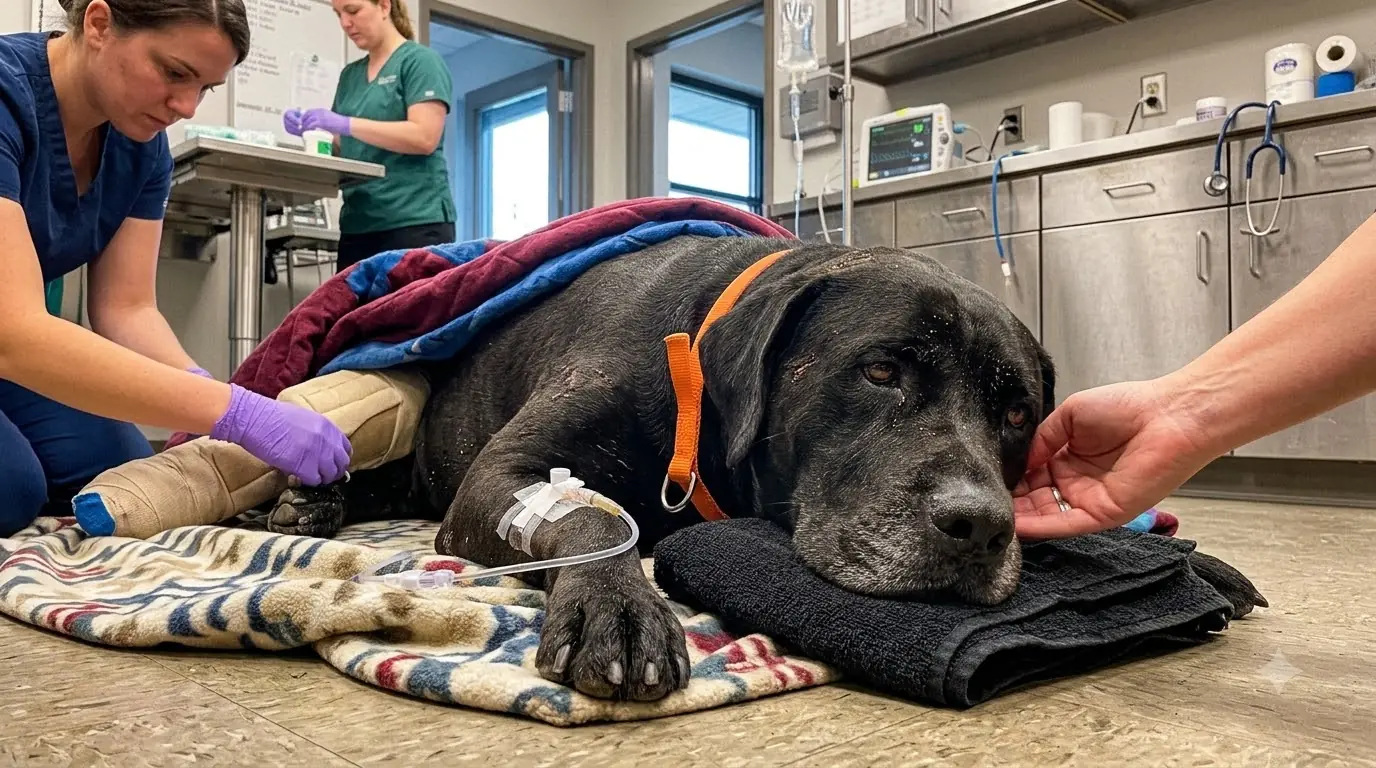
The wounds were cleaned, and he received fluids, pain medication, and antibiotics as a precaution. Staff warmed him gradually while monitoring his breathing and body temperature.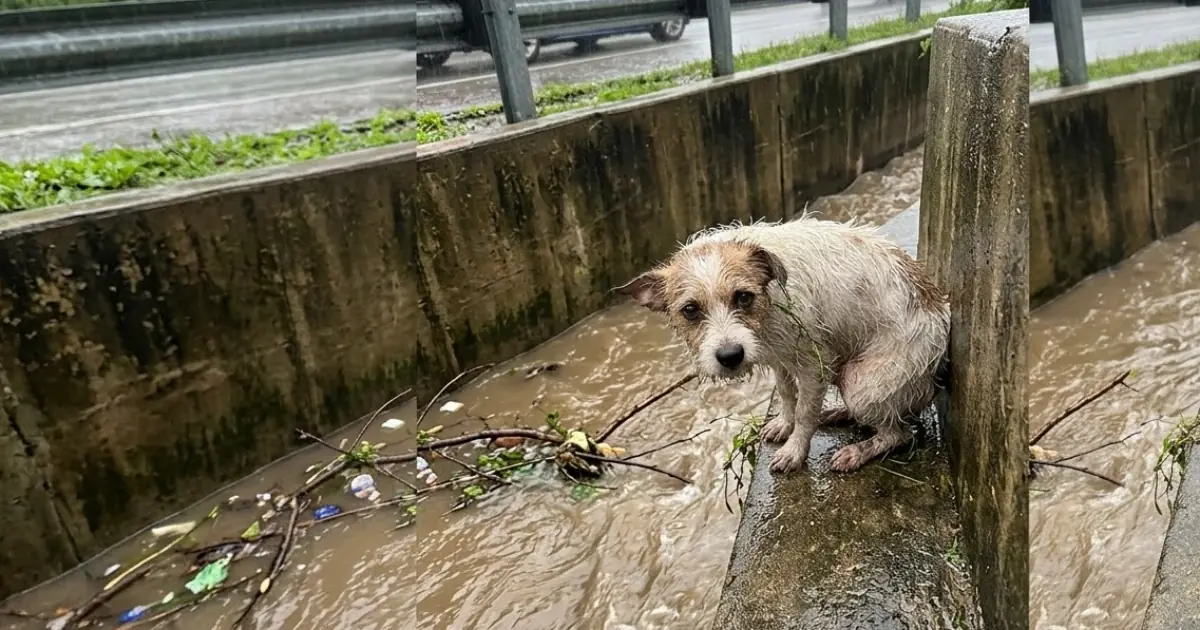
During his first few hours, Finn remained curled beneath a blanket.
He refused food whenever anyone stood near the enclosure. A technician eventually placed a small bowl beside him and sat silently several feet away.
Finn watched her carefully before eating every bite.
No microchip was found, and he wore no collar. Local shelters and veterinary clinics were contacted, but there were no immediate reports matching his description.
Staff could not determine how Finn entered the drainage channel.
He may have fallen from an opening farther upstream before being carried toward the highway. The dirt embedded in his coat and the condition of his paws suggested that he may already have been wandering for some time before the storm began.
During his first night at the clinic, Finn startled at every loud sound.
The rumble of vehicles outside caused him to lift his head and tremble. Staff moved him into a quieter room and placed a covered bed inside his enclosure, giving him somewhere to hide.
By morning, his temperature had returned to normal.
Finn stood without assistance and took several cautious steps. He still avoided putting his full weight on the injured hind leg, but he walked toward his water bowl and later accepted food from his regular caregiver’s hand.
Two days after the rescue, Finn was transferred to a foster home.
At first, he remained inside his crate even after its door was opened. His foster caregiver sat nearby and waited without reaching for him.
Eventually, Finn stepped onto the floor and began exploring with his nose.
He avoided the sound of running water and froze when rain struck the windows. During his first trip into the yard, he refused to approach a drainage grate and had to be guided around it.
However, his confidence is slowly improving.
Finn now follows his foster caregiver from room to room and sleeps in a covered bed beside the sofa. His injured leg is healing with rest, and the sores between his toes have begun to disappear.
No owner has yet been identified.
If no family comes forward after the required waiting period, Finn will become available for adoption once the veterinarian confirms that his leg has fully recovered.
No one knows how long he balanced alone above the rushing water.
What rescuers do know is that the ledge beneath him vanished only moments after he was lifted away.
The tiny dog who had nowhere left to move is now warm, dry, and learning that the sound of approaching footsteps no longer means he must cling to the nearest piece of concrete to survive.