A Weak Kitten Was Found Trapped Inside a Flooded Storm Drain
Reader Theme:
Font Size:
24px
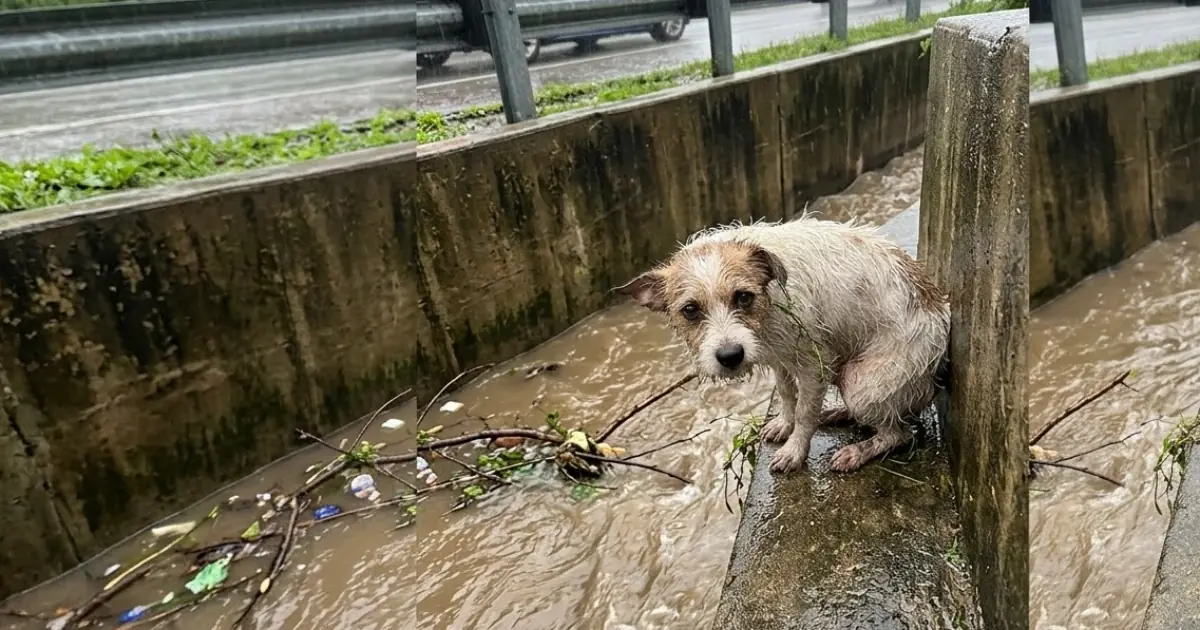
The tiny kitten was discovered deep inside a storm drain after a passerby heard faint cries beneath the sound of heavy rain. Soaked, shivering, and too weak to climb out, he stood on a narrow concrete ledge while dirty water rose around his paws.
A rescuer crawled into the drain and wrapped him in a towel, but the kitten barely reacted when he was lifted. At the veterinary clinic, staff discovered that cold and hunger were only part of the danger—his breathing had become dangerously shallow.
The kitten was first heard during an afternoon rainstorm.
A woman walking near an intersection stopped when she noticed a faint sound coming from beneath a roadside grate. At first, she believed it was a bird calling from the nearby bushes.
Then she heard it again.
The sound was a kitten crying from somewhere below the pavement.
She looked through the grate but could see only dark water and debris. When she moved farther down the road, she spotted a small orange shape inside the open end of a concrete drainage pipe.
The kitten was standing on a narrow raised edge beside the flowing water.
His fur was soaked and covered with mud. He appeared too weak to move toward the opening, and every surge of rainwater forced him to press more tightly against the wall.
The woman contacted a local animal rescue group and remained nearby.
By the time two volunteers arrived, the water had risen around the kitten’s paws. Branches, leaves, and pieces of plastic continued washing through the drain.
The team could not reach him safely from the roadside opening.
One volunteer removed a grate farther upstream while the other watched the kitten from the pipe entrance. A safety rope was secured around the first rescuer before she slowly entered the channel.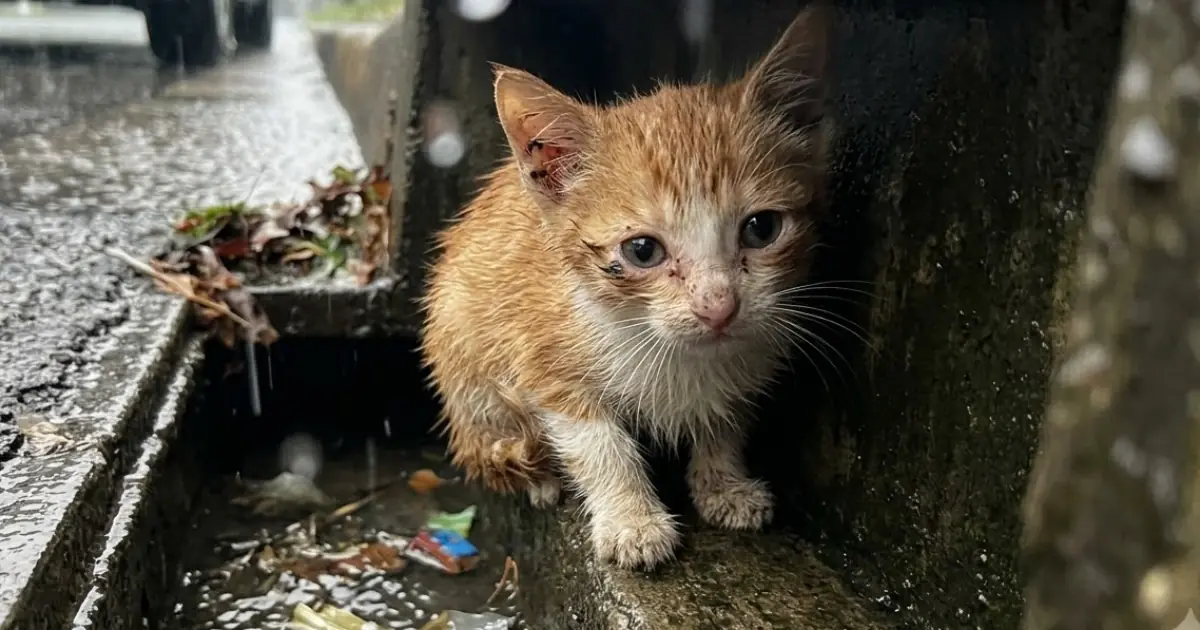
The kitten tried to retreat when he saw her approaching.
He managed only two steps before his legs folded beneath him.
The rescuer stopped and extended a towel along the concrete. When the kitten did not resist, she moved close enough to wrap the fabric around his body.
He was frighteningly cold.
The volunteer held him against her chest and carefully crawled back toward the access point. Outside, the kitten was placed inside a carrier lined with dry towels and warming packs.
The rescue team began calling him Oliver.
During the drive to the veterinary clinic, Oliver remained curled on his side. He opened his eyes when someone touched him but did not lift his head or cry.
His condition was more serious than rescuers had first realized.
Oliver’s body temperature was dangerously low, his blood sugar had fallen, and dehydration had left his gums pale and sticky. He was severely underweight and appeared to be only five or six weeks old.
His breathing was also rapid and shallow.
The veterinarian heard abnormal sounds in his lungs and worried that Oliver had inhaled contaminated water while trapped inside the drain. Chest imaging showed changes consistent with early aspiration pneumonia.
Treatment began immediately.
Oliver was placed inside a warm oxygen enclosure. Staff raised his temperature gradually, because warming a severely chilled animal too quickly could place additional stress on his heart and circulation.
He received warmed fluids, glucose, antibiotics, and oxygen support.
The dirt around his eyes and nose was cleaned carefully, but a full bath had to wait. Oliver was not stable enough to tolerate prolonged handling or another drop in body temperature.
For the first several hours, he showed little improvement.
He remained stretched on his blanket and barely reacted when the enclosure door opened. His breathing required constant observation, and staff were concerned that the infection could worsen overnight.
A technician offered a small amount of warmed formula.
Oliver did not swallow.
Because he was too weak to eat safely, the medical team provided nutrition cautiously while continuing to stabilize his temperature and blood sugar. His stomach was given only tiny amounts at a time.
Late that evening, Oliver lifted his head.
When the technician touched a drop of formula to his lips, he began licking weakly. She offered several more drops before allowing him to rest.
It was the first hopeful sign since his arrival.
By the following morning, Oliver’s temperature had returned closer to normal. He still needed oxygen, but his breathing had become more regular.
Staff wrapped him in a warm towel and held him upright for his feeding.
This time, Oliver drank a small amount on his own.
He exhausted quickly and fell asleep with his face resting against the technician’s hand. She returned him to the oxygen enclosure and placed a small stuffed toy beside him to help maintain warmth and comfort.
During the next two days, Oliver received frequent meals and continued antibiotics for pneumonia. He remained fragile, but each feeding became slightly easier.
His eyes also required treatment.
Exposure to dirty water had worsened an infection around both eyelids, leaving them swollen and crusted. Staff cleaned the area several times a day and applied medication to prevent further damage.
Oliver initially disliked the treatment.
He attempted a weak hiss whenever the cloth touched his face. By the third day, that tiny protest had become louder.
The medical team considered it progress.
Once Oliver no longer required constant oxygen support, staff gave him a careful bath. Mud, oil, and drainage residue washed from his coat, revealing brighter orange fur beneath.
Afterward, he was dried immediately and returned to a heated bed.
Oliver ate his first full serving of soft kitten food later that evening.
He stepped into the shallow dish with both front paws and covered his face in food, but he continued eating until the bowl was empty.
Five days after the rescue, Oliver began walking around his enclosure.
His legs were still weak, and he occasionally lost his balance. However, he explored the bedding, climbed over his stuffed toy, and approached the door whenever his regular technician entered.
He also began purring.
At first, the sound was so quiet that staff could hear it only while holding him against their chest. Within several days, Oliver started purring whenever someone brought his food.
He has now been transferred to an experienced foster home.
Oliver remains on medication, and his breathing must be monitored for coughing, nasal discharge, or unusual effort. Follow-up imaging will determine whether the infection in his lungs has completely cleared.
His foster caregiver continues offering several small meals each day.
Oliver sleeps in a covered bed with a safe warming pad beneath one side, allowing him to move away whenever he becomes warm enough. His stuffed toy from the clinic remains beside him.
No mother cat or littermates were found during repeated searches of the drainage area. Rescuers do not know whether Oliver became separated during the storm or had already been surviving alone.
What they do know is that he could not have escaped the drain without help.
The water was rising, his body was losing heat, and his cries had already become too faint to hear from more than a few feet away.
Oliver is still smaller than he should be, but he is gaining weight and breathing without oxygen. He now follows his foster caregiver across the room and cries loudly when a meal is even a few minutes late.
The kitten who barely made a sound beneath the rain is no longer alone in the darkness.
Tonight, he is warm, dry, and sleeping safely above ground.