“Sleep here tonight?”
Four words.
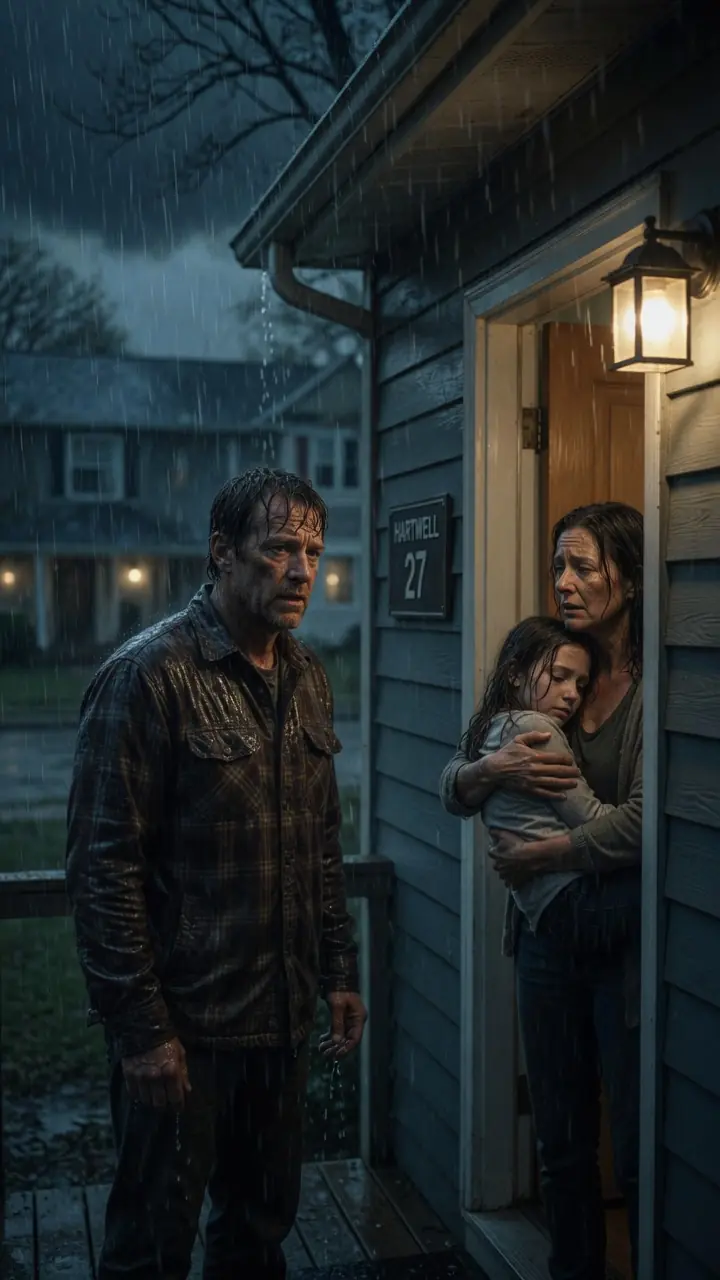
From a woman he had never met, standing in her own doorway at 1:47 in the morning, looking at a stranger who had just carried her daughter through the rain.
Ethan didn’t move.
“I’m fine. I’ll just—”
“The roads are wet.”
She shifted Maya’s weight gently against her shoulder, eyes still on him.
“You drove her home safe. The least I can do is make sure you get back the same way.”
“But ma’am, I really have to go.”
She handed Maya off to the wall, stepped around behind Ethan, and placed both hands flat on his back.
One firm push.
He was inside before he finished the sentence.
Then she steered him left, pressed down on his shoulder once, and he found himself sitting on a sofa he’d never seen before.
She straightened up and looked at him like that was the most natural thing in the world.
“Clean sheets on the armrest.”
“Coffee at 7:00 if you want it.”
Then she turned and walked down the hall.
Ethan sat there, still in his wet jacket, blinking at the empty doorway.
He had not agreed to any of this.
But somehow he was staying.
Henry had been asking for weeks.
Not in any dramatic way. Just the kind of steady, low-pressure asking that only a man who had known you for over a decade could pull off without it feeling like nagging.
“Come out Saturday.”
“Just a few hours.”
“You’ve been in that shop every night for three months.”
Ethan always had a reason to say no.
And Henry always waited until the next week to ask again.
The thing was, Henry wasn’t wrong.
Ethan had been disappearing into his woodworking shop the way some men disappear into a bottle.
Not destructively.
But completely.
There was something about working with his hands, about the clean logic of wood grain and joinery, that the rest of his life didn’t offer anymore.
In the shop, things either fit or they didn’t.
There was no gray area.
He had built that business from a second-hand table saw and a rented space in a strip mall on the east side of Hartwell.
And at 32 years old, it was the thing he was most certain of in his life.
His marriage was not that thing.
Seven months of separation from Tasha had given him enough distance to understand what he hadn’t been able to see while he was inside it.
She wasn’t a bad person in the way that required villainy.
She was just someone who needed control the way other people need oxygen.
And she had wrapped that need in enough affection early on that he hadn’t recognized it for what it was until much later.
By the time his kids were old enough to leave for college, Ethan felt like a man who had been slowly squeezed out of the shape of himself and didn’t quite remember what the original looked like.
He said yes to Henry on a Thursday mostly just to stop the asking.
The party was loud in the way Ethan had forgotten parties could be.
People stacked into a house that was too small for all of them.
Music hitting the walls.
Laughter at a volume that felt almost aggressive.
Henry found his people immediately.
Ethan found a corner near the kitchen and stood there with a drink he barely touched, watching the room the way he’d learned to watch things quietly from a distance.
Looking for what didn’t fit.
What didn’t fit was the girl in the blue dress near the back hallway.
Looking for what didn’t fit was a habit Ethan had developed over years of woodworking.
When you spend enough time building furniture, you learn that problems announce themselves long before they become obvious.
A board twists.
A joint settles wrong.
A line drifts a fraction of an inch.
Most people never notice.
But once you train yourself to see it, you can't stop.
The girl in the blue dress didn't fit.
Not because she was loud.
Quite the opposite.
Everyone else in the house seemed determined to occupy as much space as possible.
She occupied almost none.
She stood near the back hallway holding a paper cup with both hands, watching the room with the same cautious distance Ethan recognized in himself.
Not hiding.
Just observing.
At one point Henry appeared beside him.
"See somebody interesting?"
Ethan nearly choked on his drink.
"No."
Henry followed his gaze anyway.
A slow grin spread across his face.
"Oh."
"Don't."
"I'm not saying anything."
"You are absolutely saying something."
Henry laughed.
"She's Diane Marshall."
The name meant nothing to Ethan.
"Architect."
"Widowed."
"Has a daughter in high school."
"Good person."
Ethan looked at him.
"Did I ask?"
"No."
Henry took a sip of his beer.
"But you were looking."
Then he disappeared back into the crowd before Ethan could respond.
The annoying thing was that Henry wasn't entirely wrong.
Not about looking.
About noticing.
There was a difference.
At least that was what Ethan told himself.
About twenty minutes later someone bumped into Diane from behind.
Her drink splashed across the sleeve of her dress.
She stepped back automatically.
Apologized to the person who hit her.
Then began cleaning up the mess herself.
Even though it clearly wasn't her fault.
Ethan watched the exchange.
Then watched her smile and tell the embarrassed teenager not to worry about it.
Then watched her return to standing quietly by herself.
Something about that sequence lodged in his mind.
Not because it was dramatic.
Because it wasn't.
It was the sort of small thing that revealed character.
And character interested Ethan far more than appearances ever had.
An hour later he found himself standing beside the snack table at the exact same time she did.
Neither seemed particularly happy about the coincidence.
They both reached for the same bowl.
Pulled back.
Then laughed awkwardly.
"You first," Diane said.
"No, you."
"That sounds like we're negotiating."
Ethan smiled despite himself.
"Fair."
She took the bowl.
"Problem solved."
For a moment neither spoke.
Then Diane tilted her head slightly.
"You're Henry's friend."
"That obvious?"
"He points at people when he talks about them."
Ethan laughed.
"Yeah, that sounds like Henry."
"Diane."
She offered her hand.
"Ethan."
Her handshake was firm.
Practical.
The handshake of someone accustomed to making decisions.
Not impressions.
They talked for maybe ten minutes.
Nothing important.
Architecture.
Woodworking.
How small towns somehow managed to know everything about everyone while still pretending otherwise.
Easy conversation.
The kind that doesn't require effort.
The kind Ethan had almost forgotten existed.
Then someone called Diane's name from across the room.
A teenage girl appeared in the hallway.
Dark hair.
Expression halfway between amusement and impatience.
"Mom."
Diane sighed.
"That's my cue."
The girl looked at Ethan.
Then at her mother.
Then back at Ethan.
Something calculating passed across her face.
"Interesting," she said.
"Don't start."
"I'm not starting anything."
The girl absolutely was.
Diane closed her eyes briefly.
"Maya."
Maya grinned.
Then walked away.
Diane shook her head.
"Teenagers."
"I remember."
"You survived them?"
"Barely."
That earned another laugh.
A real one.
Then Diane glanced toward the hallway where Maya had disappeared.
"I should go rescue whatever situation she's about to create."
Ethan nodded.
"It was nice meeting you."
"It was."
And then she was gone.
The conversation lasted less than fifteen minutes.
By midnight Ethan was driving home.
By morning he was back in his workshop.
By Monday he had convinced himself the entire thing was inconsequential.
Just a conversation.
Just a party.
Just another person.
Then on Wednesday afternoon he found himself wondering what kind of architecture Diane designed.
And that annoyed him far more than it should have.
Wednesday turned into Thursday.
Thursday became Friday.
And Ethan kept thinking about Diane Marshall.
Not constantly.
Not obsessively.
Just often enough to irritate himself.
The problem wasn't attraction.
At least not entirely.
The problem was curiosity.
Curiosity had always been harder for him to ignore.
He found himself wondering about things he had no business wondering about.
What projects she worked on.
Why she seemed comfortable standing alone in a crowded room.
Why Maya looked at her mother with equal parts affection and protective concern.
Questions without answers.
Questions he had no practical way of asking.
Which should have been the end of it.
Instead, on Saturday morning, Henry walked into the workshop carrying coffee and an expression Ethan immediately distrusted.
"Don't."
"I haven't said anything."
"You've got that face."
"What face?"
"The one where you're about to involve yourself in my life."
Henry sat on a workbench.
Sipped his coffee.
Then casually said, "Diane's firm is helping renovate the old train depot."
Ethan stared at him.
"You absolutely planned that sentence."
"Maybe."
"I hate you."
"No, you don't."
Henry pointed toward the large oak table Ethan was building.
"Actually, you need an architect."
"I need a structural drawing."
"Exactly."
Ethan closed his eyes.
Because unfortunately Henry was right.
The custom community center project Ethan had taken on required stamped plans for several built-in installations.
And Diane's firm specialized in exactly that kind of work.
Life occasionally displayed a sense of humor he found suspicious.
Three days later he was standing in the reception area of Marshall Design Group holding a folder full of measurements.
The receptionist pointed him toward a conference room.
"Ms. Marshall will be right with you."
Ethan considered leaving.
Not because he was nervous.
Because suddenly this felt ridiculous.
Then the door opened.
Diane stepped inside carrying a tablet and a stack of drawings.
She stopped.
Looked at him.
Then laughed.
"Henry."
"Henry."
Neither needed further explanation.
Somewhere in Hartwell, Henry was probably feeling very pleased with himself.
Diane sat across the table.
"So."
"So."
"You need an architect."
"Apparently."
"And you couldn't find one anywhere else in town?"
Ethan smiled.
"Tragically, no."
The conversation slipped into professional territory almost immediately.
Measurements.
Load calculations.
Accessibility requirements.
Project specifications.
The comfortable language of people discussing things they understood.
An hour passed before either noticed.
By then the drawings were spread across the entire table.
Diane leaned forward studying one of his sketches.
"You did these?"
"Yeah."
She looked impressed.
Not politely impressed.
Genuinely impressed.
"These are good."
Ethan shrugged.
"They communicate the idea."
"They communicate it very well."
She tapped the page.
"Most people know what they want."
"You know how it works."
For reasons he couldn't fully explain, that compliment mattered.
More than it should have.
More than compliments usually did.
Because it came from someone whose opinion felt earned.
When the meeting finally ended, Diane gathered the drawings into a neat stack.
"I'll have preliminary revisions by next week."
"Sounds good."
Neither moved immediately.
There was a pause.
Not awkward.
Just unfinished.
Then Diane glanced toward the window.
"You know, there's a coffee shop across the street."
Ethan looked at her.
"Professional consultation?"
"Obviously."
"Of course."
"Entirely professional."
They both knew it wasn't.
Not entirely.
The coffee lasted ninety minutes.
Neither mentioned the time.
The coffee lasted ninety minutes.
Neither mentioned the time.
That should have been the first warning.
Not because ninety minutes was excessive.
Because it disappeared.
One moment Ethan was asking about a restoration project Diane's firm had completed for the historical society.
The next, sunlight had shifted across the café floor and both of their cups were empty.
Conversations weren't supposed to move that way.
Most of the ones Ethan experienced these days felt like work.
Pleasant work, usually.
But still work.
Questions.
Answers.
Polite pauses.
This was different.
It flowed.
When there was silence, it wasn't because either person had run out of things to say.
It was because neither felt rushed to fill it.
That distinction mattered more than Ethan realized at the time.
When they finally stood to leave, Diane glanced at her watch and laughed.
"I was supposed to be back in the office forty minutes ago."
"That seems problematic."
"A little."
"Should I apologize?"
"Probably."
She picked up her coat.
"I'm not going to let you, though."
Outside, the afternoon air had turned cool.
They stood on the sidewalk for a moment.
Neither appearing particularly eager to end the conversation.
Then Diane pointed across the street toward Ethan's truck.
"You parked illegally."
Sure enough.
A temporary construction sign had been installed after he arrived.
"No way."
"Way."
"That's unfortunate."
"It is."
Diane smiled.
"You should probably move it before somebody decides to be helpful."
"Good advice."
"I have those occasionally."
They exchanged a final wave.
Then went separate directions.
Simple.
Ordinary.
The sort of interaction people have every day.
So naturally Ethan thought about it all evening.
And most of Thursday.
And part of Friday too.
By the following week, the train depot project gave them a legitimate reason to communicate.
Emails became phone calls.
Phone calls occasionally became meetings.
Meetings somehow developed a habit of ending with coffee.
Then lunch.
Then another conversation neither of them had planned.
The progression was gradual enough to feel accidental.
Which was probably why neither resisted it.
One Friday afternoon, nearly six weeks after the party, Ethan was delivering revised shop drawings to Diane's office when Maya appeared in the doorway.
She looked at him.
Then looked at her mother.
Then back at him.
Again.
"Okay."
Diane sighed immediately.
"No."
"I haven't even said anything."
"You've made that face."
"What face?"
"The face where you're about to say something unhelpful."
Maya considered this.
"Fair."
She turned to Ethan.
"Just so you know, Mom never lets people hang around this much."
"Maya."
"What?"
"I'm providing context."
"You're providing trouble."
Maya grinned.
Then disappeared before either adult could stop her.
Silence.
Ethan looked at Diane.
Diane looked at Ethan.
Then both started laughing.
"Sorry," Diane said.
"Don't be."
"She's impossible."
"She seems efficient."
"That's one word for it."
The thing Ethan noticed most wasn't the teasing.
It was the way Diane smiled when talking about her daughter.
The warmth.
The pride.
The complete absence of performance.
She loved Maya with the kind of certainty that didn't require explanation.
And somehow that told him as much about Diane as anything she'd ever said about herself.
The summer festival arrived at the end of June.
Hartwell closed three downtown streets.
Food trucks lined the courthouse square.
Local musicians took turns on a temporary stage.
Children ran everywhere with melting ice cream and absolutely no concern for gravity.
It was exactly the sort of community event Ethan normally avoided.
Which was why he found himself there at ten in the morning carrying folding tables for Diane.
"You know," he said, setting down another stack, "I feel like I got tricked."
Diane didn't look up from the banner she was hanging.
"You volunteered."
"I was manipulated into volunteering."
"By who?"
Ethan considered that.
Then pointed vaguely in her direction.
Diane laughed.
"That's a serious accusation."
"I'm comfortable making it."
"Good."
She stepped back and studied the banner.
"Because you're carrying two more tables."
Ethan sighed dramatically.
Then picked them up anyway.
The studio project had become the center of their professional lives.
Not officially.
Neither one had said that out loud.
But the evidence kept accumulating.
Evenings spent reviewing plans.
Weekends walking potential properties.
Conversations that started with budgets and somehow ended two hours later discussing books, families, and the strange ways people rebuild after loss.
The project mattered.
But increasingly, it wasn't the only thing that did.
Maya noticed long before either of them admitted it.
Teenagers often do.
Adults like to imagine they're subtle.
They rarely are.
Around noon she appeared at the booth carrying two lemonades.
She handed one to Ethan.
One to Diane.
Then looked between them thoughtfully.
"What?" Diane asked.
"Nothing."
"Maya."
"I just think it's interesting."
"Dangerous word."
"It is."
Maya took a sip of her drink.
"You know what's funny?"
"No."
"You two spend more time together than most married couples."
Ethan nearly inhaled lemonade.
Diane closed her eyes.
"Maya."
"What?"
"Absolutely not."
"I'm just observing."
"You inherited this from your grandfather."
"I know."
"And it's exhausting."
"Also inherited that from him."
Then she walked away before retaliation became possible.
That evening, after the festival ended and volunteers finished cleaning up, Ethan and Diane sat on folding chairs behind the temporary exhibit tent.
The square had mostly emptied.
Streetlights glowed softly across the pavement.
For a while neither spoke.
The comfortable silence had become familiar.
Then Diane said quietly, "She's not wrong."
Ethan looked over.
"About what?"
Diane smiled.
"You know exactly about what."
He did.
Unfortunately.
The problem wasn't uncertainty.
The problem was timing.
Life experience teaches caution.
Particularly after loss.
Particularly after disappointment.
People become careful with hope.
Hope feels expensive once you've watched it break.
Ethan looked out across the empty square.
"I don't really know what this is."
The honesty surprised him.
Diane seemed unsurprised.
"I know."
"You?"
"I don't know either."
Another pause.
"But I know I look forward to seeing you."
Ethan felt something shift quietly inside his chest.
Not dramatic.
Not sudden.
The simple recognition of something that had already been true for a long time.
"I look forward to seeing you too."
Diane nodded.
As though confirming information rather than discovering it.
Neither rushed the moment.
Neither tried to define it.
Sometimes naming things too early damages them.
So they sat there together beneath the festival lights while the town settled into evening around them.
And for the first time in years, Ethan felt no urgency to be anywhere else.
The conversation stayed there for another few weeks.
Not defined.
Not labeled.
Not hidden either.
Some relationships announce themselves with grand declarations.
This one arrived through accumulation.
Small moments.
Repeated often enough that eventually they became impossible to ignore.
Ethan found himself keeping Tuesday evenings free because that was when Diane usually reviewed project drawings.
Diane started bringing an extra coffee whenever she visited the workshop.
Neither acknowledged these habits.
They simply developed.
And remained.
The first real complication arrived in August.
Not because of them.
Because of the divorce.
The paperwork had been moving slowly through the court system for months.
Long enough that Ethan had almost stopped thinking about it.
Then one Thursday afternoon his attorney called.
"Final hearing is next week."
Just like that.
A process that had stretched across months suddenly had an ending.
Ethan thanked him.
Hung up.
Then sat alone in the workshop for nearly twenty minutes staring at nothing.
Not because he wanted the marriage back.
He didn't.
That realization had settled long ago.
But endings carry weight even when they're necessary.
Maybe especially then.
Diane noticed immediately.
Of course she did.
They were reviewing plans for the studio renovation when she looked up from a blueprint and asked,
"What happened?"
Ethan blinked.
"What makes you think something happened?"
"You've been staring at the same page for six minutes."
"Oh."
Diane folded her arms.
"Ethan."
He considered pretending.
Then didn't.
"Final hearing."
Understanding appeared instantly.
Not sympathy.
Not pity.
Something better.
Recognition.
"Next week?"
He nodded.
Diane was quiet for a moment.
Then she reached across the table and placed her hand over his.
Nothing dramatic.
Nothing performative.
Just contact.
Simple.
Human.
"I'm glad it's almost over," she said softly.
"So am I."
And for the first time, he realized he actually meant it.
The hearing lasted twenty-three minutes.
Years of marriage.
Children.
Shared houses.
Shared routines.
Shared history.
Reduced to signatures and procedural language.
When it ended, Ethan walked outside into bright afternoon sunlight feeling unexpectedly calm.
Not happy.
Not sad.
Finished.
The best word he could find was finished.
His phone buzzed before he reached the parking lot.
One message.
From Diane.
**Coffee?**
No explanation.
No pressure.
Just the question.
Ethan smiled.
Then typed back:
**Yeah.**
The café was mostly empty when he arrived.
Diane was already there.
Two cups waiting.
She didn't ask how it went immediately.
Didn't force conversation.
They sat quietly for several minutes.
Then she said,
"How do you feel?"
Ethan thought about it.
Actually thought.
Before answering.
"Lighter."
Diane nodded.
As though that was exactly the answer she'd expected.
"Good."
Another pause.
Then:
"You deserve lighter."
The words landed harder than she probably intended.
Because nobody had said anything like that to him in a very long time.
That evening Maya arrived home to find both of them sitting on the back porch.
Talking.
Not about anything important.
Trees.
Weather.
The studio renovation.
Ordinary things.
She stopped in the doorway.
Looked at them.
Then shook her head.
"What?" Diane asked.
"Nothing."
"Maya."
"I'm just saying."
"Don't."
"You guys are unbelievably slow."
Ethan laughed so hard he nearly spilled his coffee.
Diane covered her face with both hands.
Maya pointed triumphantly.
"See?"
Then disappeared inside before either could respond.
Silence followed.
The comfortable kind.
Eventually Diane lowered her hands.
"She's terrible."
"She's not entirely wrong."
The words escaped before Ethan could stop them.
Both of them froze.
Not dramatically.
Just enough.
The moment hung there.
Waiting.
Diane looked out across the backyard.
The evening sun was settling behind the trees.
Golden light filtering through late-summer leaves.
Finally she smiled.
Small.
Warm.
A little nervous.
"Good," she said quietly.
"Because I was starting to think I was the only one noticing."
For a second neither moved.
Years earlier Ethan probably would have filled the silence.
Explained it.
Analyzed it.
Talked too much.
Instead he simply reached for her hand.
And Diane let him.
No speeches.
No declarations.
No dramatic music swelling somewhere in the distance.
Just two people who had spent enough time earning each other's trust that the next step felt less like a leap and more like a continuation.
Something already underway finally acknowledged.
The porch remained quiet.
The evening remained ordinary.
And somehow that made the moment matter more.
Because after everything both of them had survived, ordinary had become precious.
The week after Ethan's divorce was finalized, he found himself doing something he hadn't done in years.
Planning ahead.
Not in the practical sense.
Not supplier orders.
Not client schedules.
Not delivery timelines.
Something more personal than that.
The studio project with Diane had moved beyond sketches spread across a kitchen table.
They had found a building.
An old brick warehouse two blocks from the river.
The roof needed work.
The electrical system needed replacement.
Half the windows had been boarded over.
Most people saw expense.
Ethan saw structure.
Diane saw possibility.
Between them, that seemed to be enough.
The first Saturday they got access to the space, they spent six hours inside it.
Tape measures.
Clipboards.
Coffee in paper cups.
The winter air drifting through broken window frames.
Diane moved slowly through each room, studying proportions.
Tracing sight lines.
Imagining what the building could become.
Ethan followed behind her.
Noticing different things.
Load-bearing walls.
Warped joists.
Moisture damage.
The practical realities hidden beneath vision.
At one point she stopped near the center of the main floor.
"What do you think?"
Ethan looked around.
Dust floated through shafts of pale sunlight.
The room smelled faintly of old wood and brick.
"It'll work," he said.
Diane smiled.
That particular smile he had come to understand.
Not excitement.
Recognition.
The satisfaction of hearing something she already suspected confirmed by someone she trusted.
"Good," she said.
"I was hoping you'd say that."
By February, Ethan's routines had changed so gradually he barely noticed.
Some evenings ended at his apartment.
More often they ended on Linden Street.
Not because either of them had made a formal decision.
The decision seemed to make itself through repetition.
Coffee became dinner.
Dinner became long conversations.
Long conversations became simply remaining where he already was.
One night Maya walked into the kitchen and found Ethan standing at the stove making breakfast.
She stopped.
Looked at him.
Looked at her mother.
Then sat down without comment.
A minute later she said,
"You know, at some point we're probably supposed to acknowledge this."
Ethan nearly dropped the spatula.
Diane hid a smile behind her coffee cup.
"Acknowledge what?" Diane asked.
Maya gave her mother a look.
"The fact that he basically lives here now."
Silence.
Then Ethan laughed.
The real kind.
The kind that arrives before you have time to manage it.
Maya pointed at him.
"See? Even he knows."
Spring arrived early that year.
The warehouse renovation accelerated.
Volunteers appeared.
Woodworkers.
Artists.
Ceramicists.
Metalworkers.
People Ethan had known professionally for years.
People Diane knew through architecture circles.
The project gathered momentum.
Not because either of them pushed particularly hard.
Because people responded to what they were building.
A place where making things mattered.
A place where process wasn't hidden behind finished products.
A place that felt honest.
One evening after everyone else had left, Ethan and Diane stood in the center of the nearly completed studio.
Fresh paint.
New lighting.
Hand-built display walls.
The space no longer looked abandoned.
It looked alive.
Diane folded her arms.
"We actually did it."
"We did."
She looked at him.
Not at the building.
At him.
There was a long pause.
Comfortable.
Unhurried.
Then she said quietly,
"You know, my husband used to tell me something."
Ethan waited.
"He said the strongest structures aren't the ones that never move."
She looked around the room.
"They're the ones designed to flex without breaking."
The words settled between them.
Not really about architecture.
Not really about buildings at all.
Ethan understood that immediately.
"So was he right?" he asked.
Diane looked at him for a moment.
Then reached for his hand.
"Yeah," she said softly.
"He was."
The grand opening happened on a warm Saturday in May.
The building was full before noon.
Families.
Artists.
Students.
Retired craftspeople.
People who came because they were curious.
People who came because they had helped build it.
People who simply wanted to be part of something that felt real.
Ethan spent most of the day answering questions about woodworking.
Diane gave tours.
Maya handled social media updates while pretending not to enjoy herself.
By late afternoon the place hummed with conversation and movement.
Exactly the way they had imagined.
Maybe better.
At sunset, after the last visitors left, Ethan stood near the front entrance and looked back through the studio.
The space was quiet now.
Warm.
Finished.
Or finished enough.
Diane walked up beside him.
Neither spoke immediately.
They just looked.
Finally she said,
"You know what the strange part is?"
"What?"
"I thought the building was the project."
Ethan glanced at her.
"And?"
She smiled.
"It wasn't."
Outside, evening settled over Hartwell.
The lights inside the studio reflected softly against the glass.
A building designed to last.
A partnership built the same way.
Not quickly.
Not perfectly.
Carefully.
Deliberately.
One honest piece at a time.
END