The beep of a heart monitor is supposed to mean life. At 3:00 a.m. in the surgical ICU of Georgetown Memorial Hospital, it was the countdown to an assassination.
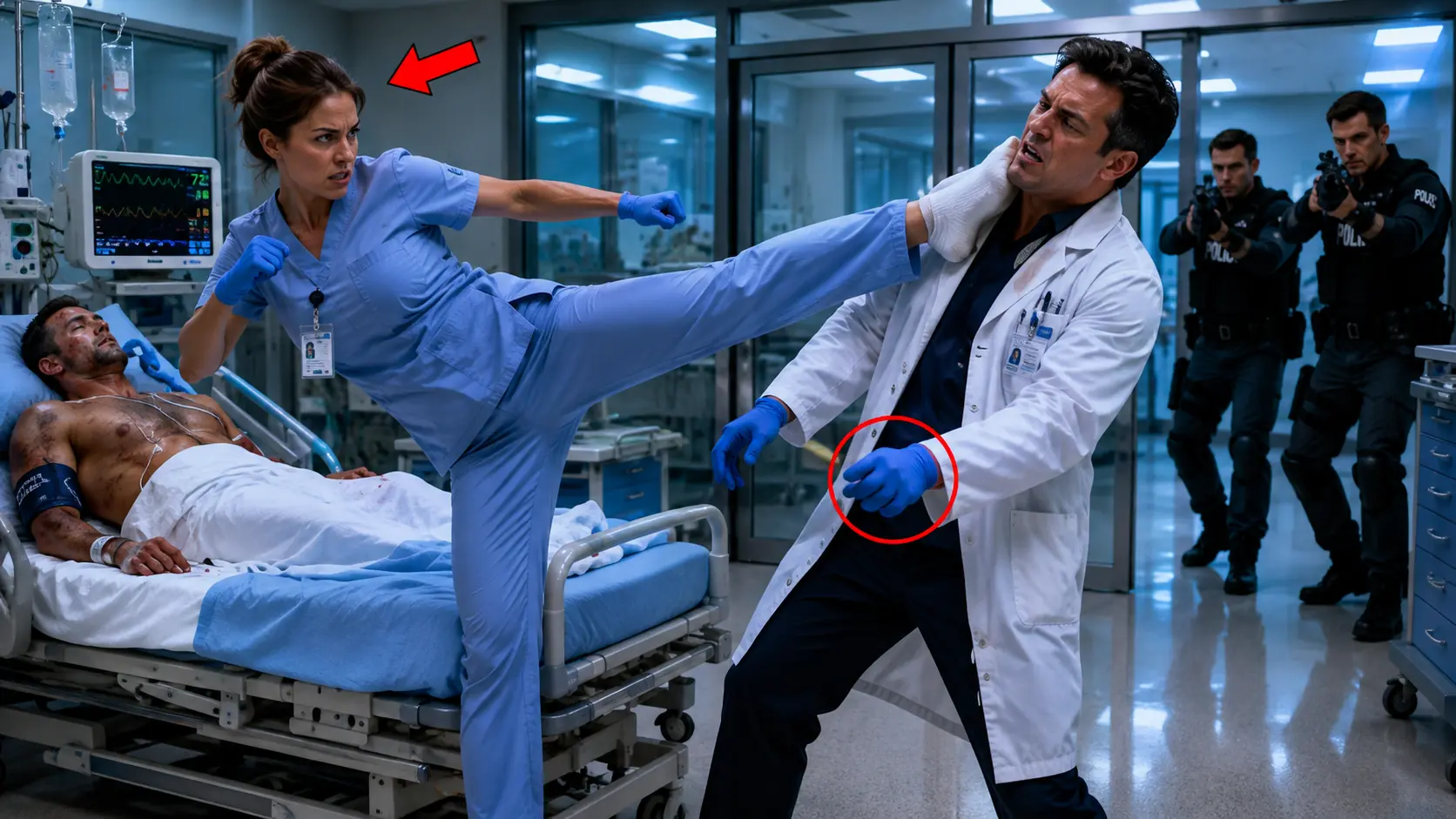
Rain hammered the reinforced glass, blurring the amber streetlights below. Inside, the world shrank to the mechanical rhythm of ventilators and the sharp, sterile scent of chlorhexidine. It was 3:14 a.m.—the hour when the human body is at its weakest and the hospital is at its quietest.
Sarah Jenkins thrived in that quiet. Eight years as a critical care nurse had trained her to listen to the spaces between the alarms. She knew the difference between a patient shifting in sleep and the sudden, terrifying silence of a blocked airway. Tonight the tension in the unit was not only medical. It was tactical.
In room four, isolated at the far end of the corridor, lay Chief Petty Officer Thomas Kavanaugh. Officially he was a civilian contractor injured in an industrial accident overseas. Unofficially—Sarah had glimpsed the classified transfer paperwork before a federal agent snatched it away—he was a DEVGRU operator, a Navy SEAL who had survived a catastrophic IED blast during a black-ops raid in northern Syria. Mid-flight a massive pulmonary embolism had forced an emergency diversion to Georgetown’s Level 1 Trauma Center. He now lay in a medically induced coma, kept alive by a web of IV lines, a propofol drip, and a mechanical ventilator.
Outside the glass door sat two men in tailored suits: Agent Davies and Agent Hayes. Polite. Unsmiling. Armed. They checked the ID of every doctor, phlebotomist, and respiratory therapist who stepped within ten feet of the room. The entire floor was locked down.
Sarah sat at the central nurses’ station, eyes moving between Kavanaugh’s telemetry and the dark hallway. Her intuition hummed like a high-tension wire. Something felt wrong. The air was too still.
Miles away, in the subterranean parking garage, a man who called himself Dr. Arthur Penhaligon stepped out of a black town car. He was not a doctor. He had never taken the Hippocratic Oath, though he knew human anatomy with lethal precision—how much pressure crushed a trachea, which arteries bled fastest, and which combination of ordinary hospital drugs could induce a massive, untraceable myocardial infarction. Penhaligon was an independent contractor who specialized in clean, unsuspicious deaths. The bounty on Kavanaugh’s head, placed by the surviving members of a Syrian terror syndicate, was staggering. The mandate was simple: the SEAL could not wake up to testify or debrief the Pentagon on what he had found in the desert.
Penhaligon adjusted a pristine white lab coat. His forged ID badge, dangling from a Georgetown Memorial lanyard, was a masterpiece of digital infiltration. Earlier that afternoon a brute-force cyberattack on the hospital’s HR servers had seamlessly inserted his alias into the employee database. He was listed as an elite cardiothoracic consultant from the Department of Defense. He walked through the emergency-room doors with the impatient arrogance of a highly sought-after surgeon. Security barely glanced at him. Doctors who walked like that were never questioned. He swiped his badge at the staff elevator, pressed the button for the fourth floor, and rode up in silence.
Back in the ICU, Sarah finished checking the Alaris pumps in Kavanaugh’s room, verified the norepinephrine drip, and adjusted his blankets. The SEAL looked startlingly young despite the jagged shrapnel scars across his left shoulder.
“How’s he doing, Sarah?” Agent Davies asked in a low rumble.
“Stable. Intracranial pressure is down. The surgical team will probably lighten his sedation tomorrow morning.”
Davies nodded, eyes still scanning the empty hallway. “The sooner we move him to a secure military facility, the better I’ll sleep.”
The soft ding of the elevator echoed through the quiet ward. Agent Hayes stood immediately, hand resting on his hip. Down the dim corridor strode Dr. Penhaligon, leather satchel in one hand, clipboard in the other, expression grave and focused. He walked straight toward room four.
“Stop right there,” Hayes commanded. “This is a restricted area.”
Penhaligon halted with a heavy sigh, the picture of a man whose valuable time was being wasted. “I am Dr. Penhaligon, DOD medical liaison. I was paged twenty minutes ago regarding a critical spike in patient Kavanaugh’s cardiac enzymes. I need to see him immediately.”
Hayes did not flinch. “I need your ID and clearance verification.”
Penhaligon handed over the badge and a set of heavily redacted Pentagon directives. “Make it quick. If his troponin levels continue to rise, he will be dead in fifteen minutes and I will personally ensure your superiors know you delayed intervention.”
Sarah frowned and pulled up the lab results on her workstation. Cardiac enzymes? She had drawn his blood an hour earlier. Troponin was 0.02—perfectly normal. There was no spike. A cold knot formed in her stomach.
Hayes swiped the badge through his portable biometric scanner. The device chirped green. The digital ghosting was flawless. The hospital’s compromised mainframe vouched for the assassin completely.
“Clearance checks out,” Hayes muttered, stepping aside. “Make it fast, doc.”
Penhaligon gave a curt nod and moved toward the glass door.
“Excuse me,” Sarah said, voice cutting through the quiet. Penhaligon paused, hand on the door handle, and turned. His eyes were pale, calculating, and entirely devoid of the exhausted warmth she was used to seeing in night-shift doctors.
“I’m his primary nurse. I didn’t see an alert for a cardio consult in his chart. Furthermore, his last lab draw showed a troponin of 0.02. That’s well within normal limits.”
Penhaligon offered a thin, patronizing smile. He had anticipated this. Nurses were the ultimate gatekeepers, but they were trained to defer to authority.
“The portable i-STAT machine used by the ER earlier had a calibration error,” he lied smoothly. “We ran a secondary assay at the central lab. The numbers are climbing rapidly. We’re looking at a microvascular occlusion.”
He opened the glass door and stepped inside. Sarah followed, heart hammering. Penhaligon moved directly to the IV pole. He did not check pupils. He did not listen to lungs. He did not glance at the ventilator settings. Every instinct Sarah had developed over a decade of critical care screamed that something was fundamentally wrong. Real doctors, even arrogant ones, possessed a baseline routine of patient assessment. This man was completely bypassing the patient and going straight for the venous access line.
He opened his satchel and withdrew a pre-filled syringe of clear liquid.
“What is that?” Sarah asked sharply.
“A proprietary vasodilator. Classified under DOD medical protocols. It will stabilize his coronary arteries.”