Everyone laughed when she planted dead sticks in the mud.
They stood along the fence line that first gray morning, men in faded overalls and dusty caps, men with sun-browned faces and wrists thick from decades of handling plow handles, hay bales, feed sacks, and stubborn machinery.
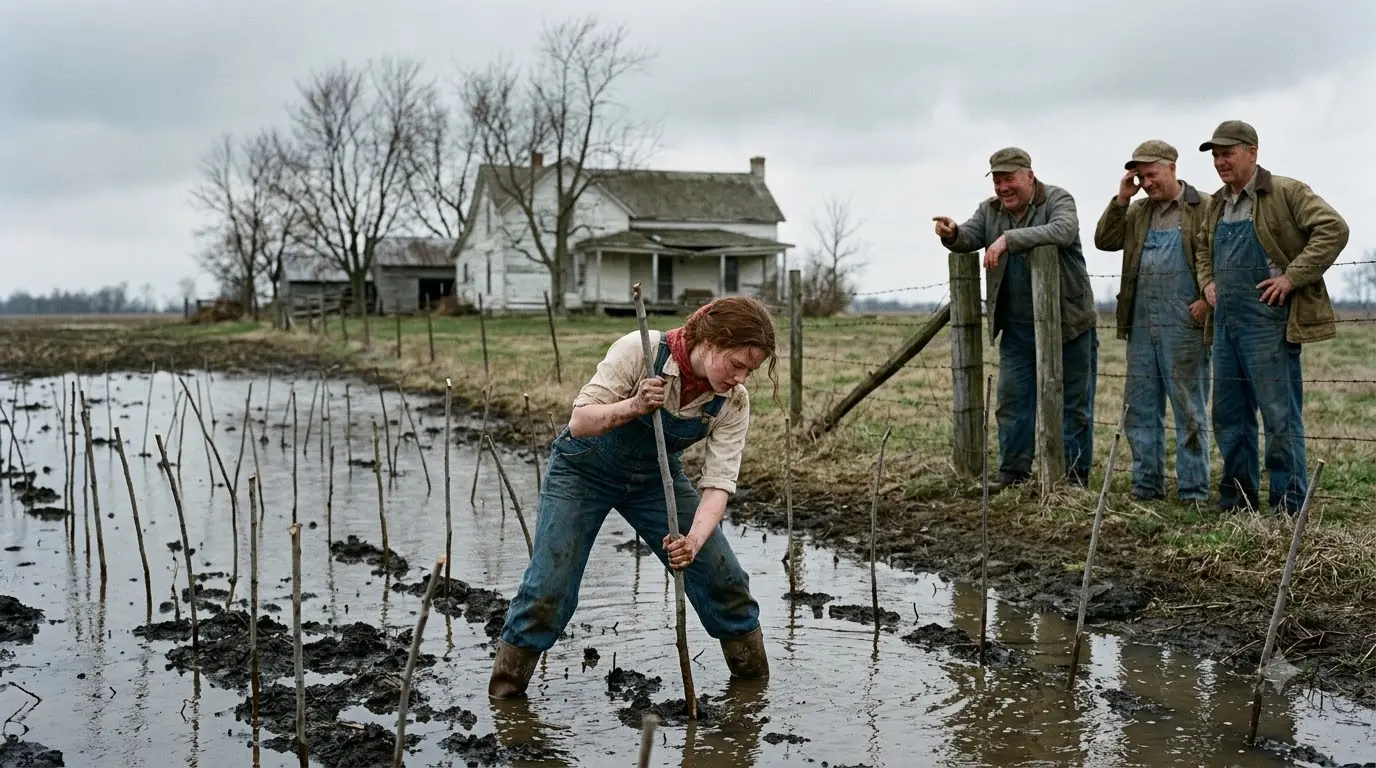
They had come because word traveled faster than rain in Mercer County, and because there was very little entertainment to be had in a flooded April except watching somebody make what looked like a spectacular mistake. One man leaned on the fence until it sagged beneath him. Another spat tobacco into the weeds and said something that made the others laugh harder.
Clara Jennings heard them. She heard every word.
She was nineteen years old, barely five feet two, with narrow shoulders, dark hair coming loose from the scarf tied around her head, and hands that had never known the proper weight of a plow. Her rubber boots were already filled with cold water. Mud streaked her skirt nearly to the knees, and the rain had plastered the fabric of her blouse between her shoulder blades. Still, she bent, pushed another gray cutting twelve inches into the black muck, pressed the mud around it with both hands, and stood to reach for the next one.
Two hundred cuttings waited in bundles beside her. Two hundred bare, leafless lengths of wood that looked so dead no sensible farmer would have bothered hauling them to a burn pile. Clara had found them tied with decaying twine in her grandmother’s attic, wrapped in oilcloth, with a note in Evelyn Jennings’s thin, trembling handwriting tucked beneath the knot.
Plant these in the mud when the creek rises. Trust the water.
That was all the first side said.
The other side contained a little more: soak in rainwater three days, plant twelve inches deep in standing water, give them full sun, and wait.
Clara had done every one of those things exactly.
The men along the fence laughed until their bellies shook and tears ran from their eyes. One called out that if she wanted firewood, he had a stack behind his barn that was already seasoned. Another asked whether she planned to harvest fence posts by Christmas. A third said he had seen chickens with more sense than that.
The hardest sound was not their laughter.
It was the silence of her father.
Ben Jennings stood twenty yards from the fence with his hands in the pockets of his work coat. He had driven out from town because somebody had telephoned the grain elevator and told him his daughter was planting sticks in the flooded bottom. He watched her for perhaps five minutes, his face tight and exhausted, then lowered his eyes and turned back toward his truck without saying a word.
Clara looked after him only once. Then she planted another cutting.
County Extension Agent Harold Vance arrived before noon in a government Ford with mud already splashed across the running boards. He wore thick glasses, a narrow tie beneath his raincoat, and carried his clipboard beneath one arm as if it were an official warrant. He stood on higher ground and watched Clara labor for several minutes before asking whether she understood she was planting woody cuttings under conditions that violated nearly every principle of established agricultural practice.
Clara pushed a cutting into the mud and asked him whether the established principles had ever made that field produce anything.
Vance frowned.
He told her saturated soil excluded oxygen, that prolonged standing water promoted rot, that the heavy alluvial clay beneath the flooded surface had poor percolation, and that what she was doing bordered on waste. He wrote a formal note advising her to remove the cuttings if fungal damage appeared. He reminded her that the field drained toward Miller’s Creek and that diseased material could threaten other plantings downstream.
Clara took the paper, folded it, and put it in the pocket of her soaked apron.
Then she kept planting.
By the time the last stick stood upright in the mud, rain had been falling steadily for seven hours. Her fingers were numb. A knot beneath her left shoulder blade burned every time she breathed. Her boots sucked at the mud with each step, and once she fell to one knee and had to brace both hands against the ground before she could get up again.
She did not stop.
She planted because there was nowhere else left to go.
She planted because three months earlier her grandmother had died in the front bedroom of the farmhouse while sleet tapped against the window and the old coal stove clicked as it cooled. She planted because First Mercantile Bank had given her sixty days to bring the account current before they began foreclosure proceedings on the forty acres Evelyn Jennings had held through widowhood, drought, illness, and twenty years of careful stubbornness. She planted because Clara’s part-time wages at Brackett’s Five and Dime could not begin to cover the mortgage arrears, back taxes, seed debts, roof repairs, or the cracked cistern line beside the kitchen garden.
Most of all, she planted because Evelyn had left those sticks for her.
And Evelyn Jennings, for all the things people called her, had never once asked Clara to trust something carelessly.
To understand why that mattered, it was necessary to understand Mercer County in the spring of 1952.
The rains began before March was finished and did not seem interested in stopping. Clouds rolled in low from the west, heavy and pewter-colored, then opened over the flat Indiana fields until ditches became streams, streams became rivers, and every low place held water. The Wabash swelled against its banks. Miller’s Creek climbed out of its narrow channel and spread over pasture and cropland in a slow brown sheet. Corn ground that should have been drying beneath spring wind instead shone like shallow lakes beneath the clouds.
Farmers stood at kitchen windows and counted lost planting days.
Men who had survived the Depression and war rationing walked field edges with their hands in their pockets and said very little. Seed corn sat stacked in barns. Tractors waited beneath sheds. The roads softened.
Culverts clogged. Fences disappeared beneath water. At church on Sundays, people spoke about the weather the way they might have spoken about an enemy army gathering just beyond the county line.
The Jennings property lay in one of the worst positions in the county for a wet spring. Forty acres stretched from the farmhouse ridge down into bottomland that bent around Miller’s Creek before the creek ran south toward the Wabash. The lower thirty acres had always been troublesome. Clara’s grandfather, Samuel, called it the drowned land, not with affection but with resignation.
Samuel Jennings had tried corn there once, long before Clara was born. The crop came up evenly, grew knee-high, and drowned in three days after an early June flood. After that, he gave the field mostly to weeds, swamp grass, and the old mule Betsy, who seemed to enjoy wet ground more than any crop ever had. Every spring the land held water. Every July it baked into dense plates of clay cut through by cracks wide enough to swallow a child’s marble.
Evelyn never cursed the field.
That was one of the many ways she differed from her husband.
She used to walk its edges after floods with her skirt pinned up above her boots and a woven basket on one arm. Clara, as a child, followed behind because Evelyn always found something worth noticing. A frog egg mass. A patch of watercress. Willow shoots along the creek bank.
Red-winged blackbirds nesting in reeds. The deep green of plants rooted in places every farmer described as useless.
“The land tells you what it can do,” Evelyn would say. “Most people are too busy telling it what they want.”
Clara had not understood then.
She had been eight, then ten, then twelve, dreaming not of farming but of books. She loved schoolrooms, chalk dust, maps rolled above blackboards, and the smell of library paste. She sketched houses in the margins of arithmetic papers and copied poems into the backs of old seed catalogs. By sixteen, she had decided she would become a teacher. She would attend normal school in Indianapolis, rent a room with other young women, and someday stand in front of children in a bright classroom where rain against the windows did not threaten the family income.
Ben encouraged that dream because he had spent his entire adult life escaping the farm.
He had grown up watching Samuel wrestle with weather, debt, and soil that alternated between mud and stone. At twenty, Ben left the fields for a job at Mercer Grain and Feed, where the wages were modest but steady. He liked knowing what Friday would bring. He liked pay envelopes. He liked work whose success was measured by a time clock rather than clouds.
When Clara told him she wanted to teach, he had touched her hair and said, “Good. Learn something that rain can’t wash away.”
Evelyn had heard him and said nothing.
But later that evening, while Clara helped shell peas on the porch, her grandmother asked whether she thought teaching meant leaving the land behind forever.
Clara had shrugged.
“I suppose so.”
Evelyn split a pea pod with her thumbnail. “Places remember people, even when people decide not to remember places.”
At sixteen, Clara considered this the sort of mysterious sentence older women produced when they had spent too much time alone with gardens.
At nineteen, standing in six inches of mud with her future balanced on two hundred gray sticks, she remembered every word.
Evelyn’s death came with little warning.
She had been tired through January, but tiredness was ordinary for a seventy-three-year-old widow in winter. She kept feeding the hens, sweeping the porch, and carrying wood despite Clara’s objections. Then one morning she sat down beside the stove, pressed a hand to the center of her chest, and asked Clara to help her to bed.
A doctor came from town in the afternoon. He listened, spoke softly to Ben in the hallway, and left medicine that did very little. Evelyn remained awake through much of that night.
Clara sat beside her.
At some point near dawn, Evelyn asked whether the creek was frozen.
“Mostly,” Clara said.