Everyone laughed when Clara Jennings planted what looked like dead sticks in the mud.
The men stood along the fence in faded overalls and dusty caps, their faces darkened by decades of hard weather, and watched a nineteen-year-old girl walk into a flooded field carrying bundles of bare branches.
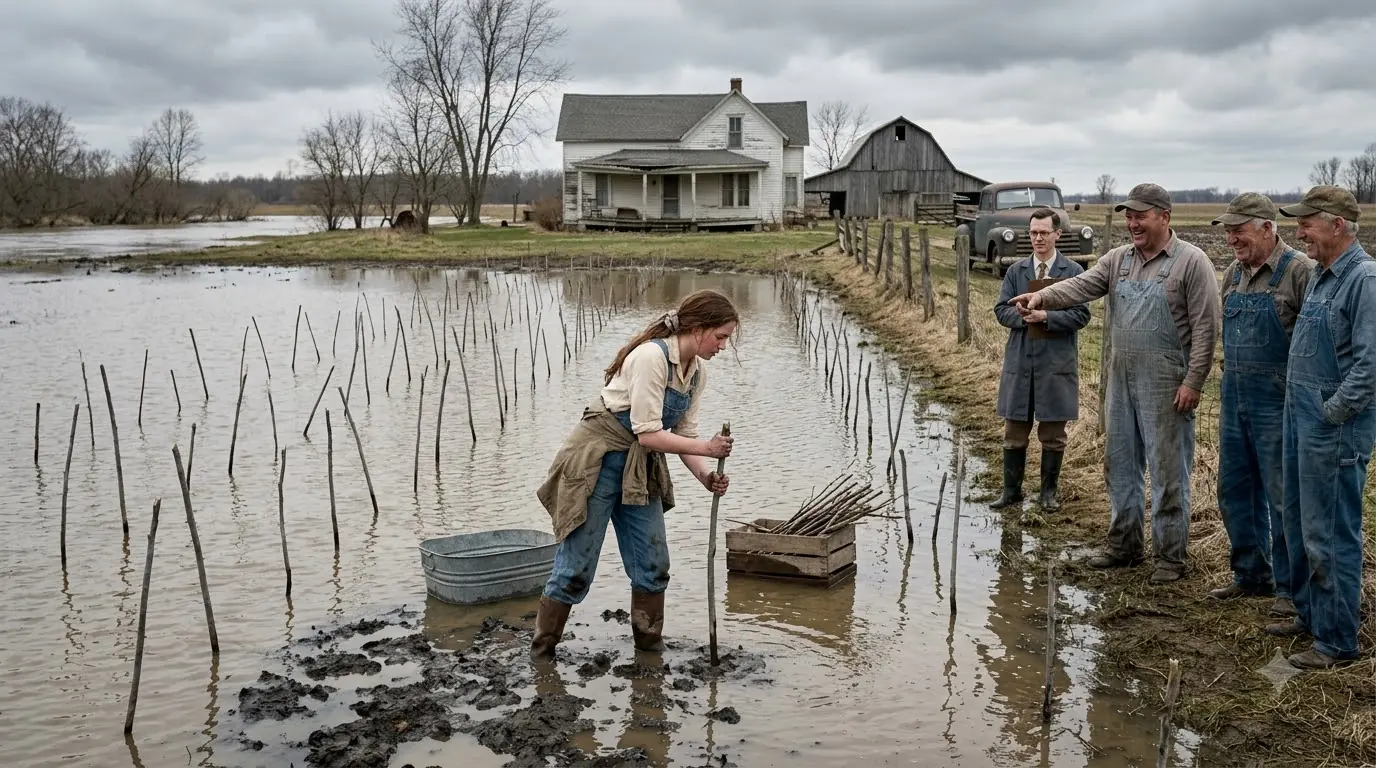
Some of them laughed openly. Others offered the quieter kind of insult, the kind that begins with a sympathetic shake of the head and ends with the certainty that you understand another person's future better than she does. Clara kept her eyes on the ground and pushed another cutting into the black earth.
There were two hundred of them, each about two feet long, stripped of leaves and tied into bundles that had been waiting in her grandmother's attic through the last of winter. On the first day she planted until the skin beneath her fingernails turned the color of the creek. On the second she returned in a borrowed pair of rubber boots that rubbed both heels raw. By the third, the flooded corner of the Jennings bottomland looked as though somebody had tried to build a fence and forgotten to connect the posts. Nothing about it suggested a crop, an income, or a future.
Clara knew what the men were saying. She could hear enough when the wind brought their voices across the water, and she had heard worse at the general store where people seemed to believe a grieving girl suddenly lost her hearing. They said she had inherited her grandmother's strange ideas along with her grandmother's debts. They said her father ought to bring her home before she ruined the property. One man told the others he had seen boys with better judgment playing with sticks behind the schoolhouse. Clara remembered that remark longer than she meant to.
What the men did not know was that the little bundle had come with a note in Evelyn Jennings's handwriting. What they could not see, beneath the murky water and under the stubborn surface of the girl they had decided was foolish, was a calculation made with the last resources she possessed. She was not planting because she believed that anything placed in mud must grow. She was planting because her grandmother had watched that land for sixty years, because the land had failed every crop people tried to force upon it, and because Clara had reached the point where doing nothing frightened her more than being laughed at.
Six months later, some of those same men would come down the lane carrying baskets, sharpened knives, and paper on which they had written questions they were embarrassed to ask. The county extension agent would remove his hat before speaking to her. A banker who once discussed the Jennings place as though its owner were not present would have to wait on the porch until she finished her work. But that spring, with the water rising and a mortgage notice on the kitchen table, none of those futures seemed possible. Even Clara did not know how much of her grandmother's experiment would survive.