No one expects to arrive ten minutes early for a scheduled bank appointment and spend the next two hours learning exactly how invisible a person can become.
Walter Jennings certainly did not.
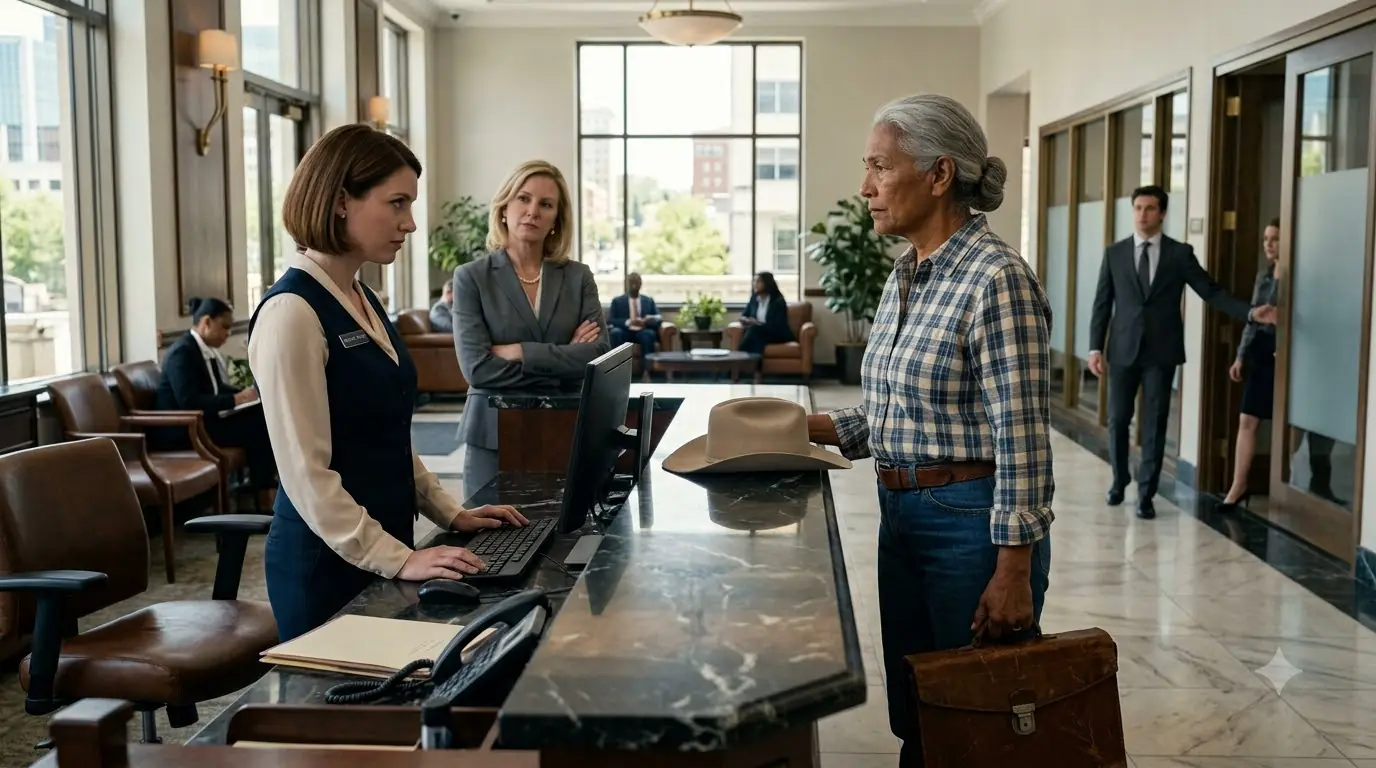
At sixty-five, Walter had spent most of his life in places where people said what they meant. A fence post was either straight or it was not. A heifer was either sick or healthy. A tractor either started on a January morning or required somebody to open the hood and find out why. There were complications in ranching, certainly, but very little room for the polished kind of pretending he encountered that Tuesday morning at Evergreen Ridge Bank.
He arrived at the downtown Knoxville branch at 9:50 a.m. for a ten o’clock appointment with branch manager Elaine Stratton.
His confirmation email was printed and folded inside the worn leather briefcase he carried in his left hand.
The briefcase had been a gift from his late wife, Margaret, on their thirtieth wedding anniversary. It had once been a rich brown color, but twenty years of pickup floors, cattle auctions, tax meetings, feed-supplier offices, and kitchen-table bookkeeping had worn the corners nearly pale. A crack ran along one side of the handle, repaired with dark stitching by a leatherworker in Pine Hollow.
Walter could have replaced it.
He never would.
Margaret had died four years earlier after thirty-eight years of marriage, and the briefcase was one of those ordinary objects grief had quietly turned valuable.
That morning, Walter had dressed more carefully than usual. He wore a clean blue-and-gray flannel shirt tucked into dark jeans, polished his brown work boots as well as old leather allowed, trimmed his beard, and even changed the belt he normally wore because the everyday one had a crack near the buckle.
His daughter, Rebecca, had seen him before he left the ranch and smiled.
“You look like you’re going to court.”
Walter had adjusted his collar.
“I’m going to a bank.”
“Same expression on your face.”
“I like cows better.”
“Cows don’t use spreadsheets.”
“They also don’t charge origination fees.”
Rebecca laughed and handed him a travel mug of coffee.
“Mom would tell you not to glare at anybody.”
“Your mother told me that everywhere.”
“She usually had a reason.”
Walter kissed his daughter’s forehead before leaving.
Pine Hollow lay east of Knoxville at the edge of the Smoky Mountains, where pasture climbed into wooded ridges and two-lane roads still followed creeks rather than straight lines. The Jennings ranch had been there since Walter’s grandfather, Samuel, purchased the original hundred and eighty acres in 1948 with money saved from wartime construction work.
Walter’s father expanded it.
Walter expanded it again.
By sixty-five, he operated just over six hundred acres between owned pasture and long-term leases. The ranch ran beef cattle, produced hay, and supplied breeding stock to farms across eastern Tennessee and western North Carolina.
It was not a television ranch.
No stone entrance gate.
No mansion.
No helicopter landing pad.
There were two barns built in different decades, three tractors of different ages, a livestock trailer that had needed a new floor twice, and a ranch house Walter and Margaret had remodeled one room at a time.
The business was healthy because Walter was careful.
He hated unnecessary debt.
He kept equipment longer than dealerships recommended.
He negotiated feed contracts early.
He sold cattle when the numbers told him to instead of when pride wanted him to wait.
The loan he wanted from Evergreen Ridge was not money to rescue a failing operation.
It was four hundred and twenty thousand dollars to replace the ranch’s aging lower barn, install a covered cattle-handling system, and upgrade the water infrastructure serving three southern pastures.
The old barn had become expensive to maintain.
More important, a severe March storm had damaged part of the roof and exposed weaknesses Walter could no longer justify patching.
His veterinarian had been telling him for three years that the cattle-handling area needed redesigning.
Rebecca, who had gradually taken over more daily operations, had told him even more bluntly.
“We either build something that works for the next twenty years, or you and I keep pretending that rust is an architectural feature.”
Walter had resisted.
Then a hydraulic gate failed during spring vaccinations and nearly injured one of his hired hands.
He stopped arguing.
The total project would cost a little over six hundred thousand dollars.
Walter planned to contribute almost two hundred thousand in cash and finance the remainder.
Evergreen Ridge already held several of his accounts.
His tax returns had been uploaded.
Land values had been documented.
Cattle inventory provided.
Insurance verified.
Equipment schedules submitted.
The ten o’clock meeting with Elaine Stratton was supposed to be the final branch-level review before the agricultural credit department issued a decision.
That was why Walter drove more than an hour into Knoxville rather than handling everything by phone.
The Pine Hollow branch of Evergreen Ridge had closed two years earlier during a consolidation. Agricultural accounts were redistributed, and Walter’s relationship eventually landed under the downtown office.
His longtime banker, Thomas Mercer, had retired the previous autumn.
Thomas knew Walter’s operation.
Elaine did not.
That was fine with Walter.
People retired.
Businesses changed.
He had no expectation that a new bank manager would know his history before meeting him.
He did expect her to keep an appointment.
Evergreen Ridge Bank occupied the ground floor of a renovated stone building several blocks from the Tennessee River. The lobby looked more like an upscale hotel than the banks Walter remembered from his twenties.
Pale marble.
Tall windows.
Modern pendant lights.
Leather chairs arranged around low tables.
A coffee station with an espresso machine that appeared complicated enough to require licensing.
The air smelled faintly of lemon polish and roasted coffee.
Walter stepped through the doors at 9:50, paused long enough to remove his hat, then approached the reception desk.
The receptionist wore a cream blouse and dark jacket. Her hair was cut into a precise straight bob, and her nameplate read BRITTANY COLE.
“Good morning,” Walter said.
Brittany looked up briefly.
“Yes?”
“Walter Jennings. I’ve got a ten o’clock appointment with Ms. Stratton.”
Her fingers moved over the keyboard.
Walter noticed her eyes move once from his flannel shirt to his boots.
Then back to the screen.
“You’re on the list.”
“Good.”
“Have a seat. She’ll be with you shortly.”
“Thank you.”
Walter chose a chair beside one of the tall windows.
He rested his hat on the briefcase and watched traffic move beyond the glass.
At 9:58, he checked his watch.
At 10:04, he did not.
Walter had no problem with a few minutes.
Ranch schedules taught flexibility better than any management seminar.
Calves did not check calendars before arriving.
Rain did not care whether hay was already cut.
Machinery preferred to fail when parts stores were closed.