The sound was small, almost delicate, and that was what made it impossible to forget. A single sheet of paper tore down the center in the hands of a woman who had already decided that the person standing before her did not deserve the courtesy of an explanation.
The bank lobby had been full of ordinary Friday-afternoon noise a moment earlier: shoes clicking over marble, a child asking for water, a printer working behind a row of polished counters.
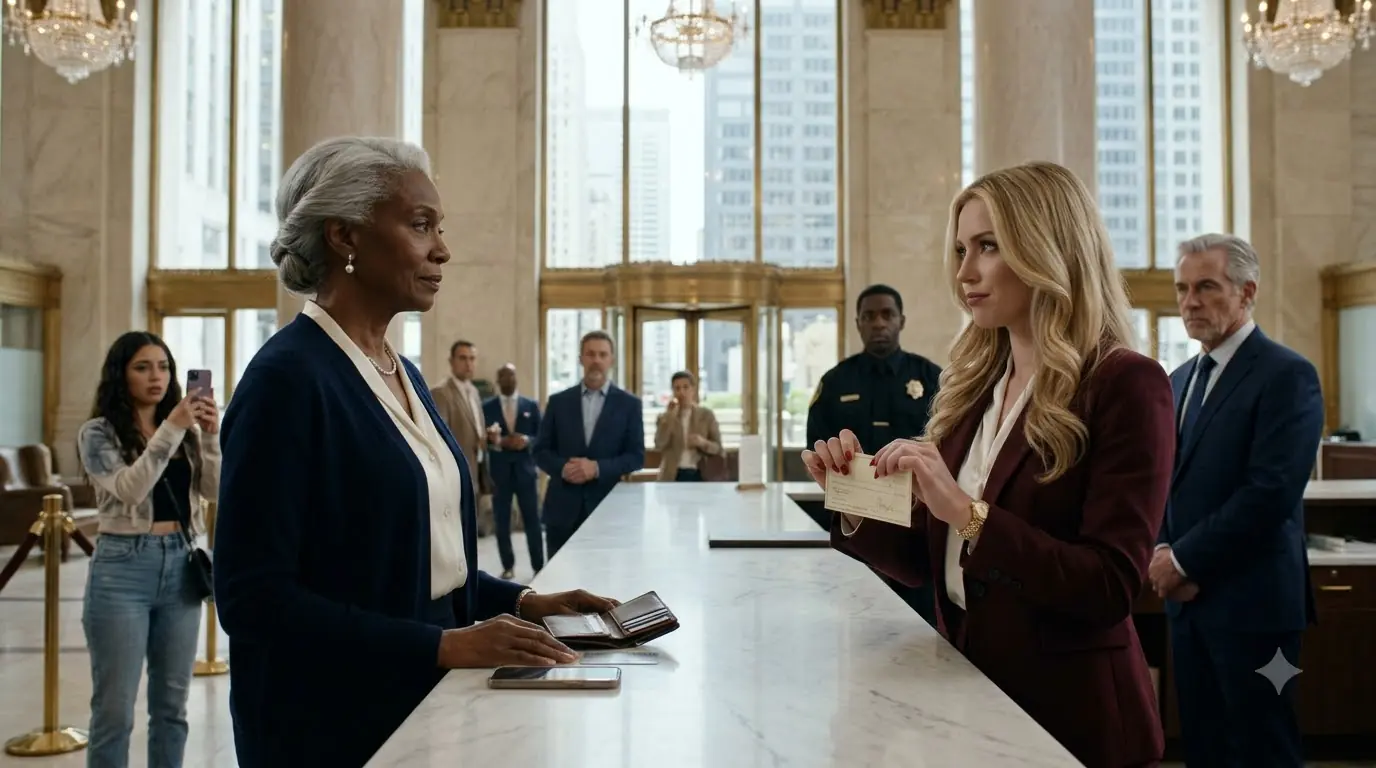
Then Chelsea Morgan ripped the check again, and the entire room seemed to hear it.
Fifty thousand dollars became eight loose pieces of paper beneath Chelsea's immaculate fingernails. They drifted across the counter and settled beside a leather wallet, a fountain pen, and the folded hands of Dr. Evelyn Carter. The check had been issued by Chicago Children's Hospital for months of specialist consultation work, work that involved frightened parents, long nights, and children whose lives depended on a surgeon's ability to remain precise when everyone around her was afraid. Chelsea looked at the pieces as though she had accomplished something useful.
"People like you don't belong in here with fake checks," she said loudly enough for the customers near the entrance to hear. "Security. We have a fraud situation at the main counter."
Evelyn did not reach for the scraps. She did not shout or lunge across the counter, and she did not tell the young woman anything about her professional title or the person waiting for her on the forty-seventh floor. She sat with her shoulders straight inside a navy cardigan, watching Chelsea press the intercom button with a crimson fingernail. In the glass doors behind them, she could see the reflections of strangers turning to stare.
A teenager near the waiting chairs lifted her phone and began recording. A mother took her little girl by the hand and moved away from the counter, not because Evelyn had threatened anyone, but because the word fraud had changed the atmosphere. Near the automated teller machines, another customer reached into her handbag for her own phone. Evelyn noticed all of them, then glanced at the small clock above the transaction desks.
It was 2:47 p.m. Her board meeting began at three.
The remarkable thing about that afternoon was not that Evelyn Carter knew powerful people. It was that, for nearly fifteen minutes, the people who confronted her refused to perform the simplest part of their jobs, even when she gave them every reasonable opportunity. They did not verify the check with its issuing institution. They did not examine the accompanying payment statement. They did not ask for a supervisor who could conduct a proper review before destroying the document in front of her.
Years later, Evelyn would remember the tearing sound more clearly than the news cameras, the corporate statements, or the invitations that followed. She would remember the particular expression on Chelsea's face: a kind of relief at finding someone she felt free to humiliate. The memory did not begin with money, and it did not end when the company's chief executive came downstairs and addressed her as his mother. To understand why, it was necessary to understand what Evelyn had carried into the bank that day, and the life that existed long before the public learned her name.