For fifty-five years, Earl Perkins farmed four hundred acres outside Hadley, drove the same rusted pickup, and never once asked anyone for help. He had fourteen dollars in his checking account the morning he walked into First National Bank and asked for a five-thousand-dollar loan. The new branch manager took one look at Earl’s cracked boots and calloused hands, glanced at the balance on his screen, and said, “No.”
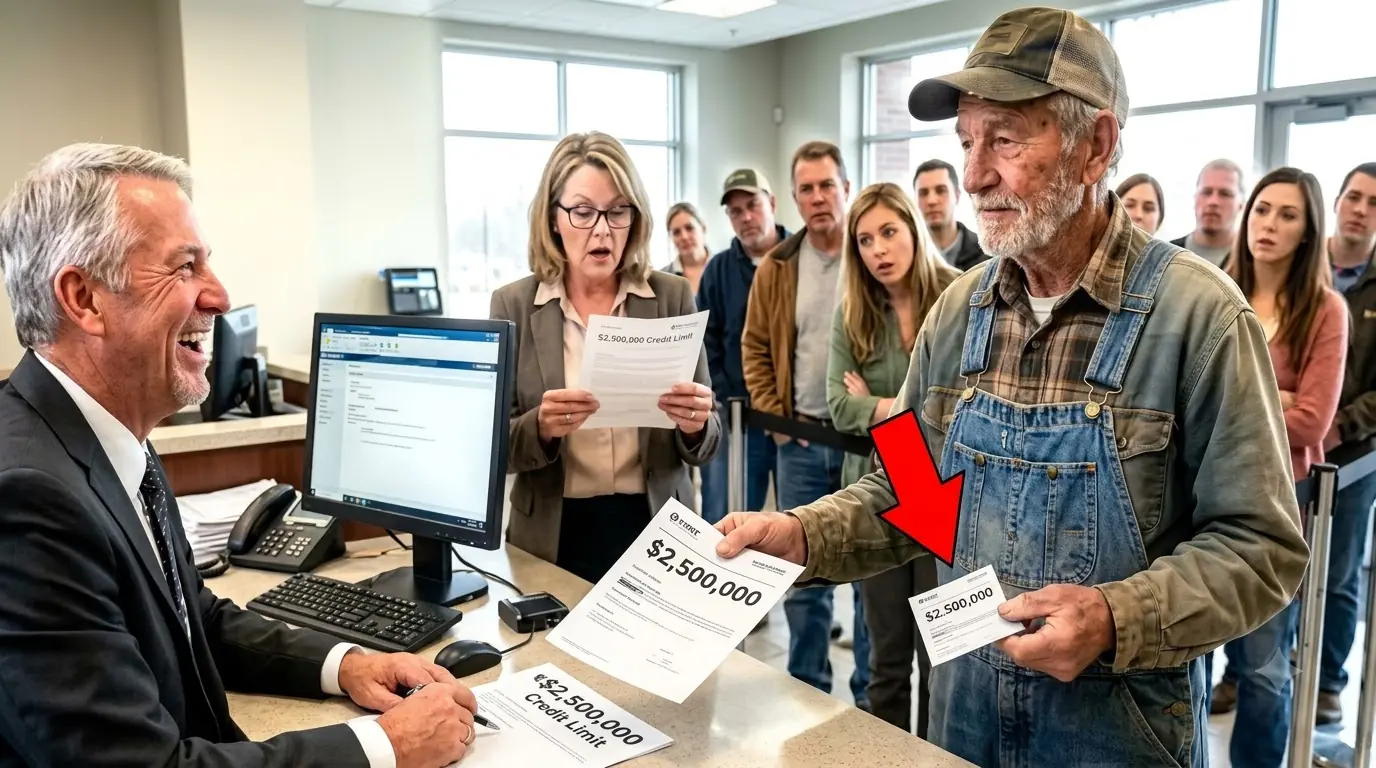
Didn’t check another file. Didn’t ask a single question. Earl nodded, stood up, and walked to the front counter. He asked the head teller, a woman who’d known him thirty years, to pull up his other account. What appeared on that screen was something no one in Hadley could have imagined.
But this story doesn’t start in a bank. It starts on a Saturday morning in April, when the air smelled like wet dirt and fresh-cut grass, and Earl Perkins climbed into his 1994 Ford pickup and drove the seven miles from his farm into town. He did this every Saturday. Had done it every Saturday since Helen died.
The truck’s paint had faded from blue to something closer to gray. The passenger seat had a permanent dip in it from fifty years of Helen sitting in the same spot. Earl never moved the seat back, never adjusted the mirror she’d angled toward herself for checking her lipstick. Some mornings he glanced at it and caught nothing but the road behind him, and that was enough to remind him she wasn’t there.
He parked in front of the diner at 7:15, same as always. The bell above the door jingled when he walked in. “Morning, Earl.” Louise was already pouring his coffee. She had his cup on the counter before he sat down. Black, no sugar. “Morning, Louise.” “Eggs and toast, if it’s not too much trouble.” She smiled. “It’s never trouble, Earl. You know that.”
He sat at the counter, third stool from the left. The vinyl was cracked and the padding had gone flat years ago, but it was his stool. Nobody in town sat there on Saturday mornings. Everybody knew. Louise set his plate down a few minutes later. Two eggs over easy, wheat toast, a small pile of hash browns she always added without charging him.
Earl ate slowly. He watched the street through the window. A few cars passed. The town was quiet on weekend mornings. Not empty, just unhurried. “How’s the planting?” Louise asked, wiping down the counter. “Coming along. Got the south field in last week.” “Soybeans again? You ever get tired of soybeans?” Earl took a sip of coffee. “Soybeans have been good to me. No reason to stop now.”
Louise laughed. She didn’t know how true that was. Nobody in that diner did. Earl left three dollars on the counter for a two-dollar breakfast. He did that every week. Louise always told him it was too much. He always told her it wasn’t enough.
He stepped outside and stood on the sidewalk for a moment, looking up the street toward the bank. The morning sun caught the glass front of the building and turned it bright white. Earl reached into his shirt pocket and touched the pair of reading glasses folded there. Helen’s glasses. Wire frames, a small scratch on the left lens. He carried them every day.
“All right, Helen,” he said under his breath. “Let’s go see about this new fella.” The bank was three blocks from the diner. Earl walked. His knees weren’t what they used to be, but he didn’t carry a cane. Helen had told him once that the day he started leaning on a cane was the day he’d start feeling old, and he figured she was right about that. She’d been right about most things.
He pushed open the glass door and stepped inside. Doris saw him first. She’d been behind that counter for thirty-one years. Gray hair pulled back, bifocals on a chain around her neck. She remembered every account number and every grandchild’s birthday in a town of twenty-two hundred people.
“Well, look who it is.” She smiled wide. “Earl Perkins. Haven’t seen you in here since January.” “Haven’t needed anything since January.” “What brings you in today?” Earl glanced toward the glass-walled office in the back. A young man sat behind the desk, typing on a laptop. Dark suit, clean-shaven, a haircut that cost forty dollars in a city.