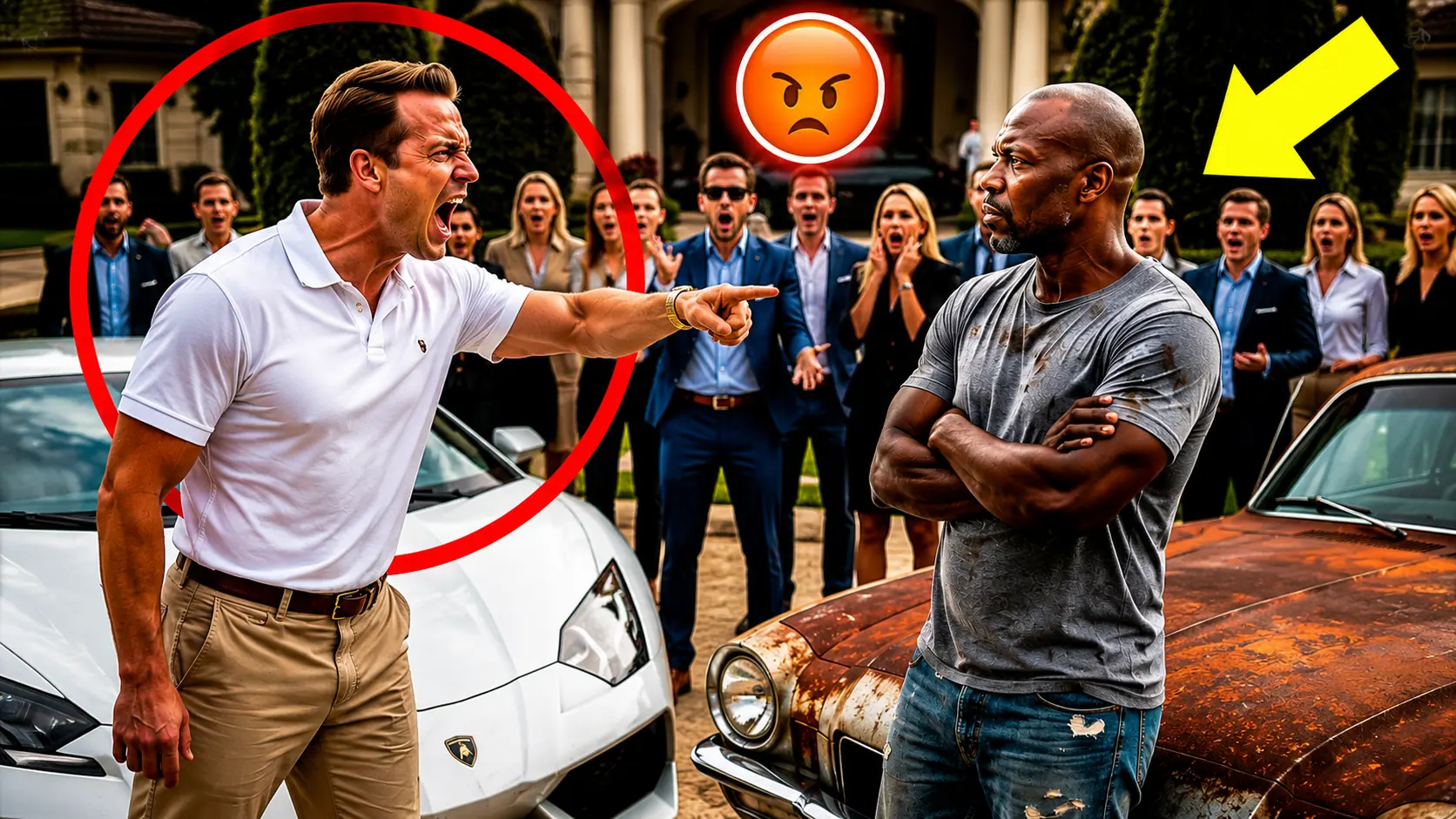
Outrun me with that junk car
Five words. A $220 million mistake.
Preston Whitmore III is a CEO, a millionaire, a member of the most exclusive country club in Scottsdale. On a March afternoon, he pulls his white Lamborghini alongside a 1972 Chevrolet Camaro at a red light. The paint is faded, the chrome is dull. Preston sees junk. He steps out. He circles the car. He looks at the black driver and laughs. “What are you doing here? This isn’t your kind of neighborhood. Then, outrun me with that junk car. I dare you.” Then he bets his entire company. He loses the race by 14 seconds. He loses his company in 90 days because that black driver, he wasn’t nobody.
Preston Whitmore looked at a black man in an old car and saw someone beneath him. He was wrong. It cost him everything.
Stay until the end. You’ll want to see who was really behind that wheel.
6:00 in the morning, Scottsdale, Arizona
The desert air still carries the coolness of night. A mockingbird calls from somewhere in the mesquite trees. The sky is shifting from black to purple to the first hints of orange.
Malcolm Travers stands in his garage. The concrete floor is spotless. He mopped it yesterday, same as every Sunday. Tools hang in perfect rows on pegboard walls, each outline traced in black marker so he knows immediately if something is out of place. His father taught him that. Order creates clarity. Clarity creates speed.
And in the center of the garage, illuminated by a single overhead light, sits the car. A 1972 Chevrolet Camaro SS. Black paint that has seen better decades, faded in places, touched up in others, never quite matching. Brown leather interior, cracked in places, soft in others. The kind of car most people would call a project or a relic or junk.
Malcolm runs his hand along the hood. The metal is cool under his palm. He knows every curve, every imperfection, every story this car holds. The small dent near the passenger mirror where his father bumped a shopping cart in 1986. The scratch on the rear quarter panel from a branch that fell during a monsoon storm in 1994. The replacement taillight housing that doesn’t quite match. The original shattered when a rock kicked up on the highway in 2003.
The car belonged to his father, Samuel Travers, a mechanic who worked 60-hour weeks and never complained. A man who taught Malcolm everything about engines before Malcolm ever sat in a race car. Samuel passed away in 2019. Cancer, quick and merciless. From diagnosis to funeral in 11 weeks.
Malcolm kept the car exactly as his father left it. The exterior, anyway. Under the hood is a different story. A 454 cubic inch V8, rebuilt and tuned to specifications that would make most engineers weep with admiration. Forged internals, custom camshaft, headers that Malcolm fabricated himself in a friend’s machine shop. But from the outside, it looks like what it is, a 52-year-old American muscle car that has seen better days.
There are no trophies in Malcolm’s house, no championship rings on display, no framed photographs of podium celebrations. If you walked through his living room, you would see comfortable furniture, a modest television, and bookshelves lined with engineering manuals and biographies of jazz musicians. You would never know that the man who lives here once stood at the absolute pinnacle of motorsport.
Three Formula 1 world championships. 1998, 2001, 2003. 41 Grand Prix victories. A career that made him a legend in Europe and a footnote in America, where open-wheel racing never quite captured the national imagination.
Malcolm retired in 2005. He was 33 years old. He walked away at the top, which is rare. He walked away quietly, which is rarer still. No farewell tour, no tearful press conferences, just a simple statement. “I came to race. I raced. Now I’m done.”
Now he runs the Travers Racing Academy, a nonprofit. 142 graduates so far. Kids from tough neighborhoods. Kids who remind Malcolm of himself at that age. Hungry, talented, overlooked. Kids whose guidance counselors told them they’d never amount to anything.
He teaches them to drive. More importantly, he teaches them discipline, focus, the understanding that excellence requires patience.
His father’s words echo in his mind every morning. “Don’t explain who you are. Let them see.” And another phrase, one Malcolm has carried like a compass through every victory and every loss. “Always finish what you start.”
Malcolm opens the driver’s door. The hinges creak slightly. He could fix that, but he likes the sound. The leather seat accepts his weight with familiar give. He reaches up and taps the dashcam mounted on the windshield. A small red light blinks on. He always runs the dashcam. Old habit from his racing days, when every piece of footage could mean the difference between a penalty and a clean record.
“You never know when you’ll need the footage,” he once told a student. The student laughed. Malcolm didn’t.
The engine turns over. That deep V8 rumble fills the garage, vibrates through the steering wheel, settles into Malcolm’s chest like a second heartbeat.
He pulls out onto the quiet street. The sun is just beginning to paint the eastern sky orange and pink. It’s going to be a warm day. Malcolm has errands to run, parts to pick up, paperwork at the academy, the ordinary machinery of an ordinary life.
He takes his usual route, past the strip malls and the gas stations, past the golf courses and the gated communities, past the entrance to Ridgecrest Country Club, where a wrought-iron gate and a guard booth separate the members from everyone else.
Malcolm has driven past this gate hundreds of times. He has never thought twice about it. Today will be different.
March 12th, 2024 – 2:52 p.m.
The Arizona sun beats down on the asphalt. Heat shimmers rise from the road like transparent curtains. The temperature gauge on Malcolm’s dashboard reads 93°.
Malcolm sits at a red light. The Ridgecrest Country Club entrance is 20 ft to his right. The guard booth is staffed now. A man in a khaki uniform sits inside, reading something on his phone. The wrought-iron gate stands closed, its decorative scrollwork casting intricate shadows on the concrete.
A white Lamborghini Huracán pulls up in the next lane. The engine note is high and sharp, an Italian scream compared to the Camaro’s American growl. The license plate reads FINEAGE1. Chrome wheels gleam. The paint is so white it almost hurts to look at in the direct sunlight.
The driver’s window descends with an electronic whir. A man in his late 40s leans out. Polo shirt, collar popped, designer sunglasses that probably cost more than Malcolm’s monthly grocery bill. The kind of tan that comes from golf courses and yacht decks, not from actual labor under the sun.
Preston Whitmore III.
He looks at the Camaro. His expression shifts from curiosity to amusement to something that looks a lot like contempt. The progression takes about 3 seconds.
“What is this thing?” Preston calls out. His voice carries that particular blend of entitlement and condescension that Malcolm has heard before in different cities, in different decades.
“Did you dig it out of a junkyard?”
Malcolm keeps his eyes forward. His hands rest on the steering wheel at 10:00 and 2:00. The dashcam’s red light blinks steadily in his peripheral vision.
Preston opens his door, steps out onto the asphalt. His loafers click against the pavement. Italian leather, probably hand-stitched. He walks around the front of his Lamborghini and approaches the Camaro, circling it like a shark examining prey.
He wraps his knuckles against the hood. The sound is hollow, metallic.
“Seriously, does this thing even run? Or do you push it around for decoration?”
Malcolm says nothing. He has learned over 52 years that silence is often the most powerful response.
Preston bends down to look through the open window. His cologne is strong, something expensive and aggressively masculine. His smile is the smile of a man who has never been told no, never been denied, never been refused entry anywhere.
“What are you doing in this neighborhood, anyway? This isn’t exactly your kind of area.”
The light is still red. Malcolm counts the seconds in his head. He has been in this situation before. Different cities, different faces, same assumptions. The assumption that the car tells you everything about the man. The assumption that appearance equals capability. The assumption that wealth equals worth.
Preston straightens up, points at Malcolm through the open window. His finger is thick, manicured, adorned with a gold ring bearing a family crest.
“Tell you what. Outrun me with that junk car. I dare you. To the 15 junction. You win, I give you 50,000 cash. Right here, right now.”
Malcolm turns his head, looks at Preston for the first time, studies the man’s face, the arrogance, the certainty, the complete absence of doubt.
“And if you win? You never drive through this neighborhood again. You take your junk car and disappear.”
Preston grins, showing teeth that have clearly benefited from expensive orthodontics.
“Deal?”
“Make it interesting.”
Preston’s grin falters for just a moment.
“50,000 isn’t interesting enough for you? Your company.”
The grin disappears entirely. Preston stares.
“My company? FinEdge? You want me to bet 220 million dollars against this?”
He gestures at the Camaro, a sweeping motion of disbelief. “This heap of scrap metal? You said it was junk.”
Malcolm’s voice is calm, level. The voice of a man who has stared down opponents at 200 miles per hour.
“Should be easy money.”
Something flickers in Preston’s eyes. Pride. Ego. The absolute certainty of a man who has never lost anything that mattered. The certainty that comes from a lifetime of winning simply because losing was never permitted.