"You're finished here. Pack your things and get out."
Victoria Harrington delivered the words from the center aisle of the fourth floor, loud enough for nearly two hundred people to hear. Her finger was pointed at a man wearing a faded navy jacket, worn work boots, and a canvas backpack repaired with electrical tape.
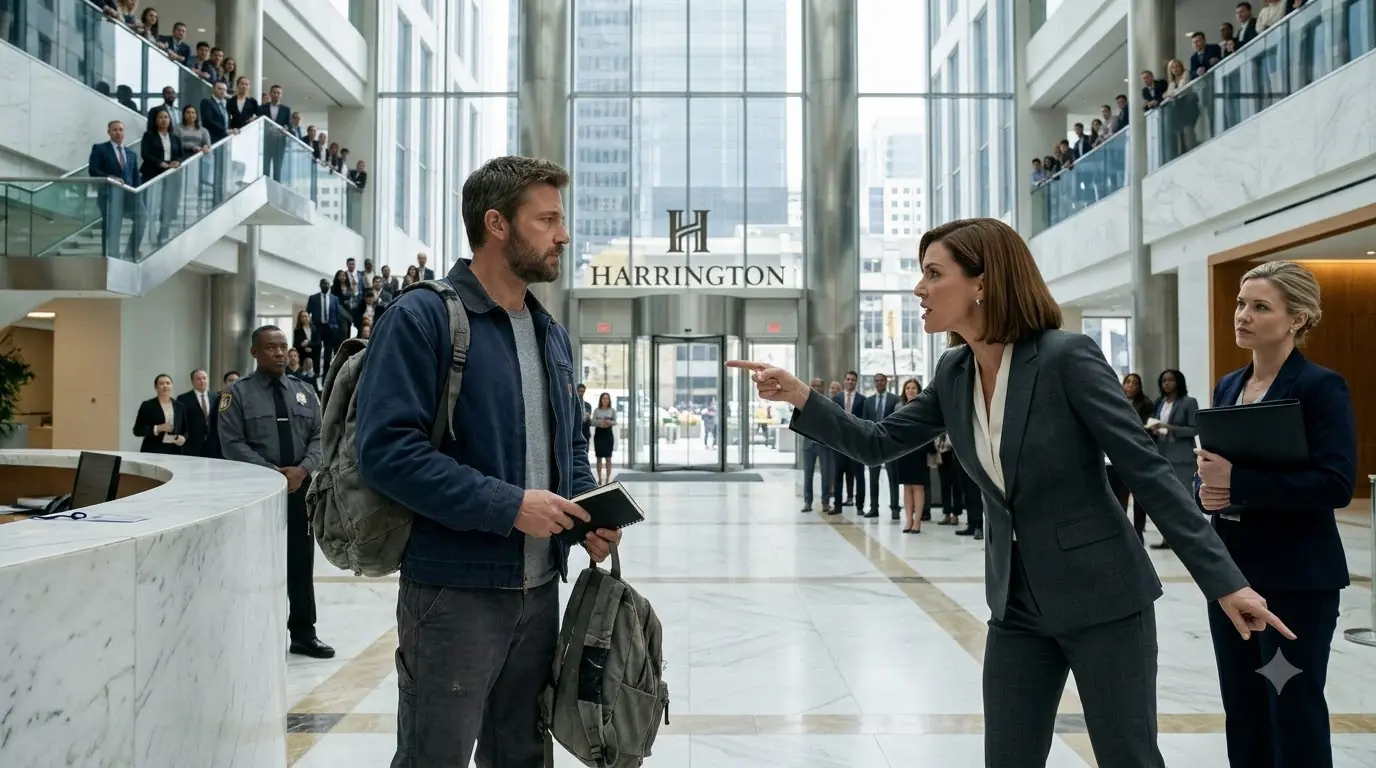
Around them, computer monitors glowed over motionless desks, and nobody seemed willing to breathe until they understood what kind of ending they were watching.
"No one in this city is going to hire you after this," she added. "You are fired, Mr. Thompson. Get out of my building."
Caleb Thompson looked at the woman who had been running his company for five years. She didn't know it was his company, not in the sense that mattered, and the employees standing behind her knew even less. They saw an ordinary operations associate dismissed in public by a chief executive who believed she had the right to define another person's worth with a glance. Caleb saw the culmination of thirty-one days of work and eight months of preparation, though the fact that he had anticipated the possibility did not make the humiliation painless.
He did not tell her who he was. He did not demand that anyone call a lawyer, threaten a lawsuit, or shout that her career was over. Instead, he took the notebook from his desk, slipped it into his backpack, placed his employee badge beside the keyboard, and thanked her for the opportunity. Then he walked toward the elevator while a hundred faces followed him and not one voice asked whether the decision was fair.
Forty minutes earlier, a group of vehicles had begun moving toward that building for an entirely different reason. Richard Coleman, the elderly investor who had helped Caleb build Harrington International, was coming with board counsel and an independent review team for a confidential meeting arranged long before Victoria stepped onto the fourth floor. By the time Caleb reached the sidewalk, ten black SUVs were turning onto the block, and the coincidence of their arrival would become a story employees told for years. What mattered was not the expensive vehicles but the man who stepped out of one of them, walked straight past the executives waiting to greet him, and lowered his head in apology before the associate everyone had just watched being fired.
To understand why that happened, and why Caleb did not use his ownership to destroy Victoria on the spot, you have to go back to a quiet house in Maryland on the morning he first put on that jacket.
The jacket cost eleven dollars at a Goodwill store along Route 1. Its color had faded unevenly at the shoulders, its zipper stuck halfway up, and one cuff bore the shiny mark of an old repair. Caleb bought it because it was clean, serviceable, and unremarkable. In the mirror above his bedroom dresser, it made a forty-five-year-old man who had appeared on magazine covers look like someone who fixed the office printer when everyone else had gone home.
His daughter Maya stood in the doorway watching him. She was seven, small for her age, with braids that never survived a complete school day and the deep brown eyes of her mother, Diane. On the bed lay the backpack Caleb had kept since an early consulting trip, its strap secured in two places with black electrical tape because he had never seen a reason to replace something that still carried his things.
"Daddy, why are you wearing that?" Maya asked. "You look like the man who came to fix the heater."
Caleb turned toward the mirror. "Is that a good thing?"
"I don't know yet," she said, considering him with the severity children reserve for adult decisions they suspect will affect dinner. "Are you going to a costume party?"
"No. I'm going to work, but I'm trying something different." He crouched so their eyes met. "If somebody asks which office I work at, what are you going to say?"
"An office with boring people and bad coffee," she recited, and then frowned. "Is the coffee actually bad?"
"I haven't tasted it yet." He smiled, though the smile took more effort than she knew. "Mrs. Patterson will pick you up today. I'll be home for dinner if I can, and if the day runs late, I'll call before you start worrying."
Maya nodded, then looked at the portrait on his dresser. Diane was laughing in the photograph, leaning into Caleb on a beach where the wind had spoiled both their carefully planned appearances. She had been dead for five years, and there were still mornings when Maya asked questions Caleb could answer only by telling a story about who her mother had been. Today, she reached out and touched the photograph's frame before taking his hand.
"Mommy liked when you wore old clothes," Maya said. "She said it meant you were going to build something."
Caleb swallowed. Diane had said almost exactly that on mornings when he had gone to his first rented office with a notebook and a sandwich packed in a paper bag. He kissed Maya's forehead, helped her find the missing half of a purple hair ribbon, and walked her to the front door. Only after the school bus had turned the corner did he allow himself to sit on the bottom stair and consider how strange his plan would have sounded to the younger version of himself.
He had founded Harrington International at twenty-six with a forty-page business plan and a loan secured against his first apartment. Back then, he was not yet a man whose movements were coordinated by assistants, security teams, and financial advisers. He was a Howard University graduate with an MBA from the University of Chicago, a stubborn belief that technology could make complicated supply systems intelligible, and scarcely enough cash to pay three employees through the next month.
His first customer was a regional distributor that had lost track of thousands of medical components between warehouses. Bigger firms had proposed systems the customer could not afford, and some had refused the project altogether. Caleb spent six weeks on warehouse floors with the people who actually moved the goods, writing down why their systems failed before telling them what a new one should do. He won the contract because the proposed software addressed the problems the workers described, not merely the problems management wanted to discuss.
Richard Coleman provided the early capital. At fifty-two, he was already a respected investor, but he was unusual in a way Caleb recognized immediately: he would ask the receptionist what she had learned about customers before he asked the chief executive about projected revenue. On their first meeting, Richard inspected Caleb's crowded office and said the furniture was terrible. Then he read the business plan all the way through and offered the money that allowed the company to hire its first engineering team.
"I'll give you enough runway to make a real product," Richard told him. "But you have to promise me one thing. Don't become one of the people who stop listening once the business starts making money."
Caleb made the promise, and for twelve years he tried to keep it. He learned employee names, took the night shift on software deployments, and sometimes sat on warehouse loading docks listening to drivers describe faults no manager had thought to report. On the wall of the company's first office he painted a sentence that became familiar to the original team: WE SEE PEOPLE HERE. ALL OF THEM. The words were not a branding strategy then; they were an instruction that shaped whom they hired, how they handled mistakes, and what counted as a good decision.