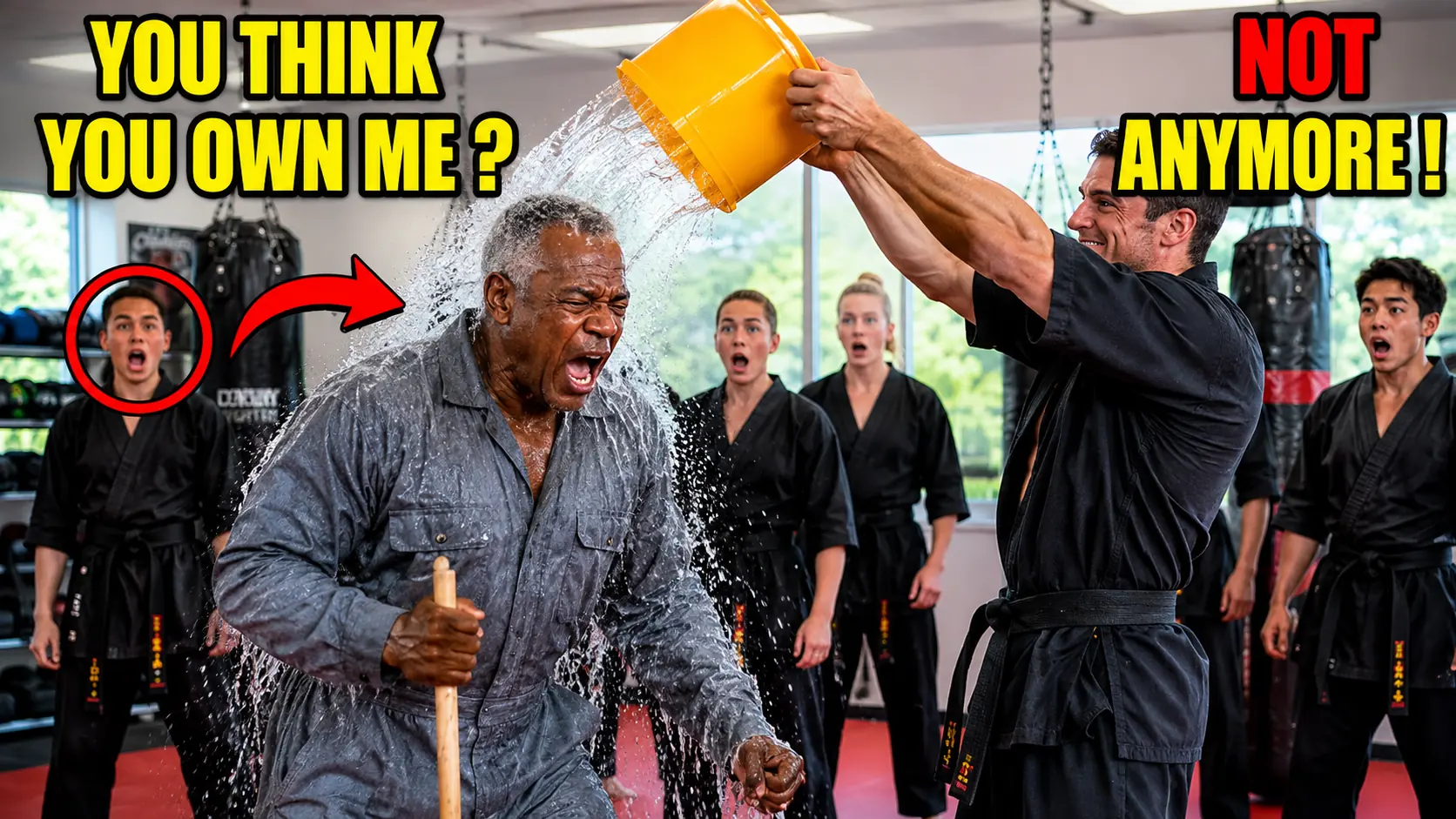
Pride smells like cheap vinyl and floor wax. Bradley was twenty-two, wearing his newly minted black belt like a loaded pistol. To him, the old man dragging a yellow bucket across the mats was nothing but scenery—a punching bag with a pulse. He dared the janitor to spar for a cheap laugh. The joke choked in his throat the exact second the gym’s terrifying owner walked in, dropped his gear, and folded into a deep trembling bow to the man holding the mop.
Bowman’s Martial Arts Academy occupied a dying strip mall sandwiched between a failing laundromat and a discount auto-parts store. The neon sign buzzed with a rhythmic irritating hum, casting a sickly red glow over the cracked asphalt parking lot. Inside, the air was thick. It tasted of vinyl, damp cotton, and the sharp metallic tang of adrenaline. This was not a dojo of quiet meditation and cherry blossoms. It was a factory for local competitors, a place where egos were inflated and bruised in equal measure. Bradley Hayes thrived in this swamp. He was twenty-two years old, built like a brick wrapped in steel wire, and possessed a natural explosive athleticism that made him dangerous. He had earned his black belt three months ago. Since that day, he wore it not as a symbol of mastery, but as a crown. He walked with a swagger that ate up the space in the room. When he sparred, he didn’t just want to win—he wanted to humiliate. He threw spinning hook kicks with a vicious snap, targeting the heads of nervous blue belts, stopping only an inch from their noses just to watch them flinch. He fed on their wide-eyed fear. It was a cheap kind of power, but to Bradley, power was power.
Richard Bowman, the owner and head instructor, tolerated Bradley because Bradley won tournaments. Bowman was a pragmatist. Trophies in the front window brought in suburban parents willing to pay premium monthly fees for their kids. Bowman was a hard man—forty-five, ex-military, with a face like a worn leather boot, and a teaching style that consisted mostly of harsh corrections and demanding physical conditioning. He controlled the room with a barked command, demanding absolute respect. But Bowman had a blind spot for his star pupil. He confused Bradley’s aggression for potential. Then there was Leon. Leon Carter was the anti-Bradley. He was a fixture of the gym, yet entirely invisible. Somewhere in his late sixties, Leon possessed a quiet, deliberate way of moving that suggested chronic joint pain mixed with an infinite reservoir of patience. He wore faded gray coveralls, the kind mechanics wore in the seventies, and kept his graying hair cropped close to his scalp. Leon was the janitor. He arrived every evening at seven, right as the advanced adult classes were peaking in intensity. He would silently empty the trash bins, restock the paper towels in the locker rooms, and wait by the heavy bags with his mop bucket. He never spoke unless spoken to, and even then his answers were soft, gravelly, and brief.
Bradley despised him. Not consciously at first—it was a subconscious irritation. Bradley lived for the spotlight, for the loud smacks of shins against Thai pads, for the applause of the junior students. Leon’s utter indifference to Bradley’s displays of dominance felt like a silent insult. Leon never clapped. He never winced when Bradley landed a brutal body shot on a sparring partner. He just watched, his dark eyes entirely unreadable, leaning against the handle of his mop. “Look at him,” Bradley muttered to a sycophantic purple belt named Jared one Tuesday night, untaping his wrists. “Guy watches us every single night. Probably goes home and shadowboxes in the mirror thinking he’s Bruce Lee.” Jared snickered, adjusting his groin guard. “He looks like he’d shatter a hip if he threw a jab.” “It’s pathetic,” Bradley said, loud enough for his voice to carry over the ambient noise of the gym. He wanted Leon to hear. He wanted a reaction. “Living your whole life in the background, cleaning up other people’s sweat.” Leon was less than fifteen feet away, wiping down the full-length mirrors with a blue microfiber cloth. His hand moved in slow methodical circles. Wipe, step, wipe, step. If he heard Bradley, he didn’t show it. His breathing remained deep and even. He didn’t tighten his grip on the cloth. He just kept working.
That lack of reaction knotted Bradley. It was a small petty thing. But for a young man whose entire identity was built on forcing people to acknowledge his superiority, Leon’s apathy was intolerable. Over the next few weeks, Bradley’s microaggressions escalated. He started leaving his empty water bottles directly in the middle of the freshly mopped mats. He would “accidentally” kick a heavy bag right as Leon was walking behind it, forcing the older man to stop and wait for the swinging vinyl to settle. Leon never complained. He picked up the bottles. He waited for the bag. He went about his work with a blue-collar stoicism that Bradley found utterly infuriating. Bradley mistook the old man’s silence for cowardice. He mistook his slow movements for weakness. He didn’t know how to look closely. If Bradley had known anything about true martial arts beyond scoring points and causing concussions, he might have noticed the way Leon walked. A cynic sees an old man dragging his feet. An expert sees a man whose center of gravity never shifts, a man who steps heel-to-toe with perfect unconscious balance. Bradley didn’t notice how Leon’s hands, though calloused and thick-knuckled, gripped the mop handle with a relaxed supple tension. Bradley only saw a target, and targets in Bradley’s world existed to be hit.
Friday nights at the academy were reserved for open mat—no formal instruction, just two hours of unstructured sparring, drilling, and grappling. It was a chaotic, high-energy environment. On this particular Friday, the atmosphere was looser than usual. Bowman had left an hour early to attend a regional promoters’ meeting, leaving Bradley to lock up. Giving a twenty-two-year-old narcissist the keys to the castle was a predictable disaster. By 9:30, the casual students had filtered out. Only Bradley and a half-dozen of his hardcore training partners remained. The air conditioning had struggled all night, and the gym felt like a sauna. Hip-hop blared from the Bluetooth speaker in the corner, shaking the cheap ceiling tiles. Bradley was high on his own supply. He had just spent twenty minutes dissecting Jared in a grappling exchange, submitting him repeatedly and loudly analyzing his mistakes for the rest of the room. “You’re telegraphing the armbar, man,” Bradley barked, standing over a panting Jared. He wiped sweat from his forehead with the back of his hand. “You got to set it up. You’re moving like you’re underwater.”