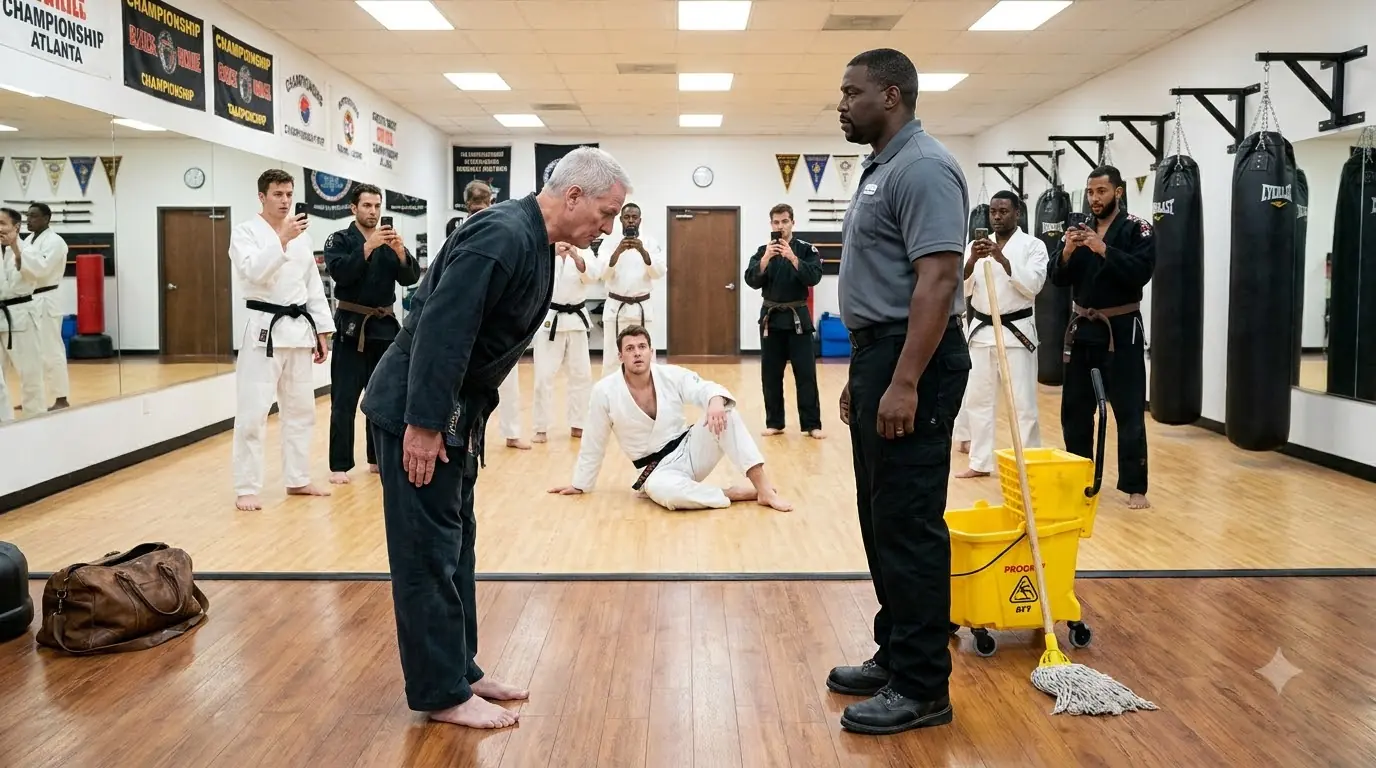
Black Belt Dares the Black Janitor to Fight "As a Joke" — Until the Sensei Walks In and Bows to Him
Black Belt Dares the Black Janitor to Fight "As a Joke" — Until the Sensei Walks In and Bows to Him
“Look how hard the janitor is scrubbing.”
Derek Coleman’s voice carried across the entire training hall.
Jerome Fisher kept walking.
Eyes down.
Bucket in one hand.
Mop in the other.
Derek stepped directly into his path.
He was still wearing his white gi from the advanced class, the black belt around his waist tied carefully enough to make sure everyone could see it.
“You smell like bleach.”
Several students laughed.
Derek leaned closer.
“Honestly, man, it’s disgusting.”
Jerome stopped.
He was forty-two years old, broad through the shoulders, quiet in the way some people mistake for weakness.
He looked at Derek.
Said nothing.
Derek reached out, snatched the mop from Jerome’s hand, and threw it onto the hardwood.
The handle hit with a sharp crack.
Everyone looked over.
Nobody moved.
Derek smiled.
“Fight me.”
Jerome slowly bent down and picked up the mop.
“One round.”
Derek raised his voice.
“It’ll be hilarious.”
He turned toward the students.
“A janitor versus a black belt. Who wants to see that?”
Laughter rolled through the room.
Phones appeared.
Jerome stood upright.
“I don’t like fighting.”
Derek laughed.
“That explains it.”
He kicked Jerome’s bucket.
Dirty water spilled across the freshly cleaned floor.
“You know how to clean.”
He nodded toward the mess.
“So clean.”
Jerome stared at the spreading water.
For a brief second, his right hand tightened.
Then relaxed.
Derek did not understand how close he had just come to discovering that the man holding a mop was not afraid of him.
Jerome Fisher was afraid of himself.
Griffin’s Martial Arts Academy sat at the end of a polished strip mall in suburban Atlanta.
Glass doors.
Trophies in the windows.
Championship banners hanging from the ceiling.
Inside, the training floor stretched beneath bright lights and mirrored walls.
Heavy bags lined the far corner.
Photographs of champions covered one hallway.
Almost every banner carried the same name somewhere on it.
Walter Griffin.
Griffin’s was not a casual neighborhood karate school.
It had a reputation.
State champions trained there.
National competitors visited.
Parents drove forty minutes each way to enroll their children.
Monthly tuition started around four hundred dollars.
The parking lot on most evenings was filled with luxury SUVs, German sedans, and parents answering work calls while waiting for class to end.
And nearly every night, after those people left, one man remained.
Jerome Fisher.
He arrived around six in the evening, just as the advanced classes were winding down.
Gray polo.
Black work pants.
Steel-toe shoes.
A mop bucket with one bad wheel that squeaked every few feet.
Jerome cleaned the mats.
Disinfected the locker rooms.
Wiped the mirrors.
Emptied trash cans.
Restocked towels and paper products.
Then, around midnight, he locked the doors.
Most students did not know his name.
Some had trained at Griffin’s for years and had never spoken to him directly.
To them, Jerome was part of the building.
A man who appeared when the class ended and disappeared before they returned the next day.
He earned $11.60 an hour.
No benefits.
No paid sick leave.
And half of nearly every paycheck went to Sunrise Hills Assisted Care in Decatur.
His mother lived there.
Evelyn Fisher was sixty-eight and suffering from early-onset dementia.
Some weeks she remembered Jerome perfectly.
Other weeks she called him by his father’s name.
Some mornings she asked why he had not visited in years when he had been sitting beside her the previous evening.
Jerome paid what he could.
When the care facility raised its monthly rate, he cut his grocery budget.
Rice.
Beans.
Eggs when they were cheap.
He never complained.
What nobody at Griffin’s knew was that Jerome’s hands had done far more than push a mop.
He had spent eight years in the United States Army.
Two overseas deployments.
Years of disciplined training.
And during that time, he had studied under instructors whose names still carried weight in traditional martial-arts circles.
Jerome had earned a fifth-degree black belt in Shotokan karate.
Not through weekend seminars.
Not through money.
Through years.
Thousands of hours.
Broken ribs.
Bleeding knuckles.
Conditioning sessions under heat that made the floor feel alive beneath his feet.
He had competed.
Taught.
Trained soldiers.
Worked with men who later became instructors themselves.
Walter Griffin knew exactly who Jerome Fisher was.
Almost nobody else did.
Jerome wanted it that way.
There was a reason.
During his final deployment, Jerome had intervened when a fellow soldier became the target of a violent hazing attack.
Two senior enlisted men had cornered the younger soldier.
What began as intimidation turned physical.
Jerome stepped in.
He warned them.
They did not stop.
Then Jerome used what he knew.
The confrontation ended quickly.
Both attackers were hospitalized.
The Army investigation ultimately supported Jerome’s account, but the underlying incident was sealed in part to protect the victim’s identity and career.
Officially, Jerome had acted to protect someone.
Emotionally, that was not how he remembered it.
He remembered the speed.
How quickly training took over.
How easy it had been.
A wrist.
An elbow.
A body hitting the ground.
He remembered realizing that something he had spent years mastering could damage people far faster than anger ever could.
That frightened him.
So when his military service ended, Jerome stopped teaching.
Stopped competing.
Stopped wearing his belt.
He told himself he wanted ordinary work.
Quiet work.
Work where nobody would ever ask what his hands could do.
He chose the mop.
He chose silence.
He chose being overlooked.
Then Derek Coleman noticed him.
Derek was twenty-eight.
Six feet one.
Around two hundred pounds.
Second-degree black belt.
Talented.
Athletic.
Strong enough to dominate beginners and technically skilled enough to win regional competitions.
He trained five days a week.
His social media was filled with tournament clips, motivational quotes, slow-motion kicks, and photographs of medals.
His father, Garrett Coleman, owned a chain of luxury automobile dealerships across Georgia.
Garrett’s money had helped renovate Griffin’s Academy.
New mats.
New locker rooms.
Equipment.
Mirrors.
A brass plaque near the changing area read:
RENOVATION MADE POSSIBLE THROUGH THE GENEROSITY OF THE COLEMAN FAMILY.
Everyone knew it.
Derek knew it most of all.
He moved through Griffin’s like a man with partial ownership.
In a way, his family practically did.
But Derek’s confidence had always been fragile.
His father made sure of that.
Garrett Coleman believed pressure built successful men.
Nothing Derek achieved seemed quite enough.
After Derek won a regional championship, Garrett had looked at the trophy during dinner and said:
“You had every advantage.”
Derek waited for praise.
Instead his father continued:
“And you still aren’t the best.”
The sentence stayed.
Soft.
That was the word Garrett used when Derek hesitated.
Soft.
When he lost.
Soft.
When he complained about an injury.
Soft.
When he showed sympathy.
Soft.
Derek could not become bigger than his father’s criticism.
So he found people smaller than himself.
Jerome was perfect.
At least Derek believed he was.
The irony was that after everyone left Griffin’s each night, Jerome had a ritual.
He finished cleaning.
Locked the front doors.
Turned off most of the lights.
And then, alone in the dim training hall, he moved.
Kata.
Slow at first.
Then faster.
His bare feet crossed the hardwood without sound.
His hands cut through the darkness.
Every movement stopped exactly where he wanted.
Years had passed.
The technique remained.
Jerome never hit bags hard.
Never tried to prove he still had power.
He simply moved.
To remind himself that control had not disappeared.
One night, Brenda Sullivan returned to the academy because she had forgotten her office keys.
Brenda was the administrative manager.
Schedules.
Payroll.
Parent complaints.
Supplier invoices.
The work nobody noticed until it was done incorrectly.
She unlocked the rear entrance around 12:20 a.m.
The building was dark.
Then she heard breathing.
Sharp.
Measured.
Feet moving against wood.
Brenda froze.
She reached for the lights.
The main hall came alive.
Jerome stood in the middle of the floor.
Sweat across his forehead.
Chest rising slowly.
His stance changed the instant the lights appeared.
He reached for his mop.
“Working late?”
Brenda asked.
“Just finishing.”
She looked at the floor.
It was dry.
Then at Jerome.
He was not.
Brenda said nothing.
But she remembered.
The trouble truly began on a Tuesday.