
Black CEO Mistaken for a Janitor — Told to Clean, Then She Fired Everyone
"Get on your knees and clean it properly. People like you always miss the corners." The white manager towers over her, disgust evident. A Black woman in business attire stands frozen in the executive restroom, stunned by the sudden intrusion and command. "The toilets in the executive suite are disgusting.
You people need to do better, or we'll find a cleaning service that will." She silently takes the cleaning supplies thrust into her hands. "And hurry up. The new CEO is arriving today, and everything needs to be perfect." The woman nods, waits for the manager to leave, then pulls out her phone and dials.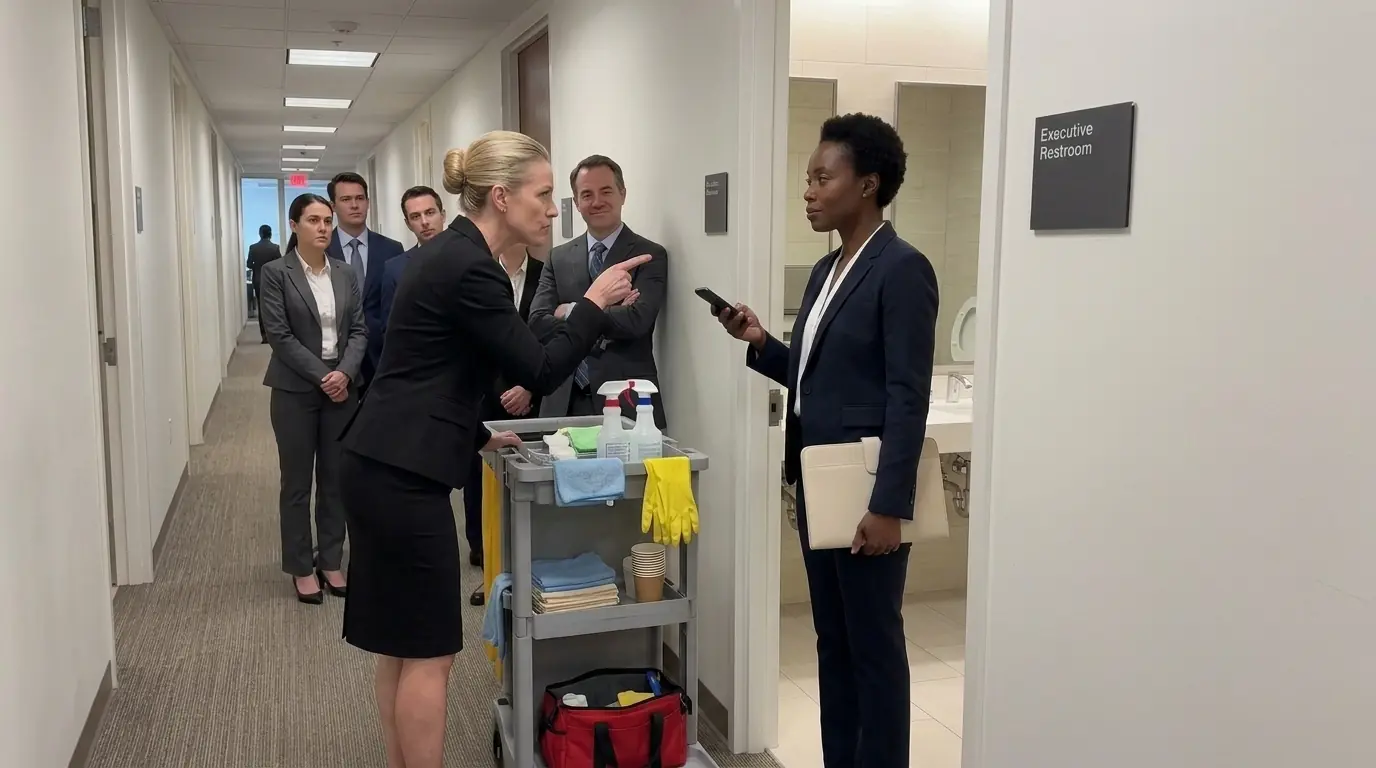
"Mark, it's Victoria. Push the board meeting to 4:00 p.m. I need to handle something personal first." She places her CEO access badge on the counter beside the cleaning supplies. But first, she decides to learn exactly what kind of company she just purchased.
Victoria Matthews steps confidently through the revolving doors of Pinnacle Solutions headquarters. At 45, her purposeful stride reflects decades of fighting for her place in the tech world. Her casual blazer and tailored slacks deliberately understated for this unannounced visit conceal the power she wields as the woman who just acquired the company. Her CEO badge remains tucked inside her leather portfolio. The lobby buzzes with activity.
Employees hurry past without noticing her, precisely as she planned. Victoria observes everything. The segregated lunch groups, the demographic patterns of who holds doors open for whom, who occupies which spaces. Her mental notes accumulate with each passing minute. Richard Keller stands at the security desk, arms crossed as he lectures a guard.
At fifty-two, the operations director carries himself with the entitled confidence of a man who's never questioned his place in the corporate hierarchy. He spots Victoria lingering near the directory. Another new hire for maintenance, Richard thinks, eyes narrowing. We just redid the contractor agreements last month. He notes her professional attire with suspicion.
Overdressed for janitorial, probably trying to impress on the first day. His mind immediately categorizes her. Outsider service staff problem to manage. The new CEO arrives today. He reminds himself.
Can't have unprofessional maintenance staff wandering around. Richard approaches Victoria with the practiced smile he reserves for those he considers beneath him. "You must be with the new cleaning service," he says, not bothering to introduce himself. ""The maintenance office is on sublevel two. You should have been directed there for proper orientation, not wandering the main floor." Victoria nods, playing along.
"Just getting familiar with the layout." "Well, that's not protocol," Richard replies, checking his watch impatiently. "We have standards here at Pinnacle." The building needs to be spotless today. The new CEO is coming, whoever they are.
He emphasizes the last words with visible disdain. As he leads her toward the service elevator, Richard unwittingly reveals company secrets. We've streamlined operations by cutting back on support staff expenses. Had to meet quarterly targets somehow. He chuckles.
Between us, these diversity mandates are killing efficiency, but that's how the game is played these days. Victoria listens, cataloging each revelation as evidence. "Here," Richard says, holding the service elevator open. Maintenance will get you sorted. And remember, everything needs to be perfect today.
Victoria notices a framed photo on Richard's desk of him golfing at the exclusive club that had rejected her application three times. The executive floor gleams with polished marble and glass. Victoria steps off the elevator, guided by Richard's dismissive directions to check in with HR about proper uniform protocols. Her eyes catalog everything. The outdated harassment reporting policies framed on the wall.
The homogeneous faces in the leadership photos, the subtle hierarchies evident in office layouts. Sandra Miller emerges from the corner office, designer heels clicking aggressively against marble. At forty-eight, the VP of human resources wears her authority like armor, her expression shifting to immediate disapproval when she spots Victoria. "Are you the new maintenance staff?" Sandra demands, not waiting for confirmation.
We've had serious issues with the cleaning on this floor. The executive bathrooms were completely unacceptable yesterday. Victoria keeps her expression neutral. "I'm just familiarizing myself with the building." Sandra sighed dramatically.
Well, standards have been dropping since they changed contractors. The executive floor requires attention to detail. Her tone carries the unmistakable weight of assumption. Some people just don't understand the level of excellence we maintain here. And Victoria discreetly opens her phone's notes app.
"What specific policies should new staff be aware of?" She asks. "That's not really your concern," Sandra dismisses. "Your supervisor should handle training. Just make sure everything is immaculate.
The new CEO arrives today. Any thoughts about the incoming CEO?" Victoria probes. Sandra's laugh is brittle. Let's hope it's someone who understands how we do things here, not another diversity hire.
The last thing we need is more disruption from people who don't fit our culture. Victoria's eyes drift to the HR violation posters outdated by three years. She moves toward the executive breakroom, noting how conversations halt when she enters. Employees cluster by demographic, whispers following her movement. Inside, Victoria calculates.
Each interaction reveals deeper systemic issues than anticipated. Her ninety-day transformation plan, already detailed in her portfolio, will need significant expansion. This isn't just about leadership transition. It's about dismantling entrenched bias infrastructure. The acquisition team had flagged potential cultural issues, but experiencing them firsthand sharpens her resolve.
Victoria has transformed toxic cultures before, but Pinnacle presents unique challenges and opportunities. She steps toward the coffee station documenting reactions as executives physically distance themselves from her presence. Victoria discovers a file folder left open with racial pay disparities and her name at top a document labeled acquisition containment strategy. The executive bathroom's pristine surface gleams under recessed lighting. Victoria examines the immaculate countertops, finding no evidence of the completely unacceptable conditions Sandra had described.
She pulls out her phone, documenting the contradiction. The door bursts open. Richard enters with three men in expensive suits, their conversation halting abruptly at the sight of her. "What are you doing in here?" Richard demands, voice sharp with performative authority. ""This is the executive restroom."" Victoria pockets her phone. ""Just checking the facilities."" Richard's face hardens.
Instead of loitering, perhaps you should be doing your job. He turns to the visitors with an apologetic smile. Good help is increasingly difficult to find. Some people need constant supervision to maintain basic standards. The clients shift uncomfortably.
One older man nods in agreement while a younger executive glances away, clearly uncomfortable, but remaining silent. "Gentlemen, excuse me a moment." Richard opens a supply closet, pulling out cleaning materials. He thrusts them into Victoria's hands, voice pitched to carry. "Since you're here, make yourself useful."
These facilities need proper attention before our meeting concludes. The brush and cleaning solution feel heavy in Victoria's hands. A deliberate humiliation performed for an audience. The toilet in the far stall needs particular attention, Richard continues, pointing. Make sure it's spotless this time.
The youngest client clears his throat. Perhaps we should continue our discussion in the lounge. Richard interrupts. She can work while we finish our conversation. The executive lounge is right through here.
We won't be disturbed. Victoria's face remains neutral as decades of experience managing microaggressions keeps her expression composed. Inside, methodical calculations continue. Each degradation adds another item to the growing list of documented offenses. She accepts the cleaning supplies with steady hands, moving toward the stall as Richard ushers his clients through to the adjacent lounge.
Their voices carry easily through the thin door. As I was saying about the post-acquisition strategy, Richard continues, "We've prepared contingencies for various leadership scenarios. If the new owner installs someone unsuitable, we have protocols to maintain operational continuity." Victoria activates her phone's voice recorder, placing it discreetly on the counter as she pretends to clean. The proposed staff reductions target redundant positions, Richard's voice continues.
Coincidentally, most fall within the diversity hire categories, allowing compliance with corporate mandates while streamlining operations. The youngest executive asks, "Won't that create potential liability issues?" HR has documentation justifying each termination, Richard assures him. Sandra's quite skilled at managing these transitions. Speaking of which, our retention statistics for minority employees.
Victoria scrubs the already clean toilet. Each movement fueling her resolve. The rage builds beneath her calm exterior, transforming into something more powerful. Strategic determination. As Victoria scrubs, her phone vibrates with a text.
Emergency at Pinnacle. Executives requesting urgent meeting with new CEO. Victoria slips into an empty conference room, locking the door behind her. For the first time since arriving, her carefully maintained facade cracks. She straightens to her full height, shoulders squaring as she sheds the submissive posture she's adopted all morning.
Her eyes flash with controlled fury. She places her phone on the polished table, dialing her attorney with practiced precision. James, Victoria Matthews., expedite the acquisition closure immediately. Her voice carries the quiet authority that built her reputation across three industries. And prepare for potential wrongful termination suits and discrimination complaints.
I need the full legal team on standby for immediate action. She paces the length of the window, looking out at the city skyline. "Yes, it's worse than anticipated." Document everything using the protocols we established for the Jensen merger. She pauses, listening.
No, I'm gathering evidence personally. You'll understand when you see it. Victoria ends the call immediately dialing again. "Mark, it's me." She exhales slowly.
The situation requires immediate intervention. Her executive assistant's voice rises in alarm as she outlines what she's experienced. "Ms. Matthews, that's completely unacceptable. Should I send security?"
"Not yet," Victoria interrupts. Have the team ready, but inconspicuous. Coordinate with Darius in HR to prepare the necessary documentation. I need every executive's personnel file and performance metrics for the past five years ready for the 4:00 p.m. Meeting.
Victoria's reflection in the window shows a woman who has navigated these waters before. 2five years building her empire taught her that bias reveals itself most honestly when people believe no one of consequence is watching. And Mark, have Pinnacle's cleaning staff contracts on my desk, particularly salary structures and demographic distribution. She ends the call, reviewing her notes and photographs. This isn't the first company culture she's had to transform.
Throughout her career, Victoria has faced similar prejudice. From being mistaken for a secretary at her first executive meeting to having investors direct questions to her male subordinates, each incident shaped her leadership philosophy. Systemic problems require systemic solutions. Individual punishment without structural change merely creates martyrs. Victoria scrolls through her photos of policy violations, segregated spaces, and documented discriminatory comments.
Her plan expands beyond addressing Richard and Sandra's behavior to reimagining the entire organizational structure. The maintenance staff, the people Richard and his team so casually disrespect, will become her first allies in the transformation. Their experiences provide the clearest window into the company's true culture. Victoria straightens her blazer, preparing to re-enter her role. The momentary display of emotion recedes, replaced by strategic resolve.
Companies are systems, and systems can be redesigned by those with the power and will to change them. Victoria discovers an email on a printer revealing the executive team's plan to contain and control the diversity hire. We need to maintain company culture during this transition. Richard's voice carries through the partially open door of conference room B. Victoria pauses in the adjacent copy room, listening.
The acquisition creates uncertainty, but our operational protocols must remain consistent. Twelve middle managers sit around the table, expressions ranging from enthusiastic agreement to uncomfortable silence. Richard stands at the head, commanding the room with practiced authority. I've heard concerning rumors about the new CEO, he continues, lowering his voice conspiratorially. Apparently, she's one of those diversity promotions.
Impressive resume on paper, but questionable real-world experience. Victoria activates her phone's recording function, positioning it discreetly. Our strategy is simple, Richard explains. Delay implementing any directives that conflict with established procedures. Document extensively.
Create bureaucratic obstacles when necessary. All communications filter through my office before reaching the executive floor. Sandra nods emphatically. From an HR perspective, I recommend formal compliance with any diversity initiatives while maintaining our actual hiring standards. Her air quotes around diversity initiatives elicit knowing chuckles.
We've successfully navigated these mandates before without compromising our culture. She distributes folders. These contain templates for documenting performance issues with new hires who don't align with our standards. The language is carefully constructed to protect the company from potential discrimination claims. Victoria photographs the documents through the gap in the door, sending images directly to her legal team with timestamps.
A younger manager raises his hand tentatively. Shouldn't we give the new leadership a chance? If the acquisition went through, they must have some. That's precisely the kind of naivety we need to address, Peterson. Richard interrupts sharply.
Corporate acquisitions are financial transactions, not merit-based promotions. Our responsibility is to protect operational integrity from inexperienced interference. Peterson shrinks in his seat as all eyes turn to him. Let me be perfectly clear, Richard continues. Anyone unable to maintain appropriate boundaries with the new management will find their future at Pinnacle Limited.
We've built something valuable here. We won't let it be dismantled by outside agendas. Victoria scans the room, identifying allies and obstacles. Four managers show visible discomfort. Eight actively support Richard's approach.
All twelve represent critical pressure points in the coming reorganization. Remember, Sandra adds, document everything. Create paper trails that support our narrative. If anyone questions your methods, direct them to HR. We know how to handle these situations.
Victoria captures each face, each nod, each uncomfortable glance, mapping the company's moral landscape with clinical precision. Victoria steps out to send the recordings, but Richard spots her near the door, his eyes narrowing with sudden suspicion. "You there, stop immediately." Richard's voice cuts through the hallway. Victoria turns slowly, maintaining her carefully constructed persona.
His footsteps quicken as he approaches, face flushed with sudden authority. "What exactly are you doing on this floor?" He demands. This is a restricted area. Victoria pockets her phone.
"Just finishing my rounds." "Your rounds?" Richard's voice rises. This section of the building requires security clearance. Where is your badge?
Who authorized your access? I was directed to clean the executive areas, Victoria replies calmly. "By whom? Show me your identification immediately." Richard's hand extends expectantly, fingers snapping with impatience.
This is a secure floor containing sensitive company information. If you cannot produce proper authorization, I'll have security remove you from the premises. The confrontation draws attention. Employees peer from offices, sensing the spectacle of power being exercised. Inside Richard's mind, alarm bells ring.
An unauthorized person near confidential meetings represents a security breach or worse, corporate espionage. The timing on acquisition day cannot be coincidental. His internal narrative constructs itself. This woman is either incompetent or dangerous, possibly an operative from a competing bid. "I'm calling security now."
He pulls out his phone. "Remain exactly where you are." Victoria studies his body language, the aggressive stance, the performative dominance, the need for public demonstration of authority. Each reaction reveals deeper insecurities beneath the corporate veneer. "Is there a problem here?"
A security guard approaches, responding to Richard's call. This person was found loitering outside restricted meeting rooms without proper identification, Richard explains. I want her credentials verified and her access revoked pending investigation. The guard, Marcus, according to his nameplate, glances at Victoria, a flicker of recognition crossing his face. He received the acquisition briefing that morning, including photographs of key personnel.
His eyes meet Victoria's briefly. She offers the slightest nod. "Yes, sir. I'll handle this immediately," Marcus responds professionally. "Ma'am, I'll need you to come with me."
Richard steps closer, lowering his voice to a performative whisper still intended to be heard. Check her belongings for recording devices or documents and pull the visitor logs. Find out who authorized her access to this floor. As Marcus guides Victoria toward the elevator, Richard calls after them and tell maintenance to revoke all temporary contractor badges immediately. We have security concerns about the cleaning crew.
His eyes narrow at Victoria. Some people don't understand their proper place in an organization. Marcus maintains his professional demeanor until they reach the elevator. Once inside, he speaks quietly. "Ms.
Matthews, I apologize for that display." Security was briefed on your arrival this morning. "Thank you, Marcus. You handled that perfectly," Victoria responds. I'd like to continue my observations.
Can you escort me to a less conspicuous location? Of course. Would you like me to intervene more directly? Not yet. I'm still gathering information.
Victoria whispers instructions to Marcus about retrieving her CEO badge. Waiting at reception, deliberately left there since morning. The service corridor hums with nervous energy. A group of maintenance staff, predominantly people of color, gather near the time clock, faces tight with worry. Security personnel check badges against a clipboard, pulling credentials from several workers.
Victoria, now with her executive badge secured but hidden in her pocket, approaches the scene. Marcus remains at a discrete distance monitoring the situation. "What's happening?" She asks a woman in a maintenance uniform. "New security protocol," the woman responds, voice low.
"They're revoking access for half the cleaning crew, effective immediately, no explanation given." Victoria observes the pattern. Younger workers and people of color targeted for credential checks, while others pass through with cursory glances. "Has this happened before?" Victoria asks.
The maintenance worker, Elena, according to her badge, hesitates before responding. Whenever management gets uncomfortable, we feel it first. Last quarter, they cut our hours after we raised concerns about chemical exposure. Six people who complained were reassigned to night shift or terminated for performance issues. Victoria pulls out her phone.
"Would you mind sharing more about your experiences here? It stays confidential." Elena's surprise at being asked. Her opinion quickly turns to measured relief. Others join the conversation, documenting systematic patterns.
They track our bathroom breaks, but not the office staffs. Three of us were passed over for supervisor twice. They hired externally both times. HR called my natural hair unprofessional during my performance review. Victoria records each testimony with timestamp and name, building her case methodically.
The maintenance staff, initially hesitant, speak more freely as Victoria asks specific, knowledgeable questions about workplace conditions. In her mind, Victoria revises her strategy. The transformation must begin from the ground up, not merely the executive suite. These employees, systematically devalued yet essential to operations, will become central to the restructuring. A commotion interrupts.
Richard approaches with Sandra from HR and two security guards flanking them. His face darkens, seeing Victoria still on premises. I thought I made myself clear, he announces loudly. Unauthorized personnel are to be removed immediately. He gestures toward the maintenance staff.
And why are these people congregating instead of working? This is exactly the kind of operational breakdown I was addressing. Sir, Marcus begins. I was just This woman has been disrupting operations all morning, Richard interrupts, pointing at Victoria. She was caught outside secure areas without authorization and now she's interfering with essential personnel.
Sandra steps forward, notebook in hand. I'll document this incident for HR records. What's your employee number? She asks Victoria with practiced bureaucratic authority. The maintenance staff retreat, familiar with the patterns of power.
Elena catches Victoria's eye briefly, a silent acknowledgement before disappearing down the corridor. You're trespassing on private property, Richard continues, voice rising. Security will escort you out and your contracting company will be notified of this breach of protocol. Richard demands Victoria surrender her unauthorized badge just as the elevator doors open and her executive team arrives. "Hand over that badge immediately."
Richard extends his hand, fingers grasping toward Victoria's collar. Whatever false credentials you're using, end now. The elevator doors slide open with perfect theatrical timing. Five individuals step out. Three women, two men, impeccably dressed in business attire that makes Richard's department store suit look suddenly inadequate.
They move with synchronized purpose. The unmistakable presence of executive power. Victoria allows the slightest smile to cross her face as she reaches into her pocket. The badge emerges between her fingers, turning slowly to reveal the embossed Pinnacle Solutions logo, the executive clearance stripe, and beneath her professional headshot the words Victoria Matthews, chief executive officer. "My credentials appear to be in order, Mr.
Keller," she says, voice calm, but carrying to every corner of the suddenly silent hallway. Richard freezes mid-reach, hand suspended in air. His face performs a complex journey. Confusion to disbelief to dawning horror. Blood drains visibly from his features as memories cascade through his consciousness.
The toilet brush thrust into her hands. The contemptuous dismissals. The strategy session she might have overheard. The systemic discrimination she just witnessed. "There's been a misunderstanding," he stammers, hand dropping to his side.
"That much is clear," Victoria agrees, turning toward her team. Allow me to introduce Darius Washington, chief of human resources, Maya Chen, legal counsel, Jonathan Pierce, operations director, Sarah Okafor, chief financial officer, and Marcus, whom you've met, heads our corporate security division. Marcus straightens, professional demeanor, now carrying new authority. Sandra clutches her HR notebook against her chest like a shield, eyes darting between faces as she mentally calculates her exposure. Mr.
Keller, Victoria continues, you expressed concerns about the cleaning staff. As CEO, I'm very interested in your explanation for ordering the removal of essential workers without proper authorization or due process. Richard's recovery attempt emerges as desperate damage control. It was a routine security protocol, nothing more. "If I'd known who you were—" "That's precisely the problem."
Victoria interrupts, voice level, but firm. Your behavior changes based on perceived status rather than treating all employees with fundamental respect. Sandra steps forward, professional smile plastered across her face. Ms. Matthews, welcome to Pinnacle.
This unfortunate incident doesn't reflect our company values. We were simply following established security procedures during the transition period. Maya Chen opens her leather portfolio. Interesting. Our review of company policy found no such procedures documented.
Perhaps you could direct us to the relevant materials. Sandra's smile falters. Victoria addresses the assembled maintenance staff who watch from a cautious distance. Please return to your regular duties. Your access credentials remain valid.
My office will address any scheduling disruptions caused by today's events. She turns to the wider audience of employees now gathering at the commotion. I'll be holding an all hands meeting in 30 minutes. Conference room A is being prepared now. Her executive team moves with practiced efficiency.
Jonathan immediately begins speaking with maintenance supervisors. Darius approaches employees with reassuring professionalism. Maya documents the scene with clinical precision. Richard and Sandra stand frozen as their power visibly transfers to the new hierarchy. Victoria steps toward the executive suite, then pauses beside Richard.
Mr. Keller, I believe you mentioned the executive bathrooms needed attention. I found them surprisingly clean during my personal inspection. She meets his eyes directly. Perhaps your standards require recalibration.
The assembled employees witness the exchange in stunned silence, recalibrating their own understanding of power within Pinnacle's walls. Victoria opens her laptop at the conference room table, revealing her screen wallpaper, herself at Pinnacle's founding thirty years earlier. Conference room. A transforms into the epicenter of seismic corporate change. Employees file in, whispering among themselves as Victoria's team efficiently arranges the space.
Executives cluster near the door, faces tense with uncertainty. Middle managers like Peterson position themselves strategically, close enough to demonstrate allegiance to whoever emerges victorious, far enough to deny culpability if needed. Richard and Sandra enter last, having hastily assembled whatever defense they could construct in 30 minutes. Their earlier confidence has evaporated, replaced by the brittle professionalism of the cornered. Victoria stands at the head of the conference table, her executive team arrayed beside her.
The room falls silent as she surveys the assembled employees from senior executives to maintenance staff invited specifically at her request. "Good afternoon," she begins, voice measured but carrying to every corner. "I'm Victoria Matthews, CEO of Pinnacle Solutions, following the acquisition by Matthews Innovation Group." Today was intended as an observational visit before my formal introduction tomorrow. She activates the presentation screen, displaying a simple organization chart.
Instead, it became an unintended case study in systemic organizational dysfunction. Victoria's tone remains factual, not accusatory. What I witnessed today wasn't isolated unprofessional behavior, but symptoms of entrenched cultural problems that undermine this company's potential. Richard clears his throat. Ms.
Matthews, if I may. "You'll have your opportunity to speak, Mr. Keller," Victoria interrupts smoothly. As will everyone in this room. Authentic transformation requires all voices.
She advances the slide to display anonymized salary data. This morning, I observed significant discrepancies in how employees are valued, both financially and culturally. These disparities follow concerning patterns. The data visualization highlights clear demographic trends in compensation, promotion rates, and termination statistics. Several executives shift uncomfortably in their seats.
Pinnacle has systemic issues requiring immediate intervention, Victoria continues. Therefore, I'm implementing the following changes effective immediately. She outlines her plan with methodical precision. First, we establish a zero tolerance policy for discrimination in any form. This isn't aspirational corporate language, but a fundamental operating principle with clear enforcement mechanisms.
Maya distributes digital tablets to department heads containing detailed policy documentation. Second, we implement an anonymous reporting system with direct access to external oversight. Reports bypass traditional management hierarchies to prevent suppression of concerns. Darius activates the system on the presentation screen demonstrating the secure third-party validated platform. Third, we commission an external audit of all HR practices, compensation structures, and promotion pathways conducted by independent specialists in workplace equity.
Sandra attempts to interject, but falls silent under Victoria's measured gaze. Fourth, we launch an immediate review of all terminations and denied promotions from the past five years with remediation for identified cases of discrimination. Throughout the presentation, Victoria maintains professional composure, never vindictive, always focused on structural reform rather than personal retribution. Richard finally manages to interrupt, standing abruptly. With all due respect, Ms.
Matthews, these sweeping changes circumvent established protocols. The board requires consultation on policy shifts of this magnitude. Victoria turns to him calmly. Mr. Keller, perhaps you're unfamiliar with acquisition terms.
The board ratified these provisions last week as conditions of the merger. She displays the signed authorization documents on screen. Furthermore, company bylaw section 4.7 explicitly grants the CEO authority to implement workplace safety measures without prior consultation when existing practices create hostile environments. Richard's attempted power play collapses against her comprehensive knowledge of the organization he thought he controlled. Victoria continues, "The maintenance staff you attempted to remove today have been invited back with formal apologies and compensation for the disruption."
She transitions to personnel announcements. Effective immediately, Richard Keller and Sandra Miller are placed on paid administrative leave pending investigation of documented policy violations. Security personnel materialize beside them, professionally, requesting they surrender company devices and credentials. "This isn't personal," Victoria adds. "It's structural accountability."
As Richard is escorted out, desperation overtakes his professional veneer. "You can't do this." The management team won't stand for this kind of radical overhaul. Victoria continues undeterred, outlining further changes. We're eliminating arbitrary hierarchies that enable abuse of power.
New promotion criteria will emphasize demonstrated skill and leadership capacity rather than conformity to unstated cultural expectations. She introduces diversity initiatives with specific accountability metrics and transparent reporting requirements. Transformation isn't achieved through punitive measures alone. Victoria emphasizes, "We are creating pathways for growth and reconciliation." She calls forward the maintenance supervisor.
Elena Rodriguez will join our executive committee as director of workplace environment, ensuring operational decisions consider impacts across all employee levels. Elena steps forward, surprise evident on her face, as Victoria hands her an official appointment letter. As Richard and Sandra are escorted to clear their offices under security supervision, Victoria convenes a smaller meeting with employees who showed discomfort with the discriminatory practices, including Peterson, the manager, who questioned Richard's approach. "I need change agents at every level," she tells them. People committed to building a more equitable workplace.
Your discomfort with the status quo suggests you may be those people. Peterson speaks up more confident now. Many of us wanted change but felt powerless against entrenched leadership. "That power dynamic ends today," Victoria responds. You'll form our initial transformation task force, empowered to implement these changes effectively.
The team disperses with clear assignments and unprecedented authority to reshape the organization from within. As Richard exits, he shouts that former board members would never allow this radical takeover, unaware they're already on Victoria's phone. Three days later, the executive conference room serves a different purpose. The polished table now holds legal documents instead of catered lunches. Richard sits alone on one side, his attorney beside him looking increasingly concerned.
Victoria occupies the opposite chair flanked by Maya Chen and an external counsel specializing in workplace discrimination. The formal hearing proceeds with methodical precision, not a vindictive tribunal, but a professional accounting of documented violations. For the record, Maya begins, "This proceeding addresses specific policy violations by Richard Keller during his tenure as operations director at Pinnacle Solutions. All evidence has been properly documented and verified by independent third parties. Victoria observes Richard, his confident facade now cracked, revealing the uncertainty beneath.
His expensive suit appears slightly rumpled as though he dressed hurriedly after a restless night. "We'll proceed chronologically," Maya continues, activating the presentation screen. Beginning with documented incidents from your first interaction with CEO Matthews on acquisition day. The timeline appears meticulously constructed with timestamps, witness statements, and supporting evidence. Audio recordings play Richard's own voice making explicitly discriminatory statements.
"Would you like to address these comments, Mr. Keller?" Victoria asks, her tone professional rather than accusatory. Richard straightens his tie. Isolated statements taken out of context during a period of organizational transition.
"My twenty-year record at Pinnacle demonstrates consistent leadership excellence." "Let's examine that record," Maya responds, advancing to the next exhibit. Inside Richard's mind, a dawning realization takes hold. The casual discrimination he considered normal business practice now appears as a systematic pattern of legally actionable behavior. Each defense he constructed crumbles against the weight of documented evidence.
"These were standard industry practices," he attempts. Every organization has unwritten protocols for maintaining operational stability during leadership transitions. Interesting perspective, Victoria notes. Perhaps you could explain how these standard practices align with federal employment law. Richard's attorney whispers urgently in his ear.
The evidence mounts. Emails directing subordinates to create performance issues for targeted employees. Documented patterns of discriminatory task assignments. Promotion denials based on subjective cultural fit assessments that consistently disadvantaged minority candidates. Former allies testify via video conference, hastily distancing themselves from policies they previously supported.
I was simply following Richard's directives, Sandra explains from her own separate hearing. As operations director, he established departmental protocols that HR was expected to implement. Richard watches in disbelief as longtime colleagues reposition themselves, sacrificing him to preserve their own careers. Ms. Rodriguez was denied promotion three times despite outperforming all other candidates.
Maya continues, displaying performance metrics. Your own assessments acknowledge her superior qualifications while citing nebulous leadership concerns as justification for rejection. Leadership qualities are necessarily subjective, Richard argues. Desperation entering his voice. I made judgment calls based on years of industry experience.
These judgment calls display statistically significant bias patterns, Victoria observes, sliding forward a data analysis performed by external auditors. The mathematical probability of these outcomes occurring without systematic bias is less than 0.02 percent. Throughout the proceedings, Victoria maintains professional detachment. Despite the humiliation she personally experienced, her focus remains on systematic accountability rather than personal retribution. The hearing concludes with formal findings.
Maya delivers the verdict. Based on comprehensive review of documented evidence, Richard Keller's employment with Pinnacle Solutions is terminated for cause, effective immediately. Severance benefits and unvested stock options are forfeited under section 7 of the employment agreement addressing ethical violations. The company reserves the right to pursue additional civil remedies pending legal review. Richard stands finally abandoning pretense.
"This entire process is a witch hunt." You came looking for problems to justify your diversity agenda. "Mr. Keller," Victoria responds calmly, "I didn't create the problems. I merely documented what already existed.
The difference is that now there are consequences." As Richard leaves for the final time, construction crews remove Pinnacle's old logo. The transformation already underway. Six months transformed Pinnacle Solutions beyond recognition. The building remains, but everything within its walls operates by new principles.
The executive floor no longer houses corner offices. Instead, an open collaborative space intermingles leadership with all departments. Victoria's desk sits among others. Her authority derived from respect rather than architectural separation. Elena Rodriguez, former maintenance supervisor, now director of workplace environment, leads a morning briefing.
Her presentation displays impressive metrics. Productivity increased 23 percent. Employee retention improved 31 percent and applications from traditionally underrepresented candidates tripled. "Our transparent promotion pathway has fundamentally changed how talent advances," Elena explains to visiting industry executives touring the transformed company. "Objective skill assessment has replaced subjective culture fit evaluations.
Victoria observes from the periphery, allowing Elena's leadership to stand on its own merit. The transformation extends far beyond personnel changes. It's a fundamental reimagining of corporate structure. The maintenance department operates with new dignity. Staff now participate in operational planning.
Their practical expertise valued rather than dismissed. Their breakroom, once a neglected basement space, now matches executive amenities. Peterson, the once timid manager who questioned Richard, now heads the culture transformation team. His team monitors implementation of the new systems, ensuring principles translate into daily practice. Industry publications feature cover stories on the Pinnacle revolution.
Business analysts initially skeptical of Victoria's approach now cite her methods as case studies in ethical leadership and sustainable growth. Quarterly profits have increased, challenging traditional assumptions about the costs of equity initiatives. Meanwhile, Richard Keller's professional decline continues. Security footage escorts him from his fourth unsuccessful interview in as many months. Former colleagues avoid association, unwilling to risk connection with his tarnished reputation.
His references mentioned the pinnacle incident. One hiring manager whispers to another. Can't risk bringing that liability into our organization. Victoria establishes the Matthews Foundation, providing scholarships and mentorship programs for underrepresented groups entering technical fields. The initiative extends beyond philanthropy to address systemic industry barriers.
The transformation methodology Victoria applied at Pinnacle becomes a blueprint. Companies facing similar challenges seek her guidance. Some embrace change proactively, recognizing its competitive advantages. Others resist until market forces, particularly talent acquisition challenges, compel adaptation. The choice is simple, Victoria explains at an industry leadership summit.
Build equitable systems proactively or watch your competitive advantage disappear as talent flows to organizations where everyone can contribute fully. Competitors who once dismissed her approach as social engineering now implement similar reforms rebranded as strategic talent optimization or operational inclusivity. The ripple effects extend beyond corporate structures to regulatory frameworks. Legislators cite Pinnacle's transformation when proposing new workplace protection standards. Industry associations develop certification programs based on Victoria's accountability metrics.
What began as one CEO's response to personal humiliation evolves into a movement redefining the relationship between business success and equitable practice. At an industry conference, Victoria spots a young woman experiencing familiar discrimination and moves to intervene in a way that will change everything. One year transforms Pinnacle Solutions from cautionary tale to industry benchmark. The company logo, once a sharp-edged pyramid symbolizing rigid hierarchy, has been re-imagined as an interconnected lattice representing strength through ethical collaboration. Victoria walks the executive floor, now indistinguishable from other departments except for function.
Employees greet her by name, not with the nervous deference of subordinates, but the authentic respect earned through consistent ethical leadership. The executive team gathered for quarterly planning reflects the demographic diversity of both the company and its customer base. Decisions emerge from substantive dialogue rather than conformity to the highest ranking voice in the room. Our client satisfaction metrics have reached record levels, reports the new sales director, displaying analytics on the conference room screen. Particularly noteworthy is the 47 percent increase in contract renewals from previously underserved markets.
Victoria nods unsurprised. When our internal culture reflects the diversity of our clients, we naturally develop more relevant solutions. She mentors promising employees from traditionally marginalized groups, providing the guidance she never received during her early career. These sessions focus not on assimilation, but on maintaining authentic leadership voices within systems still undergoing transformation. The goal isn't to succeed despite who you are, she tells a young black software engineer.
It's to succeed because of your unique perspective and the innovation it generates. Victoria visits the executive bathroom, the site of her deliberate humiliation one year earlier. The space has been renovated, not with luxury fixtures, but with thoughtful design accommodating diverse needs. A young employee enters, recognizes Victoria, and offers a genuine greeting without the performative difference that once characterized such interactions. The conversation that follows is brief but significant, focused on substantive work rather than power dynamics.
The employee speaks freely, offering perspectives Victoria hadn't considered. This, more than any policy change, represents the culture she envisioned. Richard Keller becomes a case study in MBA ethics courses, not through Victoria's doing, but through his own documented actions. His attempts to reframe his termination as cancel culture gained brief traction in certain circles before comprehensive evidence rendered the narrative unsustainable. Industry impact extends beyond Pinnacle's walls.
Companies previously resistant to change find themselves unable to compete for top talent without implementing similar reforms. What began as ethical imperatives transform into competitive necessities. Victoria delivers the keynote at the National Business Leadership Conference introduced by Elena Rodriguez, now Pinnacle's chief operating officer. The data is unequivocal. Victoria addresses the packed auditorium.
Companies with equitable systems consistently outperform those that maintain discriminatory practices in innovation, market responsiveness, and financial outcomes. She displays comparative metrics across industries. This isn't social engineering. It's sound business strategy. When organizations waste human potential through discrimination, they sabotage their own success.
The standing ovation that follows signals a tipping point. Not universal acceptance, but sufficient momentum to sustain change beyond individual champions. Later, Victoria sits alone in her office reviewing Pinnacle's transformation journey. The victory isn't in punishing those who discriminated, but in creating systems where such behavior no longer thrives. True power isn't in a title. It's in the courage to transform systems that no longer serve humanity.
Tags:
News in the same category
CHAPTER 2: WHEN THE FBI ENDED THE COVER-UP

The HOA President Sent Fake Officers to Arrest Him — Then She Made One Fatal Demand
CHAPTER 2: THE NINETY-TWO-SECOND TRAP
CHAPTER 3: THE EMPIRE THAT FELL ON CAMERA

The HOA President Crushed His Trash Can — So He Promised Her a Lesson
CHAPTER 2: WHEN PHYSICS FOUGHT BACK
CHAPTER 3: THE FALL OF THE HOA QUEEN

The Police Sergeant Tore Up Her Federal Warrant… Ten Seconds Later, U.S. Marshals Locked Down the Entire Station

Officer Brutally Attacks Black Man at Station — Turns Pale Hearing “I’m the New Chief”

Five Frozen Bikers Knocked on Her Door — One of Them Was Bleeding

The Waitress Ruined My Proposal Dinner… Then She Showed Everyone the Identical Ring Around Her Neck

A Police Cruiser Knocked Him Down — Then the Officers Arrested Him
I Found My Husband in a Hotel Room With My Best Friend… Then a Little Boy Called Him “Daddy”

Dirty Officer Robbed Drivers for Years Went Pale When Woman Showed FBI Badge

"Three Minutes. $500." The Young MMA Fighter Smirked at the Old Farmer — Then the Crowd Went Silent
A Cocky Boxer Dared an Old Janitor to Dodge One Punch — Biggest Mistake of His Life
A Millionaire Challenged a Black Waitress With a $100K Bet — Her Reply Changed Everything

A Cocky Boxer Mocked an Old Janitor and Offered One Free Punch — Then Nobody Was Laughing
News Post
The Officer Smashed His Window — But the Quiet Driver Never Fought Back
CHAPTER 2: WHEN THE FBI ENDED THE COVER-UP
The HOA President Sent Fake Officers to Arrest Him — Then She Made One Fatal Demand
CHAPTER 2: THE NINETY-TWO-SECOND TRAP
CHAPTER 3: THE EMPIRE THAT FELL ON CAMERA
The HOA President Crushed His Trash Can — So He Promised Her a Lesson
CHAPTER 2: WHEN PHYSICS FOUGHT BACK
CHAPTER 3: THE FALL OF THE HOA QUEEN
The Police Sergeant Tore Up Her Federal Warrant… Ten Seconds Later, U.S. Marshals Locked Down the Entire Station
Officer Brutally Attacks Black Man at Station — Turns Pale Hearing “I’m the New Chief”
Five Frozen Bikers Knocked on Her Door — One of Them Was Bleeding
The Waitress Ruined My Proposal Dinner… Then She Showed Everyone the Identical Ring Around Her Neck
A Police Cruiser Knocked Him Down — Then the Officers Arrested Him
I Found My Husband in a Hotel Room With My Best Friend… Then a Little Boy Called Him “Daddy”
Dirty Officer Robbed Drivers for Years Went Pale When Woman Showed FBI Badge
"Three Minutes. $500." The Young MMA Fighter Smirked at the Old Farmer — Then the Crowd Went Silent
A Cocky Boxer Dared an Old Janitor to Dodge One Punch — Biggest Mistake of His Life
A Millionaire Challenged a Black Waitress With a $100K Bet — Her Reply Changed Everything