Buddy’s Recovery After Waiting on the Porch for His Owner
Reader Theme:
Font Size:
24px
Buddy’s Recovery After Waiting on the Porch for His Owner
PART 2 — CURRENT CONDITION UPDATE
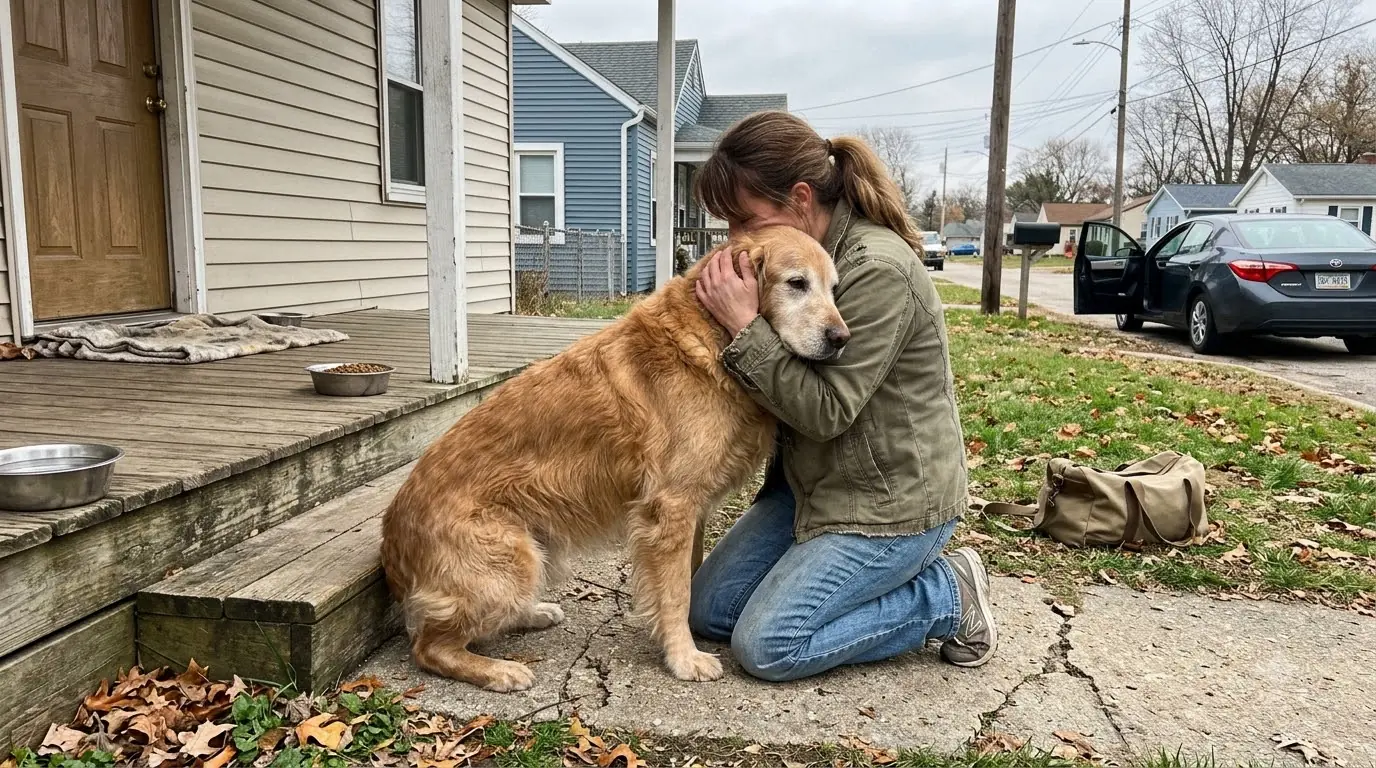
Buddy is now staying with his owner’s daughter while his owner receives extended medical care. He is safe, sleeping indoors, and eating more consistently, but his physical and emotional recovery has been gradual.
His first veterinary examination showed moderate dehydration. Buddy had access to water while he waited at the house, but neighbors could not confirm how much he drank. Stress, warm weather, and his refusal to eat likely contributed to his condition.
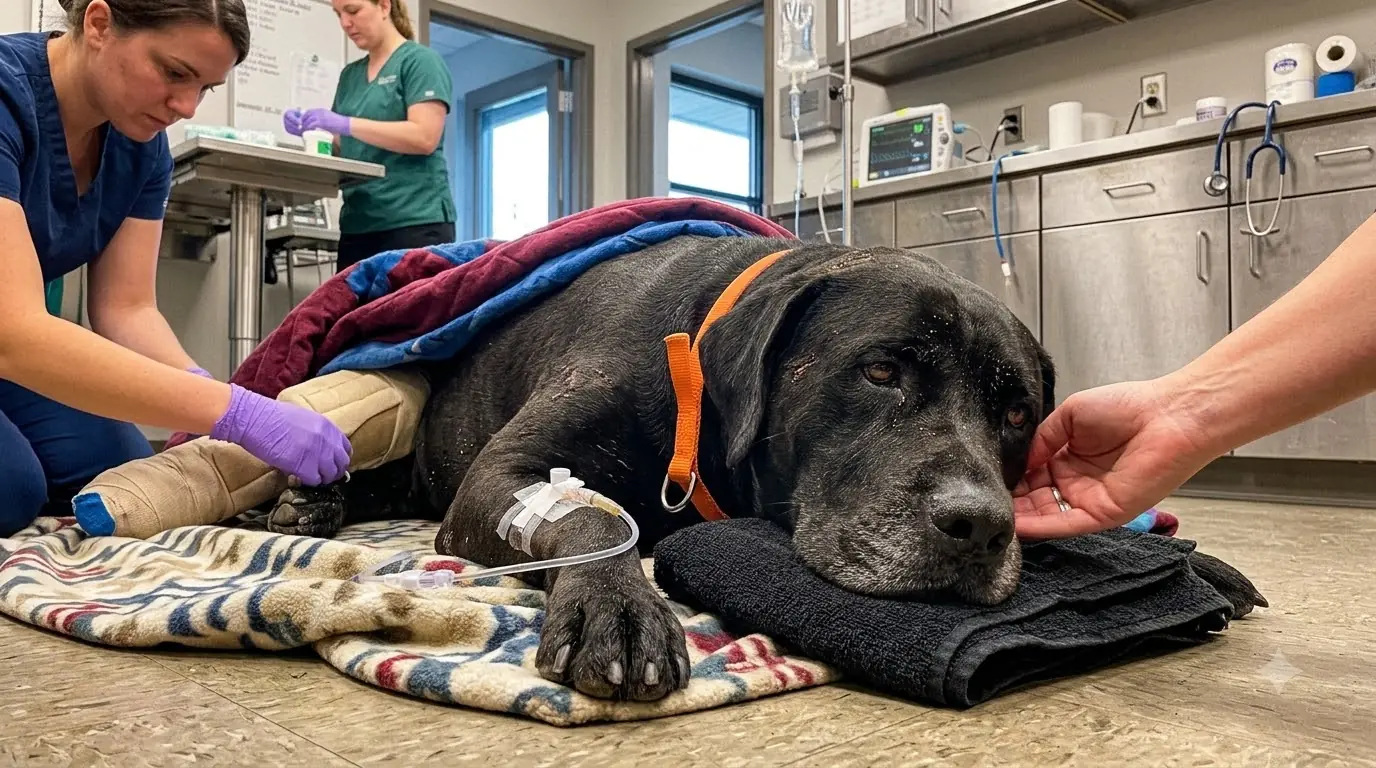
He received carefully measured fluids and was monitored for several hours. Because of the irregular heartbeat detected during the examination, the veterinary team avoided correcting his dehydration too aggressively.
Buddy responded well. His gums became less dry, his eyes appeared brighter, and he began drinking voluntarily from a bowl placed near his bed.
The irregular heartbeat was investigated with an electrocardiogram. The test detected occasional premature beats but no sustained, immediately life-threatening rhythm. Chest X-rays showed mild age-related enlargement of the heart without fluid in or around his lungs.
An echocardiogram revealed an early degenerative change affecting one heart valve. The valve is not closing as tightly as it once did, allowing a small amount of blood to move backward with each heartbeat.
Buddy is not in congestive heart failure and does not currently need medication to remove fluid. His cardiologist recommends regular monitoring and a repeat examination if he begins coughing, breathing rapidly at rest, fainting, or tiring much faster than usual.
His resting respiratory rate is now counted several times each week while he sleeps. The number has remained stable, and he breathes comfortably through the night.
The kidney changes required additional testing. Buddy’s initial bloodwork showed mildly elevated values, but dehydration can temporarily make those numbers appear worse. The veterinarian repeated the panel after several days of consistent fluids and meals.
The values improved but did not return completely to the normal range. A urine test also showed that Buddy’s urine was less concentrated than expected. Together, these findings suggest early chronic kidney disease rather than kidney failure caused solely by dehydration.
The condition appears to be in an early stage. Buddy is producing urine normally, has no persistent vomiting, and maintains a good appetite most days. Ultrasound showed mild age-related changes in both kidneys but no obstruction, large mass, or active bleeding.
His care plan focuses on preserving kidney function and identifying changes early. Fresh water is available in several rooms, and no one restricts how much he drinks.
A veterinary kidney-supportive diet is being introduced gradually. Buddy initially refused it when served alone, so his daughter mixed a small amount with the food he already recognized. The proportion was increased over more than a week.
He now eats two measured meals each day. Warm water is added to improve hydration and make the food more aromatic. Most mornings, he finishes the bowl without encouragement.
His appetite remains sensitive to emotional stress. If a car stops outside or someone enters carrying items from his former home, Buddy may leave the bowl and walk toward the front door.
His daughter does not force him to return immediately. The food is offered again once he settles, and he usually finishes it later.
Buddy lost several pounds during the week he spent waiting and may have already been slightly underweight before the ambulance arrived. His ribs could be felt too easily beneath his golden coat, and there was visible muscle loss around his hindquarters.
He has regained some weight, but the veterinary team wants the increase to remain slow. The goal is to rebuild muscle without placing unnecessary pressure on his arthritic joints or kidneys.
His blood pressure was slightly elevated during the first clinic visit. Stress may have influenced the reading, so several measurements were taken on different days while he rested beside his daughter.
The later readings were closer to normal. Medication is not required at present, but his blood pressure will continue to be checked because kidney and heart disease can both affect it.
Buddy’s hips are affected by moderate arthritis. X-rays showed chronic changes in both hip joints and along part of his lower spine. There was no fracture or recent traumatic injury.
He had likely been compensating for discomfort for some time. His daughter remembered that he had started hesitating at the porch steps months earlier, although he still followed his owner from room to room.
Pain medication was selected carefully because some common anti-inflammatory drugs require additional caution in dogs with kidney disease. Buddy receives a kidney-conscious pain-management plan, along with a veterinarian-approved joint supplement.
Nonslip rugs now cover the smooth floors of his daughter’s home. A ramp allows him to enter the yard without using steep steps, and his orthopedic bed is low enough for him to walk onto without climbing.
During his first days there, Buddy refused the bed and slept beside the front door. His daughter placed a folded blanket from the old house near him and left the new bed several feet away.
On the fourth night, Buddy rested his front half on the bed while keeping his back legs on the floor. Two nights later, he climbed fully onto it and slept there until morning.
Buddy still rises slowly, but he no longer needs several attempts to stand. His walks are short and take place on level ground. His daughter allows him to choose the pace and turns back before he becomes sore.
At first, he stopped beside every parked car. He smelled the doors and looked through the windows before continuing. That behavior has become less frequent, though he remains attentive whenever a vehicle resembles the one his owner used.
A rehabilitation specialist introduced gentle exercises to preserve strength. Buddy practices slow weight shifts, controlled turns, and several careful sit-to-stand movements on a nonslip surface.
The sessions last only a few minutes. His daughter ends them before his legs begin trembling. Buddy receives praise and one small piece of his measured food afterward.
His mobility has improved enough for him to walk to the end of the block and return without limping. On cooler mornings, he spends several minutes smelling the grass before choosing to go home.
Buddy’s coat was dusty and tangled when he left the porch. Several small mats had formed behind his ears and legs, but there were no severe wounds or parasites.
His daughter groomed him in short sessions rather than trying to remove everything at once. Buddy initially became restless whenever she moved away to put down the brush.
He now lies on his side while she works through a small section of fur. His coat has regained much of its softness and shine.
Dental examination revealed moderate tartar and gum inflammation. No urgent abscess was found, and Buddy continues to chew comfortably. A dental cleaning may be scheduled once his heart and kidney monitoring plan is fully established.
Emotionally, Buddy remains focused on the person who is missing. His behavior has not been interpreted as stubbornness or disobedience. For almost nine years, his daily life revolved around following the same person through a familiar home.
That person disappeared during a confusing emergency. Buddy had no way to understand why the ambulance came or where it went. Waiting on the porch was the only action that made sense within the routine he knew.
In his daughter’s home, Buddy initially sat beside the largest front window for hours. Every engine sound caused him to stand. If a vehicle slowed, his tail moved before he could see who was inside.
When the car continued past, Buddy lowered himself to the floor. He rarely vocalized. His disappointment appeared in the quiet repetition of standing and lying down.
His daughter began creating a new daily routine without trying to erase the old one. Breakfast arrives at the same time each morning. Walks follow the same route. Medication is given from the same place in the kitchen.
A familiar blanket, one of his owner’s shirts, and Buddy’s old water bowl were brought from the house. The items were not washed immediately because their familiar scent appeared to help him settle.
Buddy slept with his head on the shirt during his first week. He now uses it less often but returns to it when thunderstorms or unfamiliar visitors make him anxious.
Short departures were difficult at first. If his daughter picked up her keys, Buddy stood directly in front of the door and attempted to follow.
She began practicing ordinary movements without leaving. She picked up the keys, walked into another room, returned, and sat down. Once Buddy stopped reacting strongly, she began stepping outside for several seconds.
The absences increased gradually. Buddy can now remain inside while his daughter checks the mail or speaks with a neighbor. He watches the door but does not always rise.
Long periods alone are still avoided. A trusted family friend stays with Buddy when his daughter must be away for more than a short time.
Buddy recognizes this person and accepts food from her, though he waits near the window until his daughter returns. His greetings have become calmer as he learns that departures are temporary.
Several small signs show that he is engaging with his new life. He recently carried a soft toy from the living room to the kitchen and placed it beside his daughter’s chair.
He has started waiting near the refrigerator when she prepares breakfast. In the evening, he follows her to the bedroom rather than remaining beside the front door throughout the night.
One afternoon, Buddy fell asleep with his back facing the road. It was the first time his daughter had seen him fully relax without keeping the entrance in view.
His owner remains in a rehabilitation facility and is not yet able to return home. Once the medical team permitted a controlled visit, Buddy’s daughter brought him there.
The trip was planned carefully. Buddy’s heart condition, arthritis, and anxiety meant the reunion needed to remain calm. His daughter walked him briefly before entering and kept him on a secure harness.
When Buddy heard his owner’s voice, he stopped in the hallway. His ears lifted, and his entire body became still.
He moved forward slowly rather than pulling. Once he reached the chair, he pressed his head beneath his owner’s hand and remained there.
His tail moved continuously against the floor, but he did not jump. His owner stroked the gray fur around his face and spoke to him quietly.
The visit lasted only a short time so neither Buddy nor his owner became exhausted. When it was time to leave, Buddy looked back several times but followed the daughter to the car.
That evening, he ate his full meal and slept on his bed instead of beside the front door. The reunion did not resolve every part of his anxiety, but it may have helped connect the disappearance with a person who was still present.
Future visits will depend on both medical teams. Buddy cannot enter during outbreaks of infectious illness, and his owner may not always have enough strength for company.
His daughter avoids promising a visit until it is confirmed. Predictability is important, and repeated cancellations could increase Buddy’s restlessness.
The long-term living arrangement remains uncertain. His owner’s recovery may prevent an immediate return to the former home. Buddy will continue staying with the daughter for as long as necessary.
If the owner eventually becomes able to care for him again, the family and medical team will decide what arrangement is safest for both of them. That decision will consider Buddy’s medication, mobility, kidney monitoring, and need for reliable daily support.
For now, his daughter manages every veterinary appointment. Buddy will have repeat bloodwork and urine testing to track kidney function. His heart will be rechecked according to the cardiologist’s schedule.
Warning signs include refusing several meals, repeated vomiting, a major increase in drinking or urination, sudden weakness, coughing, fainting, or rapid breathing while asleep. His daughter has written instructions and emergency contact information.
Buddy’s prognosis is cautiously positive. Early kidney disease and age-related heart changes cannot be reversed, but both can often be managed with consistent care and regular monitoring.
His arthritis will also require lifelong attention. The goal is not to make him behave like a young dog but to keep ordinary movement comfortable enough for him to follow the people he loves.
Buddy still watches certain cars. He still pauses when an ambulance siren passes in the distance. Some mornings, he carries his owner’s shirt to the window and lies beside it.
But he no longer waits alone on an empty porch. His water bowl is full, his meals are prepared for his medical needs, and someone returns every time she walks through the door.
The road remains visible from his new bed. Buddy simply spends less time facing it now.