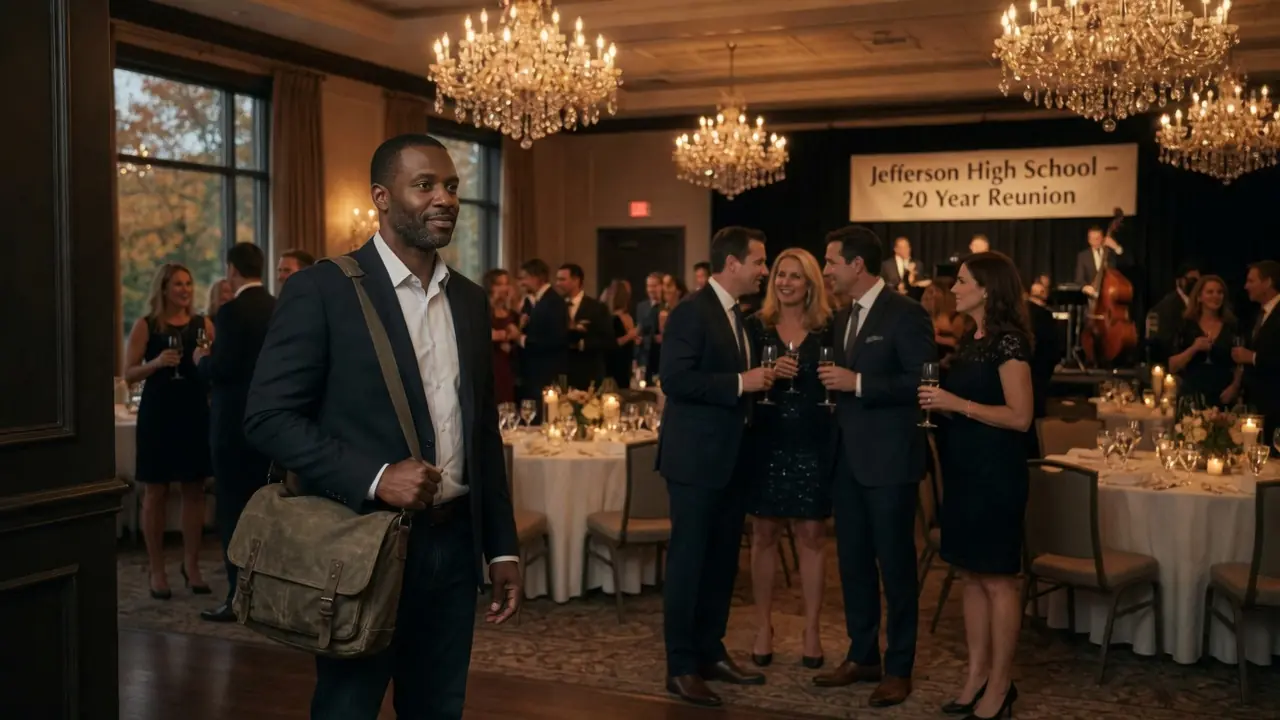
What the hell is this smell? Brad Collins turned toward the door as Lance Norwood entered the ballroom in a flannel shirt and faded jeans. Good heavens, the class loser finally shows up. Are you here to beg for leftovers, you useless piece of trash? Who let the beggar through? Still broke, still pathetic. Twenty years and you could not even afford a decent shirt.
Lance stood still. Nice to see you again, Brad, he said softly. Brad grabbed a glass of water, poured it over Lance's head slow and deliberate, and told him to cool off because he stunk up the place just by breathing. Water dripped down his face but he did not move. Brad thought he knew everyone here. He was wrong, and what happened next would haunt him for the rest of his life.
Twenty years earlier Lance Norwood stepped onto the Glenville University campus with everything he owned stuffed into a single gray duffel bag frayed at the zipper. His mother had stitched the strap back on twice with dental floss because thread was too expensive that month. He carried it over his right shoulder and walked through the front gates like a man entering a country where he did not speak the language. The campus smelled like fresh-cut grass and money. BMWs lined the parking lot. Students wore brands Lance had only seen in magazines left behind at the laundromat.
He wore a white t-shirt his mother had bleached so many times the collar had gone translucent. Eleanor Norwood had driven him there in a 1994 Honda Civic with a cracked windshield and a passenger door that only opened from the outside. She had worked three jobs that summer: hotel maid in the morning, grocery cashier in the afternoon, and overnight janitor at the bus station to cover his first semester. She did not tell him about the blood she had started coughing into the bathroom sink.
You call me every Sunday, she said, gripping his hand through the window. Yes, ma'am. And you do not let nobody make you feel small. Yes, ma'am. She drove away. The Civic backfired twice before it disappeared around the corner. Two girls sitting on a bench nearby laughed and pointed. Lance picked up his duffel bag and walked toward the dormitory. He did not look back.
He met Brad Collins on the third day in the dining hall. Lance was sitting alone at a corner table eating a plate of rice and beans, the cheapest option on the meal plan. His tray was dented and his fork was plastic because he had missed the silverware line. Brad walked in like he owned the room in a polo shirt and gold watch, three guys behind him: Derek Shaw, Tyler Griffin, and a tall kid named Wes Harmon who laughed at everything Brad said like it was scripture.
Brad stopped at Lance's table, looked down at the plate, and said rice and beans again. Lance did not look up. It is good. It is poverty food. Brad pulled out the chair across from Lance and sat down without asking. Where are you from? South Glennville. Brad repeated it slowly like he was tasting something rotten. That is where they found those meth labs last year, right? Derek leaned in and said that was where the city dumped its sewage and it made sense because Brad said he smelled like it.
Tyler laughed so hard he knocked over his water. Brad leaned closer, his breath smelling like mint gum and entitlement. What is your name? Lance. Brad nodded then grinned and said he was going to call him something else that fit better. He looked at Derek, Tyler, and Wes then back at Lance and said class loser loud enough for the tables around them to go quiet. A girl with a ponytail three seats over covered her mouth. A guy in a baseball cap snorted into his coffee. Nobody objected. Nobody told Brad to stop.
The name stuck like a cigarette burn. By the end of the first week the whole floor knew it. By the end of the first month the whole campus knew it. People Lance had never met would pass him in the hallway and mutter it under their breath. Some said it to his face. Most just smiled when Brad said it loud enough for everyone to hear. The things Brad did to Lance over the next four years were not creative. They were relentless and designed to grind a man down one humiliation at a time until there was nothing left to grind.
Sophomore year Lance spent three weeks on a research paper for Professor Gaines's economics class. He typed it on the library computer because he did not own a laptop and printed it at the campus center for twenty cents a page. He left it on his desk in the dorm to grab lunch. When he came back the paper was soaking in a puddle of Gatorade on the floor, orange, the pages curled and bled together. Brad's sneaker print was on the cover page next to a sticky note in Brad's handwriting that said better luck next life, loser.
Lance reprinted it, fifty-two pages for ten dollars and forty cents. He ate one meal a day for the rest of the week. That same semester someone taped a sign to Lance's locker in block letters with black marker that said class loser lives here. It stayed up for eleven days. The RA walked past it every morning and never removed it. Other students saw it. Some looked away. Some smirked. One girl, a sophomore whose name Lance never learned, stopped in front of it one morning, stared at it for five seconds, then kept walking. She never came back to take it down either.
Lance peeled it off himself on day twelve. The adhesive left a scar on the metal that never came off. Two weeks later someone slid a note under his dorm room door with no name, just a printed photo of a bus ticket back to South Glennville and three words scrolled across the bottom: take the hint. Lance folded the note, put it in his desk drawer, and went to class.
Junior year a group project for business strategy had Professor assign teams randomly. Lance was put with three students who all asked to switch groups within twenty-four hours because Brad had told them if they worked with Lance they would never get invited to anything again, not the parties, not the study groups, not the networking events where alumni handed out internships like candy. The professor let them switch without asking why. Lance did the project alone, a sixty-page report with financial modeling and market analysis. He got an A. The group that dropped him got a B minus. Nobody mentioned it.
The worst day came in the spring of senior year during Professor Whitmore's advanced finance seminar final presentations. Lance had prepared for two weeks. His slides were clean and his data was tight. He stood at the front of the room and began speaking about micro-lending models in underserved communities. Ninety seconds in a sound came from the back row, a monkey screech high-pitched, exaggerated, and unmistakable. Brad was leaning back in his chair with his hand over his mouth making the sound just loud enough for the room to hear. Derek covered his face shaking with laughter. Tyler bit his fist. Megan Walsh had her phone out recording the whole thing with a grin that could curdle milk.
The room froze with twenty-six students and one professor. Nobody said a word. Nobody told Brad to stop. Nobody even shifted in their seat. Professor Whitmore adjusted his glasses, looked at Brad, looked at Lance, then looked down at his laptop and said continue, Mr. Norwood. Lance continued. His voice did not crack. His hands did not shake. He finished all fourteen slides and walked back to his seat in silence.
Megan posted the video that night with forty-three laughing emojis in the comments. Lance saw every single one. That night he sat on the floor of his dorm room and called his mother. Mama, I want to come home. A long pause. He could hear her breathing, thinner than it used to be, shallower, like air through a cracked window. You are not coming home, baby. They do not want me here. I did not send you there to be wanted. I sent you there to learn. And when you are done learning, you build something so big that every single one of them will have to look up to see it.
Lance pressed the phone against his forehead and closed his eyes. You hear me, Lance? Yes, ma'am. Then stay. He stayed. He stayed through the name calling, through the Gatorade and the sneaker prints, through the monkey sounds and the silence of professors who chose their donors over their students, through the sign on his locker and the video with forty-three laughing emojis. He stayed through all four years, and on graduation day he walked across the stage in a gown he had borrowed and shoes with holes in the soles.
His mother sat in the back row in a wheelchair with an oxygen tube under her nose, clapping with hands that barely had the strength to close. Nobody else clapped. Brad and his crew were in the front row whispering and laughing, already planning their summer in the Hamptons. Lance took his diploma, looked out at the audience, found his mother's face. She was smiling. That was enough. He walked off the stage, put the diploma in his duffel bag, the same gray one with the dental floss strap, and left Glenville without saying goodbye to a single person.
He had two hundred dollars in his checking account, a degree nobody respected, and a name that still rang in his ears every time he closed his eyes: class loser. He was going to make them eat it. The bus ticket from Glennville to Atlanta cost forty-seven dollars. Lance caught himself and exchanged it for one that cost forty-six. He arrived at the Greyhound station on Foresight Street with his duffel bag, his diploma, and one hundred fifty-four dollars left in his pocket. The station smelled like diesel and floor cleaner.
A man sleeping on a bench near the vending machines reminded Lance of his uncle. He bought two coffees, gave one to the man, and kept walking. His first apartment was a studio above a dry cleaner in East Point for four hundred dollars a month with no air conditioning. The ceiling leaked when it rained, and it rained a lot that June. He put a pot under the drip and slept on a mattress he had found on the sidewalk three blocks away. He flipped it over and sprayed it with disinfectant. It smelled like chemicals for two weeks. Then it just smelled like him.
He got a job at a warehouse in College Park on the night shift loading pallets of frozen chicken onto refrigerated trucks from ten p.m. to six a.m. The cold was the kind that got into your joints and stayed there. His fingers cracked and bled by the second week. He wrapped them in electrical tape and kept lifting. During the day he walked to the Atlanta Fulton Public Library on Carnegie Way. He sat at a desktop computer between a retired school teacher learning email and a teenager playing flash games.
He opened free coding tutorials: HTML first, then CSS, then JavaScript, then Python. He did not understand any of it at first. The syntax looked like a foreign alphabet, but he kept showing up every single day, eight hours at the library, eight hours at the warehouse. The remaining eight hours split between sleep, eating, and staring at the ceiling. By year two he could build a basic website. By year three he could build a database. By year four he was writing his own algorithms in a notebook on the bus to work.
The idea came to him at three a.m. on a Tuesday. He was stacking pallets of frozen shrimp when the warehouse foreman screamed at a driver for delivering to the wrong dock. The driver screamed back. The shipment sat in the loading bay for forty minutes thawing. Lance watched twelve thousand dollars worth of seafood turn into garbage because two men could not coordinate a delivery. He went home that morning and wrote three words on a napkin: fix the chain. Logistics. That was the problem. Not the trucks, not the drivers, not the warehouses. The software that connected them was broken or did not exist.
Small and midsize companies were still using spreadsheets and phone calls to track shipments. Lance had seen it from the inside. He had watched millions of dollars rot on loading docks because the left hand did not know what the right hand was doing. He spent six months building a prototype, a logistics platform that tracked shipments in real time, optimized routes, and predicted delays before they happened. He coded it on the library computer, tested it on paper, and refined it in his notebook on the bus.
Then he started knocking on doors. The first investor said no before Lance finished his second sentence. The second investor did not show up to the meeting. The third laughed. The fourth said the market was too crowded. The fifth said Lance did not have the right background. The sixth said he did not have the right connections. The seventh said he did not have the right look. Lance knew what that meant. Investors eight through fourteen found different ways to say the same thing: too risky, too early, too unproven.
One of them, a man in a blue suit with a Harvard ring, leaned across the table and said son, go get a real job. This is not for people like you. Lance stood up, shook his hand, walked out, sat in his car, a 2003 Corolla with one hundred ninety thousand miles, and pressed his forehead against the steering wheel. He thought about his mother. Eleanor had died eight months earlier from lung cancer, stage four by the time she finally went to a doctor because she had spent three decades choosing between her health and her son's tuition.
Lance had driven back to Glennville for the funeral. Twelve people came. The pastor mispronounced her last name. Lance paid for the casket with his warehouse savings. He could not afford a headstone so he marked the plot with a wooden cross he had built from pallet scraps. He sat in that parking lot for twenty minutes. Then he started the engine and drove to the next meeting.
Investor fifteen was Gloria Whitfield. She was sixty-one with silver hair and reading glasses on a beaded chain. She ran a small venture fund out of a converted firehouse in Midtown and specialized in founders that other people overlooked. Lance walked in with his laptop, a refurbished ThinkPad he had bought for one hundred twenty dollars, and gave the same pitch he had given fourteen times before with the same slides, same data, and same calm steady voice.
Gloria listened without interrupting. When he finished she took off her glasses and set them on the table. How long have you been building this? Six months for the prototype. Four years learning to code. Where did you learn? Public library. She stared at him for a long time, not at his clothes, not at his shoes, at his eyes. Fifty thousand dollars, she said. I want fifteen percent equity and a board seat. Lance's hands shook under the table. He pressed them against his knees. Deal.
Apex Ventures was born in a garage on Memorial Drive that Lance rented for four hundred dollars a month. The first three employees were people he had met at the library: a retired database administrator, a college dropout who taught herself UX design, and a Nigerian immigrant who could write backend code faster than anyone Lance had ever seen. They worked eighteen-hour days. They ate ramen and gas station sandwiches. They slept on air mattresses between server racks. The garage had no heat in winter and no ventilation in summer.
Lance lost fifteen pounds in the first six months but the product worked. Lance remembered the first time the dashboard lit up green, every truck accounted for, every route optimized, every delivery window hit. He sat in the garage at two a.m. staring at the screen and thought about the frozen shrimp rotting on that loading dock, about the foreman screaming, about the twelve thousand dollars that disappeared because nobody had built what he had just built. He closed his laptop and slept four hours on the air mattress. It was the best sleep he had had in years.
The first client was a regional grocery chain with thirty-two stores across Georgia. Their logistics were a disaster with spoiled produce, late deliveries, and phantom inventory. Lance's platform cut their waste by forty percent in ninety days. The CFO called Gloria Whitfield personally to say it was the best investment she had ever recommended. Word spread quietly at first then louder. By thirty Apex had two hundred employees and contracts in eleven states. By thirty-two they had expanded to cold chain pharmaceuticals, vaccines, insulin, and blood products, the kind of cargo where a missed delivery did not mean lost revenue but meant someone died.
By thirty-five Apex went public. The IPO valued the company at four point two billion dollars. Lance Norwood, the kid from South Glennville who had eaten rice and beans alone in a college dining hall, was now worth more than every person who had ever called him class loser combined. But he did not do interviews, did not post on social media, did not attend galas or charity auctions where cameras waited at the door. No Forbes cover, no TED talk, no public photos. After 2019 he was a ghost with a balance sheet.
And he started buying things quietly: a commercial real estate portfolio across the southeast, a minority stake in two professional sports teams, a tech incubator in downtown Atlanta, and one purchase that nobody understood, the Grand Glennville Hotel, the most expensive property in a town most people could not find on a map. He bought it through a shell company called Meridian Holdings with no announcement and no press release. The staff did not know who owned it. The town did not know.
Brad Collins, who by then had run his father's company into the ground and was working as a mid-level operations manager at Pinnacle Logistics, definitely did not know. Pinnacle Logistics was a subsidiary of Apex Ventures. Brad Collins had been working for Lance Norwood for two years and had no idea. The Grand Glennville Hotel had never looked better. Someone had hung a banner across the ballroom entrance that said Glennville University class of 2006 together again in gold letters on navy fabric.
Underneath it a table held name tags arranged in alphabetical order. Each tag had the graduate's senior yearbook photo printed beside their name. Lance found his. The photo showed an eighteen-year-old kid in a borrowed gown looking straight at the camera with an expression that was either exhaustion or defiance. Hard to tell the difference. He peeled the tag off the table and stuck it to his flannel shirt.
The ballroom was already filling up. Crystal chandeliers threw light across marble floors. A jazz quartet played in the corner near a bar stocked with bottles that cost more than Lance's first month of rent in Atlanta. Round tables with white tablecloths and centerpieces with lilies and candles filled the kind of room designed to make people feel important. Brad Collins stood near the center of it all. He had gained weight, not the soft kind but the swollen kind that comes from stress eating and too many bourbons after work.
His suit was expensive but did not fit right. The jacket pulled at the shoulders. The pants broke too high above his shoes. He wore a Rolex but Lance noticed the way Brad kept adjusting it, rotating it on his wrist like a nervous habit. A man who was comfortable with wealth did not fidget with his watch. The Rolex was a lie Brad wore on his body. Lance could spot it from across the room.
Derek Shaw stood beside him, thinner than in college with a receding hairline. He sold insurance. Lance knew this because Apex's data analytics division tracked Pinnacle's employee networks and Derek had tried to sell a policy to one of Pinnacle's warehouse supervisors last year. Tyler Griffin was there too. He managed a car dealership in Mon and was divorced twice. Megan Walsh had flown in from Charlotte where she ran a struggling interior design business and posted inspirational quotes on Instagram every morning to an audience of four hundred followers.
These were the people who had made Lance's life hell for four years. They looked ordinary now, smaller than he remembered. Time had done to them what they had tried to do to Lance: ground them down quietly, without mercy, without announcement. Brad spotted Lance the moment he walked in. The scene from the hook played out exactly as Brad had planned: the smell comment, the cologne spray, the napkin shoved into his chest.
Brad had rehearsed this moment. Maybe not consciously, but somewhere deep in his wiring he needed Lance to be small again. He needed the old hierarchy to hold. He needed to believe that the world still worked the way it had in college where last names and bank accounts determined who mattered. What Brad did not notice were the small things happening around the edges of the room. A bartender glanced at Lance and straightened his posture. A waiter carrying a tray of champagne flutes adjusted his path to pass closer to Lance, not to serve him but to nod with a barely visible nod, the kind subordinates give when the boss walks in and they have been told not to make a scene.
Catherine Wells, the hotel's general manager, stood near the service entrance in a charcoal suit. She had been running the Grand for three years, hired directly by Meridian Holdings, which meant hired directly by Lance. She was the only person in Glennville who knew who owned the building. She watched Brad spray cologne on her employer and her jaw tightened so hard the tendons in her neck showed. She pulled out her phone and typed a message: Sir, should I intervene?
Lance felt his phone buzz in his pocket. He read the message under the table while Brad was telling Derek about his VP level position at Pinnacle. Brad called it VP level. His actual title was regional operations coordinator. Lance had signed off on that title eighteen months ago without blinking. He typed back one word: no. Catherine read it, exhaled through her nose, put the phone away, and waited.
Brad was on his third bourbon now. The alcohol had loosened him, made him louder and more reckless. He stood at the center of a cluster of former classmates holding court like he used to in the dining hall with the same posture, same volume, and same need to be the loudest voice in the room. You guys see Lance came? Brad said jerking his thumb toward the corner where Lance sat alone. Unbelievable. I thought he would at least buy a new shirt. Polite laughter. A few people shifted uncomfortably.
I am serious, Brad continued. Twenty years and the guy shows up looking like he walked here from a bus stop. Some people just do not change. He took a long sip of bourbon. Once a loser, always a loser. Derek nodded. Tyler chuckled. Megan was already composing an Instagram story, a photo of Lance sitting alone at the table with a caption she had not finalized yet but was leaning toward something with the word throwback.
A woman named Sarah Pennington who had sat behind Lance in three classes and never spoken to him once leaned toward her husband and whispered this feels wrong. Her husband shrugged. It is Brad being Brad. Sarah looked at Lance across the room. He was sitting with his hands folded on the table, still calm, looking at nothing in particular. She thought he looked like a man waiting for something. She just could not figure out what.
Brad finished his bourbon and set the glass down hard enough to rattle the silverware. All right, he said clapping his hands. Time for the main event. He walked toward the stage at the front of the ballroom. A projector had been set up behind a podium. A laptop was already connected. Brad had spent two weeks putting together a slideshow of senior year photos, campus memories, and inside jokes. But the real reason for the slideshow was the same reason he had sent that invitation with the handwritten note. He wanted an audience for what came next.
Brad tapped the microphone. The jazz quartet stopped. Conversations faded. Two hundred faces turned toward the stage. Welcome back, class of 2006, Brad said spreading his arms wide. Twenty years. Can you believe it? Some of us got better. He flexed. Weak laughter. And some of us, he looked directly at Lance. Some of us did not change at all. More laughter, louder this time. The alcohol was working on the crowd now.
Lance sat at his table with hands still folded and eyes on Brad. Catherine Wells stood by the service door with arms crossed watching. Her phone was in her left hand. One text from Lance and this entire evening would pivot on its axis. But Lance had not sent that text yet. He was waiting the way his mother had taught him to wait, not with weakness, not with surrender, but with patience that had teeth.
Brad clicked the remote. The projector hummed to life. A photo filled the screen: the Glennville University front gate with autumn leaves and golden light. A few people said aw. Let us take a trip down memory lane, Brad said. Click. Homecoming game 2003. The football team hoisting the conference trophy. Derek pumped his fist. That is me, number forty-four. Click. Spring formal 2004. Girls in dresses, guys in rented tuxedos. Click. The campus quad in winter. Snowball fight. Laughter frozen in pixels.
Click. The room went quiet. It was Lance, freshman year, sitting alone in the dining hall with rice and beans on a dented tray. His t-shirt had a stain near the collar. His eyes were down. Someone had taken the photo without him knowing. The angle was slightly above like a person standing over him with a phone held low. Brad let it sit on the screen for five seconds, then ten, long enough for every pair of eyes to absorb the image.
And here he is, Brad said grinning. The one, the only, the class loser. Laughter. Not everyone but enough. Lance, stand up buddy. Come on up here. A sarcastic slow clap started near Derek's table. Tyler joined. Then a few others who had enough bourbon in them to think cruelty was comedy. The sound bounced off the marble walls like a hollow mocking heartbeat.
Lance stood and walked to the stage unhurried with hands at his sides and face unreadable. Brad threw an arm around his shoulder like they were old friends. The weight of it felt like a leash. So Lance, twenty years, what have you been up to? I work in tech, Lance said. Brad's eyebrows shot up. Tech? You? He turned to the audience. Lance Norwood in tech doing what? Resetting passwords. Something like that, Lance said.
Something like that, Brad dragged each word. He clicked the remote. Another photo: Lance's locker with class loser lives here taped across it in block letters. Someone gasped. Most people just stared. Remember this? Brad said. Classic. Absolute classic. Lance looked at the photo, his locker, the block letters, the adhesive scar he had spent an hour scrubbing off with his fingernails, the empty hallway, nobody helping. He said nothing.
I got to be honest, Brad continued turning to face Lance. When I sent you that invite I did not think you would come. He gestured at Lance's clothes. Same outfit, same energy, same Lance. He clicked again. A side-by-side appeared. Freshman Lance on the left, a photo of Lance walking into the hotel tonight on the right. Brad had someone photograph Lance at the door specifically for this slide. He had planned this moment the way a prosecutor plans a closing argument. Every image chosen, every pause rehearsed, every laugh line tested in the mirror at home.
Twenty years apart, Brad said. Spot the difference. He squinted. I cannot find one. Derek slapped the table. Tyler pounded his fist. Megan zoomed in with her phone making sure she got Lance's face. Brad reached into his pocket, pulled out a five-dollar bill, tucked it into Lance's shirt pocket, and patted his chest twice slow and deliberate the way you would pat a dog. There you go buddy. Get yourself something nice. Maybe a belt. Maybe some dignity.
The laughter hit like a wave. Derek doubled over. Tyler had tears in his eyes. Megan filmed from the second row with phone steady and angle perfect. A few people laughed nervously, the kind of laughter people produce when they are uncomfortable but too afraid to be the one who stops it. Lance felt the five-dollar bill against his chest. He felt the stage lights on his forehead. He felt two hundred pairs of eyes pressing into him like thumbs on a bruise.
He reached into his pocket, took out the bill, folded it neatly, placed it on the podium. Keep it, he said quietly. You are going to need it more than I do. The room went still. Brad blinked. Something flickered behind his eyes, not understanding, just a faint crack in the windshield. Then he laughed loud and forced. Sure Lance, whatever you say. He turned to the audience. Give it up for the class loser. Twenty years and still taking it like a champ.
Applause. Scattered. Uncomfortable. Sarah Pennington sat with her hands in her lap staring at her drink. Her husband looked at the ceiling. Lance walked back to his table, sat down, and folded his hands in the same position and same stillness. Under the table his phone buzzed. Catherine Wells: Sir, the documents are ready. Say the word. Lance looked across the room. Brad was still on stage basking in the attention, drunk on the same power he had been drunk on since freshman year. Same cruelty, same audience, same silence from everyone who knew it was wrong and chose the easy path of looking away.
He thought about his mother. The duffel bag with the dental floss strap. The rice and beans. The monkey sound from the back row. The parking lot where he had pressed his forehead against the steering wheel and almost gave up. Almost. He picked up his phone. One word: now.
Catherine Wells read the message, straightened her jacket, nodded to the two security officers behind her, and started walking toward the stage. The ballroom doors opened. Not slowly, not dramatically. Catherine Wells pushed them open with both hands like a woman who had been waiting three years for this exact moment and was done being patient. She walked in flanked by two security officers in dark suits. Her heels clicked against the marble in a rhythm that silenced the jazz quartet mid-note.
Conversations stopped. Glasses paused halfway to lips. Every head in the room turned toward the sound. Brad was still on stage. He squinted at Catherine annoyed at the interruption. Excuse me, he said into the microphone. We are kind of in the middle of something. Catherine did not slow down. She walked past the round tables, past the centerpieces with their lilies and candles, past Derek and Tyler and Megan and two hundred people who had spent the last hour laughing at a man they did not know was signing their paychecks.
She stopped at the foot of the stage. Mr. Collins, she said, her voice carried without a microphone. I need to address the room. Brad leaned into the mic. And who are you? Catherine Wells, general manager of the Grand Glennville Hotel. Brad waved his hand dismissively. Great. Whatever it is, we will handle it after the party. We are having a good time. I am afraid this cannot wait. Something in her voice, a weight, a finality, made the room go still.
Brad's smirk faded by one degree. He looked at the two security officers then back at Catherine then at the audience searching for support. Nobody moved. Fine, Brad said. Make it quick. Catherine stepped onto the stage. She did not take the microphone from Brad. She did not need to. She turned to face the audience and spoke clearly the way someone speaks when they have rehearsed every word.
Ladies and gentlemen, I apologize for the interruption but there has been a significant misunderstanding this evening regarding the nature of this venue and who you are guests of. Brad crossed his arms. I booked this ballroom. I paid for it. What is the misunderstanding? Catherine turned to him. You paid a rental fee, Mr. Collins. You do not own this hotel. The owner has been in this room all evening.
The air changed. It was like someone had opened a window in a sealed room. People sat up straighter, necks craned, eyes scanned the crowd. Catherine turned toward the corner table where Lance sat with his hands folded. Mr. Norwood, she said. Would you like to address your guests? The silence was absolute. Two hundred people held their breath at the same time. The chandeliers above seemed to hum louder in the vacuum.
Lance looked at Catherine then at the audience then at Brad. He stood up, buttoned the top button of his flannel shirt, the only adjustment he made. He walked to the stage for the second time that night. But this time the room did not laugh. This time the room watched him the way you watch a wave you did not see coming.
He stepped up to the microphone and tapped it once. The sound echoed through the ballroom. My name is Lance Norwood, he said. Most of you know me as the class loser. He let the name hang in the air. People shifted in their seats. Derek's smile collapsed like wet cardboard. This hotel, every chandelier, every marble tile, every bottle behind that bar belongs to me. I purchased it three years ago through a holding company called Meridian Holdings. It is a subsidiary of my company, Apex Ventures.
Whispers erupted. Phones came out. Fingers typed furiously. Megan Walsh, who ten minutes ago had been filming Lance's humiliation, Googled Lance Norwood Apex Ventures. Her screen filled with Forbes articles, Bloomberg profiles, CNBC interviews, a net worth figure with a B in front of it. Her face went white. She turned her phone toward Derek. Derek read it. His mouth opened. Nothing came out.
Tyler Griffin put down his drink so hard the glass cracked against the table. Brad stood three feet from Lance. His arms had uncrossed. They hung at his sides like they had forgotten what to do. His jaw worked back and forth chewing on words that would not form. That is, Brad started. That is not possible. You are lying. Catherine stepped forward. She held a tablet on the screen with property ownership documents: Meridian Holdings LLC, a wholly owned subsidiary of Apex Ventures Inc., signed by Lance A. Norwood, chairman and CEO. Acquisition date March fifteenth, 2023.
She turned the tablet toward the audience, toward Brad, toward the projector. The ownership documents appeared on the same screen that had shown Lance eating rice and beans alone. Brad stared at the screen then at Lance then at the screen again. His face went through a sequence of expressions: disbelief, confusion, calculation, and then something Lance recognized from twenty years ago. Fear. The particular fear of a man who realizes the ground he is standing on belongs to someone else.
You are telling me, Brad said slowly his voice cracking at the edges, that you own this building? I own this building, Lance said. I own the land it sits on. I own the parking lot where your leased BMW is parked right now. He paused. And Brad? I own something else too. The room tilted. Everyone felt it. Not physically but the center of gravity in that ballroom shifted from Brad Collins to Lance Norwood in the space of a single sentence. And it would never shift back.
Brad's mouth was open. No sound. But we will get to that in a moment, Lance said. He turned to the audience. Two hundred faces stared back at him. Some were pale. Some were flushed. Sarah Pennington was crying, not loud, just a steady stream down her cheeks with mascara drawing two thin lines toward her jaw. Lance looked at the five-dollar bill still sitting on the podium where he had left it. He picked it up, held it between two fingers, turned to Brad.
You put this in my pocket, Lance said. In front of everyone. You patted my chest like I was your pet. Brad's mouth moved. Nothing. I told you to keep it. Lance set the bill down on the podium again. That offer still stands. He turned back to the microphone. Now let me tell you about Pinnacle Logistics.
Brad's face changed. The fear sharpened into something else. Recognition. The slow sickening recognition of a man who just heard the name of the company that paid his mortgage spoken by a person who should not know it existed. What about Pinnacle? Brad whispered. Lance smiled for the first time all night. It was not a kind smile.
Pinnacle Logistics, Lance said into the microphone. Ring a bell, Brad? Brad's face was the color of old cement. His lips moved but nothing came out. The Rolex on his wrist caught the chandelier light as his hand trembled. You work there, Lance continued. Regional operations coordinator. Started two years ago. Salary seventy-four thousand dollars a year plus a company car. A silver Chevy Malibu if I am not mistaken.
The room was so quiet Lance could hear the ice melting in someone's glass. Brad swallowed. How do you know that? Because Pinnacle Logistics is a subsidiary of Apex Ventures. Lance paused. Let every syllable land. My company. You have been working for me for twenty-four months, Brad. Every paycheck you have cashed. Every Monday morning you have clocked in. Every quarterly review you have sat through. All of it. Mine.
Brad's knees buckled. Not all the way, just a slight dip like a building settling before it collapses. He caught himself on the podium. His fingers gripped the edge until the knuckles turned white. That is not, Brad's voice came out thin and reedy, the voice of a man whose throat had closed around his own pride. That is not true.
Lance pulled out his phone, held it up so Brad could see the screen with a contact labeled Helen Price, Pinnacle HR Director. He pressed call and put it on speaker. One ring. Two rings. Mr. Norwood, good evening sir. The room heard it. Every word through the phone speaker and through the ballroom's dead silence. Helen Price's voice was as clear as a church bell.
Helen, Lance said his eyes never leaving Brad's face. I need you to process a termination. Effective immediately. Of course sir. Employee name? Brad Collins, regional operations coordinator. A pause. The sound of typing confirmed. Mr. Norwood. Termination paperwork will be sent to Mr. Collins email within the hour. Shall I flag his final paycheck for expedited processing? That will not be necessary, Lance said. I think Mr. Collins can wait.
He ended the call. The phone screen went dark. Lance slid it back into his pocket. Brad stood frozen on the stage. His mouth hung open. His eyes were glassy, the look of a man watching his own house burn down from across the street with the keys still in his hand. You cannot, Brad's voice broke. You cannot do this to me. I have a mortgage. I have car payments. I have. You have nothing, Lance said. Your father's company went bankrupt in 2019.
You burned through your inheritance in three years. The house is leveraged. The BMW is leased. The Rolex, Lance glanced at Brad's wrist. That is a replica. I noticed it when I walked in. A gasp rippled through the crowd. Someone near the back said oh my god loud enough for the entire room to hear. Megan Walsh lowered her phone slowly like a soldier putting down a weapon. Her hands were shaking. The Instagram story she had been composing about Lance, the one with the word throwback, was still on her screen. She deleted it.
Derek Shaw stared at the floor like he was trying to melt into it. Tyler Griffin had pushed his chair back from his table putting as much distance between himself and Brad as the ballroom walls would allow, as if failure were contagious and he could feel the infection spreading. Brad's face crumpled. Not rage. Not defiance. Something worse. The look of a man who had just realized that every single person in the room now knew the truth about him. Not the truth he had been telling for twenty years. The real one.
You spent four years calling me class loser, Lance said. He did not raise his voice. He did not need to. You poured Gatorade on my papers. You taped a sign to my locker. You made monkey sounds while I presented my thesis. You invited me here tonight to humiliate me in front of two hundred people. He picked up the five-dollar bill from the podium and held it out toward Brad. Here. You are going to need this now.
Brad did not take it. His hand hung limp at his side. Lance placed the bill gently on Brad's jacket lapel and patted it twice slow and deliberate, the exact same motion Brad had used an hour ago. There you go buddy, Lance said softly. Get yourself something nice. He turned off the microphone, set it on the podium, and stepped off the stage.
Behind him the only sound was Brad Collins breathing fast, shallow, ragged like a man drowning on dry land. Nobody helped him. Nobody ever had helped Lance either. The difference was that Lance had learned to swim. Lance walked through the ballroom without looking back. The crowd parted for him not because anyone told them to but because something in the air had changed, a shift in gravity that pulled people out of his way the same way it had pushed them toward Brad for twenty years.
His shoes made no sound on the marble. Or maybe they did and nobody could hear it over the silence. Catherine Wells stood by the exit. She held the door open with one hand. Her eyes were red. She did not say anything. She did not need to. Lance walked through the lobby past the front desk where two clerks stood at attention, past the concierge who pressed his hand to his chest in a gesture that was not trained, not rehearsed, just human, past the revolving doors and into the Georgia night.
The air smelled like magnolia and warm asphalt. Crickets sang in the hedgerow along the circular driveway. A black Rolls-Royce Phantom sat at the curb with engine running and headlights cutting two clean lines into the dark. The driver stepped out and opened the rear door. Where to, sir? Lance did not answer right away. He stood on the steps of the Grand Glennville Hotel, the building he owned in the town that had tried to break him, and looked up.
The sky was clear. Stars scattered across it like salt on black cloth. Somewhere behind those stars his mother was watching. He was sure of it. Not because he was religious. Not because he believed in signs. Because Eleanor Norwood had spent her entire life watching over her son and he did not think death was stubborn enough to stop her. Home, Lance said.
He got into the car. The door closed. The Rolls-Royce pulled away from the curb. Its tail lights glowed red against the oak-lined drive then dimmed then disappeared. Inside the ballroom Brad Collins stood alone on the stage with a five-dollar bill pinned to his lapel. Two hundred people staring at him. The projector behind him still showed the ownership documents. Lance's name in black ink right next to the photo of a boy eating rice and beans alone.
And for the first time in his life not a single word left to say. The class loser had left the building and he took everything with him. Success is the best revenge. Do not waste energy clapping back. Just build. Stay quiet. Stay hungry. Let the results do the talking. The people who laughed will be watching. Oh trust me.