"Can somebody here give me work?" The young woman did not raise her voice to compete with the noise of the garage.
She waited until the man beneath the motorcycle had stopped his impact wrench, until the radio above the parts counter slipped between songs, and until the rain beating against the steel roof seemed for a moment to take a breath.
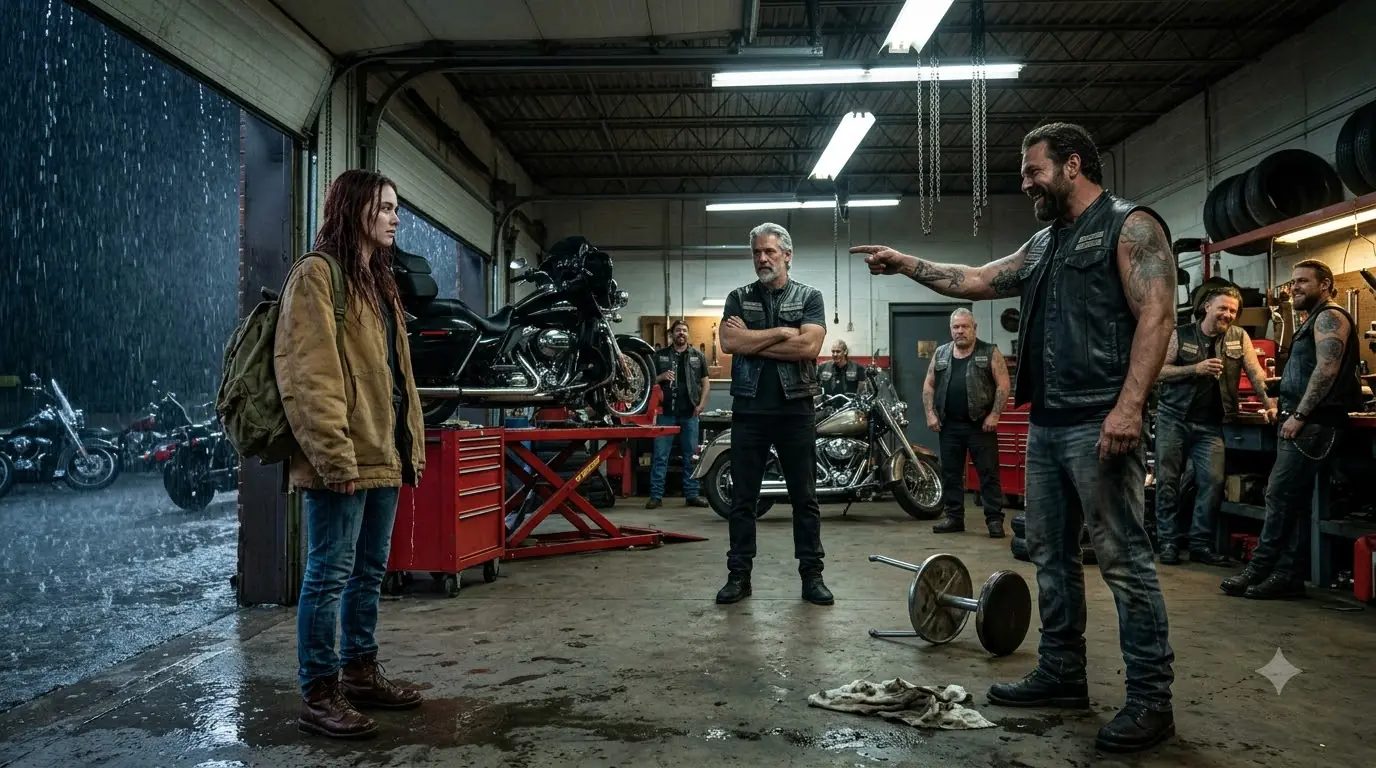
Then she said the words again, not pleading, not making a speech, simply offering them to the room as though she expected an honest answer. Six men looked up from six different kinds of work, and the whole building seemed to listen.
She stood just inside the wide service entrance of the Northern Shields garage in Coldmare, Ontario. Water dripped from a men's canvas barn coat hanging off her shoulders, ran down the backs of her hands, and darkened the concrete around a pair of boots that had traveled farther than their soles were made to travel. Her backpack had one broken strap held together with a silver carabiner, and the corner of her lower lip was split. She was twenty-four, although there were moments when her face looked seventeen and moments when her eyes made the number irrelevant.
The garage was still open at a quarter past eight because motorcycle work never really observed the hours painted on the door. A black touring bike sat high on the center lift, its front wheel removed and tagged for inspection. An older Heritage Softail occupied a bay beneath a long bank of fluorescent lights, and an Electra Glide rested near the back wall with part of its lower frame exposed. The air smelled of machine oil, metal warmed by work lights, wet leather, and the soup somebody had brought in a thermos and forgotten to finish. It was not the kind of place where a stranger generally walked in expecting rescue.
Clem Varga saw her first. Clem was sixty-one and built as if someone had put heavy-duty farm equipment in human clothes, although he moved with a quiet economy that came from a different life. The men at Northern Shields called him Fig, a nickname whose origin he had explained exactly once before refusing to discuss it again. He had served in the army long enough to acquire the habit of noticing doors, footsteps, and changes in other people's breathing, and now he noticed the way the stranger held herself upright by effort rather than ease.
"You talking to me?" he asked, setting down the carburetor components he had been sorting.
"I'm talking to whoever decides," she said. Her voice was rough from cold and probably from not using it much that day, but she met his eyes. Fig glanced at her backpack and then at the rain behind her, and instead of asking whether she knew what kind of place she had entered, he turned toward the office. "Reese," he called. "Got somebody you ought to meet."