The shove came hard enough to drive Reed Harland’s shoulder into the brass edge of the service counter.
A line of white porcelain coffee cups trembled in their saucers, and one teaspoon jumped completely free, spinning once across the marble before dropping onto the carpet. Several people gasped, but what unsettled the room was not the sound.
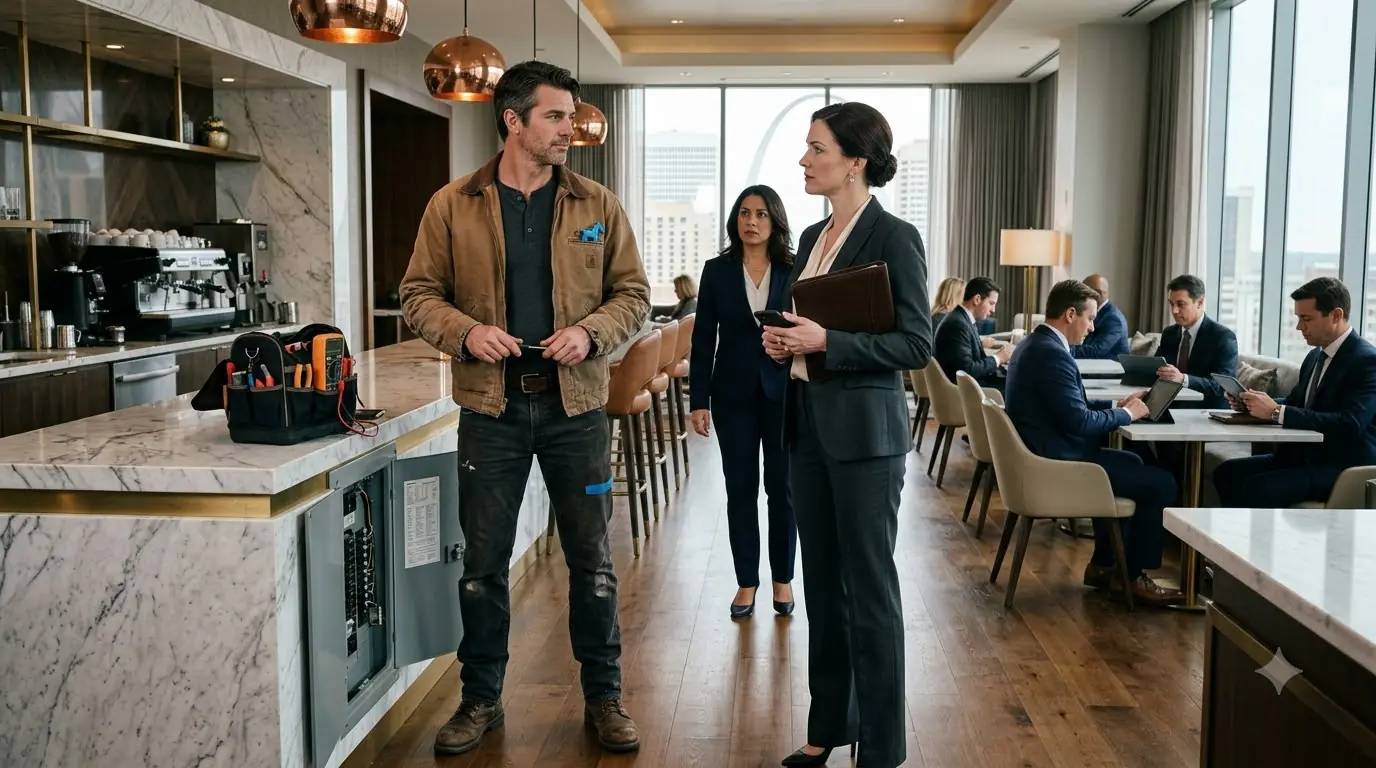
It was Reed.
He did not swear. He did not swing back. He did not even look embarrassed.
He simply caught himself with one hand, placed the wire strippers he had been holding onto a folded towel, and turned toward Derek Hollis with the distant concentration of a man listening to thunder from miles away.
The West Lounge of the Marlo Hotel went quiet table by table. Conversations faded. A spoon stopped halfway to someone’s mouth. Even the espresso machine behind the bar seemed to hiss more softly.
Derek stood in front of Reed, red-faced and breathing through his nose.
He was taller by an inch, heavier by at least thirty pounds, and dressed in a navy suit tailored closely enough to make every angry breath visible. His silver watch glinted under the copper pendant lights as he lifted one hand again, apparently convinced the first shove had not made his point clearly enough.
Reed’s canvas work jacket was faded at the elbows. His boots carried dried salt from a February storm and black marks from machine-room floors. A strip of blue painter’s tape clung to one knee of his jeans from work he had done earlier that morning. To anyone who had looked at him for half a second before returning to their coffee, he was only the repairman who had wandered too close to people with expensive titles.
Reed met Derek’s eyes.
“That’s the last time you touch me.”
His voice was low.
Not threatening.
Not loud.
Final.
Twenty feet away, Vivien Hartwell slowly lowered the leather folder in her hands.
She had come to the Marlo for a private strategy lunch with senior executives from Hartwell AeroSecure. The company was days away from a federal demonstration involving emergency logistics software used to coordinate medical shipments, evacuation flights, and critical supplies during disasters. Vivien expected difficult questions about redundancy, response time, data validation, and whether her company was ready for its largest public-sector contract in a decade.
She had not expected to watch her operations director put both hands on an electrician.
More unsettling was the man Derek had shoved.
Reed did not look frightened.
He looked restrained.
Vivien had spent most of her adult life around people pretending to be calm. Executives did it in boardrooms. Lawyers did it before negotiations. Investors did it while watching millions of dollars disappear in real time.
This was different.
Reed’s stillness did not look performed.
It looked practiced.
There is a kind of control that comes from etiquette, and another that comes from knowing exactly what you are capable of doing if you stop controlling yourself.
Vivien suddenly suspected she was looking at the second kind.
The Marlo’s West Lounge was built for people who liked privacy but wanted other people to notice they had it. Copper lamps hung low over pale marble tables. Walnut paneling softened the acoustics. Floor-to-ceiling windows framed the gray winter skyline of St. Louis and, beyond the rooftops, a distant strip of the Mississippi reflecting the afternoon light.
On most days, the room smelled of espresso, citrus cleaner, wool coats drying from rain, and expensive cologne.
That Thursday, the back half had been reserved for Hartwell AeroSecure.
Vivien arrived at eleven forty-five in a charcoal wool coat and low black heels. Her dark hair was pinned neatly at the nape of her neck. At forty-one, she had spent six years as president of the company her father had founded, long enough to stop trying to imitate his leadership style.
Her father had filled rooms.
Vivien narrowed them.
She rarely raised her voice. She asked exact questions and remembered exact answers. People who tried to impress her with ten-minute speeches usually discovered that she was waiting for the one sentence they had avoided saying.
Hartwell AeroSecure had begun thirty years earlier as a routing and avionics support firm. It had evolved into a mid-sized technology company specializing in encrypted emergency logistics, resilient communication layers, and routing systems designed to continue functioning when weather, infrastructure failures, or damaged networks made ordinary systems unreliable.
The work sounded abstract until a hurricane closed six airports and hospitals still needed blood products.
Or wildfire evacuation aircraft needed a safe landing route through smoke.
Or an ice storm cut off three counties and emergency generators had to be dispatched before fuel ran out.
Vivien believed that kind of work demanded humility.
Failures were not always numbers.
Sometimes they were minutes.
Sometimes minutes became lives.
Derek Hollis had once understood that.
Or Vivien had believed he did.
At forty-six, Derek was Hartwell’s senior director of operations, responsible for vendor coordination, deployment schedules, facility readiness, and operational exceptions across several critical programs. He was smart, fast, persuasive, and very good at making impossible deadlines look almost reasonable.
He was also increasingly unpleasant.
Assistants rotated out of his office.
Junior managers became careful around him.
People described his style with words like intense, demanding, direct.
Vivien had heard worse terms privately.
She had also tolerated him longer than she now wanted to admit.
Derek produced results.
There was always another contract.
Another emergency.
Another quarter.
Another excuse to deal with the culture problem later.
That was how powerful organizations taught themselves not to notice damage.
Reed Harland had arrived at the Marlo at seven twelve that morning.
He did not know Hartwell AeroSecure would be holding a private meeting there.
He knew only that Nora Bell, the West Lounge manager, had called him at six seventeen while he was spreading mustard across two slices of bread in his small kitchen.
“Tell me it’s not the coffee machine again,” Reed had said.
“It’s not the coffee machine.”
“That sounded defensive.”
“It’s the circuit behind the coffee machine.”
“That’s worse.”
Nora sighed.
“The breaker tripped twice yesterday when the warming drawers and the under-counter dishwasher were running together. Hotel engineering reset it, but I don’t like the smell near the panel.”
That got his attention.
“What kind of smell?”
“Hot plastic, maybe.”
“Shut the warming drawers off.”
“I already did.”
“Good.”
“Can you come?”
Reed glanced at the clock.
His ten-year-old daughter, Juny, was still upstairs searching for a missing sneaker she had almost certainly left beneath the couch.
“I can be there after school drop-off.”
“You are saving my life.”
“No. I’m looking at a breaker.”
“You haven’t tasted our coffee during breakfast rush.”