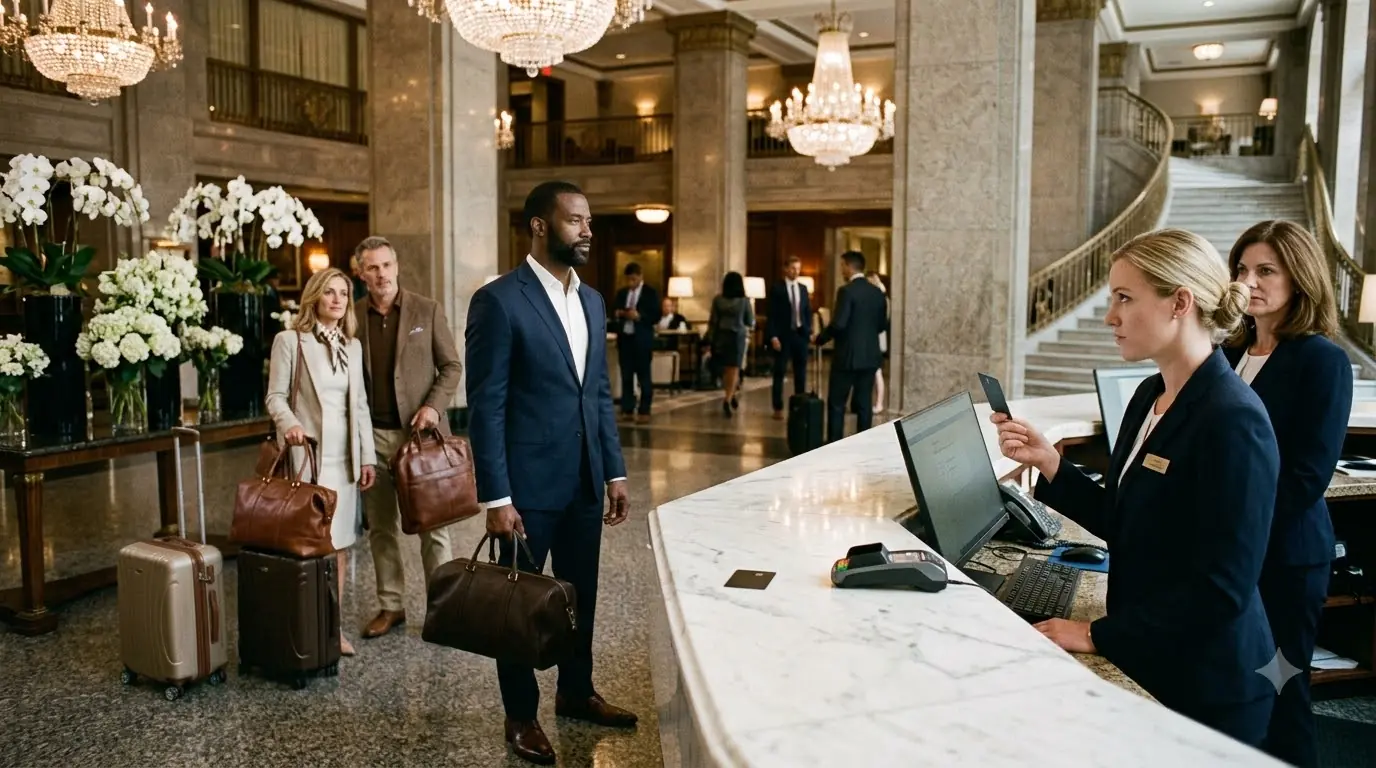
The black metal card was still lying on the polished granite counter when I first understood that something had gone wrong.
Not because the card had been declined.
It had not.
Not because the name on the reservation had failed to match the identification placed beside it.
It had not.
Not because our payment system had produced a fraud warning, a security alert, or even the most ordinary request for additional verification.
It had produced nothing.
The card had never touched the reader.
I was standing twenty feet from the front desk of the Marlowe Grand Hotel with a conference tablet tucked beneath one arm, working through the executive arrival list for the largest corporate closing our property had hosted in almost three years.
My name is Evan Brooks.
I was thirty-eight years old then and had spent more than eleven years in luxury hotel operations, the last four as Director of Conference Operations at the Marlowe Grand.
It was one of those jobs nobody notices when things go correctly.
A visiting executive finds a car waiting outside the airport.
A board member walks into the right suite and sees the documents already arranged.
A lawyer asks for a projector cable at 11:40 p.m., and somehow one appears before she finishes the sentence.
Coffee arrives before anyone realizes the room needs coffee.
Dietary restrictions are remembered.
Security elevators open.
Ballrooms become negotiation rooms.
Negotiation rooms become signing rooms.
At hotels like ours, competence is supposed to feel invisible.
The Marlowe Grand stood in the center of one of the largest American business districts, forty-two stories of glass, stone, brass, and carefully managed discretion.
Our lobby ceiling rose three floors.
Huge cream-colored stone columns framed the reception area.
The floor was polished granite, dark enough to reflect chandeliers hanging overhead like upside-down constellations.
Executives liked the hotel because it never felt crowded even when it was full.
Celebrities liked it because employees had been trained not to stare.
Law firms liked it because private conference floors could be secured with separate elevators.
Banks liked it because our business center understood the difference between an ordinary print request and a document that could change the value of a company before lunch.
The Hollander-ClearSpan closing was exactly that kind of event.
ClearSpan Logistics Systems was a privately controlled transportation and infrastructure technology company valued at a little under four billion dollars.
It had spent nearly twenty years building logistics software, regional distribution networks, automated warehouse systems, and fleet-routing platforms used by manufacturers across the country.
Hollander Industrial Holdings wanted it.
The negotiations had lasted fourteen months.
Two previous closing dates had slipped.
There had been regulatory questions.
Debt restructuring.
A dispute over intellectual property licensing.
Three weeks of arguments over executive retention packages.
Then finally, after all of it, both sides had agreed to meet at the Marlowe Grand and sign.
The projected transaction value was approximately $3.8 billion.
My department was responsible for almost everything that happened around the lawyers.
ClearSpan had reserved twenty-eight executive rooms.
Hollander had twenty-four.
Three private dining rooms were blocked.
A closing suite on the thirty-seventh floor had been converted into a secure signing room.
We had airport transportation scheduled from six different arrival terminals.
Two private aviation pickups.
Three executive SUVs.
One armored sedan requested by outside counsel.
Catering had dietary profiles for fifty-seven people.
The hotel had assigned dedicated elevator access.
Security had been increased quietly.
Nothing about the event was supposed to attract attention.
That was the point.
The man standing at the front desk that evening did not look like somebody who expected attention either.
He was a Black American man in his mid-forties, tall, athletic without appearing bulky, with closely cropped black hair and a neatly trimmed beard.
He wore a dark navy suit without a tie, a crisp white shirt, and polished brown shoes.
One leather overnight bag rested beside his leg.
No entourage.
No assistant hovering behind him.
No security detail.
No expensive luggage stacked on a cart.
He looked like a senior business traveler arriving for one night.
Which, technically, he was.
The front desk agent helping him was Aaron Walsh.
Aaron had worked at the Marlowe Grand for about fourteen months.
She was thirty, blonde, composed, generally efficient, and good at remembering repeat guests.
I had never had a serious issue with her.
That matters.
People like neat stories where bad behavior comes from obviously bad people.
Real organizations rarely work that way.
Most failures begin with ordinary people making an assumption and then finding a process willing to accommodate it.
I heard Aaron say, “I don’t see many of these.”
The guest had already provided his driver’s license.
His reservation was open on her screen.
I could see enough from where I stood to know there was no red warning banner beside the booking.
Aaron lifted the black card between two fingers.
Heavy metal.
Dark matte finish.
Minimal branding.
I recognized the general type.
Premium charge cards.
Executive cards.