The rusted chain-link fence collapsed under the blade of a yellow bulldozer as it lurched onto the gravel lot of the Ember and Oak Diner, scattering a flock of startled sparrows into the pale morning sky. Grace Holloway dropped the coffee pot she was holding, glass shattering across the linoleum floor, as she ran out the front door in her apron screaming for the driver to stop. Behind her three retired truckers and a table of elderly veterans rose from their stools in stunned silence, but the man standing beside the demolition crew watching it all through the tinted window of a black luxury sedan did not care. He had paid off the town’s zoning board and forged a structural report just to clear this land for his newest flagship restaurant. Then he made his fatal mistake.
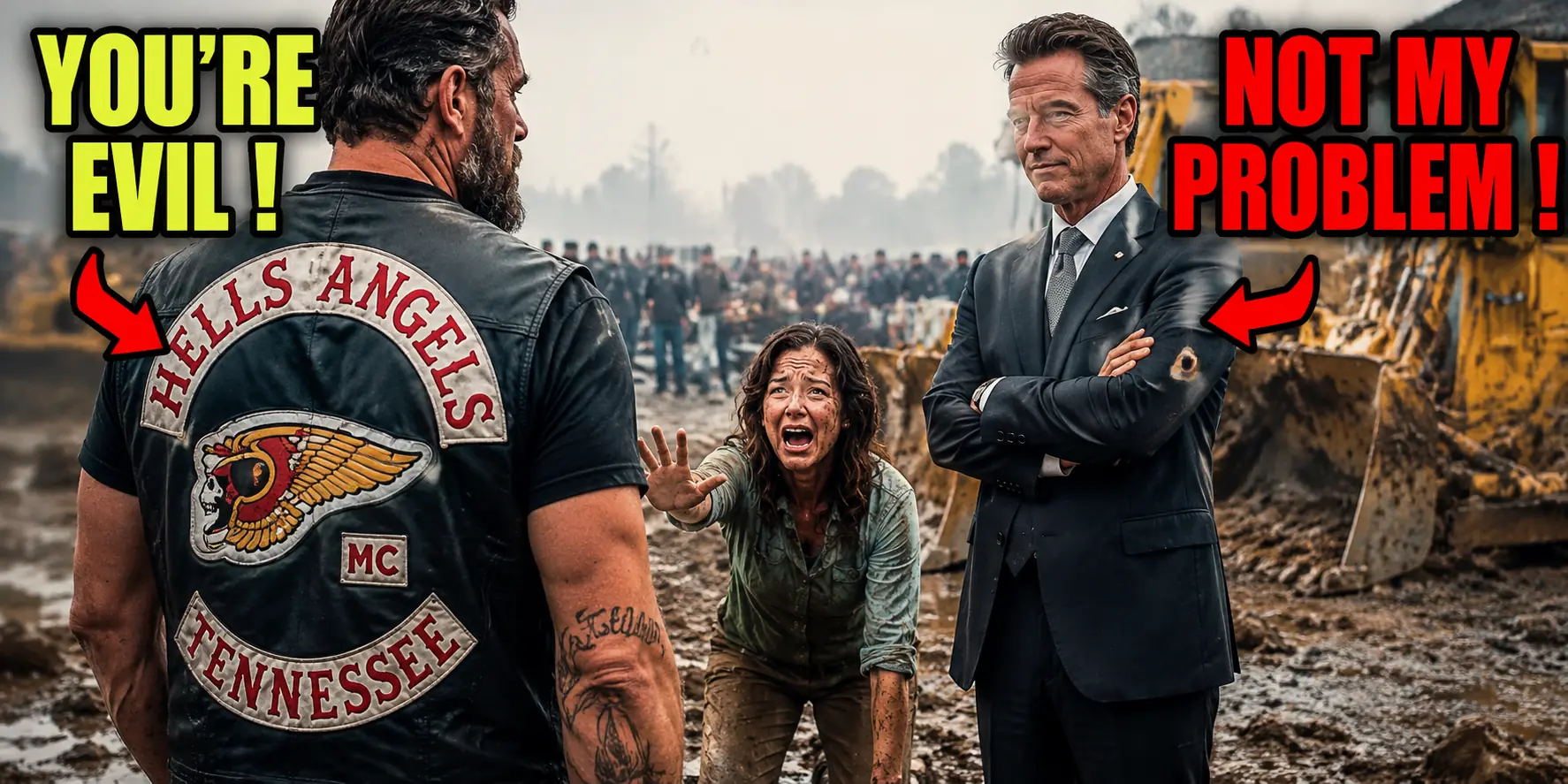
Preston Kane stepped out of his car, walked across the churned mud in his tailored grey suit, and ground his polished shoe directly into a wooden sign lying face up in the rubble. It was a hand-carved plaque bearing the name of Grace’s late husband, a decorated Army veteran and a respected Hells Angels road captain who had built this diner beam by beam with his own hands. Kane laughed as he twisted his heel over the carved letters, calling the dead man’s memory nothing but sentimental garbage standing in the way of progress. He believed he had already won. But what happened over the next hour would leave an entire county speechless.
Piney Ridge, Tennessee, sat at the base of the Cumberland foothills, a town of eleven thousand people where the tallest building was still the grain silo built in 1941. The Ember and Oak Diner stood on the corner of Route 9 and Miller Street, a squat stone building with a tin roof that rattled every time a truck rolled past. The smell of bacon grease and fresh biscuits drifted out through a screen door that never quite closed all the way, mixing with the sharper scent of diesel from the gas station across the street. Inside, the linoleum floor had gone the color of weak tea from four decades of boots, and the counter—an oak slab salvaged from an old cattle auction house—still bore a burn mark shaped like a horseshoe that nobody could ever quite sand out.
Ethan Holloway built that counter with his own hands. He came home from his second deployment with a Purple Heart pinned to a uniform he rarely wore again and a silence in his eyes that only lifted when he was welding a motorcycle frame or hammering a nail. He found his brotherhood twice in his life—once in the Army and once on two wheels when a Hells Angels chapter out of Knoxville took him in and gave him a road name: Hollow, because he said the war had scooped something out of him that only the open highway could fill. He rose to road captain within four years, the man who mapped every charity ride and funeral procession the chapter ever ran, the man other riders trusted to find the safest line through a mountain switchback in the rain.
Grace met him three years after his discharge, waiting tables at the same truck stop off the interstate where she would later work double shifts to help him rebuild the barn. He came in every Sunday morning on a motorcycle that sounded like distant weather, always ordering the same black coffee and two eggs, always leaving a folded dollar bill under the saucer even when the tip jar sat empty on slow mornings. It took him four months to ask for her number and another six to admit, sitting on the tailgate of his truck under a sky full of stars, that he had spent most of those months too afraid of disappointing someone to try. Grace told him then that the war might have taken pieces of him, but it had left behind a man who noticed when the elderly regular in the corner booth needed his coffee refilled before he even asked, and that was more than most whole men ever managed.
He married Grace on a Tuesday in October in the gravel lot behind this very building, back when it was still a crumbling blacksmith barn the county was ready to condemn. Ethan bought it for almost nothing and spent two years rebuilding it beam by beam, evenings and weekends, while Grace waited tables at a truck stop off the interstate to keep the lights on in their rented trailer. She remembered the sound of his hammer through the thin walls at night, steady as a heartbeat, and the smell of sawdust that never quite left his hair no matter how many times he showered. When the doors finally opened, Ethan carved a wooden sign himself and hung it above the entrance: the Ember and Oak. Ember for the forge that once stood here. Oak for the beam that held the roof.
For six years the diner became the unofficial clubhouse annex, the place where road captains held pre-ride briefings over black coffee and grits, where the widow of a fallen brother from another charter was quietly slipped free meals for a full year after her husband’s funeral, where a corkboard by the register slowly filled with photographs of charity runs and toy drives and a single yellowed newspaper clipping about the year the chapter raised eleven thousand dollars for the Children’s Hospital in Knoxville. Then, on a flooded stretch of Route 11 during a spring storm, a school bus carrying five children skidded off the shoulder and caught fire against a fallen power line. Ethan was riding home from a supply run when he saw the flames through the rain, orange light smearing across a windshield already blurred by water. He did not wait for the fire department.
The driver later told investigators she remembered a single figure in a soaked leather cut wading through knee-deep water toward the burning frame, moving with the flat, unhurried purpose of a man who had done far worse things under far worse fire. He broke the rear emergency door with the heel of his boot, reached into black smoke that swallowed his arm to the shoulder, and pulled a child free by the collar of her jacket, setting her down in the mud before turning straight back toward the wreck. He carried the second child out coughing. He carried the third out limp and breathed life back into her on the shoulder of the road until she sputtered awake. Rain hissed against burning metal. Smoke rolled low across the water. His reflection in the flooded ditch caught the orange glow for half a second before he turned back toward the wreck. The fuel tank caught as he reached in for the fourth, a wall of heat rolling over him hard enough to knock him backward into the ditch. He climbed back to his feet anyway and pulled the last child through a window frame with his bare hands, his gloves already burned through by the time her sneakers touched the mud. He survived eleven days in a burn unit in Nashville before his heart gave out.