CHAPTER 2: Karen's Spoiled Son Damaged My Lamborghini — Biggest Mistake of His Life
Reader Theme:
Font Size:
24px
CHAPTER 2: Karen's Spoiled Son Damaged My Lamborghini — Biggest Mistake of His Life

The girlfriend changed her story before trial. Her parents hired a lawyer and made her cooperate. She admitted the vandalism had been planned after the son saw my car online and became angry that I owned it. He wanted to impress friends by humiliating me. He wanted to prove I did not belong.
Then she revealed the part that broke their defense entirely.
His mother had suggested the word painted on the hood.
The son turned toward his mother in disbelief. For the first time, he seemed to understand that she could not protect him anymore. The shield he had hidden behind his whole life had cracked in public.
The judge denied leniency.
He said the attack involved planning, intimidation, prejudice, and extraordinary financial harm. The son received time in custody, years of probation, mandatory counseling, hundreds of community service hours, and a restitution order that would follow him long after release.
His license was suspended, and he was banned from contacting me or entering my street.
His mother was charged separately for conspiracy, intimidation, and helping conceal prior offenses. Her confident expression vanished when deputies approached her courtroom chair.
The civil case was even more devastating.
My insurance company sued them for the repair cost, loss of use, diminished value, legal expenses, and business losses from canceled appearances. Their attorney tried to settle quietly, but by then too many victims were involved and too much evidence existed.
The judge froze assets to prevent them from hiding money. Their luxury SUV was repossessed. The mother’s jewelry collection was listed. A lien landed on their home.
The same family that mocked my success had to start selling pieces of their own life to cover the consequences of what they had done.
Their social standing collapsed too.
The mother had been president of the neighborhood association. She had used that position to bully residents, control small disputes, file selective complaints, and protect her son from accountability. Once the case exposed her, the board removed her unanimously.
Emails revealed she had targeted tenants, blocked renovations, and filed false complaints against families she disliked. Residents packed the meeting and described years of intimidation. Some had never spoken publicly before. Some brought folders. Some brought printed emails.
She sat in the front row, silent, while every person she had dismissed finally spoke.
By the end of the meeting, her name had been removed from every committee, every community account, and every position of privilege.
Her son’s friends disappeared when restitution became real. Nobody wanted to be connected to that video. The expensive college that had accepted him withdrew the offer. His employer fired him after learning he had lied about the arrest. His girlfriend ended the relationship and testified during the civil proceedings.
He had destroyed my car for attention.
The attention stripped away everything he valued.
Even after release, every paycheck would be partially taken until the judgment was paid, possibly for decades.
My Lamborghini returned months later.
The shop had replaced panels, restored the carbon fiber, rebuilt the damaged sensor systems, corrected the finish, and applied a new custom protective coating. When the transport truck lowered it onto my driveway, neighbors came outside.
I expected to feel triumphant.
Instead, it felt heavier.
The car looked perfect again. The yellow was clean and deep under the sunlight. No red paint. No visible damage. No hateful word across the hood. But I remembered exactly where every mark had been.
I remembered standing there while people watched and said nothing.
I invited the neighbors closer and thanked the ones who had finally provided footage. Some looked ashamed. Some looked relieved. Some simply nodded because they understood that their silence had helped that family keep control for too long.
Truth had ended what silence protected.
I decided against revenge.
Instead, I used the insurance payout and the increased business that followed to install cameras for elderly neighbors and families who could not afford them. My company also created a small legal fund for delivery drivers and contractors facing harassment from residents who thought uniforms, work vans, or modest cars made them easy targets.
The story spread online, and customers supported the business in numbers beyond anything I could have imagined. People booked appointments not only because they loved cars, but because they understood what that car had come to represent.
The vandalism caused months of strain, but their attempt to humiliate me strengthened the community they had terrorized.
That outcome hurt them more than any angry confrontation ever could.
The mother eventually lost the house.
At sentencing, she asked the judge for mercy and claimed one mistake had destroyed her family. The judge corrected her. It had not been one mistake. It had been years of intimidation, cover-ups, and cruelty, followed by a deliberate crime they believed would have no consequences.
Her son sat behind her staring at the floor.
Neither of them apologized to me sincerely. They apologized only after the cost reached them. That distinction mattered, and the judge made sure the record reflected it.
Later, I parked the Lamborghini outside my shop and watched sunlight cross the clean yellow hood. No red paint. No insult. Only the reflection of the building I had earned.
Their karma did not come from me destroying them.
It came through evidence, victims united, and consequences they had avoided for years.
The son wanted a cruel joke in a viral video. Instead, he exposed his family’s history.
He laughed beside my car once.
He never laughed in court.
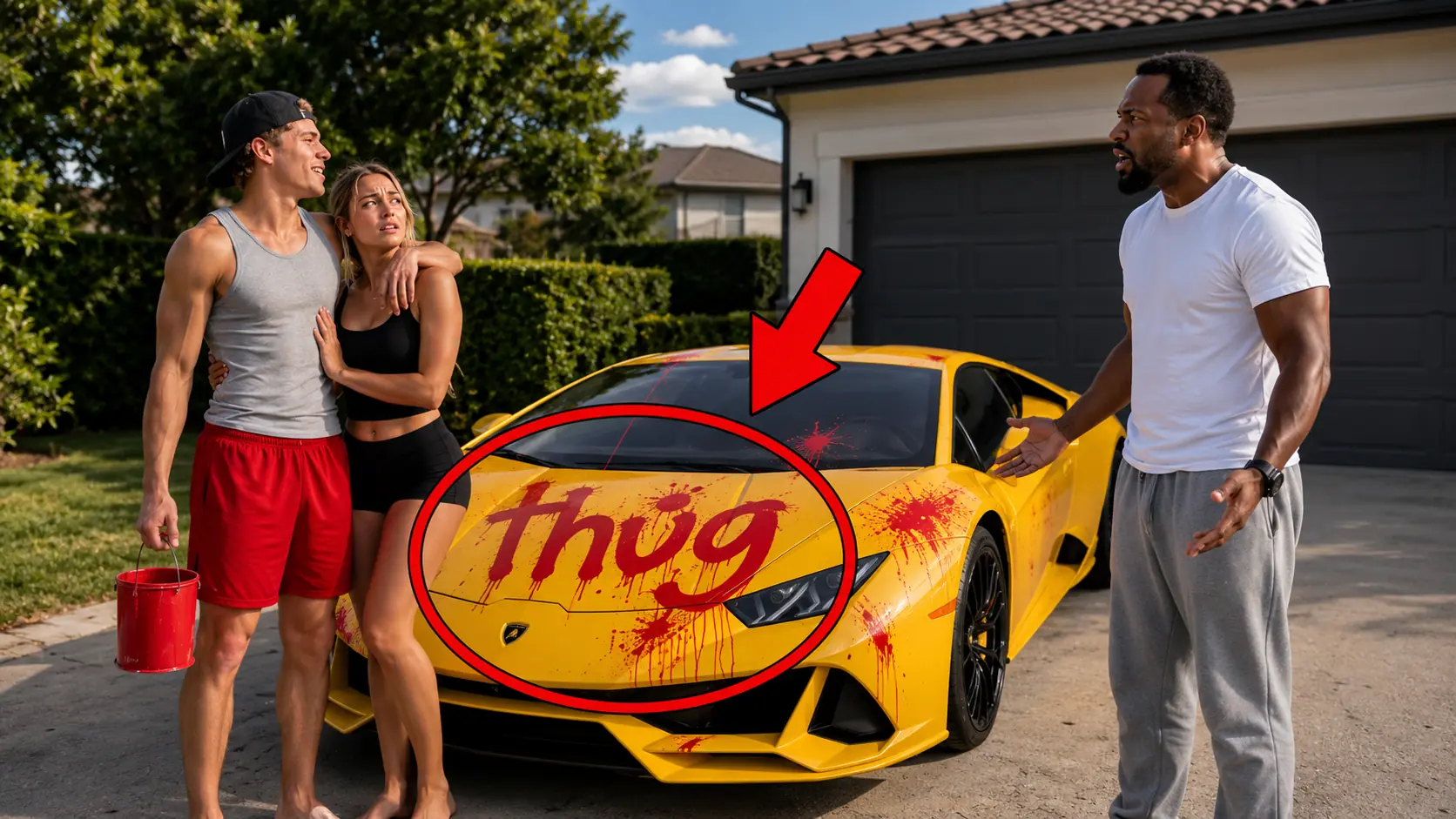
People tried to make the story about the Lamborghini because the car was easy to picture: a yellow supercar in a driveway, red paint on the hood, and a teenager laughing beside it. But the car was only the surface. The deeper story was about entitlement, status, and a family that believed the neighborhood belonged to them more than anyone else.
It started with small comments, tight smiles, questions about whether my business was real, and complaints aimed at people they disliked. None of those moments were large enough alone to make a case. That is how people like that survive: they build control through things small enough to deny.
By the time their son poured paint on my car, he was not creating the culture. He was revealing it.
One delivery driver brought messages showing how the mother had threatened to get him fired after he parked briefly in front of her driveway. A contractor brought photos of damage to his truck after refusing to do extra work for free. A former classmate shared recordings of the son bragging about getting away with things because his mother always handled it.
Each piece of evidence widened the frame.
What happened to my car was not an isolated outburst. It was the loudest part of a long-running pattern.
My attorney told me not to turn the case into a shouting match. Do not argue. Do not trade insults. Document everything. Every call was logged, every email saved, every photograph backed up, and every former victim sent to the right investigator. When they called it a misunderstanding, the record answered. When they called it a prank, the repair estimate answered.
The day the neighborhood association voted her out, I stood at the back of the room and listened. The people she had pushed around for years finally felt safe enough to tell the truth.
An elderly widower described being threatened over his porch light. A young couple described being fined repeatedly after refusing to sell their home to one of her friends. A single mother described how the son had harassed her delivery drivers until companies stopped wanting to come to her address.
The board members looked uncomfortable, but that discomfort was overdue.
For years, they had treated her behavior as strong leadership. They had mistaken fear for order. They had mistaken silence for peace.
That meeting ended the illusion.
Afterward, one neighbor approached me in the parking lot. He had watched from behind his curtains that morning and admitted he had footage from the beginning but hesitated because he did not want to get involved. I told him, “You were involved the moment you saw it.” He nodded and did not argue.
When the legal fund started, I thought only a few people would use it. In the first month, three delivery drivers contacted us. Then a landscaper. Then a young mechanic accused of stealing tools from a garage he had never entered. We connected people with attorneys, helped them preserve evidence, and gave them cameras when they needed proof more than sympathy. That became the part of the story I was proudest of.
Months after the case ended, I drove the Lamborghini to a community event at my shop. I parked it outside, not as a trophy, but as a reminder. The hood was flawless again, and people came up to admire it. Some asked about the paint. Some asked about the repairs. Some asked if I still felt angry.
I thought about that before answering.
Anger had been there, of course. I would be lying if I said it had not. But anger was not what carried me through the case. Discipline did. Documentation did. Community did.
The family wanted me to lose control. They wanted me to shout, threaten, or make one mistake they could use to rewrite the story.
I refused to give them that.
Their cruelty created the evidence. Their arrogance created the witnesses. Their threats created the additional charges. Their history created the pattern. All I did was refuse to erase what they had done.
That is why, when people ask whether I forgave them, I tell them forgiveness is not the same as silence.
They faced consequences because consequences were earned.
The son had wanted a moment of laughter. His mother had wanted another cover-up. They both assumed the same thing every bully assumes: that the person they hurt would be too shocked, too isolated, or too tired to fight back properly.
They were wrong.
The car was repaired.
The house was sold.
The judgment remained.
And the neighborhood learned that the truth, once documented and shared by enough people, can become heavier than any family name, any social position, or any threat whispered over the phone.
I still drive the Lamborghini sometimes. Not every day. Not to prove anything. I drive it because I like the way it feels, because I earned it, and because the hood reflects the sky without carrying their word anymore.
That is the only victory I needed.

The girlfriend changed her story before trial. Her parents hired a lawyer and made her cooperate. She admitted the vandalism had been planned after the son saw my car online and became angry that I owned it. He wanted to impress friends by humiliating me. He wanted to prove I did not belong.
Then she revealed the part that broke their defense entirely.
His mother had suggested the word painted on the hood.
The son turned toward his mother in disbelief. For the first time, he seemed to understand that she could not protect him anymore. The shield he had hidden behind his whole life had cracked in public.
The judge denied leniency.
He said the attack involved planning, intimidation, prejudice, and extraordinary financial harm. The son received time in custody, years of probation, mandatory counseling, hundreds of community service hours, and a restitution order that would follow him long after release.
His license was suspended, and he was banned from contacting me or entering my street.
His mother was charged separately for conspiracy, intimidation, and helping conceal prior offenses. Her confident expression vanished when deputies approached her courtroom chair.
The civil case was even more devastating.
My insurance company sued them for the repair cost, loss of use, diminished value, legal expenses, and business losses from canceled appearances. Their attorney tried to settle quietly, but by then too many victims were involved and too much evidence existed.
The judge froze assets to prevent them from hiding money. Their luxury SUV was repossessed. The mother’s jewelry collection was listed. A lien landed on their home.
The same family that mocked my success had to start selling pieces of their own life to cover the consequences of what they had done.
Their social standing collapsed too.
The mother had been president of the neighborhood association. She had used that position to bully residents, control small disputes, file selective complaints, and protect her son from accountability. Once the case exposed her, the board removed her unanimously.
Emails revealed she had targeted tenants, blocked renovations, and filed false complaints against families she disliked. Residents packed the meeting and described years of intimidation. Some had never spoken publicly before. Some brought folders. Some brought printed emails.
She sat in the front row, silent, while every person she had dismissed finally spoke.
By the end of the meeting, her name had been removed from every committee, every community account, and every position of privilege.
Her son’s friends disappeared when restitution became real. Nobody wanted to be connected to that video. The expensive college that had accepted him withdrew the offer. His employer fired him after learning he had lied about the arrest. His girlfriend ended the relationship and testified during the civil proceedings.
He had destroyed my car for attention.
The attention stripped away everything he valued.
Even after release, every paycheck would be partially taken until the judgment was paid, possibly for decades.
My Lamborghini returned months later.
The shop had replaced panels, restored the carbon fiber, rebuilt the damaged sensor systems, corrected the finish, and applied a new custom protective coating. When the transport truck lowered it onto my driveway, neighbors came outside.
I expected to feel triumphant.
Instead, it felt heavier.
The car looked perfect again. The yellow was clean and deep under the sunlight. No red paint. No visible damage. No hateful word across the hood. But I remembered exactly where every mark had been.
I remembered standing there while people watched and said nothing.
I invited the neighbors closer and thanked the ones who had finally provided footage. Some looked ashamed. Some looked relieved. Some simply nodded because they understood that their silence had helped that family keep control for too long.
Truth had ended what silence protected.
I decided against revenge.
Instead, I used the insurance payout and the increased business that followed to install cameras for elderly neighbors and families who could not afford them. My company also created a small legal fund for delivery drivers and contractors facing harassment from residents who thought uniforms, work vans, or modest cars made them easy targets.
The story spread online, and customers supported the business in numbers beyond anything I could have imagined. People booked appointments not only because they loved cars, but because they understood what that car had come to represent.
The vandalism caused months of strain, but their attempt to humiliate me strengthened the community they had terrorized.
That outcome hurt them more than any angry confrontation ever could.
The mother eventually lost the house.
At sentencing, she asked the judge for mercy and claimed one mistake had destroyed her family. The judge corrected her. It had not been one mistake. It had been years of intimidation, cover-ups, and cruelty, followed by a deliberate crime they believed would have no consequences.
Her son sat behind her staring at the floor.
Neither of them apologized to me sincerely. They apologized only after the cost reached them. That distinction mattered, and the judge made sure the record reflected it.
Later, I parked the Lamborghini outside my shop and watched sunlight cross the clean yellow hood. No red paint. No insult. Only the reflection of the building I had earned.
Their karma did not come from me destroying them.
It came through evidence, victims united, and consequences they had avoided for years.
The son wanted a cruel joke in a viral video. Instead, he exposed his family’s history.
He laughed beside my car once.
He never laughed in court.
People tried to make the story about the Lamborghini because the car was easy to picture: a yellow supercar in a driveway, red paint on the hood, and a teenager laughing beside it. But the car was only the surface. The deeper story was about entitlement, status, and a family that believed the neighborhood belonged to them more than anyone else.
It started with small comments, tight smiles, questions about whether my business was real, and complaints aimed at people they disliked. None of those moments were large enough alone to make a case. That is how people like that survive: they build control through things small enough to deny.
By the time their son poured paint on my car, he was not creating the culture. He was revealing it.
One delivery driver brought messages showing how the mother had threatened to get him fired after he parked briefly in front of her driveway. A contractor brought photos of damage to his truck after refusing to do extra work for free. A former classmate shared recordings of the son bragging about getting away with things because his mother always handled it.
Each piece of evidence widened the frame.
What happened to my car was not an isolated outburst. It was the loudest part of a long-running pattern.
My attorney told me not to turn the case into a shouting match. Do not argue. Do not trade insults. Document everything. Every call was logged, every email saved, every photograph backed up, and every former victim sent to the right investigator. When they called it a misunderstanding, the record answered. When they called it a prank, the repair estimate answered.
The day the neighborhood association voted her out, I stood at the back of the room and listened. The people she had pushed around for years finally felt safe enough to tell the truth.
An elderly widower described being threatened over his porch light. A young couple described being fined repeatedly after refusing to sell their home to one of her friends. A single mother described how the son had harassed her delivery drivers until companies stopped wanting to come to her address.
The board members looked uncomfortable, but that discomfort was overdue.
For years, they had treated her behavior as strong leadership. They had mistaken fear for order. They had mistaken silence for peace.
That meeting ended the illusion.
Afterward, one neighbor approached me in the parking lot. He had watched from behind his curtains that morning and admitted he had footage from the beginning but hesitated because he did not want to get involved. I told him, “You were involved the moment you saw it.” He nodded and did not argue.
When the legal fund started, I thought only a few people would use it. In the first month, three delivery drivers contacted us. Then a landscaper. Then a young mechanic accused of stealing tools from a garage he had never entered. We connected people with attorneys, helped them preserve evidence, and gave them cameras when they needed proof more than sympathy. That became the part of the story I was proudest of.
Months after the case ended, I drove the Lamborghini to a community event at my shop. I parked it outside, not as a trophy, but as a reminder. The hood was flawless again, and people came up to admire it. Some asked about the paint. Some asked about the repairs. Some asked if I still felt angry.
I thought about that before answering.
Anger had been there, of course. I would be lying if I said it had not. But anger was not what carried me through the case. Discipline did. Documentation did. Community did.
The family wanted me to lose control. They wanted me to shout, threaten, or make one mistake they could use to rewrite the story.
I refused to give them that.
Their cruelty created the evidence. Their arrogance created the witnesses. Their threats created the additional charges. Their history created the pattern. All I did was refuse to erase what they had done.
That is why, when people ask whether I forgave them, I tell them forgiveness is not the same as silence.
They faced consequences because consequences were earned.
The son had wanted a moment of laughter. His mother had wanted another cover-up. They both assumed the same thing every bully assumes: that the person they hurt would be too shocked, too isolated, or too tired to fight back properly.
They were wrong.
The car was repaired.
The house was sold.
The judgment remained.
And the neighborhood learned that the truth, once documented and shared by enough people, can become heavier than any family name, any social position, or any threat whispered over the phone.
I still drive the Lamborghini sometimes. Not every day. Not to prove anything. I drive it because I like the way it feels, because I earned it, and because the hood reflects the sky without carrying their word anymore.
That is the only victory I needed.


