CHAPTER 2: THE NIGHT THE FEDERAL TEAM ARRIVED
Hayes's eyes hardened into cold slits. A tier 1 operator, one of the deadliest, most highly trained men on the planet, had just triggered a capture distress beacon from inside a civilian police station in New York. Get the director of the FBI on a secure line right now, Admiral Hayes ordered, his voice dropping to a dangerous, icy register. And patch me through to the chief of police in Oak Ridge.
Wake him up if you have to. Someone in that town just made the biggest mistake of their pathetic life. Chief Arthur Pendleton was a man who appreciated the quiet predictability of small town law enforcement. At 58 years old, he was coasting toward a comfortable retirement, his days primarily occupied by budget meetings, mediating minor municipal disputes, and ensuring the annual Oak Ridge Autumn Parade went off without a hitch.
He had been asleep for precisely 3 hours when the encrypted secure line in his home office began to ring. It was not his standard-issued smartphone. It was a bulky hardwired terminal installed by the Department of Homeland Security years ago as part of a post-9/11 federal communication initiative. A device that had literally never rung in its entire existence.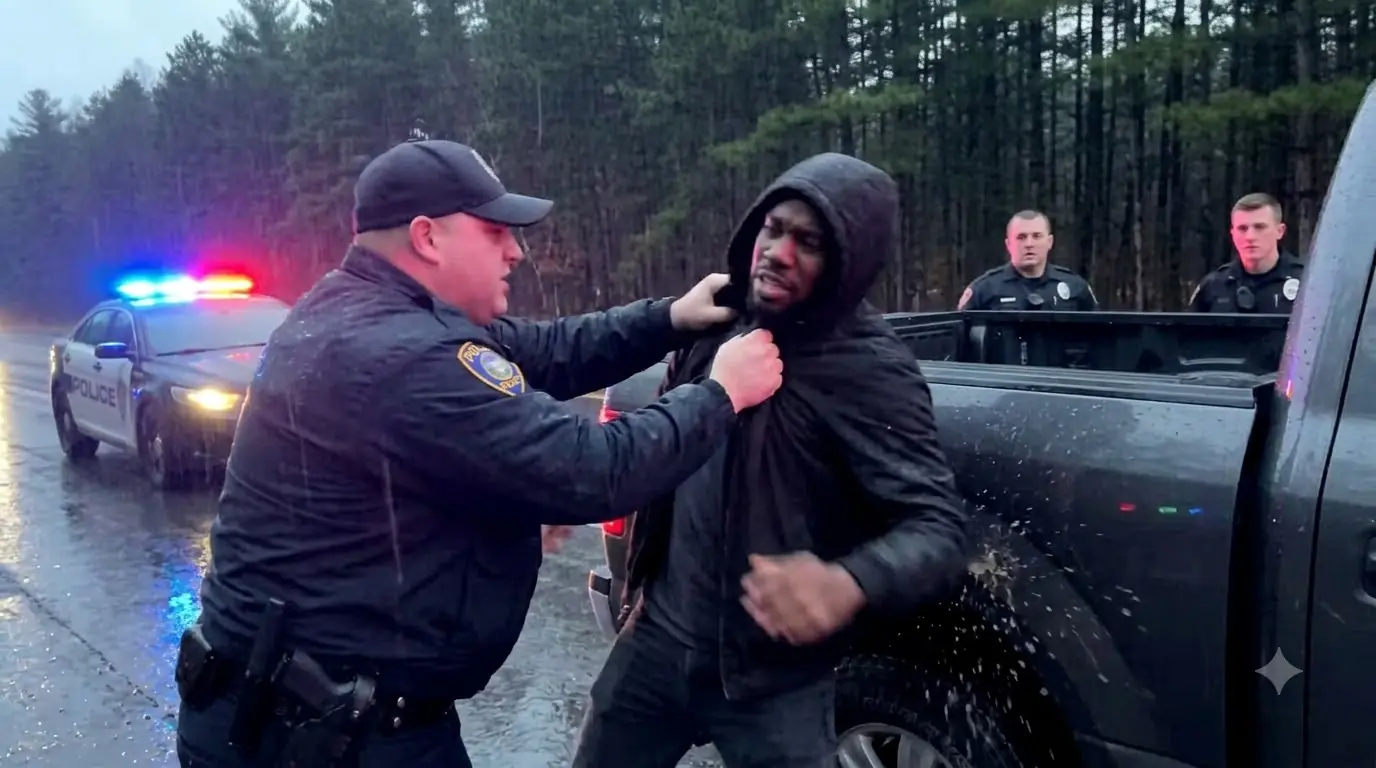
The jarring mechanical trill echoed through the quiet house, waking him instantly. Pendleton stumbled out of bed, his heart hammering against his ribs, and hurried down the hallway in the dark. He picked up the heavy receiver. Chief Pendleton speaking.
Chief Pendleton, this is Admiral Richard Hayes, Deputy Director of Joint Special Operations Command at the Pentagon. I am currently patching in special agent David Kensington, the special agent in charge of the Albany FBI field office. Do you understand who you are speaking to? Pendleton's blood ran cold.
The sheer weight of the titles alone was enough to vaporize any remaining sleep from his mind. Yes, Admiral, I understand. What on earth is happening? 52 minutes ago, a priority 1 distress beacon was activated from inside your primary police precinct, Admiral Hayes stated.
His voice devoid of any warmth, carrying the lethal precision of a guided munition. The beacon belongs to a tier one asset assigned to the Naval Special Warfare Development Group, Chief Petty Officer Isaiah Coleman. He was traveling to your local hospital on an emergency family leave status. According to our satellite telemetry and the audio captured before his encrypted device was deliberately tampered with, one of your officers has taken him into custody without cause.
Pendleton felt his knees weaken. He gripped the edge of his mahogany desk to steady himself. Admiral, there has to be some kind of misunderstanding. We don't hold military personnel without notifying the proper chain of command.
I haven't been briefed on any major arrests tonight. It is not a misunderstanding, Chief. Special Agent Kensington chimed in, his voice equally severe. The tamper protocol on Chief Coleman's government-issued communication device was triggered by multiple failed password attempts.
The audio recorded an officer identifying himself as Sergeant Gordon. Your man illegally seized highly classified federal property and initiated a zeroize protocol. That is a violation of the Espionage Act, a federal felony. Gordon, Pendleton whispered, a sickening wave of realization washing over him.
Tremaine Gordon was a walking liability, a relic of an older, uglier era of policing who had managed to evade termination through union loopholes. Chief Pendleton, listen to me very carefully," Admiral Hayes continued, his tone dropping to a terrifying register. "You are currently holding a man who holds a top secret, sensitive, compartmented information clearance. He has operated in environments your men cannot even comprehend.
He is not a civilian suspect. He is a vital national security asset. You will immediately contact your dispatch. You will order this Sergeant Gordon to stand down, step away from the holding cell, and not so much as breathe in Chief Coleman's direction.
Federal agents and military liaison are currently inbound to your location to secure the asset. If one hair on his head is harmed, I will personally ensure your department is dismantled by the Department of Justice and your officers will face federal kidnapping charges. Do I make myself perfectly clear? Crystal clear.
Admiral, I am calling the station on my other line right now. I am leaving for the precinct immediately, Pendleton stammered, sweat beading on his forehead, despite the chill in the room. You have 5 minutes before my people hit your front door, Special Agent Kensington added. The line clicked dead.
Back at the Oak Ridge Police Department, Tremaine Gordon was feeling entirely triumphant. He leaned back in his creaky desk chair, his boots propped up on a stack of incident reports, sipping a stale cup of coffee. He had successfully collided a suspect who had dared to disrespect him, and he was currently crafting a heavily embellished arrest report to justify the excessive force and the dubious traffic stop. The heavy metal door connecting the garage to the bullpen swung open, and Officer Kevin Webb walked in, completely drenched from the freezing autumn rain.
He looked pale, exhausted, and visibly anxious. "Well," Gordon asked, not looking up from his keyboard. "How many keys of narcotics did you find tucked into the upholstery? Give me the good news, rookie." Webb swallowed hard, pulling off his soaked uniform cap.
Sarge, there are no drugs. I tore the entire cabin apart. I checked the undercarriage, the wheel wells, the spare tire compartment. Nothing.
Gordon scoffed, shaking his head in disgust. Then he dumped it before I lit him up. Or it's perfectly hidden. What about his bags?
Did you search the duffel? I searched it, Webb said, his voice trembling slightly. He walked over and placed a large, heavy item on Gordon's desk. It was a specialized tactical medical kit, completely devoid of civilian branding.
Sarge, I don't think this guy is a drug runner. Look at this gear. This is a blowout kit. It's got military-grade tourniquets, chest seals, hemostatic gauze.
The tags on his clothing say Crye Precision. and bolted to the floorboard in the back under a floor mat is a steel reinforced pelican case with a biometric lock. I couldn't get it open, so he's a highly organized criminal. Gordon sneered, refusing to accept the mounting evidence that he had made a colossal error. Probably running guns for a cartel.
That explains the fancy medical gear and the encrypted phone. Sarge, he gave you his name. Isaiah Coleman. I ran him through the National Crime Information Center database while I was in the cruiser.
Webb pleaded, leaning over the desk. Nothing came back. No prior, no warrants, no traffic tickets. But when I tried to run his driver's license through the secondary federal database, my computer screen locked up.
It just flashed a routing code to the Department of Defense. Sarge, I think he was telling the truth. I think he's military. He's a liar.
Gordon snapped, slamming his coffee mug down on the desk. I've been on this job 20 years, Webb. I know a dirt bag when I see one. You're just too green to see through the act.
Across the room, the dispatch console lit up. Brenda picked up the headset, her usual bored expression instantly vanishing, replaced by wideeyed panic. Yes, Chief. Yes, sir.
He's sitting right here. Chief, calm down. I can barely understand. Brenda ripped the headset off and stared across the room at Gordon.
Gordon, the chief is online one. He is screaming your name. He sounds like he's having a heart attack. Gordon rolled his eyes, utterly unbothered.
He picked up his desk phone and punched the blinking button. Sergeant Gordon, what's going on? Arty, bit late for you to be micromanaging the night shift, isn't it? Shut your mouth and listen to me, you absolute imbecile.
Chief Pendleton's voice exploded through the receiver with such sheer volume that Webb could hear it from 3 ft away. Who exactly do you have in holding cell 3 right now? A suspected narcotics trafficker caught him speeding on 32, erratic driving, refused a search. "You lying, arrogant fool!" Pendleton roared, his voice cracking with panic and rage.
"You arrested a tier 1 Navy Seal on emergency leave. You confiscated and destroyed a highly classified piece of federal communication equipment. The Pentagon just woke me up, Tmaine. The director of the FBI's field office just threatened to indict my entire department for federal kidnapping.
Gordon's smug expression froze. The color instantly drained from his face, leaving his skin an unhealthy, pallid gray. The silence in the precinct was deafening, save for the rhythmic drumming of the rain against the reinforced windows. He looked down at the tactical medical kit on his desk, then over to the plastic evidence bin where he had carelessly tossed the heavy black satellite phone.
"Chief!" Arty! He was acting suspicious. "He wouldn't cooperate. I was just doing my job," Gordon stammered.
The reality of his situation violently breaching his ego. "You don't have a job anymore, Tmaine." Pendleton seethed. You are stripped of your badge, your gun, and your authority effective this exact second. You will not approach that holding cell.
You will not speak to that man. You will sit down at your desk, put your hands flat on the table, and wait for the federal agents who are currently descending on our precinct. If you do anything else, I will personally throw you to the wolves. Do you understand me?
The line went dead. Gordon slowly lowered the phone to the cradle. His hands were shaking. He looked at Webb, who had taken two distinct steps backward, visibly distancing himself from his commanding officer.
"Sarge?" Webb asked, his voice barely a whisper. "What did you do?" Down the concrete hallway, seated on the thin, stained mattress of holding cell 3, Isaiah Coleman remained perfectly still. His eyes were closed, his breathing slow and rhythmic. He had heard the phone ring.
He had heard the frantic, elevated tones of the dispatcher, and he could feel the sudden, crushing shift in the atmosphere of the building, the arrogant swagger of his captives had evaporated, replaced by the suffocating stench of pure, unadulterated terror. Isaiah opened his eyes and checked the luminescent dial of his tactical watch. It was 3:12 a.m. He calculated the response time of the quick reaction force stationed at the nearest federal installation. They were ahead of schedule.
The low rhythmic thumping started as a subtle vibration in the floorboards of the Oak Ridge Police Department. A distant hum that slowly built into a deafening chest rattling roar. Officer Webb rushed to the front windows, peering through the rain streaked glass into the darkness. Holy mother of Webb breathed, stepping back as a blinding spotlight pierced the night.
A massive slategrey Sikorski UH60 tactical helicopter descended from the stormy sky, completely ignoring the municipal noise ordinances and the lack of a proper helipad. It hovered inches above the precinct's employee parking lot, the immense downdraft from its rotors violently whipping the pine trees, sending garbage cans spiraling across the asphalt and shattering the passenger side window of Gordon's parked cruiser. Before the landing gear even fully settled onto the pavement, the side doors slid open. Figures clad in full tactical gear, heavy plate carriers, ballistic helmets, and suppressed short-barreled rifles poured out of the aircraft with terrifying synchronized precision.
They moved not like police officers, but like a localized force of nature, swarming the entrance of the small town precinct. They were members of the FBI's regional hostage rescue team, accompanied by heavily armed military police personnel. The front doors of the station were practically ripped off their hinges. Seven Federal tactical operators flooded the bullpen, their weapons lowered, but instantly commanding every square inch of the room.
Federal agents, nobody move. Hands where we can see them. The lead operator barked, his voice echoing off the cinder block walls. Brenda threw her hands in the air, terrified.
Officer Webb immediately dropped to his knees, lacing his fingers behind his head. Thoroughly convinced his short career was ending in a federal prison, Gordon remained frozen in his chair, staring in horrified disbelief at the heavily armed strike team occupying his jurisdiction. Following the tactical team walked special agent David Kensington. He wore a damp trench coat over a tailored suit, his expression hardened into a scowl of pure disgust.
Beside him walked Captain Jonathan Reed of the United States Navy Judge Advocate General's Corps, pristine in his service dress uniform despite the weather. Kensington bypassed the front desk entirely, marching directly toward Gordon's desk. He looked down at the terrified sergeant, then glanced at the tactical gear piled on the desk and the destroyed classified phone in the evidence bin. "Are you Sergeant Tremaine Gordon?" Kensington demanded, his voice dangerously quiet.
I Yes, sir. I I am, Gordon croaked, his throat completely dry. Sergeant Gordon, you are currently under investigation for violating the Espionage Act. deprivation of rights under color of law and false imprisonment of a United States military official, Kensington stated, withdrawing a set of heavy federal handcuffs from his belt. Stand up, turn around, put your hands behind your back.
Gordon's mind completely broke. The invincibility he had felt for 20 years vanished, leaving only a pathetic, trembling shell. Agent, please. This is a mistake.
I was running a routine traffic stop. He was uncooperative. I thought he was trafficking. Captain Reed stepped forward, towering over Gordon.
You thought a tier 1 operator driving a legally rented vehicle with zero contraband who politely provided his identification was a trafficker? Or did you just see a black man in an expensive truck and decide to ruin his night to stroke your own fragile ego? Gordon had no answer. He slowly stood up and turned around, offering his wrists.
Kensington clamped the cuffs down brutally tight, a poetic echo of what Gordon had done an hour prior. "Where is Chief Petty Officer Coleman?" Captain Reed demanded, looking at the rookie officer still kneeling on the floor. "Holding cell three, sir," Webb practically shouted. "Down the hall, last door on the left." "Get the keys now," Kensington ordered.
Webb scrambled to his feet, sprinted to the pegboard behind the dispatch console, and grabbed the heavy brass key ring. He sprinted down the hallway, practically tripping over his own boots with Captain Reed and Special Agent Kensington right behind him. Webb fumbled with the heavy iron lock, his hands shaking so violently he dropped the keys twice before finally securing it in the mechanism. He threw the heavy barred door open.
Isaiah Coleman was sitting exactly where they had left him, his posture completely relaxed. He looked up at the assembly of federal agents, and military brass gathered outside his cell. He didn't look relieved. He looked utterly impatient.
Captain Reed snapped sharply to attention, delivering a crisp, immaculate salute. Chief Coleman, sir. Captain Reed, JAG Corps. On behalf of the Department of the Navy and the Federal Government, I apologize for this catastrophic breach of protocol and your unlawful detainment.
Your commanding officer sends his regards, and we are here to facilitate your immediate release and transport." Isaiah stood up, smoothly, returning the salute despite his bruised wrists. He walked out of the cell, bypassing Web entirely, and looked special agent Kensington dead in the eye. "Agent Kensington," Isaiah said, his voice a low, rumbling base. "I appreciate the swift extraction, but I do not care about pressing charges right now.
I do not care about the paperwork. I have a mother on a ventilator at Oak Ridge Memorial Hospital, and I have lost 90 minutes of time. I cannot get back. I need my keys and I need my vehicle.
Chief, your truck is currently being secured by my team, Kensington replied immediately, stepping aside to clear the path. But you aren't driving. We have a federal convoy waiting outside and a state trooper escort ready to shut down the interstate. We will have you at Oak Ridge Memorial in less than 8 minutes.
Isaiah nodded once, a brief acknowledgement of gratitude. Let's move. As they walked back through the bullpen, they passed Gordon, who was now seated in handcuffs on a wooden bench, surrounded by heavily armed federal agents. Gordon looked up, his eyes meeting Isaiah's for a fleeting second.
He expected to see triumph, anger, or gloating in the seal's expression. Instead, Isaiah looked at him with absolute chilling indifference. To Isaiah Coleman, Gordon wasn't a threat, a rival, or even a worthy adversary. He was an insect that had briefly flown into his windshield, an irrelevant obstacle that had already been swept away.
Isaiah didn't say a single word to him. He simply walked out the shattered front doors, stepping into the torrential rain and the blinding lights of the federal convoy, leaving Tremaine Gordon to the ruins of his miserable life. Tires screamed against the rainslicked asphalt as the federal convoy tore through the sleeping streets of Oak Ridge. Two New York State Police interceptors led the vanguard, their sirens wailing a continuous, piercing note that bounced off the brick storefronts of the downtown district.
Behind them, a trio of armored black Chevrolet Suburbans moved in flawless high-speed formation, shielding the vehicle carrying Chief Petty Officer Isaiah Coleman. Inside the center suburban, the atmosphere was thick with tense, heavily armed silence. Isaiah sat in the rear passenger seat, his eyes fixed on the blurring street lights outside the reinforced glass. The anger that had simmered in the holding cell had entirely vanished, replaced by a cold, suffocating dread.
On a battlefield, he had agency. He had a weapon, a team, and a tactical objective. But in the face of a massive ischemic stroke, all his elite training, all the millions of dollars the government had invested in, making him an apex predator, meant absolutely nothing. He was completely powerless, and it terrified him in a way combat never could.
Special Agent Kensington sat across from him, quietly monitoring a localized encrypted radio feed. He tapped his earpiece. Chief, the state troopers have locked down the intersection surrounding Oak Ridge Memorial. We have a clear path directly to the emergency room loading bay.
My men have already coordinated with the hospital's head of security. We bypass triage and take the freight elevator straight to the intensive care unit on the fourth floor. Thank you, Agent Kensington, Isaiah murmured, his voice tight. I appreciate the logistics.
It is the absolute least we could do, sir, Captain Reed added from the front passenger seat, glancing back. The Department of Defense considers your family's welfare a priority. Nobody delays one of our own. The convoy violently banked left, tires skidding slightly before catching traction and surged up the steep driveway of Oak Ridge Memorial Hospital.
They didn't park in the visitors lot. The Suburbans bypassed the civilian entrance entirely, screeching to a halt directly beneath the brightly lit awning of the ambulance bay. Before the vehicles had even fully settled on their suspensions, the tactical operators from the hostage rescue team were out, forming a defensive perimeter around the center SUV. It was a standard VIP protection protocol, executed with terrifying efficiency.
The sliding doors of the emergency room blew open and a startled night shift charge nurse watched in absolute bewilderment as a heavily armed federal strike team escorted a lone Black man in civilian clothes through the sliding glass doors. "Clear a path. Federal agents moving through," one of the operators announced, his voice echoing off the sterile white tiled walls. Isaiah didn't look at the staring doctors, the wideeyed patients in the waiting chairs, or the flashing lights.
His vision tunneled, locking entirely on the elevator banks at the end of the corridor. He walked with a rapid, predatory stride, shedding the lingering physical stiffness of Gordon's tight handcuffs. The elevator ride to the fourth floor took exactly 22 seconds, but to Isaiah it felt like a grueling, suffocating eternity. The doors finally parted with a soft chime, opening into the hushed, softly lit corridors of the ICU.
The air here smelled heavily of clinical antiseptic and quiet desperation. A silver-haired physician, wearing a white coat over green scrubs, was waiting at the nurse's station, flanked by two FBI agents who had secured the floor minutes prior. "Chief Coleman," the doctor asked, stepping forward with a chart in his hands. "I am Dr. Oris Thorne, the attending neurologist." "Where is she, Doc?" Isaiah asked, completely bypassing the formalities.
"Room 412, right this way," Dr. Thorne said, guiding Isaiah down the quiet hall. Her condition is critical, chief. The stroke affected the left hemisphere of her brain. We administered tPA, a clot busting medication, shortly after she arrived, but the damage was extensive.
She has been unresponsive for the last 6 hours. She is currently on a mechanical ventilator to assist her breathing. He stepped into the dimly lit room. The silence was broken only by the rhythmic mechanical hiss of the ventilator and the steady erratic blipping of the heart monitor.
Lying in the center of the bed, surrounded by a complex web of intravenous lines and diagnostic sensors, was his mother, Martha Coleman. She looked impossibly frail. the vibrant, fiercely independent woman who had raised him on a meager teacher's salary, who had worked double shifts to buy his football cleats, and who had proudly pinned his trident on his chest in Coronado, seemed to have shrunk into the white hospital sheets. Isaiah's stoic, impenetrable armor. The psychological shield that allowed him to kick down doors in hostile territory finally cracked.
He walked to the side of the bed, his large, calloused hands gently enveloping her small, fragile one. He carefully avoided the IV lines taped to her skin. "I'm here, mama," Isaiah whispered, his voice trembling for the first time in a decade. He dropped to his knees on the cold linoleum floor, resting his forehead against the edge of the mattress.
"I'm so sorry I'm late. I got held up, but I'm here now. He closed his eyes, tears finally slipping down his weathered cheeks. He prayed.
He didn't pray for vengeance against the arrogant cop who had stolen his time, nor did he pray for his own strength. He simply pleaded for her life, offering everything he had in exchange for just a little more time. For the next 4 hours, Isaiah didn't move. He sat in a hard plastic chair beside her bed holding her hand, speaking softly to her about his childhood, about the men on his team, and about the quiet house he was saving up to buy her by the ocean in Virginia.
Outside the room, a pair of federal agents stood guard in silent vigil, ensuring that the outside world, with all its petty cruelties and corruptions, could not touch him here, as the first gray light of dawn began to creep through the horizontal blinds of the hospital window, casting long, pale shadows across the room. Isaiah felt a sudden, faint pressure against his palm. He froze, his breath catching in his throat. He looked down at their intertwined hands.
Martha's index finger twitched. Then, very slowly, her hand squeezed his. It was a weak, barely perceptible movement. But to a man who specialized in detecting the slightest shifts in his environment, it felt like an earthquake.
Isaiah shot up from the chair, his eyes locked on her face. The rhythmic hissing of the ventilator continued, but beneath the clear plastic mask, Martha's eyelids fluttered. They struggled against the weight of the medication and the trauma, trembling for an agonizing moment before finally parting. Her eyes, cloudy and unfocused, slowly darted around the room until they found him.
She couldn't speak around the breathing tube, but the sheer overwhelming recognition in her gaze was unmistakable. The heart monitor beeped with a slightly elevated stronger rhythm. "Doc," Isaiah bellowed, his voice ringing out into the hallway with the concussive force of a flashbang. "Get in here.
She's awake." Within seconds, Dr. Thorne and a team of ICU nurses flooded the room. As they rushed to the bedside to assess her vitals and neurological responses, Isaiah stepped back against the wall. He wiped the tears from his face, exhaling a long, shuddering breath. The war wasn't over.
But the tide had just turned. She was fighting, and as long as she was fighting, Isaiah knew she would survive.
Isaiah had finally reached his mother, but while hope returned inside the ICU, a different reckoning was beginning for the officer who had stolen those precious minutes.
CHAPTER 2: THE NIGHT THE FEDERAL TEAM ARRIVED
Theme:
Font Size:
24px