CHAPTER 2: THE NINETY-TWO-SECOND TRAP
I put down the phone. I sat at the kitchen table with Estelle and May, and we ate a quiet dinner of grilled grouper and rice. I tucked May in at 9:30. I told her, very gently, that the next morning was going to be a day she would remember for the rest of her life. I told her that whatever happened, I needed her to be brave for 90 seconds.
I told her that after those 90 seconds, the entire United States Department of Justice was going to be on our street. She kissed my forehead. "Grandpa, I can be brave for 90 seconds." I sat in her doorway for a long time after she fell asleep. The hallway light caught the side of her tennis racket propped against the dresser, and a photograph on the wall of her mother holding her at 6 months old in a yellow sun hat on a Sarasota beach. I thought about Annalee.
I thought about Beck, 200 miles offshore, asleep in a steel bunk. I thought about every elderly Floridian I had not yet been able to save. Then I went to the kitchen, made a fresh pot of coffee, and sat at the table with my service weapon broken down on a soft cloth, cleaning each component the way my father had taught me to clean a rifle in 1976. Theron Ackley walked across his front lawn to mine on the Sunday afternoon before the assault. He was 76 years old in khaki shorts and a worn fishing shirt with a manila accordion file the size of a small briefcase under his arm.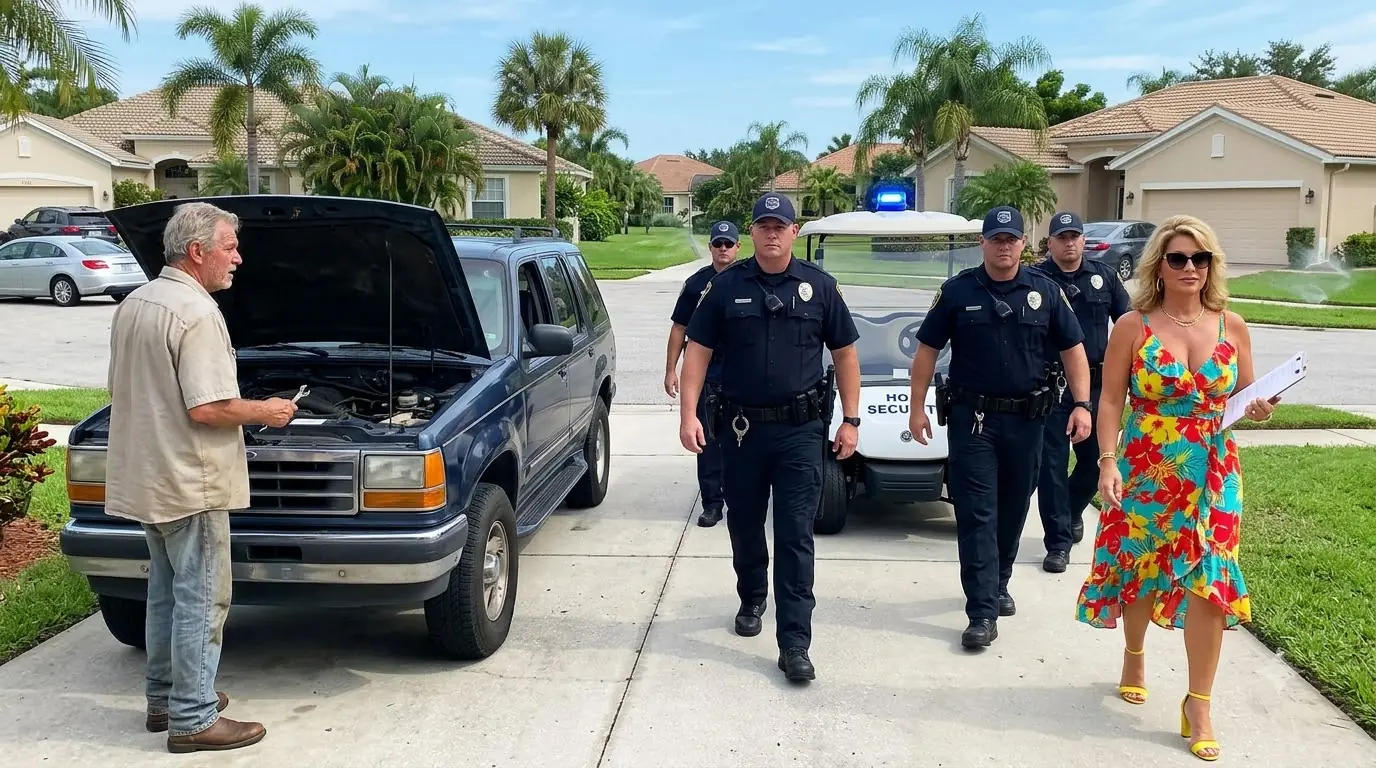
He had retired in 2019 from the federal bench in Tampa after 22 years as a U. S. Magistrate Judge. He had heard, by quiet arrangement with Camille Mortenson, that I was the FBI's victim of record on the Sentinel case. He had been waiting 2 years for somebody to ask the right question.
He set the accordion file on my patio table. "Hayes, I have been keeping a file on Sentinel Estate Protection Services since 2022. I would like you to look at it. There are six deaths. I asked him to repeat himself.
Six deaths, three at Bayou Pines Estates, two at a community called Hammock Cove in Sarasota County, one at Cypress Lakes in DeSoto County. All elderly. All occurred during or within 24 hours of a Sentinel detention. Four of them were ruled natural causes by the same Manatee County medical examiner. A man named Dr. Garner Voorhees, who is Spencer Voorhees' older brother.
The fifth was ruled accidental in DeSoto. The sixth was an aspiration pneumonia in a man who had been tased by a Sentinel guard 6 hours before he died. No criminal charges were filed in any of them. I let that sit for a long moment. Theron, have you taken this to anyone?
Hayes, I have been sitting on this file for 2 years. I tried twice in 2022. I called the Manatee County Sheriff's Office. They told me Sentinel was a licensed private service and they had no jurisdiction. I called the Florida Department of Law Enforcement.
They opened a file and never returned my calls. I drafted a letter to the FBI in November of 2022. I did not send it because at the time I did not know if the Bureau would treat it seriously. And I was afraid that if my name went on a letter that died in a drawer, my own family might be the next victim. I was waiting for somebody who could not be intimidated.
I read the Bureau briefing on you last week. I decided you were the man. I opened the accordion file. The first folder was about a man named Wilburn Hendricks, age 74, a retired Lockheed Martin engineer. He died of cardiac arrest in 2022 after being detained by three Sentinel guards for an unleashed Yorkie.
The autopsy had been signed by Dr. Garner Voorhees. The autopsy noted that Mr. Hendricks had been found unresponsive at his home. The autopsy did not mention the Sentinel detention. The autopsy did not mention the taser barbs that two witnesses had seen in his shirt at the scene. I closed the folder.
The case was no longer about fake police impersonating real ones. The case was about a private security firm that had killed elderly Floridians and had relied on a coroner who was a relative of the firm's owner to cover it up. I called Camille Mortenson that same afternoon. "Camille, we need a second team. We need the medical examiner.
We need exhumation orders on at least three bodies. The case just got bigger by an order of magnitude." She was quiet for a long moment. "A Hayes, we will get the team. We will get the orders. But this also means you have to survive Saturday morning.
They are not just going to find you. If they killed Wilburn Hendricks over a Yorkie, they will not hesitate to put a baton in the back of your skull." "I know, Camille. Send the team." That night, I sat on my back porch with the file open on my lap. Estelle sat beside me. May was asleep with her tennis racket beside her bed.
I thought about Wilburn Hendricks' autopsy. I thought about the next 48 hours. I made a quiet promise to a man I had never met. To his widow, a woman named Roslyn Hendricks, who, according to Theron's file, had spent two years asking the Manatee County Sheriff's Office for a real investigation and had been told, twice, that there was no jurisdiction. I promised Wilburn Hendricks, sitting under a Florida sky on a back porch he would never see again, that the men who had killed him for an unleashed Yorkie were going to spend the rest of their lives in federal prison.
And I promised Roslyn that after we were done, she would never have to make another phone call to a Sheriff's Office that would not pick up. The 48 hours before the assault were the most carefully rehearsed 48 hours of my retirement. Camille Mortenson drove out to Bayou Pines on a Sunday night in plain clothes and a personal Volvo with a folder that looked like it could have come from a real estate agent's car. We sat at my kitchen table, Camille, Estelle, May, and me. Wynn Castellano joined us by encrypted video conference from Sarasota.
Special Agent Drewson Crane, the Bureau's lead tactical agent on the operation, joined from the panel van two houses down. Special Agent Bryden Kraus, the Bureau's lead surveillance specialist, joined on a second channel. We walked through the morning of the assault step-by-step. At 7:00 a.m., the unmarked panel van at 6722 Bayou Drive would be on full operational footing. Four agents inside, 12 cameras around my house active, four directional microphones recording, a tactical radio loop tied to the Tampa field office.
At 7:15 a.m., a second unmarked Bureau van, a delivery-style Mercedes Sprinter with no markings, would park three blocks away at the back end of the community on a side street called Cypress Knoll. The Sprinter contained eight tactical agents in plain clothes plus body armor and weapons in concealed holsters. Their response time to my front yard was, by tested measurement, 92 seconds. At 7:30 a.m., Estelle would drive me to her cousin's house in Bradenton with two backpacks of clothes. Camille had insisted, gently but firmly, that the granddaughter not be in the home at the moment of contact.
Estelle would return alone by 8:00 a.m. At 7:55 a.m., I would be in my front yard on purpose with my Jeep Wagoneer's hood open. I would be visible. I would look exactly like a retired man working on a project car. At 8:00 a.m., according to Camille's intelligence, the sentinel deployment would arrive. The plan was simple.
I would not resist. I would not run. I would not draw a weapon, although I had one in a holster at the small of my back under a loose linen shirt. I would let them come up the driveway. I would let them speak first.
I would, if they attempted to make physical contact, defend myself only to the extent necessary to remain conscious and capable of giving sworn testimony. I would, if at any point they detain me, comply verbally while making clear on camera and on audio that I had not consented and was not voluntarily complying. The cameras would capture everything. The Sprinter would deploy within 92 seconds. The Bayou Drive panel van would secure the perimeter.
The Tampa Field Office Tactical Operations Center would coordinate the arrests of every other Sentinel unit on patrol within the hour on a synchronized takedown. Camille had a simple way of putting it. Hayes, you are the door. Once they come through the door, we have them on every charge in the United States Code that matters. Federal civil rights, conspiracy, RICO, murder, if the exhumations come back the way Theron Ackley's files suggest they will.
There was one moment in the plan that nobody at the table liked, but which I insisted on. I asked Camille not to deploy until they hit me. Estelle did not love it. She did not say anything. She just looked at me across the table the way she looks at me when she has decided to trust my judgement and would prefer I not abuse it.
Wynn objected. Hayes, if you let them hit you, the assault is on you. There is a real risk of serious injury. You are 62. You had cardiac stents in 2017.
Wynn, the stents are fine. The cameras need the assault on camera. Without it, the case is paperwork. With it, the case is conviction. I'm willing to be the door.
There was a long silence at the table. Camille looked at me for a long moment. Hayes, Hayes, okay. We let them commit the act. We secure on hit.
The simple takeaway here, for anyone who is ever going to be the witness in a federal case, is one Camille said three times during our preparation. Documentation is everything. Cameras are everything. The institution will move at the speed of the evidence. If you have the evidence, the institution moves fast.
If you do Do the institution waits. Estelle drove May to her cousin's house in Bradenton at 7:32 a.m. on Saturday morning. She kissed May goodbye. She told her she would be back by lunch. She kissed me goodbye in the driveway and said three words, "Be the door." Then she drove home and sat in the kitchen with her hand on the spice rack switch.
I walked out to the Jeep at 7:55 a.m. I opened the hood. I waited. The Sentinel cart turned onto Bayou Drive at 8:02 a.m. on a Saturday morning in late May. I was at the front of my Jeep Wagoneer with my hood up and a 14-millimeter wrench in my hand. I had been there for 7 minutes.
The morning was already warm in the low 80s with that thick Florida humidity that always announces a thunderstorm by mid-afternoon. A mockingbird was working through its full repertoire from the live oak in my front yard. I could hear the second van at the back of the community click its radio twice. Drewson Crane's standard signal that contact was imminent. The Sentinel cart had four men.
Three were riding, one was driving. They were all wearing the navy uniform with the patch that at any distance over six feet looked indistinguishable from a Manatee County Sheriff's Deputy. They had batons on their right hips. They had tasers on their left. They had what appeared to be handcuffs and pepper spray on the back of their belts.
The driver pulled into my driveway without permission. He stepped off the cart and walked up to me with a clipboard. "Mr. Talmadge, Sentinel Estate Protection. We are here to execute HOA citation enforcement order number 17. Please put down the wrench and step away from the vehicle." I set the wrench on the fender.
I did not step away. I kept my hands visible. "Sir, I do not consent to your presence on my property. Please leave." "Sir, under Bayou Pines Estates HOA Bylaw 14.3, we are authorized to enter the property and enforce compliance. Sir, there is no such authorization in Florida law.
There is no such bylaw in the recorded Bayou Pines Estates Declaration of Covenants. I have read the document. You are trespassing. I am asking you to leave my driveway. He looked over his shoulder at the other three Sentinel men.
They climbed off the cart and started walking up the driveway. They had drawn their batons. The leader took one step closer to me. Mr. Talmadge, you are under HOA arrest. Sir, there is no such thing as HOA arrest.
He swung the baton. I had been a federal agent for 28 years. I had been trained for this exact moment by instructors at Quantico, by hand-to-hand combat trainers at the Tampa Field Office, and by a Marine Corps drill sergeant my father had insisted I spend a summer with when I was 16. I knew in the half second between the swing and the impact that I had two choices. I could deflect, draw my own weapon, and end the encounter with the lead Sentinel guard wounded or dead in my driveway.
I could also take the hit and trigger the federal response. I had promised Camille I would take the hit. I took the hit. The baton came down on the back of my left shoulder. I went to one knee in the St.
Augustine grass. The pain was the kind I had felt twice in my career when I had taken a punch from a heavyweight suspect. It was hard but survivable. My left arm went briefly numb. The other three guards came up the driveway fast.
One of them produced a Taser. He fired it from about eight feet. The probes hit me square in the chest. The current was set high. I went all the way down on my back in my own grass.
Inside the house, May was not there. May was in Bradenton. Estelle was in the kitchen. Estelle reached up to the spice rack behind the rosemary jar. In the panel van at 6722 Bayou Drive, four red lights came up green on a console.
In the Mercedes Sprinter at the back of the community, Eight tactical agents put down their water bottles and reached for their vests. In the FBI Tampa Field Office Tactical Operations Center, a quiet woman named Special Agent Petra Lindquist hit a single button on her dashboard and routed every camera, every microphone, and every coordination radio to the Department of Justice's secure server in Washington, D. C. The clock started. 92 seconds.
The Sentinel leader stepped over me in my own front yard in front of 12 cameras with the taser still crackling on the grass beside my shoulder. He bent down to put fake handcuffs on my wrists. He did not get them on. The first Bureau sedan came around the corner at 91 seconds. Special Agent Drewson Crane was in the lead.
He stepped out of the driver's side of an unmarked dark blue Ford Explorer with his sidearm at low ready, his badge out, and his FBI windbreaker open at the chest. Behind him, three tactical agents in full plainclothes and body armor configuration moved up my driveway in a clean three-point formation that I had personally watched Drewson rehearse on the Quantico track in 2014. FBI, hands up. Hands up. Drop the baton.
Drop the taser. Drop the cuffs. On the ground now. The four Sentinel guards froze. The one with the taser dropped it first.
The other three followed. The leader, the one who had swung the baton, raised both hands slowly. He had the face of a man who had been waiting 11 years for this exact morning and had not realized until 91 seconds ago that he had been waiting. The sprinter rounded the corner two seconds later. Eight more agents poured out.
They cleared the cart. They cleared the front yard. They cleared the four Sentinel men onto their stomachs in my grass and zip cuffed them in a clean line the way I had taught my agents to do it 20 years earlier. One of the agents, a young woman named Special Agent Murray Donnelly, who had been on my old squad in 2019, knelt beside me in the grass. "Mr. Talmadge, you hit?" "I'm hit, Murray.
I'm okay. The Taser barbs are in my chest. The shoulder is bruised. I am not bleeding. Get me sitting up." She helped me sit up.
She called for paramedics on her shoulder mic. She kept her hand on my back. While she was kneeling beside me, the rest of the operation unfolded across the eastern half of Manatee County. At 8:04 a.m., a six-agent FBI team arrived at the Voorhees residence at 8 Cypress Point Boulevard. Spencer Voorhees answered the door in a polo shirt and khaki shorts.
He was arrested on federal civil rights, RICO, and conspiracy charges. He did not resist. He asked for an attorney. He was escorted in handcuffs to a bureau vehicle. At 8:06 a.m., a separate four-agent FBI team arrived at the Bayou Pines Estates HOA office.
Carlene Voorhees was at her desk in a peach blouse and white capris, sipping iced coffee from a Yeti tumbler. She was arrested on federal conspiracy, mail fraud, and money laundering charges. She tried twice to call her husband on her cell phone. The phone was, by court order, seized at the moment of her arrest. At 8:11 a.m., a tactical team in Sarasota County arrived at Hammock Cove.
Two more Sentinel guards on patrol there were arrested. At 8:14 a.m., a third team in DeSoto County arrived at Cypress Lakes. Three Sentinel guards were arrested. By 8:30 a.m., a total of 31 Sentinel personnel and seven HOA board members across three counties were in federal custody. At 9:14 a.m., FBI agents knocked on the door of Dr. Garner Voorhees, the Manatee County medical examiner, who had signed the four suspect autopsies.
He was at home in his bathrobe. He surrendered without a word. He requested an attorney. He was placed under arrest pending a coordinated federal-state investigation of his autopsy work going back to 2019. By 11:00 a.m., the Florida Department of Law Enforcement had issued a formal cease and desist order against Sentinel Estate Protection Services.
By noon, the 15 HOAs that had contracts with Sentinel had each been formally notified that their contracts were void. By 3:00 p.m., the Florida Attorney General had filed exhumation orders on three of Theron Ackley's six victims. I sat on my front porch with a bag of ice on my shoulder. Estelle sat beside me with her hand on mine. Drewson Crane stood at the foot of the porch steps with his clipboard.
"Hey Hayes, statement when you're ready." "I'm ready, Drusden." I gave my statement. I gave it on camera with two of his agents as witnesses in the same clear procedural voice I had used to give statements for 28 years. The shoulder hurt. The chest hurt. The Taser barbs were already removed by a paramedic with sterile gloves and a stop the bleed kit.
None of it mattered. The cameras had captured every second. The empire was already over. Camille Mortenson called me at 12:14 p.m. "Hey Hayes, we have it all." I sat on the porch for a long moment. "Camille, tell Theron Ackley I'd like him to sit at the prosecutor's table when this goes to trial." "Hey Hayes, he's already invited." I hung up.
The assault, the federal response, and the synchronized arrests had all been captured. But ending Sentinel's operation was only the beginning; the victims, the hidden deaths, and the people who enabled them still had to face public judgment.
CHAPTER 2: THE NINETY-TWO-SECOND TRAP
Theme:
Font Size:
24px