CHAPTER 2: WHEN THE PARK CAMERAS TOLD THE TRUTH
The sound was a jarring counterpoint to the cheerful pastel frosting on the cake. "Make a wish, Cherish," Dilbert said. His voice was steady. It didn't waver. It didn't carry the adrenaline-laced tremor that usually follows a physical altercation.
Cherish looked at the candles, then up at her father. Children possess an acute radar for danger, and hers was entirely scrambled. The scary men were on the ground, bleeding. Her dad, the quiet man who fixed her bicycle chain and made her oatmeal, was standing there holding a lighter. She took a shuddering breath, her tear-streaked face bathed in the soft glow and blew the candles out.
The small crowd of party guests, mostly Sydney's family and a few neighborhood friends, applauded. It was the most hesitant, terrified applause ever recorded at a child's birthday party. The siren started 3 minutes later. First came the high-pitched whale of a park ranger's SUV chewing through the grass, much like the Mitchell's truck had done 40 minutes prior. Then the deeper authoritative blare of an ambulance and two local police cruisers.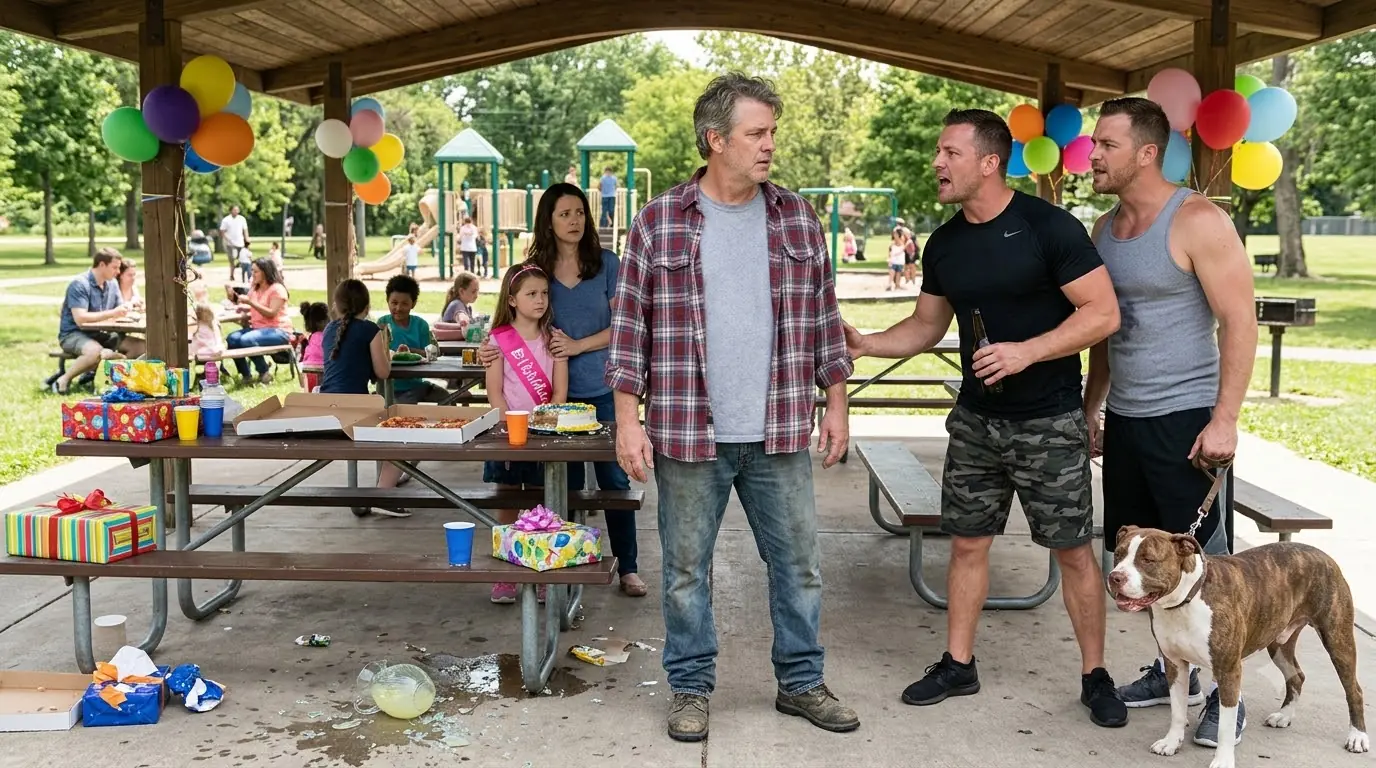
The cavalry had arrived, summoned by a panicked 911 call from a teenager two pavilions down. When the uniforms piled out of their vehicles, hands resting cautiously on their duty belts. They immediately assessed a scene that made no logical sense. They saw two local men, both built like brick houses, both well known in the local precinct for initiating bar fights and domestic disputes, laid out on the concrete. Greg was just regaining consciousness, vomiting weakly onto the grass, unable to sit up due to the severe concussion rocking his skull.
Todd was hyperventilating through a nose that looked like it had been hit with a meat tenderizer. Standing 10 ft away, calmly slicing a piece of vanilla sheetcake with a plastic knife, was Dilbert Wilson. Officer Miller, a veteran cop with 20 years on the force and a graying mustache, approached Dilbert. His hand was firmly on the grip of his sidearm. He looked at the bodies, then at the flannel shirt.
"Sir, put the knife down," Miller commanded, his voice carrying the hard edge of authority. Dilbert didn't argue. He didn't raise his hands in a theatrical display of surrender. He simply placed the plastic knife on the cardboard cake tray, took two steps back, and laced his fingers together behind his head. The movement was smooth, practiced, and entirely compliant.
"He attacked us! " One of the apex striking gym members suddenly shouted, finally finding his courage now that the police were present. He pointed a trembling finger at Dilbert. He just went crazy, snapped out of nowhere and tried to kill Greg. Miller narrowed his eyes. He motioned for his partner to secure the gym members while the paramedics rushed to the Mitchell brothers.
Miller walked up to Dilbert, eyeing the slight limp, the graying temples, and the absolute lack of defensive wounds. "Is that true, sir? " Miller asked, pulling a notepad from his breast pocket. "Did you assault these men? " And Dilbert lowered his hand slowly. "No, officer. I defended my family. " Sydney stepped forward.
Her legs felt like they were moving through wet cement. The logistics manager in her brain was trying to organize the chaos to file the violence into neat, understandable categories, but she couldn't. All she could do was shield Cherish behind her leg and speak the truth. "They... they harassed us," Sydney said, her voice shaking. She hated the tremor in her words.
She hated how weak she sounded compared to the absolute stillness of her ex-husband. Their dog ruined our table. They refused to move. The big one, Greg, he pushed Dilbert. Then he tried to grab him.
Dilbert just stopped him. Stopped him. Miller looked back at Greg, who was currently being fitted with a cervical collar by a frantic EMT. Ma'am, it looks like he hit him with a baseball bat. He didn't have a weapon, Sydney insisted.
He just used his hands. It happened so fast. Miller turned his attention back to Dilbert. He asked for identification. Dilbert pulled his wallet from his back pocket and handed over a plain Virginia driver's license.
Miller ran the name through the radio clip to his shoulder. A tense silence settled over the pavilion, punctuated only by Todd's wet sobbing as the paramedics loaded him onto a stretcher. The gym buddies were quiet now, aggressively avoiding eye contact with the police. One of them, a lanky guy in a tight tank top, was quietly deleting the video he had recorded on his phone. He had thought he was going to film his coaches beating up a suburban dad for TikTok.
Instead, he had captured a felony level masterclass in close quarters combat. He didn't want the police seeing that footage, but the park had cameras, high-definition security domes mounted on the street lamps. The radio on Miller's shoulder crackled. The dispatcher's voice filtered through the static, feeding back Dilbert's clean record. No arrests, no warrants.
Then a secondary code came through. A quiet alphanumeric sequence that made Miller stop writing. Miller looked up. He looked at Dilbert's face. Really looked at it this time.
He saw the cold, detached patience. He saw the heavy flannel shirt in the summer heat. "You served? " Miller asked quietly, dropping the aggressive interrogation tone. Yes, Dilbert replied simply. Where?
Here and there. Mostly the Middle East. Miller nodded slowly. He didn't ask for specifics. Cops who had been on the beat long enough knew better than to dig into the redacted files of men who moved like Dilbert Wilson.
They just understood that the civilian world was a thin, fragile layer of paint over a very dark, very violent reality. And sometimes the paint chipped. "The cameras caught the whole thing, officer," Dilbert said, nodding toward the metal pole by the parking lot. "He made physical contact first. He escalated with intent to cause grievous bodily harm.
I neutralized the threat with proportional force and immediately ceased engagement once the threat was eliminated. He spoke in the sterile, precise terminology of an after-action report. It wasn't an excuse. It was an objective statement of fact. Miller clicked his pen shut.
He looked at the Mitchell brothers currently being loaded into the back of the ambulance. Their reign of local terror definitively ended by a man who just wanted to eat cake. "All right, Mr. Wilson," Miller said, his tone entirely conversational now. "We're going to pull the tape.
If it lines up with what you're saying, and I suspect it will, this is clear-cut self-defense. They instigated. They attacked. You survived. Have a seat at the table.
We'll need a formal written statement before you leave. " Dilbert nodded. "Thank you, officer. " Dil turned back to the party. The guests were staring at him. His own family was staring at him. He was a stranger in their midst, an apex predator disguised in dad jeans.
He walked over to the cooler, pulled out a juice box, punctured the foil with the tiny plastic straw, and handed it to Cherish. "Drink up, sweetie," Dilbert smiled, gently, tucking a stray lock of hair behind her ear. "We still have presents to open. " The sun began its slow descent behind the Virginia treeline, casting long, bruised purple shadows across Centennial Park. The Mitchell's truck had been towed. The blood on the concrete had been hosed away by a nervous park employee.
The police had the footage, the attackers had been removed, and Dilbert had been cleared to remain with his family. But once the park finally grew quiet, Sydney still had to confront the part of him she had spent years misunderstanding.
>>>>>>NEXT CHAPTER 3: THE PROTECTOR SHE FINALLY UNDERSTOOD<<<<<<