CHAPTER 3: A Harvard Professor Bet a Black Janitor Couldn't Solve an "Impossible" Equation — She Solved It in Just 2 Minutes
Chapter 3: The Folder and the Door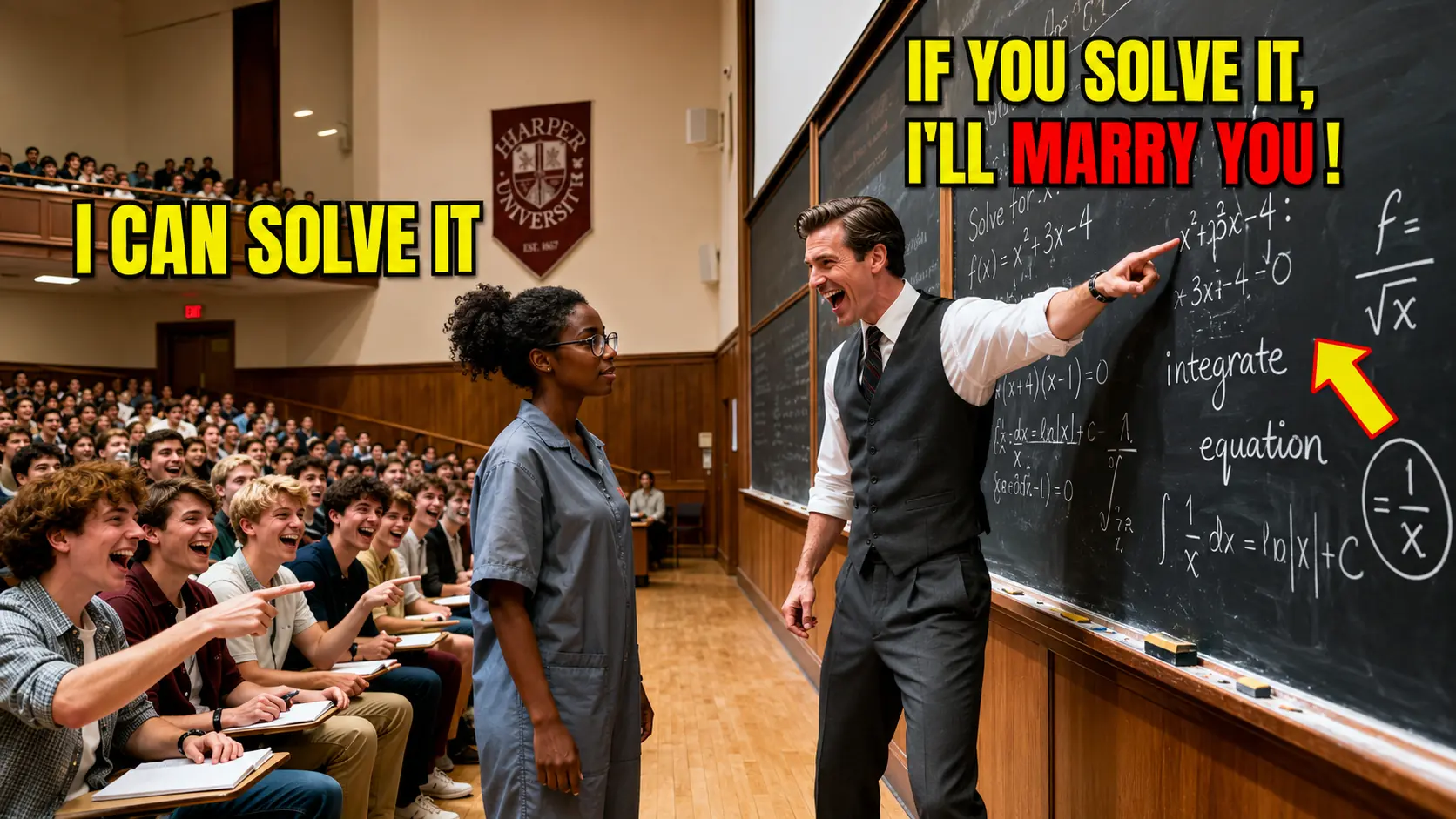
But Ashford is not done. He is cornered, and cornered men reach for cruelty.
He walks fast to the panel table. He grabs a folder off the table—his folder, full of notes on her, prepared by someone in admin who pulled records he had no right to. He turns to the room. The stopwatch is at 1:48.
“Ladies and gentlemen,” he says, voice loud, voice shaking, “before we get carried away, let me put something on the record. This woman—” He holds up the folder. “—is not a mystery genius. Her name is Whitney Brooks. MIT, Mathematics, 2013 to 2016. Withdrew at 20. No degree. No publications. Custodial staff for ten years.”
He turns to her. The cruelty in his voice is now naked.
“I’m sure your life took the turns it had to, Ms. Brooks, but let’s not pretend this is a Cinderella story. Look at her, ladies and gentlemen. Look at her. And then look at me, and tell me with a straight face that this is the woman you’d have me marry.”
The room reacts. Two people stand up to leave. A woman in row five says “Excuse me” loud enough to be heard. Audrey Whitfield is no longer recording. She has set her phone down and her hand is over her mouth. Eleanor Vance stands up so fast her chair scrapes—but Whitney lifts her hand. Eleanor sees it. Eleanor sits back down.
Whitney does not cry. She does not even look surprised. She looks at Ashford for a long second. And then she does something nobody expects.
She smiles. Small. Tired. Almost grateful.
Because in that moment she understands two things at once. One: the man in front of her is afraid. Two: she does not have to be polite to him anymore.
She walks back to the board. The stopwatch reads 1:39. She turns to the room and speaks calmly, for the first time directly to the camera.
“Professor Ashford has just told you why I left MIT. He didn’t tell you the rest. My mother had stage-four ovarian cancer. My brother was twelve. I was twenty. I was the only person who could do both jobs.” She pauses. “I’d do it again.”
She turns back to the board.
“Now I’m going to finish his integral.”
The stopwatch reads 1:32.
For a moment the room is dead silent—the kind of silent that is heavier than noise. Whitney stands at the board. The marker is in her hand. Her shoulders are square. From the outside she looks fine. But her whole body is doing one thing right now, and it’s holding still.
Because Ashford was right about one thing. He held up a folder and inside that folder was the truth. She withdrew. She didn’t finish. She lost ten years. She has, by every metric the world keeps, failed. And the worst part is that until two hours ago she had almost made peace with it. She had told herself a story. The story went: I traded my career for two people I love. I would do it again. The math will live in the supply-closet folder. It doesn’t have to live in the world.
And then this man—this stranger—had walked into her quiet life and said: Prove yourself. Prove yourself in two minutes or be a janitor forever. And she had let him. She had walked up here. She had picked up the marker. She had wanted, for the first time in ten years, to be seen. And now he had pulled out a folder and the room had seen and her dignity was on a live-stream feed in front of the world.
She closes her eyes for two seconds. The stopwatch ticks. 1:30. 1:29.
Two rows back from the panel table, a woman she’s never spoken to does something small and important. Eleanor Vance stands up, takes off her own jacket, and walks to the empty chair beside the podium. She lays the jacket carefully across the back of the chair. The Princeton seal on the inside of the lapel is visible to the entire room. Then Eleanor walks down the steps and sits in the audience in the front row. Like a student.
The message is silent and unmistakable: That seat is yours. The board is yours. Finish.
Whitney opens her eyes. She sees the jacket. She sees Eleanor in the front row. She sees behind Eleanor the young Black undergraduate from earlier, still standing, still watching her with her hands at her mouth.
In Brookline, Teddy is on his floor, his grandmother on speakerphone, and he is whispering: “Get up, Whit. Get up. Get up. Get up.”
In Atlanta, Whitney’s grandmother—eighty-two years old, knees bad, still on speakerphone with Teddy—pulls herself up out of her armchair and walks to the small wooden table in her hallway. On that table is a framed photograph of Whitney’s mother, taken the year before she died. The grandmother turns the frame so it faces the television, so her daughter, wherever she is, can see her granddaughter on the screen.
In a break room at a hospital in Cleveland, a nurse named Delores has stopped charting. She is watching the live stream on her phone. She is forty-six years old. She has, three different times in her life, been told by a man with more credentials than her that she didn’t understand something she did, in fact, understand. She is not crying. She is waiting—the way a person waits for a verdict they need.
Whitney lifts her chin. She does not turn to Ashford. She does not give him the satisfaction. She turns to the camera—to her brother, to every Black girl in the country who that morning was watching this on a phone propped against a cereal box.
“My name is Whitney Brooks,” she says. Her voice is even. “I left MIT in 2016 because my mother was dying, and somebody had to raise my brother. I have been working as a janitor at this university for ten years. In those ten years I have written six papers in a folder I keep on the bottom shelf of my cleaning cart. I have never shown them to anyone. I was never going to.”
She glances at Eleanor’s jacket on the chair.
“I’m going to finish the integral. Not because of the bet. Not because of him. Because Professor Vance asked me to.”
She turns back to the board. The stopwatch reads 1:22. She lifts the marker.
And this is the moment something cracks open. Because this is not a woman about to win a math problem. This is a woman about to forgive herself in public for ten years of being invisible.
Whitney begins to write.
The stopwatch reads 1:22, then 1:18, then 1:14. And the marker does not stop.
Move one. She rewrites the integrand using the polar transformation she demonstrated before. Clean. Fast. No hesitation. She is not improvising. She has done this proof in her supply closet on the back of inventory requisitions more times than she can count. The room recognizes the move. Three faculty in the front row mouth, “Yes.”
Move two. She introduces the contour deformation. She draws γ, the small loop in the complex plane, in the same spot as before. Henrik Sandberg has stopped breathing. The grad students in row two have linked arms. The stopwatch reads one minute.
Move three. The hidden symmetry. She circles it. She labels it. She draws the small triangle. The room makes a sound that is half a gasp and half a laugh. Audrey Whitfield is openly crying in row three, recording with one hand.
Move four. She invokes a single residue. She writes its value. The expression on the screen—the twelve-foot expression that has terrified graduate students for nine years—visibly collapses. It folds in on itself line by line like a paper crane being unfolded. The stopwatch reads 0:42.
Move five. She underlines the closed form. It fits on one line.
The stopwatch reads 0:18.
She caps the marker. She turns around.
The room does not move for four full seconds. Four seconds of silence so complete you can hear the projector fan. Then a single graduate student in the back claps once. And then Henrik Sandberg starts clapping. And then the entire row stands up clapping. And then the row behind them stands up. And then the whole hall is on its feet. And the noise is loud enough that the camera microphone on the live stream actually distorts.
Eleanor Vance does not clap. She is staring at the board, lips parted, eyes moving line by line, doing the math herself.
Whitney does not smile. She does not bow. She turns toward Ashford.
Ashford has not moved from where he was standing. His marker is on the floor. His stopwatch is hanging from his fingers. He looks like a man who has just watched his own house burn down from across the street.
Whitney walks toward him, slowly. The room quiets. The cameras swing. She stops three feet away from him. She does not raise her voice. The microphone on her uniform, clipped on for the live stream, picks up every word.
“Professor Ashford,” she says, “I want to say three things.”
The room is absolutely silent.
“First, you spent nine years trying to prove this couldn’t be done.” She tilts her head. “You should have spent thirty seconds checking whether it was the right equation.”
Ashford’s jaw moves, but no words come out.
“Second—” she nods toward the board—“your boundary isn’t intractable. It’s just been asked the wrong question by the wrong person for nine years.”
A soft, involuntary “Oh” rolls through the audience. Audrey Whitfield writes both lines down, word for word.
Whitney takes one step closer.
“Third.” Her voice drops, but everyone can still hear her. “About the marriage bet—I’m not going to hold you to it.”
Ashford looks up, blinking. For a half second, hope crosses his face. The hope of a man who thinks he’s just been spared.
Whitney closes that hope down.
“Not because I lost. I didn’t lose. Because I don’t marry men I don’t respect.” She pauses. The pause is exact. “And Professor, judging by how long you’ve been alone, I think you already know that’s a list longer than mine.”
The room makes a sound that is not laughter and not a gasp. It is the sound 180 people make when they witness a man being told the truth about himself in public.
A long beat. Three full seconds where nobody breathes. Audrey Whitfield in row three writes the line down word for word and then sets her pen on top of it like a paperweight—like she’s afraid the words will float away if she doesn’t hold them down.
In the front row, Eleanor Vance is sitting very straight. Her hands are folded in her lap. Her chin is tilted up. The expression on her face is not satisfaction. It is something older and quieter. It is the expression of a woman who has waited a very long time to watch someone do the thing she was never allowed to do.
The young Black undergraduate from earlier has now moved all the way to the front row. She is sitting on the floor between the seats, knees pulled to her chest, watching Whitney like she’s watching a door she didn’t know existed swing open.
Ashford does not respond. He cannot. His eyes go down. His shoulders go down. He looks, for the first time all morning, his actual age. Thirty-five. Alone. And very small.
Whitney turns away from him. She walks back to the board. She picks up the eraser. And she does the most elegant thing she could possibly do.
She does not erase her own work. She erases his. The lines above her correction—the wrong derivation he spent nine years defending. She wipes them clean in two long strokes, leaving only her own work behind. Then she sets the eraser down and walks off the stage.
Eleanor Vance stands up. The whole room is still on its feet. She walks to the board. She places her hand flat against the closed form just above where Whitney’s signature would go if she had signed it. Eleanor turns to the room. Her voice is controlled, but there is something burning under it.
“For the record,” she says, “I will be referring this proof to the Annals of Mathematics this afternoon. I will be requesting expedited review. Ms. Brooks, if you’ll permit me, will be listed as sole author.”
The room erupts again. Whitney is already at the side aisle. She does not stop. She does not turn. She walks past her cart, past the yellow mop bucket, past the duct-taped textbook, and she keeps walking out of Hall G into the corridor, into the rest of her life.
In Brookline, Teddy is screaming at a laptop. In Cleveland, in Atlanta, in Houston, in Oakland, in living rooms and break rooms and hospital waiting rooms, hundreds of thousands of people are watching the same moment on the same live stream and feeling the same thing. They are feeling seen.
Whitney does not get out of the building. She makes it to the foyer. She is halfway to the door when she hears footsteps behind her—fast, almost running. She turns.
It is Henrik Sandberg. He is holding a folder. He stops three feet away from her. He’s out of breath. His face is wet. He holds up the folder like an offering.
“Ms. Brooks,” he says.
Whitney looks at the folder. It is her folder. The one labeled Inventory Q3 in pencil—the one she keeps under the bottom shelf of her cart in the supply closet on the third floor.
“I found it six months ago,” Henrik says. His voice is shaking. “Cleaning out the closet for a fire inspection. I read it.” He swallows. “All of it. I went back to that closet every week for six months. I read every page you added. I knew. And I didn’t say anything.” He’s crying openly now. “I’m sorry. I’m so sorry. I should have told someone. I should have told you.”
Whitney does not speak for a long moment. She takes the folder. She opens it. Inside are ninety-two pages—her own handwriting. Six full proofs across complex analysis, three of which resolve open problems Jeffrey Ashford himself has cited in his last decade of work.
Audrey Whitfield catches up to them in the corridor. She’s been running. She has heard the last part.
“Ms. Brooks,” Audrey says. “I’m filing tonight. Front page. Above the fold. With your permission.”
Whitney looks at her. Then at Henrik. Then at the folder in her hands. She nods once.
The next morning the Boston Globe runs the headline:
Janitor at Harvard Quietly Solved Six Open Problems in Complex Analysis. The Math Department Never Asked Her Name.
Within seventy-two hours the story is in every major paper in the country. Within a week Eleanor Vance has formally invited Whitney to a visiting fellowship at the Institute for Advanced Study in Princeton. Within a month Jeffrey Ashford has signed a public statement posted on the Harvard math department’s homepage acknowledging the validity of Whitney’s proof, the alteration of the original equation, and his own conduct. He signs it. He does not appear in person.
How many other folders are tucked under how many other carts in how many other supply closets in this country?
Six months later. A small lecture hall at the Institute for Advanced Study in Princeton, New Jersey. Whitney Brooks stands at the board. She is wearing the same kind of plain, gentle clothes she has always worn. Her hair is in the same plain bun. Her glasses are the same old ones. The white tape is gone, but the frame is the same—because she liked the frame.
She has not changed to deserve to be here. She was always allowed to be here. She just had to walk through the door.
In the front row, three Black women are sitting with notebooks open. In the second row are two more graduate students, both women. In the back row, in a brand-new Northeastern hoodie, is her brother Teddy. He has driven down from Boston for her first lecture.
Jeffrey Ashford is not there. He is on a leave of absence. He has written exactly one short letter to Eleanor Vance, which Eleanor has never made public. The letter contains one sentence:
I was wrong about the problem. And I was wrong about her. And I am only equipped to apologize for one of them.
Whitney does not read the letter. She tucks it into the back of her notebook and never speaks of it.
There is one thing she does keep, though. In the top drawer of her new desk at the Institute for Advanced Study, in a small frame she bought at a thrift store in Princeton for four dollars, is a single yellow napkin. The handwriting on it is not hers. The derivation is not finished. Line three is crossed out and rewritten in the same wrong way it was crossed out and rewritten the first time.
She keeps it because it reminds her of two things at once: that somebody else gave up on a problem, and that she didn’t.
She turns to the lecture hall. She lifts a marker. She writes one word on the board.
Hello.
Then she turns to her students. She smiles. Really smiles. The first time the camera has caught it.
“Good morning,” she says. “Before we begin the lecture, let’s go around the room. I’d like to know your names. Starting with you.”
She points—not at the brightest students, not at the one with the best posture, but at the quiet young woman in the back who looks startled to be seen.
“You first.”
The young woman opens her mouth. The camera holds on her face.