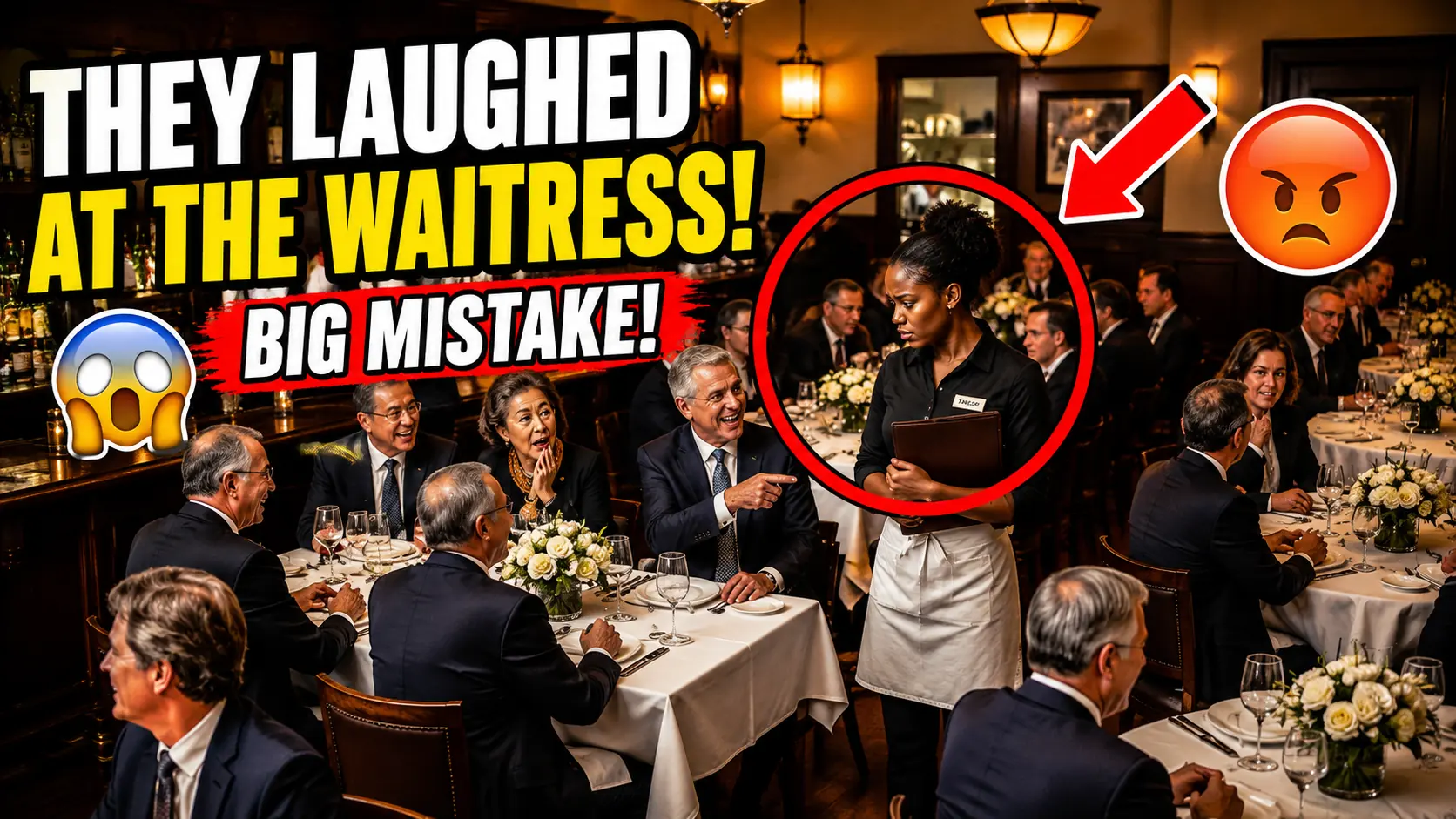
Chapter 3: The Test, the Check, and the Standing Ovation
Gerald was at the bar. Third scotch. Staring at nothing. That’s when his wife made her move. Lillian Covington didn’t go to the bar. She went to the service station near the kitchen, where Whitney was standing alone, refilling a water pitcher with hands that still weren’t steady.
“Ms. Sawyer.”
Whitney looked up. Whatever she expected, it wasn’t this. Not Gerald’s wife. Not that expression on her face. Not the crack in her voice.
“I want to apologize for my husband.” Lillian’s words were quiet but precise. “Not because he asked me to. He didn’t. Because I should have said something at that table, and I didn’t. That’s on me.”
Whitney set the pitcher down. “You don’t need to apologize for someone else’s words, ma’am.”
Lillian’s eyes were wet. “But silence is its own kind of word, isn’t it?”
Neither of them spoke for a moment. The kitchen noise filled the gap—dishes clanking, the hiss of a stove, someone calling out an order. But between these two women, the silence said more than any sentence could. Lillian wasn’t a villain. She wasn’t cruel. She was a woman who’d spent twenty years sitting next to a man who spoke for her, over her, and through her. And tonight, watching Whitney refuse to be silenced, something inside her cracked open.
She squeezed Whitney’s hand once, then walked back to the dining room without another word.
Whitney stood there for a moment. Then she stepped into the staff hallway, pulled out her phone, and made a call. It rang three times.
“Nainai.”
“Grandmother,” she said it soft, almost a whisper.
Her grandmother’s voice came through—thin, tired, warm. The voice of a seventy-six-year-old woman who’d spent the day cleaning someone else’s house.
“Someone offered me a job tonight, Grandma. A real job. Because I spoke Chinese.”
The line went quiet. Not the awkward kind. The kind of quiet that happens when someone is holding the phone against their chest because they can’t speak yet. Then Evelyn Sawyer said, “I always told those ladies at the shop, my granddaughter listens better than anyone.”
Whitney pressed her back against the hallway wall, closed her eyes. The hallway smelled like espresso and lemon polish. Through the door she could hear the muffled sound of the dining room—laughter, clinking glasses, conversations carrying on like the world hadn’t just shifted on its axis. But it had.
She opened her eyes when she heard footsteps. Derek was standing at the end of the hallway. He didn’t say much. He never did. He just walked over, put a hand on her shoulder, and said five words:
“You didn’t make waves tonight.”
She looked at him.
“You changed the tide.”
Then he walked back toward the dining room. And Whitney stood there for one more breath—just one—before straightening her apron, squaring her shoulders, and following him through the door.
The night wasn’t over yet.
Gerald Covington came back from the bar with a different look in his eyes. Not defeated. Recalibrated. He’d had three scotches. He wasn’t drunk. Gerald didn’t get drunk in public. But the alcohol had done what it always did for men like him: it turned embarrassment into strategy. Humiliation into a plan.
He sat down, buttoned his jacket, and addressed the entire table. “Look, I’ll admit it. She speaks Chinese. Fine. Credit where it’s due.” He paused. Let the concession breathe. Then he leaned forward. “But I made a bet. A hundred thousand dollars. And I’m a man of my word. So let’s make it official.”
He pulled out his phone again. “I’m going to get a certified Mandarin interpreter on video call right now. If your waitress passes a professional-grade translation test—legal, medical, and technical—live, in front of all of us, I’ll write the check tonight.” He looked at Whitney. “But if she fails even one section, she admits it was a parlor trick, apologizes to my guests, and walks out of this restaurant for good.”
The stakes had just doubled. This wasn’t about a hundred thousand dollars anymore. This was about Whitney’s dignity. Her job. Her future at Harmon and Vine. Gerald was betting on something specific: street fluency versus professional certification. He’d seen Whitney speak. He’d watched her translate a contract. But a formal test administered by an expert—that was a different arena. That was where self-taught falls apart. Where the gap between immersion and education is supposed to show. He was counting on that gap.
Mr. Shu looked at Whitney. Douglas, standing near the bar, looked at Whitney. Derek, watching from the kitchen doorway, looked at Whitney. The whole restaurant was holding its breath.
Whitney set down her tray. “Call them.”
Two words. No hesitation. No bluff. Just the quiet confidence of someone who’d been preparing for this moment since she was nine years old on a plastic stool in a Chinatown grocery store.
Gerald dialed. The screen flickered. A face appeared. A woman in her fifties. Professional background. Bookshelf behind her. Dr. Pamela Greer. Court-certified Mandarin interpreter. Twenty years of experience. She’d translated for federal courts, international trade commissions, and the United Nations. Gerald explained the situation in thirty seconds. Dr. Greer raised an eyebrow but agreed.
“I’ll administer three standard challenges: legal, medical, cultural. These are the same tests we use for federal certification.” She looked at Whitney through the screen. “Are you ready, Ms. Sawyer?”
“Yes, ma’am.”
Challenge one: Legal. Dr. Greer read a paragraph from a Sino-American joint venture agreement. Dense. Technical. Full of terms that don’t translate cleanly. Liability structures. Fiduciary obligations. Subordination clauses. Whitney listened, then translated section by section—clear, precise. She didn’t stumble once. She didn’t pause for more than a breath between sentences. She handled the legal terminology like she’d been reading contracts her whole life. Dr. Greer’s expression shifted just slightly. The professional mask cracked half an inch. “Accurate. Excellent register.”
Gerald didn’t move.
Challenge two: Medical. A patient intake form from a Chinese hospital. This was harder. Medical terminology is specialized in every language, but in Mandarin it’s particularly dense. Characters that look similar mean completely different things. One wrong tone and a diagnosis becomes a different organ. Whitney started translating—steady, confident. Then she hit a term: a rare hepatological phrase that even native speakers sometimes trip over. She paused. The room tightened. Gerald leaned forward. This was it. This was the crack he’d been waiting for.
Whitney closed her eyes for two seconds. Then she broke the characters down radical by radical, component by component, and rebuilt the meaning from the ground up—the way someone does when they’ve learned a language not from textbooks, but from the structure of the characters themselves.
“Hepatic portal hypertension secondary to biliary atresia,” she said.
Dr. Greer stared at the screen for a long moment. “That’s a term most of my colleagues would need to look up, Ms. Sawyer.”
Gerald’s leaned-forward posture slowly sank back into his chair.
Challenge three: Cultural and idiomatic. Dr. Greer’s voice changed—softer now, almost respectful. “This last one is above professional level. I want to be transparent about that. This is academic.” She read a passage from a classical Chinese essay. Not modern Mandarin. Literary Chinese—the kind of writing that predates the modern language by centuries, dense with metaphor, layered with historical allusion, the kind of text that PhD candidates struggle with.
“Take your time,” Dr. Greer said.
Whitney listened to the whole passage, eyes closed, hands still at her sides. When Dr. Greer finished reading, the dining room was so quiet you could hear the candles flickering. Whitney opened her eyes and she translated—not word for word. That would have been impossible with classical Chinese. She translated the meaning, the metaphor, the tone. She found English words that carried the same weight as characters written a thousand years ago. She captured the poetry without losing the precision.
When she finished, no one moved. Dr. Greer took off her glasses, set them on her desk, and said on camera—visible to every person at that table and to the dozen diners who had gathered behind Gerald’s chair to watch:
“In twenty years of certified translation work, I have never seen someone with this level of fluency who doesn’t hold a formal degree in the language. Ms. Sawyer, wherever you learned, you learned it completely.”
The room exhaled. Mr. Shu closed his eyes and nodded slowly. Mrs. Shu pressed both hands together. Raymond Cross rubbed his forehead like a man who’d just watched something he’d be thinking about for years.
Gerald Covington sat perfectly still. Then he reached into his inside jacket pocket and pulled out a checkbook. He didn’t do it gracefully. He didn’t smile. He didn’t make a speech. He opened the checkbook, uncapped a pen, and wrote in silence. Slow, deliberate strokes. The handwriting of a man who was paying for something he never believed he’d owe. He tore the check from the book and placed it on the table. $100,000. It landed right next to the $20 bill—the same bill he’d flicked at her chest two hours ago. The bill that had sat on the floor all night like a symbol of everything he thought she was worth. $20 next to $100,000.
Whitney looked at both. Then she picked up the check and folded it once—clean, precise. Then she reached down slowly and picked up the $20 bill, the one that had been on the floor since the first five minutes of the night. She held it for a moment, turned it over in her fingers, then placed it on the table in front of Gerald.
“Keep it. You need it more than I do.”
The room erupted. It started with one person. Mr. Shu pushed his chair back and stood. Not fast. Not dramatic. The way a man stands when he wants everyone to understand that what he’s doing is deliberate. He brought his hands together and began to clap—slow, measured, each clap landing like a period at the end of a sentence. His wife stood next, then the two associates. Four people from the same table—the table that started all of this—standing and applauding a woman in a black apron.
Then it spread. The couple at the next table. The woman dining alone by the window—she stood so fast her napkin fell to the floor and she didn’t even notice. A man in a gray suit three tables over. Two women celebrating a birthday near the back wall. The sommelier still standing in the doorway started clapping without even realizing his hands were moving. The hostess at the front desk. A bus boy holding a tray of dirty plates—he set it down on the nearest surface and joined in. The bartender. A server who’d been watching through the kitchen window the entire night pushed through the door and stood in the dining room with tears running down her face.
One by one, table by table, person by person. Within thirty seconds every single person in Harmon and Vine was on their feet. Sixty people standing, clapping. Not the raucous, hollering kind of applause you hear at a concert. This was something different. Quieter. Heavier. The kind of recognition that comes from the gut—from watching something happen that you know you’ll remember for the rest of your life.
Whitney stood in the middle of it. Black apron. Name tag. A $100,000 check folded in her hand. And she didn’t know where to look. Her eyes went to the floor first, then to Derek, who was standing in the kitchen doorway with the entire staff behind him—dishwashers, line cooks, the sous chef—all of them crammed into the frame of that doorway like a family portrait nobody planned. Derek was clapping too. But he wasn’t looking at the crowd. He was looking at her. And he was nodding. Slow. Steady. The nod of a man who just watched someone do the thing he always knew they could.
Douglas Harmon waited until the applause softened. Then he walked to the center of the dining room. He didn’t make a speech. Douglas wasn’t that kind of man. He reached up to his own lapel and unpinned something. A small gold pin shaped like a vine leaf. It was the Harmon and Vine founding pin. Only six people had ever worn it—Douglas, his late wife, his original head chef, three others who’d been with him since the beginning twenty-two years ago. He walked to Whitney, took her apron strap gently between two fingers, and pinned it right above her name tag.
“You’ve been staff for two years,” he said, quiet enough that only she could hear. But the room was so silent that everyone heard anyway. “Tonight, you’re family.”
Whitney looked down at the pin. Her fingers touched it once, light, like she was checking to make sure it was real.
Mr. Shu stepped forward next. He reached into his jacket—not for another business card, for the same card he’d offered earlier. But this time he held it differently. Both hands. A slight bow. The full gesture, the kind reserved for people you consider equals.
“This offer is real, Miss Sawyer. My Shanghai office will expect your call.” He paused. “Take your time, but don’t take too long.”
Whitney accepted the card with both hands, bowed her head slightly. The gesture was so natural, so culturally precise, that Mr. Shu’s eyes widened for just a moment before softening into a smile—the first truly warm smile anyone had seen from him all evening.
Then Raymond Cross stood up. Gerald’s business partner. The man who’d been silent the entire night. The man who’d sat through every insult, every humiliation, every moment of Gerald’s performance without saying a single word. He spoke now.
“I’ve spent twenty years in private equity. I’ve sat across from MBAs, PhDs, and Rhodes scholars.” He looked at Whitney. “I don’t think any of them could have done what I just watched. Miss Sawyer, if you ever want to consult for our firm, you have my number.” He placed his business card on the table.
Then something unscripted happened. The woman who’d been dining alone by the window—the one whose napkin fell when she stood—walked over. She introduced herself as the director of a nonprofit language education program in Oakland. She placed her card next to Raymond’s. Then another person: a man who ran a translation agency. Then a woman who worked in international development. Then a couple who owned a chain of language schools in the Bay Area. One by one, business cards appeared on the table in front of Whitney. Eleven cards total. Eleven doors that didn’t exist an hour ago.
Gerald Covington watched all of it. Then he stood, buttoned his jacket. The room went quiet again. A different kind of quiet. The kind where everyone is watching to see what happens next. He looked at Whitney for a long moment—not with anger, not with shame, with something more complicated than either.
“I underestimated you,” he said. “That’s the most expensive mistake I’ve made in a long time.”
Then he walked toward the door. Lillian stayed behind for a moment, just long enough to find Whitney’s hand and squeeze it once. Then she followed her husband into the night.
The dining room exhaled. Whitney stood at that table surrounded by eleven business cards, wearing a gold pin that only six people in twenty-two years had ever worn, holding a check for more money than she’d made in the last three years combined. And then she said something that turned the whole night on its head one more time.
She looked at Douglas, then at Derek, then at the kitchen staff still crowded in the doorway. “I want to put half of this toward the graduate program I’ve been saving for.” She held up the check. “And the other half… I want to start a fund for kids who grew up like me. Between languages. Between worlds. The ones nobody ever thinks to ask what they know.”
Douglas nodded slowly. “I’ll match it.”
From across the table, Mr. Shu, still standing, spoke without hesitation. “So will I.”
The $20 bill was gone from the table. Nobody remembered when it disappeared. Nobody cared. But the gold pin on Whitney’s apron caught the light every time she moved, and it would stay there long after the plates were cleared, the candles burned down, and the last guest walked out into the San Francisco night.
Whitney Sawyer enrolled in the graduate linguistics program at San Francisco State that fall. She completed it in eighteen months while consulting part-time for Mr. Shu’s firm remotely from her apartment in the Sunset District—the same apartment she’d been living in since community college. The same kitchen table where she used to practice Chinese characters with a ballpoint pen and a stack of napkins from work.
The fund she started—the Evelyn Sawyer Bilingual Youth Initiative—awarded its first twelve scholarships the following spring. All twelve went to children from immigrant communities in San Francisco. Kids who spoke two languages at home and were told that neither one counted. Kids who sat behind grocery counters and restaurant kitchens absorbing words that nobody would test them on until now.
Gerald Covington closed his waterfront deal three months late. Different terms. Lower equity stake. He never returned to Harmon and Vine. Not once. Lillian Covington, however, made a quiet donation to the Evelyn Sawyer Fund six months later. She didn’t attach her name, but Whitney knew.
Douglas Harmon hung a framed photo behind the bar. It showed Whitney standing in the dining room on the night it happened—black apron, gold vine pin, the check in her hand. Underneath the photo, a small brass plate read four words:
Talent doesn’t wait to be invited.
Derek Tols was promoted to floor manager. On his first day he taped a handwritten note inside the staff locker room. It said: “If you speak something, speak up.”
Raymond Cross left Gerald’s firm eight months later. He started his own consulting company. Whitney was his first hire.